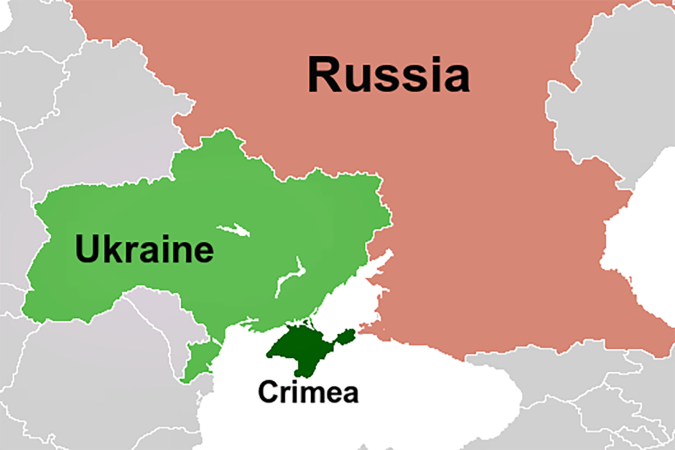
This is ridiculous.
Ukrainian officials say they will not accept any formal surrender of the Crimean peninsula to Russia as a condition of ending the war with Russia. Fine. U.S. officials should say that we will no longer assist in funding a war being fought against a superior military power by a nation that resides in fantasyland and governs by delusion. No other response is justifiable.
Russia has controlled Crimea for 14 years. Ukraine is not getting it back, but maintains that it will not recognize that Russia owns the territory, which Barack Obama allowed Russia to take with the U.S. registering little more than pat protests and a shrug. Read this nonsense from the AP report:
Ukrainian officials… expect to concede the territory to the Kremlin, at least temporarily [but] [g]iving up the land that was illegally annexed by Russia in 2014 is also politically and legally impossible, according to experts. It would require a change to the Ukrainian constitution and a nationwide vote, and it could be considered treason. Lawmakers and the public are firmly opposed to the idea. “It doesn’t mean anything,” said Oleksandr Merezkho, a lawmaker with Ukrainian President Volodymyr Zelenskyy’s party. “We will never recognize Crimea as part of Russia.” Unlike a territorial concession, a formal surrender would permanently relinquish Crimea and abandon the hope that Ukraine could regain it in the future. The Ukrainian public largely understands that land must be ceded as part of any armistice because there is no way to retake it militarily. Polls indicate a rising percentage of the population accepts such a trade-off…But much of the public messaging about land concessions has suggested that they are not necessarily permanent, as when Kyiv Mayor Vitalii Klitschko told the BBC recently that Ukraine may need to temporarily give up land as part of a peace deal. Saying otherwise would effectively admit defeat — a deeply unpopular move, especially for Ukrainians living under Russian occupation who hope to be liberated and reunited with their families one day. It also would call into question the sacrifices made by tens of thousands of Ukrainian service members who have been killed or wounded.”
What? WHAT? Russia has the territory and has had it for 14 years, whether it is “illegal” or not. Admitting that Russia now has it and that Ukraine does not now and will not later have the ability to get it back calls into question “the sacrifices made by tens of thousands of Ukrainian service members who have been killed or wounded,” so the favored course is to keep fighting and getting more soldiers killed or wounded? Brilliant. The public is in favor of “conceding” the area to Russia (since it already is under Russia control), but won’t surrender the territory because the constitution won’t permit it, and because that will mean giving up hope of reacquiring the Crimea, which Ukraine isn’t going to do anyway except in Zelenskyy’s dreams. So they know they’ll have to give up the territory they haven’t had for 14 years, but don’t want to officially give it up, which is impossible (say anonymous “experts”) because that will mean that can’t get it back, even though they can’t get it back. So they think they should keep fighting.
Tell me again: why we have been spending billions to help these bozos?
That tears it. Any money spent from now on to help Ukraine is throwing good money after bad. The U.S. should give Zelenskyy an ultimatum: agree to surrender Crimea, or work out your constitutional problems and your inability to face reality on your own dime, because we have better things to spend our money on. Much better things. Anything would be better, in fact.
The sentimental support for Ukraine is now officially indefensible, as in “unethical.” Wasteful. Stupid. It is a nation and a government in denial. President Trump should tell them to give him a call when they’ve successfully dealt with their inability to face facts.
 Ethics Alarms
Is history not replete with instances of ceasefires without giving up territorial claims?
Russia’s demand for a formal surrender of Crimea seems to be the pig headed stance in a world build on respect of lawful borders. At a minimum, Russia should at least make pretend this is only a temporary necessity for some [insert valid sounding excuse].
Except that this is a proposal to end the war, not just have a “ceasefire.”
Why should we expect “the war” to “end” when a “ceasefire” is just as good.
Putin will feel exactly as limited by a peace as his will by a temporary peace. At least with a ceasefire you can run with the useful fiction that we don’t accept Russia’s immoral land grab.
“Why should we expect “the war” to “end” when a “ceasefire” is just as good.”
Because it isn’t just as good. See: Hamas-Israel, first Iraq War and Korea.
Surrender is worse than stalemate which is worse than winning.
Ukraine isn’t going to win, but legal surrender isn’t the only remaining option.
You’re running a false dichotomy here and trapping yourself in a rhetorical corner- for international competition, lots of useful fictions are way better than all or none declarations.
If, as I suspect, about 20 years from now, Russia will be in such disarray and demographic collapse that Ukraine could waltz back in and secure its lost territory, the useful fiction of a “ceasefire” is a lot easier to overcome than the hard declaration of a legal cession of territory.
Yes this runs up against a sort of unarticulated epochal “statute of limitations” which I agree exists-
It’s why we can say, 175 years after the United States secured the southwest from Mexico that it would be unethical for Mexico to seek violent retaking of the southwest from the United States *even if it was possibly unethical for the USA to have done so in the first place in 1848*. On the far end of the scale, it is *not* unethical for Ukraine to maintain claims over Crimea that Russia unethically took from Ukraine 11 years ago.
If Russia maintained control of Crimea for 150 years, then sure, at some point Ukraine’s claim is ethically void.
But in the near or short term? I don’t see it.
Ukraine isn’t the only one being pigheaded in this. Putin is as well. The United States *and the rest of the West (as useless as most of them are)* could be doing a lot more to force Putin to concede at least his rhetoric.
Thanks for the Mexico analogy. I cut it from the post in the interest of brevity.
But, as I demonstrated, the 175 year old American Southwest example *does not* inform the 11 year old Crimea question.
Somewhere between 175 years and 11 years, a country ultimately loses its claim on any lost territory. I don’t know what the cut off window is, especially since the cut off window will move forwards or backwards based on a lot of considerations like how much cultural replacement has occurred, assimilation, etc.
You don’t think the US definitively “owned” Mexico’s former territory after 11 years?
Additional complications here:
Mexico legally surrendered the land because they were in no condition to oppose the demand – our army was sitting in Mexico City, its army was broken, and there was every ability to go ahead and “finish the job”. Ukraine is currently not under that level of duress.
Mexico would NOT have been unethical to take up arms in an attempt to retake the land in that period of time, if the land was unethically obtained to begin with. But they couldn’t. So they didn’t. And somewhere between 1848 and now, enough generations passed with enough establishment of new norms and ways of life, that Mexico lost any chance of making an ethical move on the lost territories.
(too be clear, I’m begrudgingly ‘sympathetic’ with the likelihood that Crimea has been, through hyper-aggressive and gross methods, Russified by Putin’s goons through the settlement of Russians and the removal of Ukrainians ala Kaliningrad – that perhaps, in 11 years, the kind of “cultural replacement” that has occurred means that there may not be a meaningful concentration of Ukrainians in Crimea anymore)
Which means that if Ukraine gained Crimea back, it would have to do the same forceful relocation of people – but, within an 11 year time span, any Russians being forced to relocate would, justly, be parties of the original crime being rectified.
Here is the thing, as I see it (and I disagree with Jack’s main point).
While Russia has de facto control of Crimea, which is not going to change in the near future, the U.S. and its European allies have not recognized that it is legally a part of Russia. Why? In its simplest terms, that would reward an aggressor nation. It would send a message to other regimes that they too might be able to grab a part of one of their neighbors and the United States would acquiesce.
Taiwan comes to mind in that we’ve not formally recognized it as a nation state.
You mentioned Korea as a failure — on the contrary, I would regard Korea as one of the great success stories that the United States has been responsible for since WWII.
Korea is certainly a far different case in that we lost tens of thousands of young men during that war. In 1953, we threatened South Korea and forced them to accept the cease fire and accept the existing battle lines.
For what ends? Well, look at South Korea today — it is a thriving democracy, an economic powerhouse, and a staunch ally. That didn’t happen by chance, although it took decades.
When we agreed to the cease fire, we kept a ‘greater sanctions’ threat. 15,000 of our soldiers stayed in Korea as a trip wire. There was no ambiguity, as there was in the spring of 1950 — North Korea and China knew that if their troops rolled over the border they would instantly be at war with the United States.
We’re not going to put troops in Ukraine, but if we strike some economic deals and there are civilians on the ground in Ukraine, that may be enough of a deterrent. If Russia were to invade again and Americans started being killed in Ukraine — well, one hopes that we would respond in kind.
As I understand it, Ukraine has agreed to accept the de facto loss of Crimea. I also understand that their constitution forbids them legally surrendering the territory. But one would think that a de facto acceptance would be enough for the Trump administration. Absent an actual surrender by one side or the other, I don’t see that a peace treaty is in the cards. But a cease fire in place ought to be achievable.
There is no reason that the U.S. and its allies couldn’t provide sufficient guarantees to keep Putin from re-invading. The biggest question — and one that has been twice answered in the negative — is would we live up to those guarantees.
Crimea could well become Russia’s Northern Ireland. The day may come when they regret they took it, as their soldiers and police get shot in the back or blown up. However, the British held on to Northern Ireland by standing firm and they could probably hold on to Crimea by standing firm, because in the end, although a guerilla force can give an army a very hard time, it cannot defeat it UNLESS that army loses public support. The Russian army is not going to lose public support. Go ahead, look at the history if you don’t believe me. We lost in Vietnam because our efforts there lost public support. The British only lost in Ireland in 1922 because their efforts there lost public support. The list goes on and on.
However, if a military stands firm, or an occupying power decides they are not going to give up, or their public continues to be in favor of their efforts, it usually pays off. The IRA gave up in 1998 because it finally dawned on them that they were never going to push the British out of Northern ireland. We don’t hear about the Russian war in Chechnya anymore because the Russian army didn’t lose public support and finally stomped the rebellion flat. I also believe that if the UK had cut a separate peace deal with Hitler after Dunkirk and the US had decided not to get involved in the war in Europe, there’s a very good chance that most of that continent would be speaking German now. Would it last forever? Probably not, all empires eventually fall apart, however, it was a good chance that 80 years later they would still be firmly in control.
The fact of the matter is, that the only way to retake Crimea is to go in with vastly superior force. Ukraine does not have that vastly superior force, and the US and NATO are not going to provide them with it, because the idea is to keep this conflict bottled up, not let it expand into World War 3. There comes a point in any conflict where you have to admit a loss and cut the best deal you can. Crimea was lost when Obama, who was at his least powerful, decided not to do anything about it. There was an article recently in which the Democratic party was advised that they needed to “take the L” from last year and move on. They still haven’t, and the possibilities for them going anywhere are almost nonexistent and they have to hope that Trump does himself in with this tariff thing (which could happen, but that’s another discussion).
Zelensky can posture all he wants, and take the praise of Europe and the left all he wants, but in the end it’s not going to give him Crimea and it’s not going to give him victory. The time to stop all this from happening was February of 2022, but I think we can all agree that Biden was simply not up to that task. You can be outraged all you want, but unless you take action it’s just huffing and puffing. You can also speak truth to power all you want, but in the end a little power trumps a whole lot of truth everyday and twice on Wednesdays and Sundays. Putin has more than just a little power. He can’t take on the west, but a nation like Ukraine that he outnumbers by 100 million people is no big problem for him. I still wonder where the vast Russian air power is, or whether the Russian Air Force is just a shadow of its former self. However, I think if Putin decided to throw everything in one big attack, there’s a very good chance Ukraine might fall. Then what?
I don’t like the idea of pulling the rug out from under Ukraine at all, but there is no sense in trying to win a war that can’t be won except at an unacceptable price. Oh, and Zelensky’s not exactly a paragon of human rights. For that matter, neither was Kuwait, but Iraq was beatable and a key resource was at stake.
As usual, a nuanced and valuable analysis. But the short version is still “It Is Now Irresponsible and Incompetent For the U.S. to Provide Any Further Aid to Ukraine.”
Agreed. That’s the what, what I wrote was the why.
Russia was never good at SEAD / DEAD. The combination of former Soviet SAM systems Ukraine had, former Warsaw pact SAM systems, and western systems gifted them keep the Russian airforce at bay. Russia is forced to use standoff weapons or they’ll lose aircraft. Even then Russia is still losing aircraft, something like 70 so far.
Lots of people seem to think Russia is holding back. Why would they? They don’t have political implications that lead them to hold back. They’re trying as hard as they can, they want this over.
Three words: warm water port.
The eternal Russian wish.
No worries. I’m pretty sure climate change will have Al Gore and/or Michael Mann listing Murmansk as a warm-water port by 2030.
Climate change will make the Arctic a geopolitical competition zone. It will also raise Canada’s importance in the world believe it or not. Two countries with currently reduced arability will find themselves among the world’s largest agricultural zones: Canada and Russia.
Canada also straddles the Northwest Passage – a better alternative to the Panama Canal (which was made because of the unreliability of the NW Passage).
***Yet more reasons why any effort to gain Greenland is not a foolish venture by any president***
Frequently this article (link below) comes to mind, from African Studies literature. It makes the distinction between “real” and “juridical” statehood. https://www.african.cam.ac.uk/system/files/documents/jackson.pdf
Ukraine has the same problem that many “new” states have experienced when they first achieve statehood. it is a new state, fragile, with a juridical existence, and is only somewhat able to achieve the status of a “real” statehood, which is the defense of its national territory. Sure, the Ukrainian people are numerous, and they have suffered a lot, and they want a state, and I sure don’t blame them. It would have been nice if Ukraine could have hung onto Crimea–the Russians probably figured that they built up Crimea over hundreds of years as Turkish power receded, and they want it more than Ukraine does. When did the Russian Empire finally get control of Crimea for good? The internet tells me it was 1783, under Catherine the Great. Ukraine’s strategy to defend its national territory is to to join a defense bloc (NATO) so that it doesn’t have to become like 19th century Prussia or 20th century Switzerland or contemporary Israel: armed to the teeth and fully prepared for war. Finland showed the way, as well. Some risk loving strategists in Europe and the USA thought the best way to pare Russia down to size was to expand NATO up the border of the Russian Federation. What could possibly go wrong? I hope this makes sense to some of the fabulous commenters here. Once you really comprehend the “real” vs. “juridical” statehood distinction, you see it everywhere. In some parts of the world it doesn’t matter so much. Most South American countries don’t fear being gobbled up by their jealous neighbors. Europe, historically, has been a place where vulnerable national states sometimes vanished if they couldn’t defend themselves, or if all their strong neighbors could agree to partition them (Poland for example). Border territories could be swapped back and forth as it suited Great Power inerests. My knowledge of history is fragmentary, but I understand that British military and diplomatic strategy insisted on the existence of Belgium, and that it would be friendly or neutral. A weak Belgium across the channel from England was ok, but the Brits did not like to see any arch-foe control the territory across the channel from England.
Thanks for reading.
charles w abbott
rochester NY
Belgium was a part of the Netherlands after the Napoleonic wars and the Congress of Vienna. After the French revolution of 1830, the Belgians also revolted against the Netherlands and were able to fend off the Dutch army.
The London Conference of 1830, which included the major European powers — Britain, France, Prussia, Russia, and Austria — paved the way for Belgian independence. Official conflict with the Netherlands continued until the Treaty of London in 1839, by the same powers, who ended the war and those powers jointly guaranteed the ongoing neutrality of Belgium.
At the start of WWI, Germany invaded Belgium, which Britain viewed as a Casus Belli for going to war. I’ve long found it interesting that in both World Wars, Britain was not attacked but instead declared war on Germany because it had invaded a neutral country.
sorry about the lack of carriage returns in the above article. I tried. At least the software let me get the comment posted.
charles