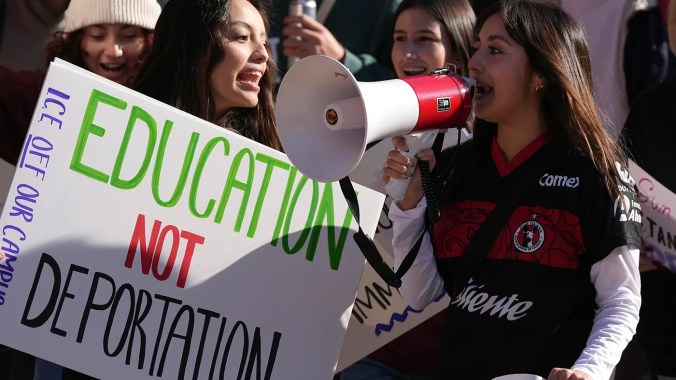
“Reason” (of course) has an article up headlined “Immigrants and Radicals Have the Same Free Speech Rights as Everyone Else.” That may be correct, but it’s not at all certain, and I’m not sure it’s ethically necessary either. (Shame on “Reason” for following the Left’s deliberate conflating of immigrants with illegal immigrants.)
Marco Rubio and the Trump Administration are asserting that foreign students, other aliens here legally but temporarily and illegal immigrants do not have the same rights of free speech as American citizens. This week, a federal judge in Massachusetts allowed a lawsuit against the Trump administration’s deportation proceedings involving non-citizen anti-Israel college protesters and activists to go forward on the grounds that the government is targeting protected speech and therefore chilling the free speech rights of foreign university students and faculty. American Association of University Professors v. Rubio was brought by the American Association of University Professors, that organization’s Harvard and New York University chapters, and the Middle East Studies Association alleging the “chilling” of non-citizen members’ activities by federal policy. The plaintiffs allege that members of their organization “have, variously, taken down social media posts and previously published writing and scholarship, stopped assigning material about Palestine in class, withdrawn from a conference presentation, ceased traveling abroad for conferences, ceased engaging in political protest and assembly in which they previously participated, ceased teaching a course they previously taught, and foregone opportunities to write and speak at public events,” because they fear deportation.
Secretary of State Rubio, echoing the policy President Trump has advocated, claims that that non-citizens cannot undermine U.S. policy and values with their speech here, unlike citizens. Trump, after all, took office pledging in two executive orders to “combat anti-semitism” and “to prosecute, remove, or otherwise hold to account the perpetrators of unlawful anti-Semitic harassment and violence” as well as to protect citizens from aliens who “espouse hateful ideology.” Citizens can always espouse hateful ideology; in fact the whole Democratic party is devoted to it. The question is, how inclusive is the First Amendment, and how inclusive should it be?
Prof. Eugene Volokh of the Hoover Institution and the UCLA School of Law, a conservative constitutional scholar, wrote that “when it comes to aliens and immigration law, the First Amendment questions aren’t settled.” That is because when the Bill of Rights was promulgated, there was no such thing as illegal immigrants or resident non-citizens: if you were living here, you were an American. “It is well established that non-citizens have at least some First Amendment rights,” wrote Judge William G. Young of the U.S. District of Massachusetts. “Although case law defining the scope of non-citizens’ First Amendment rights is notably sparse, the Plaintiffs have at least plausibly alleged that non-citizens, including lawful permanent residents, are being targeted specifically for exercising their right to political speech.”
But this is an ethics blog: what would be the most ethical resolution of this issue? I would have no problem ethically if the Supreme Court were to rule that non-citizens don’t have the same wide-ranging license in their political speech as citizens. If you come here, don’t make trouble. If you come here, be on good behavior. If you come here determined to undermine American values and policies, on college campuses or anywhere else, you can be kicked out. You’re a guest: behave like one, or else. I could also find little reason to complain if the decision was to make the First Amendment all-inclusive, with non-citizens and even illegal aliens having the same free speech rights as tax-paying, law-abiding natural citizens. The latter position is idealistic, the former, restrictive interpretation is more practical. Both are ethical. It is a close call, but I favor the more restrictive approach.
It would help if those advocating the Rubio-Trump interpretation of the First Amendment weren’t so unpersuasive and sloppy. This morning some alleged constitutional lawyer was on Fox News insisting that the Rubio policy was the correct one. Then she said, as an example of why “free speech has limits,” that you can’t “shout ‘Fire!’ in a crowded theater unless you do it from the stage as part of the play.” Moron. Will we ever be free from lazy demagogues misinterpreting Justice Holmes’ famous analogy? There is nothing wrong, illegal or inappropriate about shouting “Fire!” in a crowded theater if the theater is on fire. What is illegal about shouting “Fire!” when there isn’t a fire is that it will start a dangerous panic: it is conduct, not speech. The example didn’t belong in Holmes’ opinion, and it may be the most misused quote in the legal literature.
My guess is that when this issue gets to the Supreme Court, the Justices will resist the urge to limit freedom of speech to citizens. That does not mean that deciding the issue the other way is unethical.
 Ethics Alarms
I made this comment.
https://reason.com/2025/05/02/immigrants-and-radicals-have-the-same-free-speech-rights-as-everyone-else/?comments=true#comment-11030008
This is something that has to be argued before the Supreme Court, which once held that legal resident aliens can be kicked out for past membership in the Communist Party.
The relevant Supreme Court case in my understanding is Bridges v. Wixon (1945), which stopped the deportation of Bridges, an Australian citizen and green-card holder for his affiliation with the Communist Party.
The third point of syllabus of this decision says: Freedom of speech and of the press is accorded aliens residing in this country P 326 U.S. 148.
https://supreme.justia.com/cases/federal/us/326/135/
I have very little sympathy for Hamas supporters, communists, and others who support ideologies contrary to the values of this nation, and reject Western civilization. However, I also believe that the only remedy to bad speech is more speech, and I am very hesitant to support any form of censorship, and adverse legal action based on speech alone. If the Trump administration crosses that Rubicon, it will set a precedent for a next administration (AOC / Omar) to deport green-card holders based on anti-woke views.
I am a bit shocked that a conservative like Rubio claims that “speech has limits”, citing Oliver Wendell Holmes; this is exactly the talking point the left uses to argue in favor of outlawing speech considered “hate speech”, and is which is the de facto view in countries like Germany and the United Kingdom. Oliver Wendell Holmes made his notorious “shouting fire in a theater” phrase in his opinion in Schenck v. United States (1919) arguing that Schenck’s speech in opposition to the draft during World War I was not protected under the First Amendment. This case was later partially overruled by Brandenburg v. Ohio (1969) which limited the scope of unprotected speech to incitement of imminent lawless action.
a green card holder would be different from: a) someone here illegally; b) someone here on a tourist visa; and 3) someone here on a student visa.
the difference is that they have no legal residence here. The visa holders are guests with no right to stay. The person here illegally is not even a guest (though that gets a bit complicated if you have people who overstayed their visas).
-Jut
Also see here.
https://supreme.justia.com/cases/federal/us/430/787/
“. . .non-citizens, including lawful permanent residents, are being targeted specifically for exercising their right to political speech.”
Donations to political campaigns are considered political speech and foreign persons or organizations are barred from contributing to political candidates. If it does not matter from what geographical place the foreign source of money comes from it should not matter where a foreign national speaks on political matters. Thus, it stands to reason that if one cannot contribute to candidates using money as political speech then words are merely another form of political currency and should also be prohibited when they are guests in another land.
A more practical way of evaluating this is you don’t enter the home of a political adversary and start berating him and expect him to give you any courtesy except to show you the door. Rant all you want in your own home.
Just my take on this subject.
The implication of this would be that a green-card holder should not comment on Ethics Alarms on issues with a political angle like this one. Following the precedent of Bridges v. Wixon I think that the Supreme Court would disagree with this. But as a green-card holder I do not vote or contribute to a campaign, as that would violate the law.
I would rather see that the Trump administration make a case against Mahmoud Khalil based on violation of the civil rights of Jewish students than by chipping away at free speech rights.
CVB
You make an excellent argument. I should have considered that it becomes a slippery slope. There is however a significant difference between a Green Card holder and a person on a visa. I was drawing a distinction between that and those seeking permanent residence but was not specific. I should have been.
My perspective was formed based on the reasoning that foreign nationals are not permitted by law to contribute to our political parties. If that were allowed, foreign nations could interfere with our electoral process. I did not see much of a difference between sending cash to favored candidates or providing in-kind contributions in the form of placing activists in colleges around the US to foment unrest. The latter would prove to be a far better investment.
Foreign speakers are often invited to speak on matters of cultural and political importance (at conferences, by universities, …) ; we should be careful not chill debate. E.g. the UK banned the Dutch parliamentarian Geert Wilders in 2009 from visiting due to views on Islam that were deemed too controversial for progressives. The United States should not become like the UK and Germany regarding free speech and censorship, as JD Vance recently pointed out in Munich.
At the other hand I would like to know why people like Mahmoud Khalil were able to get a green card so quickly. He got a green card in 2024 after been in the US since 2022. Were strings being pulled?
Another question is about were advocacy turns into material support for a terrorist organization. Material support for a terrorist organization is a narrow ground for deportation; relying on this narrow ground would leave the principle of free speech intact for foreign nationals. A similar narrow exception that would make you fail your test for citizenship is advocacy to overthrow the government.
I am also wondering why never any arrest were made during those pro-Hamas rallies for violating civil rights of Jews. If the KKK held a rally at Ole Miss, preventing black students from attending college the consequences for students who helped organize that event would most likely be more serious. Misdemeanors are certainly a ground for deportation.
If your visa admits you to the country as a tourist, then it should be cancelled for “behavior inconsistent with tourism”, that is, travel and observation. If it’s for residence as a student, then it should be cancelled for “behavior inconsistent with study”, that is, absorbing information and writing to assignments. Someone admitted for eventual citizenship should be carefully vetted before being accepted into that category, and only punished for behavior inconsistent with the acts of a legal citizen (which may allow a choice between deportation or jail/fines), such as material support for terrorism. These rules seem sufficiently clear-cut as to be fairly enforced.
I’d draw an analogy to the Fourth Amendment right to be free of unreasonable Search and Seizure. It’s a long-standing precedent that high schools are permitted to search students’ lockers and seize anything they find inside. The justification for this, IIRC, is that students, who are citizens but also minors, don’t enjoy the same level of freedom as an adult citizen.
If Constitutional rights can be limited in that way, then it’s not a long trip at all to suggest that Constitutional rights can be similarly limited for non-citizens.
–Dwayne
P.S. And I didn’t even have to break out the myriad of ways that 2A is limited and/or removed from certain people . . . .