The conservative Washington Free Beacon launched a thorough investigation into the ways Harvard University has deliberately sought ways to defy the Supreme Court’s ruling that affirmative action policies at colleges and universities are illegal and unconstitutional. (You didn’t expect the Axis media to do that, did you?) Last week, the project resulted in a damning report of how the Harvard Law Review engaged in—is engaging in—outright racial discrimination in selecting staff, authors and articles:
The law review states on its website that it considers race only in the context of an applicant’s personal statement. But according to dozens of documents obtained by the Free Beacon—including lists of every new policy adopted by the law review since 2021—race plays a far larger role in the selection of both editors and articles than the journal has publicly acknowledged.
Just over half of journal members, for example, are admitted solely based on academic performance. The rest are chosen by a “holistic review committee” that has made the inclusion of “underrepresented groups”—defined to include race, gender identity, and sexual orientation—its “first priority,” according to resolution passed in 2021.
The law review has also incorporated race into nearly every stage of its article selection process, which as a matter of policy considers “both substantive and DEI factors.” Editors routinely kill or advance pieces based in part on the race of the author, according to eight different memos reviewed by the Free Beacon, with one editor even referring to an author’s race as a “negative” when recommending that his article be cut from consideration.
“This author is not from an underrepresented background,” the editor wrote in the “negatives” section of a 2024 memo. The piece, which concerned criminal procedure and police reform, did not make it into the issue.
Such policies have had a major effect on the demographics of published scholars. Since 2018, according to data compiled by the journal, only one white author, Harvard’s Michael Klarman, has been chosen to write the foreword to the law review’s Supreme Court issue, arguably the most prestigious honor in legal academia. The rest—with the exception of Jamal Greene, who is black—have been minority women.
Nice. What does the race of an author have to do with the quality of legal analysis, which is what law review articles are supposed to be? Nothing. Absolutely nothing.
How has the publication responded to being outed as an organization that discriminates on the basis of race and gender? This way: Seventy-two hours after the Trump administration announced last week that it was investigating the “Harvard Law Review” over allegations of race discrimination, the journal asked prospective editors to disclose their race as part of the application process, writing in an email that it would use this information to select candidates from “diverse … backgrounds.” The email was sent to all first-year law students along with a memo suggesting that applicants to “convey aspects of their identity,” including their race, through an optional “holistic review” statement.
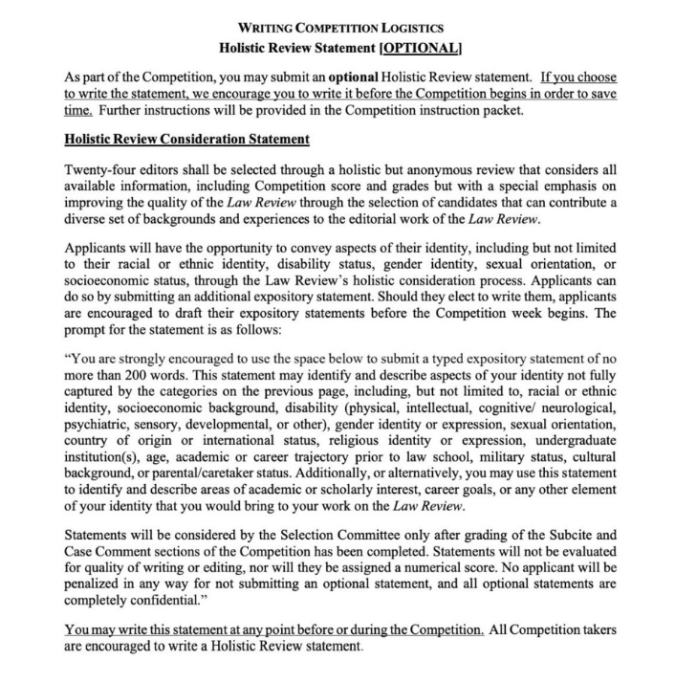
The memo is clearly exactly what the Supreme Court declared was illegal. “It’s a common tactic,” said David Bernstein, a professor of constitutional law at George Mason University’s Antonin Scalia Law School told the Free Beacon. “The implicit claim is that if you are looking broadly at all sorts of diversity, illegal racial discrimination becomes legal. But that’s an absurd interpretation” of the law.” “It’s kind of them to so openly dispense with any pretenses concerning what they’re doing and why,” Dan Morenoff, the executive director of the American Civil Rights Project, added. Meanwhile, the journal’s main concern now seems to be finding and punishing whoever leaked the damning emails and documents to a conservative publication. “The information contained in the article should not have been shared,” the editors wrote in a memo asking for tips on who squealed.
Laughably, Harvard insists that the Harvard Law Review is not affiliated with Harvard. True, it’s formally an independent non-profit operates out of a Harvard building, is tended to by Harvard janitors, and employs only Harvard students as editors, while being supervised and overseen by administrators and professors at Harvard Law School, including the school’s dean. As Michael Clayton (George Clooney) says when the general counsel of a criminal chemical corporation tries to duck the significance of a smoking gun memo proving its guilt by arguing that the document is protected by attorney-client privilege, “See, now, that’s just not the way to go here.”
Soon after the Free Beacon’s report was published, Faculty, Alumni, & Students Opposed to Racial Preferences sent every student at the law school an email directing them to preserve documents that the group plans to subpoena. Harvard quickly condemned the email the next day and implied that no student at the law school was required to preserve the materials. “See, now, that’s just not the way to go here“: Experienced litigators who reviewed the message said it was a brazen violation of legal norms that could result in sanctions for both students and the university. “I’m surprised that Harvard Law School is taking the position that documents do not need to be preserved,” said Jason Torchinsky, a partner at Holtzman Vogel and a former official in the Justice Department’s civil rights division. “The consequences for students applying to the bar if a judge later disagrees with Harvard and the students destroy documents could be significant.”
Yeah, I’d agree that bar associations tend to look down on the practice of destroying documents when one knows they likely to be sought in future litigation. The law school appeared to have abandoned that defiant position, with the publication now telling its editors to preserve documents pursuant to the litigation hold.
____________________
 Ethics Alarms
In other words, Obama didn’t either grade onto or write onto the law review? He applied and was admitted because he is black, at least under the one drop rule?