More than 100 Harvard affiliates gathered in Harvard’s Zimmer Hall Plaza Thursday night to protest sexual violence, calling on the University to strengthen protections for survivors and reform its handling of harassment complaints. The rally was part of a nationwide day of action calling for justice for Jane Doe, a former Cornell University student, and Kendall D. Francis, a Louisiana State University student, who have both alleged sexual assault. Organizers at Harvard also issued six demands, including an independent grievance process for harassment and discrimination complaints, expanded resources for survivors, and the reopening of two diversity offices shuttered in July 2025…
“Jane Doe” is Lucy Craig, who has become one of the most improbable “Believe All Women” icons yet after suing seven male colleagues at Cornell for sexual assault despite massive evidence that she was a willing—well, you know. The only words that spring to mind are in bad taste. Women are disgracing themselves in this Ethics Train Wreck and apparently don’t care. My Leftist social media friends have decided that the Cornell 7 are rapists despite both the school and a district attorney determining that Craig’s claims are not credible; after all, she only sued after she was disinvited from a Halloween Party given by the same fraternity where she made whoopie, as Eddie Canter would say. But Lucy got her revenge: Cornell has cancelled that party and all others at fraternities for the rest of the school year. So there! New York’s woke Democratic governor Kathy Hochul appointed a special prosecutor who had already announced that she had decided the men were guilty despite her assignment of running an “independent” investigation. (Your host is quoted in this story about that...)
The LSU case? I don’t know anything about it, and I suspect the Harvard demonstrators don’t know much about it either, but someone figured out that Lucy’s tale is too thin to base a “nationwide day of action” on even in The Age of the Great Stupid (and before mid-terms).
How does a dubious rape claim at Cornell relate to the need for more “diversity” offices at Harvard? Why don’t these affiliated organizations also demand that the MLB divisional play-offs be expanded from five games to seven? Or that the official language of the U.S. be changed to Swedish?
The rest of the Crimson report is equally risible:
Not that I find the latest controversial course offering at Harvard ennobling or likely to prompt me remove my diploma from its place of shame—front to the wall, on the floor— in the hallway to my office, but it is defensible, which is not the same as calling it “good.”
Harvard University hosted OnlyFans drool-object Ari Kytsya….
….(she’s another “influencer”) at a business class discussion on the adult entertainment industry. Kytsya spoke at Harvard about her career on the adult live porn site and the business of being an online peep show entrepreneur. During the lecture, Kytsya discussed the nuances of profiting from making “adult content” and shared anecdotes from her work. For example, once she was paid to “shit in a box for 10K.” Nice. She also emphasized how important it is to enjoy one’s work.
Harvard is being criticized for hosting the lecture, the complaint being that the school is debasing elite education by elevating sexually explicit content and adult entertainers to the status of legitimate topics for academic study.
The criticism is, I think, unfair. OnlyFans was a creative use of new technology when it was conceived; it is also a model that allows individuals to build a brand and a business. I can certainly see how there are valuable business lessons to be learned from the OnlyFans phenomenon that can be applied to other, more traditional businesses.
Nor are dubious courses anything new at Harvard. When I was at the college, there was an infamous “gut”—Harvardese for a shamelessly easy course—nicknamed “Ships.” The semester course, taught by an amiable and ancient professor, covered the history of sea vessels, and if you couldn’t get an A in that course, you were probably dead. There was nothing useful in “Ships” unless one was considering landing on Plymouth Rock. The OnlyFans discussion, in contrast, could have practical applications.
Ethics Alarms recently relayed the news that has-been B list actress Shannon Elizabeth, well past her wet T-shirt pull date, was displaying her wares on the site. It was reported last month that the 52-year-old earned $1 million in her first week. Now, business courses are not the only academic settings where the porn site is worthy of study; sociology, American culture and psychology students, as well as technology scholars, should heed the phenomenon. Back in 2021, law professor Catherine McKinnon called out OnlyFans as a toxic influence on the culture, contributing to societal approval of pornography and sex work, and described the platform as a cyber-pimp.
She may be right. But that would make the case that OnlyFans is a valid topic for academic inquiry stronger.
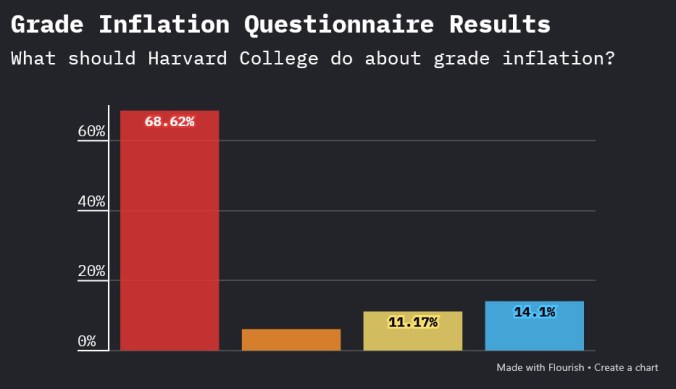
The chart above reflects the results Harvard got from its alums when it asked last month in its alumni magazine what the school should do about its absurd grade inflation, which Ethics Alarms examined here , here, and here.
The red bar shows the percentage of readers who felt that Harvard should “Implement recommendations from a Faculty of Arts and Sciences subcommittee, such as imposing a 20-percent cap on A’s in every class and awarding internal honors based on “average percentile rank” instead of GPA.” In other words, fix the problem. In other words, establish a grading system with some integrity. In other words, ensure that a Harvard College diploma means something other than that a student somehow got admitted to the iconic and supposedly challenging institution.
What should be troubling to Harvard—and us— is that the other options got as much support as they did:
14.1% think that the school should “Grade all classes pass-fail; take A’s out of the equation.” This doesn’t address the problem at all. Harvard doesn’t fail anyone already: it is harder to flunk out of Harvard than almost any U.S. college. The pass-fail option just substitutes one false standard for another.
11.17% chose the “solution” “Nothing; students work hard and it’s unfair to change the rules.” Morons. Who says they “work hard”? Effort doesn’t mean success, achievement or mastery: one can work hard and accomplish nothing. It’s unfair to change what obviously doesn’t work? How does an intelligent, educated person reach that bizarre conclusion? Revelation: over 10% of all Harvard grads are incompetent and irresponsible.
6. 12% voted to “Implement changes, but only if other schools do it too.” Wow. There’s leadership for you. 6.12% of all Harvard grads are apparently weenies.
In related news, the embarrassing Harvard student petition opposing grading reform at Harvard University as “racially harmful” has been removed from Change.org. The petition urged Harvard to abandon the plan limiting top grades because doing so would “mirror and reinforce existing racial and socioeconomic hierarchies.” I had expressed my dismay at the petition here.
Just look at this thing! It is such a blatant far-Left, “white people are the enemy” piece of intersectionalism, CRT and white-guilt stoking propaganda orgy that I feel nauseous at the prospect of describing it. What is this bigoted, pseudo-scientific, DEI- promoting crap doing on the official Harvard University domain?
Here is how this subversive political propaganda is introduced:
“In the current climate of racial tension and police brutality, it is quite easy to feel overwhelmed by the onslaught of heart-breaking news and information. Yet through the whirlwind of chaos, change in the system is occuring and now more than ever, people are vocal on prevalent issues of racism, encouraging others to join in the fight against systemic racism. However, simply not being a racist is insufficient in eradicating the problem. We must work on actively becoming Anti-Racist in order to properly push back against the system that oppresses Black, Indegenious, People of Color (BIPOC). Members of our community have sought out and compiled resources that can educate, facilitate, and equip those seeking to become more effective anti-racism allies. We hope that these resources will prove helpful in the journey towards a more equal, united America. Thank you for your active engagement. “
Remember, Harvard University is promoting this.
These are the links one encounters: it’s like an anti-white racism Chamber of Horrors:
Then comes the “For Parents Section,” a handy-dandy how-to raise a little white-hating non-white child or a groveling, self-hating white patsy for DEI dominance. Again, just look at this crap:
Harvard has issued a102-page draft document to persuade investors to buy a new bond designed to raise funds to replace the billions being withheld from the school by the Trump Administration. The Administration has pledged that those funds are lost until Harvard agrees to comply with “both the intellectual and civil rights conditions that justify federal investment.” In other words, Harvard can eschew federal funding until it stops being a leftist indoctrination and propaganda tool and starts educating again.
Harvard has used Massachusetts’ municipal bond authority, overseen by hard-left Bay State governor Maura Healy, for $1,169,075,000 in bond offerings in 2024 and 2025. The proposed 2026 bond offering is for $675 million, which would bring the total to $1.8 billion in three years. You wouldn’t want Harvard to have to dip into its approximately $57 billion endowment, would you?
One eye-catching item in the draft: “First-year student applications received” by Harvard dropped more than 21 % to 47,893 for the 2025-2026 academic year from a high of 61,221 in 2022-23. This is below Yale with 54,919 applicants , Brown with 47,937 applicants, and Columbia’s 61,031 applications.
Harvard won’t release its application numbers for students entering in the fall of 2026 until it is required to by the federal government, the Harvard Crimson reported. Hey! I thought democracy dies in darkness! When an institution refuses to disclose something, one may fairly presume it has something to hide.
The Washington Free Beacon notes that while it is complaining that King Trump is endangering potentially life-saving cancer research with its suspension of federal funds, Old Ivy employs 12 vice presidents, a bit of an extravagance since, for example, MIT somehow survives with a mere seven.
Harvard’s applications drop, I suspect, comes as it becomes increasingly clear that it fosters a culture antithetical to a full education and freedom of thought, all while remaining committed to anti-white, anti-male, anti-American objectives and is actively hostile to large sectors of American society. This has been in evidence for many years; the campus anti-Semitism and Claudine Gay debacle only brought into the open the ethics rot that was already well underway. Veteran readers here know that Ethics Alarms has been pointing to Harvard’s revolting conduct continually.
If my efforts have had even the most minuscule role in diverting a single vibrant young mind from attending this destructive institution, in the eloquent tradition of Lena Lamont in “Singing in the Rain,” it makes me feel as though my “hard work ain’t been in vain for nothin’.”
“The correct ask in this report is not the ask of an institution being condemned. It is the ask of an institution being held to its own standard by people who still believe it can meet it.”
That authentic frontier gibberish—I’m still not sure what it means, and I’ve read it a dozen times—is in “A Narrowing Gate, Jewish Enrollment at Harvard and its Peers | 1967-2025,” a report by the Harvard Jewish Alumni Alliance. The report found that that Jewish undergraduate enrollment at Harvard University has dropped to about 7% in 2025, its lowest level since before World War II and the lowest among Ivy League schools with reliable data.
I was going to write about the report itself, but if Jewish alumni of Harvard end up writing like that, maybe its a good thing not as many Jewish students are attending Harvard.
This is the Executive Summary. The report seems to be implying that anti-Semitism at Harvard has to be the reason for the unexplained drop, because none of the other possible factors it identifies explain it. Apparently Jewish applications to the school haven’t fallen off sufficiently to cause a 50% reduction, though I don’t know why. On national television Harvard’s then-president Claudine Gay told a Congressional committee that she considered anti-Jewish demonstrations in Harvard Yard to be acceptable free speech, and was unable to articulate a basic truth, which is that anti-Semitic demonstrations on a college campus constitute unethical and intolerable conduct that creates a hostile environment for Jewish students. Gay’s eventually firing for scholarly misconduct (not mealy-mouthed acceptance of campus enmity toward a minority) could not have provided aspiring Jewish applicants much confidence.
We also learn from the report that Jewish alumni had to gather the data for the report because Harvard no longer compiles data on Jewish students.
All of that is interesting, but when I read that statement, I lost interest in examining the report further, and lost any confidence in the people who prepared it. Maybe it’s a hangover from listening to Kamala Harris and Joe Biden for four years and Donald Trump for a decade, but if someone can’t communicate clearly, I can’t have confidence that they are thinking clearly either.
Back in 2015, in an earlier grade- and recognition-inflation post, I wrote in horror about the growing tendency of high schools to name up to a third of the graduating class “valedictorians.” I observed in part,
“…this atrocious practice is obviously catching on. Integrity is such a chore. Excellence, superiority, achievement…they are all chores too. As for the genuinely superior students, they are out of luck: this is the high school equivalent of all the gladiators standing up and crying “I’m Spartacus!,” except now it’s “I’m the smartest one in the class!” This Maoist denial of the fact that some of us earn more success than others and that there is nothing wrong with doing so is all the rage…”
In a cover essay in the current issue of Harvard Magazine, Lindsay Mitchell writes about “The True Cost of Grade Inflation,” focuses not on the costs of deceiving employers and flooding the job market with young sufferers of the Dunning-Kruger syndrome, but on student self-esteem and stress. The former Harvard instructor writes in part,
“…As Amanda Claybaugh, the dean of undergraduate education who authored the October grade inflation report, told me, “One might expect that a world where everyone got A’s would be a very relaxed world, but actually, it’s the most stressed-out world of all.”…The psychology driving this grade-frenzied atmosphere stems from the way A’s flooding the marketplace changes their value as a currency, rendering them both essential and trash at the same time. When you feel that everybody’s got an A, then you must get one, too—every time—or you have failed to keep up with the mainstream. Yet all the A’s in the world will still do zilch to get you ahead…
“…the swelling fear of not keeping up with the perfectly graded masses discourages students from taking academic risks. On campus, stories abound of introductory classes populated by enrollees who don’t need them—many have already taken a version of the same class in high school—but who are willing to repeat the material to have their A outcome in the bag. In those classes, if there’s a curve set by the highest or median score, students taking the class to actually learn the material are often left to claim the lower grades.
“And instead of picking courses that might prove challenging or just exploratory, many students aggressively seek out “gems,” the new Harvard slang for “guts”: easy classes without rigorous grading schemes. Meanwhile, the number of students taking classes pass-fail drifts upward, as students cower before intimidating subjects and elect the route that obviates grading altogether…terrified students would often email me their revised drafts repeatedly to get me to say they were “okay” before I graded them. On occasion, someone emailed me every couple of hours when I didn’t respond immediately. With one abject soul, I was able to track her miserable night by looking at the string of messages she dispatched through the wee hours, while I was sleeping. She had sent me her thesis statement over and over—with each successive iteration showing an almost imperceptible tweak—pleading with me to tell her if it sounded like an A thesis…When students become this obsessed with grades, the student-teacher interaction is reframed in crudely transactional terms…I, as the instructor, acted merely as a giver of A’s, and my willingness (or lack thereof) to grant them in turn defined the value of the student, who would go out into the world and make money or attain status in proportion to her graded value. With this mindset, my students mostly received solid A’s with an attitude of relief rather than joy. Any grade below that, on the other hand, landed as deflating or even ruinous, depending on how GPA-dependent that student’s future plans were…
“In my own classes, I frequently encountered reading comprehension issues serious enough to hamper the putative goal of a writing class—and even seemed to witness students’ reading skills degrading in real time. In my early Expos days, I liked to bring an old Lampoon parody of a Harvard student essay into class to read aloud together—with each person taking the next sentence round robin at the seminar table—as a lighthearted way to kick off a discussion of my students’ own papers. After several years, though, I noticed more and more students seemed unfamiliar with the vocabulary in the parody, with many now stumbling over words like “penchant,” “motif,” and “preponderance.” I finally stopped bringing the Lampoon piece to class, since by then the laughs had turned scarce and the faces had turned red with embarrassment…These students were not puffed up with unjustified praise, like the entitled Harvardian of the grade inflation think pieces. They showed awareness that they were not performing as well as they should…Many students feel the inflated grades they’ve received compose a smooth edifice that surrounds them and could crumble at any moment to reveal the pockmarked reality of their performance. For some, this can become a source of shame, because their inflated A’s suggest their faults are unspeakable and must be hidden, whereas, for all they know, other students’ A’s are entirely deserved. Grade inflation then becomes a dimension of imposter syndrome that reflects other aspects of this generation’s coming-of-age experience. It is similar to looking repeatedly at a friend’s social media posts portraying her life as perfect, while knowing that your own posts were curated to obscure a multitude of flaws…
“Most of the students I talked to about the grade inflation report, even while admitting grades are too high, took a defensive stance. They were already being worked to the point of exhaustion—and now Harvard was talking about making things harder yet? These conversations confirmed how entrenched grade inflation is in the modern educational landscape. To reinstate strict academic standards, Harvard will need to help students see how a world with fewer A’s could be a better one for all involved…”
[This is a long post, but I urge you to read it all the way through. I cannot imagine a more powerful rebuttal to the advocates of “diversity, equity and inclusion.”]
Last October, in “Harvard’s Self-Indicting Grade Inflation Report,” I wrote about the school’s embarrassing report that revealed that 60% of the grades handed out at the supposedly elite college (my alma matter, and my sister’s, and my father’s, where my mother was Dean of Housing once-upon-a-time) are now As, making Harvard resemble Garrisons Keilor’s imaginary Minnesota community where “all the children” seem to be are “above average” even though that’s impossible.
In a prescient comment (as is often the case), AM Golden wrote in part, taking off from a Dean Amanda Claybaugh’s statement that it was desirable to “ produce a broader distribution of grades,”
That’s the problem. They don’t want to admit they accept unqualified applicants because many of those applicants will be disproportionately minorities. Returning standards to what an elite institution should have will mess with the faculty push for D.E.I. The standards have to stay low if the experiment is to be prioritized over pure academics. They have set too many precedents to easily back away now…
They have created bubbles where remote learning, mask wearing, protesting for the correct causes and making equal outcomes are virtues valued over a solid education. Backing up now will cause mass revolt on campuses. Like the news media, the colleges will be accused of caving to Trump. The asylum has been run by people who should have been inmates for so long that the actual inmates can’t be helped.
Sometimes I think Ethics Alarms is the only online community where clear-eyed vision dependably resides. For right on cue, as Harvard announced a long term effort to start grading seriously again, a coalition of “of color” Harvard students sent this open letter to the campus:
In addition to its leftist bias , its throbbing arrogance, and its incompetence as the supposed role model for American higher education, Harvard also lacks courage. The latest example is that the school recently removed Gregory K. Davis as Dunster House “resident dean” and sent him packing “immediately.”
Why? Trump Deranged, hysterically woke and anti-white tweets from the George Floyd freak-out and before, that’s why.
“It has been the greatest honor of my life to serve as the Resident Dean for Dunster,” Davis wrote. “I will miss my work with students and staff immensely.” Davis was appointed to the role in 2024 when Harvard’s DEI mania, exemplified by its disastrous selection of black, female Claudine Gay as its president despite her slim qualifications (besides being “historic.”) Dean Davis was plunged into controversy in October 2025 when Yardreport, a new anti-Harvard news aggregator, dug up old social media posts in which Davis advocated violence and looting at protests while making inflammatory statements about police and President Donald Trump.
In a 2020 thread on X, for example, Davis wrote that he would not fault individuals who wished harm upon Trump and attached a meme that stated, “If he dies, he dies.” In other posts, Davis characterized “rioting and looting” as part of a democratic process and called police officers “racist and evil.” Yardreport concluded that Davis was biased against “white people, police, Republicans, and President Trump” and called on Harvard to fire him immediately.
That decision reinforces everything I, conservatives and Donald Trump have been saying about Harvard and elite universities for years. Too frequently, all that mattered (matters?) to these schools is whether an administrator is marginally qualified, sufficiently progressive, and checks the right demographic boxes. As with Gay, other qualities that Harvard should have been concerned about in the vetting process were exposed to public scrutiny, and the school had no defense at all. It then defaulted to “Oopsie! Never mind!”
In saying that I’m defending Davis, then, I do not question that Harvard was foolish, irresponsible and lazy to appoint him in the first place. Maybe a better description is that I feel sorry for Davis. Now his character and reputation is being scarred because he will carry around the stigma of being summarily fired by Harvard from a rocking chair position for having the same attitudes that helped get him the job in the first place. I read Harvard’s alumni magazine, and for months it has been trying to get contributions by posing as a brave, defiant champion of academic freedom that refuses to “bend a knee” to the fascist dictator, then it does this. Davis is such a marginal figure that even the President wouldn’t waste time attacking him.
I bet that a disturbing proportion of Harvard’s faculty, administration and woke-programmed students agreed with Davis’s dumb tweets when he made them and do now.
Maybe the President’s assault on partisan colleges and universities is having the desired (and necessary) effect.
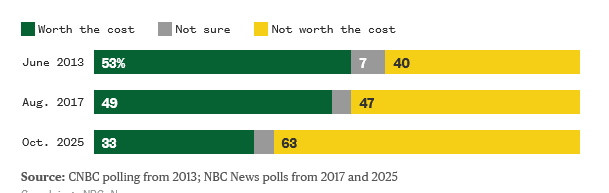
A new NBC News poll claims that only 33% of American agree that a four-year college degree is “worth the cost.” 63% believe that it’s “not worth the cost” because “people often graduate without specific job skills and with a large amount of debt to pay off.”
Four per cent don’t know what college is, are too dumb to compose any answer, or answered “Fish!” or something.