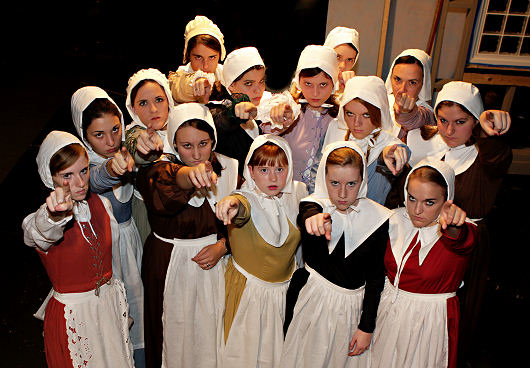
That’s what this unholy mess of a high school play ethics train wreck would be called if it were an old “Perry Mason” episode.
The run of a student production of “The Crucible” at Fannin County High School in Blue Ridge Georgia was cut from two performances to one for reasons unknown. Understandably, the students and their parents were upset. The administration explained that the reason was a licensing agreement violation, and the school was afraid of having to pay damages, or something. It said in a statement,
“After Friday night’s performance of “The Crucible,” we received several complaints as to an unauthorized change in the script of the play. Upon investigation, we learned that the performance did not reflect the original script. These alterations were not approved by the licensing company or administration. The performance contract for The Crucible does not allow modifications without prior written approval. Failing to follow the proper licensing approval process for additions led to a breach in our contract with the play’s publisher. The infraction resulted in an automatic termination of the licensing agreement. The second performance of The Crucible could not occur because we were no longer covered by a copyright agreement.”
Ah, but woke theater Fury Howard Sherman, the same guy who thinks that it’s okay for actors to boycott performances they are contractually obligated to perform because they don’t like the political views of particular audience members (like, say, the President of the United States), is muckraking again. He writes on his website that he’s sure that the show was really cancelled because “the play about witch hunts, about the persecution of people out of hysteria, despite being an acknowledge American classic widely taught in high school classrooms and performed frequently on high school stages, had provoked the same moral persecution it portrayed as unjust.” See, somebody’s mother told a student that the principle had said “that somebody in the audience didn’t like the context of the play and said that it was demonic and disgusting” so the final performance was cancelled.
Does Sherman produce any evidence that isn’t double hearsay that such a sequence occurred? Nope. Do we hear a quote or see a message from the alleged illiterate lunatic who registered such a complaint? No again. But never mind: Sherman is a progressive (to be fair, most theater types are progressives…welcome to my world) with an agenda.
He wants to frame this mysterious incident as one more example of Far Right literature censorship in the schools, even though there is no reason to believe that except virulent confirmation bias. So, as night follows day, my Trump Deranged theater pals on Facebook posted his misleading screed, calling the episode “chilling” as multiple commenters erupted with anger and hate at the “censorship.”
Sherman, who has a deep and impressive CV which only proves to me that one can be highly accomplished in the theater world while being a biased and irresponsible jerk, details his investigation of the licensing explanation, which he said revealed that the alleged violation would probably not have resulted in any penalties to the school. However, I know from personal experience that this exact breach, the extra scene, was and is forbidden in productions of “The Crucible.” When the American Century Theater produced the show (I was the artistic Director) the director wanted to begin the play with the same scene, not in the play but in the movie, that the high school production featured. I asked permission from both Dramatists’ and Arthur Miller personally, and both refused. So that theory is not as unlikely as the author, who obviously has an agenda, implies.
Moreover, we learn in Sherman’s post that “the production was proceeding without the supervision of the drama teacher at the high school, who had departed two weeks earlier – some said he was forced to resign, others said fired – leaving the students to complete work on the show themselves. It left them without the natural advocate for the show and conduit of information with the administration. However, the remaining rehearsals, with the purportedly offending staging, had been repeatedly performed with administrative personnel present in a supervisory role.”
Hmmmm. That sounds ominous. I can authoritatively state that the average high school administrator couldn’t tell a faithful performance of “The Crucible ” from a bucket of warm spit, and Sherman knows this as well as I do. The decision to allow a complex and difficult drama like “The Crucible” be directed by a student without competent faculty oversight is bonkers; it’s quite possible that the first performance was an embarrassment, and the licensing story was devised to save face for the cast. Then Sherman came along to spin the unfortunate events into an indictment of the Religious Right.
That’s just a guess, however, just like Sherman’s theory is a guess, except that he irresponsibly wrote a now widely-circulating essay that concludes, “with two separate parental accounts, one recorded, it seems that the school’s administration decided, after content complaints, to use the wordless opening scene, an interpretive choice, as a pretext for shutting the show down, after bowing to complaints about the show’s actual content, namely the words of Arthur Miller and his characters.”
That’s the narrative that serves his ideological agenda. I agree completely that the school owes everyone involved an honest and true explanation of what happened, but in the absence of one, Sherman concluding that the decision constituted right-wing censorship is indefensible.
 Ethics Alarms
You seem to know what the extra scene was. Could you enlighten us.
I realize that it has no bearing on whether the play should have been canceled. Just curious.
I’m sorry, I should have included that. The whole story begins with a East Indies slave woman named Tituba holding a pagan freakout in the woods. Girls from the Salem community are caught up in it, dancing and seemingly overwhelmed with the ceremony and rituals, like smearing themselves with blood. The scene is referenced in the dialogue and has historical validity, but there is no such scene in the script. In the movie version of the play (with Daniel Day Lewis), Miller allowed the scene to be in the screenplay.
I should add that Sherman makes a big deal out of the fact that the added scene has no dialogue. He knows better: a wordless scene with that kind of vivid content is just as much an intrusion on the author’s vision and intent as added lines, and maybe more so.
And Tituba is a Person of Color so it’s a controversy tailor-made for the race grievance-mongers.
So much for “artistic license”! Possibly the school shut it down, due to not understanding it, or maybe commentary on the McCarthy era of politics is forbidden in progressive education today. Maybe, without ” staff” being present to oversee the work/ performing of the student thespians, there was fear that someone might appear with a MAGA hat as a costume part. We will probably never know the why, but the students know the who. My basic rebellious spirit would have me giving the teaching staff/ administration a big “mooney” on the graduation platform!
License is the keyword there. This was a licensed play, which comes with restrictions, and in those situations, “artistic license” literally does not exist to the performing company, unless they receive the consent of the rights holder. Usually some degree of it exists within the licensing agreement – costumes, backdrop, etc might not specifically require they depict a certain castle or location. But for major changes, such as cutting or adding a scene, the rights holder usually keeps pretty tight control on what they will approve or not.
This is actually pretty standard stuff, especially within educational settings. License restrictions exist on text books, musical and theater performances, the use of movies that can be shown to classes, and even how test material can be presented or altered.
Now, I personally think that any license agreement which isn’t clearly presented and intelligible to the average 5th grader should be rendered null and void as a matter of principle (that principle being that if you can’t state a thing clearly and concisely, it should have absolutely no legal validity), and be grounds for terminating the copyright on the work outright. But since the rest of the world has chosen to move in a different direction (one where the likelihood of passing a law or getting someone to sign an agreement appears to have a direct correlation to how many acres were deforested to draft the document…), this is where we’re at.
There are many works within the public domain where a high school performing company can choose to exercise all the artistic license they would ever want. This work, unfortunately for them, wasn’t one of them.
There absolutely IS artistic license in effect here, but the “artist” in question is the play’s author, not the play’s performers. The play’s performers agree to this as a condition of being allowed to perform the play.
It’s really just that simple.
–Dwayne
So much for “artistic license”! Possibly the school shut it down, due to not understanding it, or maybe commentary on the McCarthy era of politics is forbidden in progressive education today. Maybe, without ” staff” being present to oversee the work/ performing of the student thespians, there was fear that someone might appear with a MAGA hat as a costume part. We will probably never know the why, but the students know the who. My basic rebellious spirit would have me giving the teaching staff/ administration a big “mooney” on the graduation platform!
When my daughter was in HS Theater, the teacher repeatedly told the kids that altering scenes was verboten because of the license issues.
They complained the first couple times and then learned admin wasn’t ever going to allow changes, so they dealt with it.
The seniors also created their own works at year end, and did have to run scripts by admin for approval, but they did a great job without crossing lines too controversial.
This is not a hard situation for any of them. Even if the other teacher left or was fired, everybody knew the rules well in advance, because they block it and rehearse it for weeks and weeks. It doesn’t come together in a week or two. And it might be that administrators knew the fired guy was doing it in contravention of what their licensing agreement was, and fired him for it.
Seems to me this clown is trying to create a scene to keep the “Look! Conservatives are Nazis!” narrative going as the country turns away from lunacy. That, and a lot of theater types are self aggrandizing narcissists, so he’s feeling really good about himself for this, really, no matter what.
I’m sad: the fact that Curmie hasn’t commented on this post, which is right in his wheelhouse as a drama teacher (among his other talents), is the final proof that he has deserted EA in a fever of Trump Derangement. His perspective has always been honored and appreciated here, and this emotional rather than rational reaction is disappointing. He has been a wonderful contributor and resource, and I view him as a respected friend. Curmie’s last comment was on January 15, in the waning days of what is amusingly called “the Biden Administration.” He tersely commented “nice try” to this post. I’m not even sure what he meant. A while back I inquired about his absence via email, and received a similarly curt answer.
My crime, I believe, was being right.
are we sure using the silent voodoo scene from the movies was the issue. Or was it the latent sexual innuendos that was either being excluded or hyped up.
I’ve doen this play in high school ( when it wasonce required readingf) and in amateur theter groups. It is diificult to stage but not impossible to stick to Miller’s brilliance.