I know I’m revealing my own reaction, contrary to EA quiz protocol, but this story calls for Major Tipton:
Accompanying the hand-wringing and progressive head explosions over the Trump Administration’s various demands on Harvard University and its threatened sanctions (including blocking Harvard’s ability to enroll—and get money from—international students), was the stunning information that 6,800 international students attended Harvard College in the 2024-25 school year, which is about 27% of the student body! This, according to university enrollment data. That figure is an increase from 19.7 percent in 2010-11.
Wait: almost 30% of the slots at the U.S’s most prestigious and (supposedly) best college, with resulting diplomas that are virtual golden tickets to success, riches and happiness (or so the legend goes) don’t go to Americans?
Your Ethics Alarms Ethics Quiz of the Day this Memorial Day is…
How the Hell is this fair, civically responsible, prudent, reasonable or justifiable?
Mayhap you discern from the tone of the query my personal response to this news (at least its news to me). Here’s how the New York Times tries to spin the situation: ‘The administration’s decision is likely to have a significant effect on the university’s bottom line. Tuition at Harvard is $59,320 for the 2025-26 school year, and costs can rise to nearly $87,000 when room and board are included. International students tend to pay larger shares of education costs compared with other students.”
That’s odd: the Left condemns colleges and universities admitting so called “legacy” students, often from wealthy families who also pay larger shares of education costs…on top of that, they are Americans, come from America-loving families, and plan to use their degrees to contribute to American culture and society. Moreover, why should anyone worry about “the university’s bottom line”? Harvard mints money from its alums, the wealthiest in the country.
How much foreign alums contribute to Harvard after graduation? Gee, does the Times wonder if the American graduates who would take the place of those foreign students would contribute more? I don’t!
Now here’s Harvard’s protest:
“We are fully committed to maintaining Harvard’s ability to host our international students and scholars, who hail from more than 140 countries and enrich the university — and this nation — immeasurably. We are working quickly to provide guidance and support to members of our community. This retaliatory action threatens serious harm to the Harvard community and our country, and undermines Harvard’s academic and research mission.”
If you say so, Ivy Face. Here’s what the President of the United States says:
“I don’t have a problem with foreign students. But it shouldn’t be 31 percent. It’s too much, because we have Americans who want to go there, and to other places, and they can’t go there because there’s 31 percent foreigners.”
I agree with him, but what matters most to the Axis journalists is that he said 31% when the real number is 27%. See? Trump lies all the time!
But maybe you can explain why it makes sense for an elite U.S. school to allow such a large portion of its classes to be reserved for non-citizens. If you can, please do.
Oh…here are the schools with the largest numbers of foreign students, according to the Washington Post. Note that it doesn’t tell us the percentages…

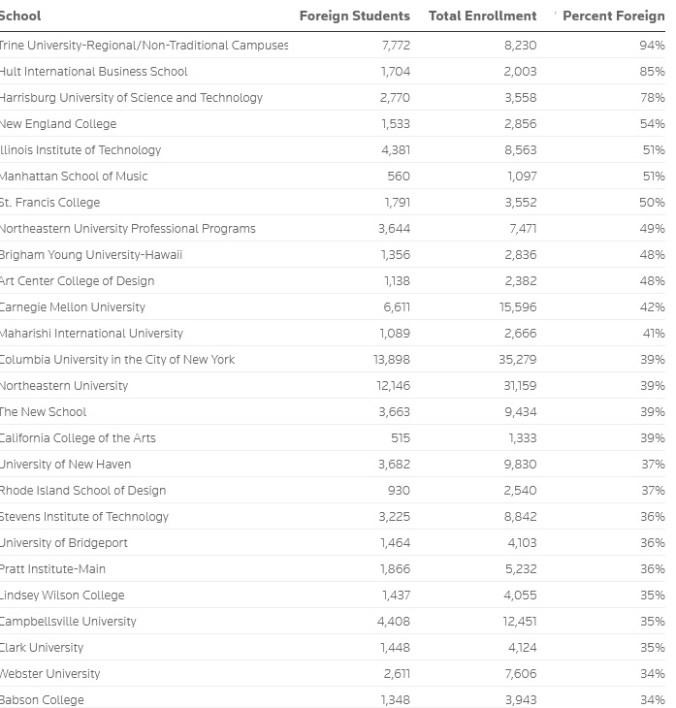
And here are U.S. schools with percentages of foreign students that make Harvard look stingy:
 Ethics Alarms
US colleges and universities are happy to admit international students, because they pay higher tuition than US domestic students (especially if one is talking about in-state residents at public universities) and don’t expect to receive the financial aid which US domestic students qualify for. (Although you should have seen all of the international teenagers on Quora asking hopefully about full-ride scholarships to US universities, especially pre-pandemic!) This is less true in the case of heavily-endowed private universities such as Harvard, but international students still “enrich the university . . . immeasurably” mainly through the tuition dollars they pay.
There’s nothing unethical about accepting international students, anymore than it’s unethical to have international customers in your business, or international actors in your theater company. Why would it be?
Not a good analogy, right? International customers don’t necessarily squeeze out domestic customers. I DO think American productions hiring foreign actors to play American roles is ethically questionable, as do many of my Actors Equity friends. There are a lot of unemployed actors in the US who could play the roles all those Brits and Aussies play in “The Walking Dead” series.
American universities are American resources that should benefit/serve/educate/credential American students as a primary mission. I don’t know where the line should drawn, but it should be drawn. I’d cap foreign students at 10%
I haven’t heard of an American director casting international actors for any other reason that they’re best suited for the part. American actors who feel slighted for losing out roles to Brits ought to step up their game. That’s good old-fashioned competition, which is as American as it gets.
I’d say that it’s a similar situation to students, except of course the reason a foreign student might get accepted over an American is usually financial. That’s hardly Harvard’s fault. American private universities on the whole have become less affordable in the post-Reagan tax status. In generations past, far more families could afford the cost of private tuition without drowning in debt.
But even putting all that aside, why 10%? 30% is unethical, but a third of that number is utterly reasonable? Personally I don’t think private universities are resources that ought to serve Americans–that’s what public schools are for, including state universities. But if you disagree, why not 0%? How could there possibly be a magic number that passes ethical muster?
I personally believe that if the school is private and not the recipient of tax dollars, then sure, let the international students come. However, if our tax dollars are paying for anything at a school, there should be a cap, a low cap, on the amount of foreign students to better serve the American students, they better express the desire to become citizens later, and they better have significantly better qualifications than the rest of us.
I think we can justify more than 0% if it is part of a recruiting platform to get the best and the brightest to America. However, to let governments pay money to send their students to our colleges, forcing our students out or our tuition up, means that we are harming our nation.
If Harvard gets any tax dollars, 30% is WAY too high. American tax dollars should be spent to better America.
Exactly. Harvard or any university can admit only mole-people if it wants to—but Harvard is only quasi-private. The President is 100% right: serve American interests, or forgo government support.
I haven’t heard of an American director casting international actors for any other reason that they’re best suited for the part. American actors who feel slighted for losing out roles to Brits ought to step up their game. That’s good old-fashioned competition, which is as American as it gets.
As a professional stage director of some note and experience, I can tell you with confidence that this is naivete. Almost any role can be played with equal competence by thousands of actors, and the US has many, many more actors than the UK. For a unique talent like Danial Day Lewis, there is certainly justification for casting such a performer regardless of citizenship, but for the vast, vast majority of roles, there are probably 10 good US options—or many more—for every Brit cast in shows like “The Wire,” “The Walking Dead” or “The Affair.”
As a layman of no artistic capability, but one who’s been around many an artist (my daughter was in theater and had some opera training, my wife’s dad was a Chicago public school teacher who sang at the Chicago Opera, friends who’ve been incredibly talented musicians), it is astonishing how many incredibly talented people never make it past a local scene, even those who’ve gone to LA or Hollywood or NY in an attempt to do so.
If you attend any local theater, you certainly see some not so talented, as well, the nature of what it is, but if you can find a venue that’s well funded by local patrons and can draw a good crowd as well, you will see some incredible work.
There’s a place in Tucson run by a Juliard grad, and they did an adaptive performance of some Virginia Woolf stuff that was just unbelievable. All local people or friends of the fellow who flew in on weekends and vacation time to rehearse and perform. One of the most incredible life experiences I’ve had.
There is zero doubt as to what Jack asserts about the availability of talent, in any number of fields. My dad was an executive at a large defense company, and they had STEM programs to reach out to less well to do communities. He found incredibly talented kids who could’ve had any career they wanted, but the were in an environment that has them thinking about being bar owners and tattoo artists. This was a man in charge of 40,000 engineers who rose to the top and was not a narcissistic asshole (I had a biological donor who filled THAT role…), he KNEW how to spot talent.
I think it’s important for us to take care of our own communities and nation first. Nothing wrong with that and it’s what every nation does to uphold the values it finds important.
I would love the name of that Tucson group if you care to share. Thanks.
https://www.theroguetheatre.org/
Neat place.
As an aside, she had work there in her sophomore year, non -stage work, and blew them off mid production to go to her cousin’s wedding in Hawaii (she’s not that close to the cousin. I was floored she could act so selfishly….)
By the grace of God, they gave her a second chance, as assistant director on the Virginia Woolf event, and in the Q&A after the show, she got called out for her great work by one of the actors.
Sadly, she’s gone on to endeavors in Europe (circus… though her mom and I certainly created a circus environment while she grew up; apropos, I guess….) that waste her talent, in my opinion… Oh well.
Thank you! I work in the theater as a side gig and love checking out regional and community theater when I’m visiting places. I’m in Tucson often enough. And I agree with you: there is some astounding talent in local theater. Here in Wisconsin we have performers who went to some pretty prestigious schools, got their master’s in music and/or performance and then came back to the midwest to raise their families. Our local theater groups are the beneficiaries of all that talent.
And so British actors are cast instead…why? David Simon just loves tea-time at the crafts table?
I have some note and experience in this field myself, and the only time I’ve heard of casting being chosen by region is when it’s either essential for the part, or being filmed on location, which often requires a certain percentage of labor be used locally.
It’s not they they are being cast by region, but that they are NOT being cast by region. American actors need the work,these are American countries, and the talent pool here is wider and deeper except at the most extreme end, the Daniel Day Lewis, Anthony Hopkins, Christian Bale and Johnny Depp level. The Brits have “cache” or something. It’s the same issue here in DC, where the Equity houses cast New York actors when equally able local performers are desperate for work. Bias makes you stupid.
Regional hiring is done all the time when filming on location. If you are filming your American thriller in Vancouver or Prague, then you are hiring local actors and crew, as a condition of filming there.
The idea that a British actor is playing some random role in “The Walking Dead” is because of some anti-American cache is dubious. What’s most likely is that they nailed the audition. In the case of theater, they’ll ship in high-profile foreign actors for their marquee appeal, no cash-strapped local company is casting a random gal from Melbourne over a local actress.
This is why it’s a fair analogy for Harvard. Harvard admits visible “stars”–athletes, children of celebrities–the better to attract other students with bonafide talent and smarts. That those students increasingly come from abroad is not surprising, given the state of American education.
Regional hiring is done all the time when filming on location. If you are filming your American thriller in Vancouver or Prague, then you are hiring local actors and crew, as a condition of filming there.
Irrelevant. I’m not talking about that, and the DC-NYC bias shows the opposite going on.
“Regional hiring” wouldn’t seem to account for the Walking Dead, shot mainly in Georgia. (An unusual amount of stuff is filmed here).
I wasn’t clear in my comment just now, mainly addressing Gully’s claim. Foreign actors in The Walking Dead (and other stuff filmed in Georgia) were definitely not “regional”.
My point is that foreign actors are hired all the time for various reasons. (To assume, for instance, that there are lots of capable actors in Georgia, is as iffy as assuming that there aren’t any.) There’s nothing to indicate that the central cause is bias, which is a silly term anyway for creative, collaborative endeavors. Artists aren’t athletes, and their abilities can’t be judged fairly, if that even were a goal for assessing a work of art.
Catherine McClarey said:
US colleges and universities are happy to admit international students, because they pay higher tuition than US domestic students (especially if one is talking about in-state residents at public universities) and don’t expect to receive the financial aid which US domestic students qualify for.
I understand that this is how it’s always outlined, but can someone explain the process involved? I did a quick search and it sounds like the reason that domestic students pay less in tuition is because their education has government subsidies attached to it.
If that’s correct… Why would the school care where you came from? While the amount they collect directly from the student might be different, wouldn’t the gross revenue per student be the same?
And if that’s the case, I have it in the back of my head that there might be an interesting conversation about the benefit to the American taxpayer to having foreign enrollment. I mean, food for thought – depending on the percentage, the average foreigner going to Harvard might save the American taxpayer more than the average instance of educational debt forgiveness.
Jack:
Harvard or any university can admit only mole-people if it wants to—but Harvard is only quasi-private. The President is 100% right: serve American interests, or forgo government support.
“Support” in that context probably doesn’t mean what the average person would mean it to. The President is requiring Harvard to take more government support, not forgo it, unless “support” in this context means “allow to sell their service to people from outside the united states”, which…. let’s be real, every other type of business in America is more than free to do. Let’s be even more real: In fact, much of President Trump’s rhetoric this season has been about the necessity of increasing American sales to foreigners.
America “exports” 700 billion dollars annually in services, which is three times as much contribution to the GDP as oil exports. This is literally what you’re best at. You’re having a bizarre national conversation: One one hand, we’re talking about GDP and trade imbalances, recognizing that it is a benefit to America for foreign people to spend their money here…. And on the other, we’re trying to reject foreign dollars and undercut the largest sector of the American trade economy.
Would you say that food exporters are un-American because they’re exporting beef to foreign markets while there are starving kids in America?
“Elite” universities are finite resources, not commodities, not the same thing. Every nation on earth uses it’s finite resources to benefit itself, as it should.
The fact that university management and faculty have become profit and ideology prostitutes (or “ideology drug” dealers) who care only about what it gets them doesn’t change the fact that it’s a bad idea.
They’re the academic equivalent of those in the gangster rap videos, flashing guns and cash in front of everybody, celebrating the fact that they’re destroying the communities they live in.
There’s no such thing as an infinite resource. The very first thing someone learns in their first economics class is that economics is the study of how to get the most utility out of finite resources, because everything is a finite resource.
I think the distinction you’re trying to make is that it’s a relatively scarce value and disproportionately valuable… But the next step is obvious: It’s also priced that way.
The question is: “Why should Americans have a monopoly on that resource?”
And the answer I think you’ll make is: “Because Americans get a whole lot of utility (in theory) from domestic enrollment, so we should aim towards that.”
And my question then is: “What’s the limiting principle on that? If America can monopolize the output of private institutions because of the utilitarian benefit to America, why don’t you force domestic sales of food until there aren’t any hungry kids?”
And also, a side of: “When did you decide to become a communist?”
Why shouldn’t Americans have a monopoly, or nearly so, on an American institution?
I’m not sure what bearing your last statement has on the topic.
I think we need to take a big step back here.
Jack isn’t in agreement with the Trump Administration on this topic. Trump isn’t having this pissing match with Harvard because he’s ideologically opposed to having foreign students spend their money in America. Educational tourism contributes billions of dollars to the economy and pulling it as suggested here would negatively impact your trade deficits, which have been the cornerstone of his economic policies.
The administration is having a pissing match with Harvard because they’re culturally at cross purposes on things like DEI, civil rights (read: affirmative action), and anti-Semitism. They’re using the foreign students as leverage because that’s what Trump does. And I think they’ve chosen Harvard because if the administration can make Harvard blink, perhaps the other schools will adjust without having to incur the damage that apply similar leverage would entail.
That’s the best-case defense of this policy, and proponents of it can make the argument that the outcomes might offset the costs, and so we can hold our collective noses and accept this…. But that doesn’t make it good. And in fact, I can’t imagine that it’s constitutional… Harvard is not a worst offender by any articulable metric. What’s the justification for singling them out for punishment?
I asked when you decided to become a communist, because advocating that the government to dictate who someone can sell to, and at what price, with a side helping of corruption, seems very comradely to me. I understand why you’d try to avoid the comparison.
Well, one, you’re arguing things not in evidence. I said nothing about government mandates or subsidies or pricing or any such thing.
Two, Jack’s argument is that Harvard would better serve it’s home nation with a more homogenous student body. Not exclusively, but largely.
Finally, we’re arguing for choices we believe admissions should be making given where they reside irrespective of government “intervention”.
As you note, education in the US has been failing (mostly in large blue cities, but that failure is in a LOT of places), in my opinion in large part because of the kind of claptrap espoused not only by our elite universities, but by most of our educational institutions, which has filtered back down in to our K-12 establishments.
Ironically, dumber people is a feature of communist regimes – anybody with two braincells to rub together to create some critical-thinking heat would keep most all of them from buying in to the crap that communism/DEI/”Multiculturalism” sells.
Go Trump! Though I’ve never voted for him in a primary yet, I think he’s the only figure that could bring out the true nature of currrent societal bullshit and change it. How else to explain that he moved every demographic except black women to the right?
I said nothing about government mandates or subsidies or pricing or any such thing.
You started out by saying:
-University Spots are finite
–Nations should best allocate their finite resources to their benefit.
And my point was that you’d described the broad strokes of communism. Every resource is finite. With very few exceptions, nations should not be allocating anything. Should comrade Bob be able to sell his lemonade to tourists, or should that sweet lemon nectar only go to the parched throats of working Americans? Lemonade is finite, you know.
Jack’s argument is that Harvard would better serve it’s home nation with a more homogenous student body.
I don’t think that’s Jack’s argument, and America is probably the least homogenous nation on Earth. But assuming that this is your point: While it might be better for America if every American aimed towards the north star of acting in ways that maximally benefitted America, the reality is that most people navigate in a way that doesn’t maximally benefit America.
There are countless American organizations with the mandate of explicitly funneling American resources to other nations. Is UNICEF’s mandate unethical? Should we force their dollars be spent only in-nation until American poverty is solved?
There are countless American companies that export finite American resources, like steel, to other countries, for a profit motive. Is Nucor unethical? Should we force them to use their resources domestically until American homelessness is solved?
My point has always been that the policy prescription being described is an economic disaster, and my second point was that that even the people making this move probably don’t agree with you.
America *does* see a benefit to the nation by allowing educational tourism, just not the benefit you’d prefer. Even if you wanted to break your nose to spite your face, even if you wanted to forgo those billions of dollars of revenue and free up all those sweet, sweet post-secondary spots, as has been mentioned elsewhere: While a kid might not be able to get into their school of choice, basically anyone can get into *a* school, so you won’t be increasing the number of people getting a degree, you’ll just be shuffling them around.
And elite schools aren’t elite because the professors are so much better at disseminating information, or the textbooks have hidden secrets in them, they’re better because they have better standards (ostensibly). More, while some of a domestic Harvard education is government subsidized, not all of it is, so the people getting accepted into the more prestigious (read: more expensive school) would somehow have to finance it.
It’s like a perfect cluster of problems:
-You’d forgo the foreign revenue.
-You’d be increasing educational debt.
-And either the school would have to lower standards, or the failure rate would increase.
-If the former: What did we go give all those benefits up for?
-If the latter: Fewer Americans would get a degree, because people that might fail out of Harvard also might have succeeded elsewhere.
“Why would the school care where you came from?” If the school doesn’t regard teh higher education system as a national resource, but simply as their own fiefdom to accomplish their own agenda, it wouldn’t. But because it is part of the nation’s education system, it should. It was very obvious to me at Harvard that the last 2/3 of the student body could be replaced by equally able students around the country several times over. Well, 1f reducing that 27% down to, say, 10% would allow more Americans to have Harvard educations, then that’s what Harvard should do.
But why doesn’t it then?
See… The goalposts have shifted. The first contention was that Harvard had a profit motive… But I don’t think that has the benefit of being true, I think that revenue is probably the same for the school regardless of where the student originated. More, I think it was you that made the point that a significant amount of Harvard’s income is Alumni donations, and I’m wondering if there’s a disparity between the donations of foreign alumni to domestic. Is it possible that Harvard is actually forgoing some amount of income by increasing the percentage of foreign enrollment?
So we’ve moved on to this… Which doesn’t really try to explain why the thing is happening, so much as it just asserts the thing is happening, and it’s bad. Which…. Sure. If you look at it that way.
Harvard is a business, and I doubt that if you asked the average person what that business is, they’d answer: “To better educate the people of the United States”. I doubt that’s what Harvard says either. I didn’t go to Harvard, so correct me if I’m wrong. If I had to bet on how they market themselves, I’d say that they probably say that they’re an elite institution, that they only take the best of the best, that X amount of Y were Harvard graduates, that graduation is a cheat code for maximal earnings. Am I close?
And if I am, I think that answers the question: “Why does Harvard do this?”
In my mind, probably because American schools suck. They have been failing your kids generationally, and it wouldn’t surprise me if the shifting domestic/foreign demographics in higher education are a function of standards, and while America might benefit from having more domestic education, Harvard has an interest in maintaining their standards.
And again… I’m not an expert, I could be wrong about a great number of those contentions, but I think I’m right, it makes sense to me, and if I’m wrong, I’d like someone to explain it.
This dovetails into a frightening trend in education: Your results have been declining for decades. So many of the problems we agonize over basically boil down to a lack of ability to teach kids how to read, write and problem-solve.
This is the exact same stance I took on affirmative action: By the point we get to post secondary institutions, the damage is done. Those minority kids that disproportionately fail weren’t failed by university admissions standards, they were failed at every step of the process up to that point, and their admissions failure is the metric that proves it.
Similarly, if American kids, regardless of inherent characteristics, are falling behind the rest of the world, that should probably prompt a little more soul-searching, and a little less navel-gazing.
Harvard isn’t the problem.
And again, if the goal is suddenly to serve American students first, why should the rate be 10%? Why not 0, or 8, or 11, or maybe–here me out–the people running the institution should be free to make their own choices without government dictation.
Also, consider this: if the federal government is considering helping fund major research at Harvard for, say, immunology research, which benefits America more–to only have Americans working on the project, or to have the top scientists, regardless of origin, in the lab, to increase chances of a valuable discovery?
I question the veracity of your statement that American harvard graduates are in fact lovers of America
Actually, I said their families are. The students probably are until they are indoctrinated after four years of brain-washing.
Once heard an army nurse take down an arrogant Harvard trained surgeron sayng:
Thery are three things in life that are highly overrated, they all begin with H:
Home cooking, Home screwing, and Harvard Medicine!
I know it’s been proposed before that federal loans for education should maybe be tied to the likely marketability of the skills acquired with the particular degree. Perhaps they should also create limits based on the ratio of various “administrators” and other such Supernumeraries on staff at a college.
Some complain that a college education is “free” in many European countries, but ignore (or are ignorant of) the reality that students have to seriously compete for the limited available slots, and even then might not be able to get into a program for the vocation they desire, as the state limits what’s offered based on their expectations of what will be needed in the workplace.
Willem Reese: “but ignore (or are ignorant of) the reality that students have to seriously compete for the limited available slots.”
That was my limited experience when I studied in Sweden. You could not go to college just because you wanted to. You had to get in. I walked through the library and I believe each student had an assigned seat, and the seats were filled because it was a very competitive environment and not a lot of freedom as a result.
My impression was that this was not atypical of Europe, but I did not know.
In contrast, in the U.S., anybody who wants to go to college can get in somewhere, even if it is community college. My mother earned her A.A. from a community college when she was 57.
-Jut
However it started, Harvard is in the category of world universities that attract large numbers of international students. Like Oxford (46% international), Cambridge, University of Glasgow, Abu Dhabi University (60%), Hong Kong University, etc. Should those universities or their countries put a limit on the number of international students?
Should the US pass on the economic impact of students? If we tell Canada, for instance, that their students can’t come here, or if Canadian students just stop coming, and go to other counties, we lose the $1.65 billion (2023) those students spend on other things.
Are the schools at the lower end of the list limiting their students by not providing them with the perspective of others? Should those schools be required to recruit more international students?
What’s the perfect percentage? Is there one, or is it just opinions? Who gets to decide? Does the fact that it’s Harvard make a difference?
There can be a big advantage in foreign students – money. My local high school has 2902 students of which 174 that is 6% are foreign students. These foreign students pay a lot more for their education here than the government gives to the school for local students so the school can then choose to spend the money on anything that will give the local students a better education whether it be better facilities or bonuses to better teachers.
The students can then choose to sit the international Cambridge Exams in which the school has the second best results in the country or they may want to sit the local New Zealand exams.
I believe Nobel laureate in economics Theodore W. Schultz discussed the theoretical implications of foreign university students some decades ago. Probably it was a chapter in _Investing in people_ (1981).
Schultz was an agricultural economist by training, he was probably thinking more along the lines of a student from Malawi studying agronomy at Iowa State, rather than the son of an oil rich Arab prince studying political science at Harvard to make connections. Or the daughter of a European political or business magnate, for that matter.
Everyone paying attention knows that US colleges and universities have been full of tuition paying students from places like China for more than a decade now. The reasons are various. The universities get revenue. STEM departments get graduate students who are competent in math and bench science. Students from East Asia get an opportunity to improve their English proficiency and get some insight, even if superficial, into what American university systems are like.
In many cases graduate students in STEM are provided with research or teaching assistantships, awarded at the department level based on their promise of scholarly competence.
What are the long term implications? They are various. I think no one can fully predict the long term consequences.
I think it’s obvious that a major factor is “elite recruitment.” Most of what I know about elite recruitment and the international “circulation of elites” is impressionistic, or anecdotal, or invidious.
It’s obvious that going to the Ivies or Stanford is good for elite recruitment. Future elites outside the US can meet future elites in the US. But foreign students aren’t just at Ivies, they are at Iowa, Wisconsin, Texas, Michigan State, North Carolina, Penn State, etc. Let us imagine tens of thousands of foreign graduate students in STEM graduate programs. We’re talking, for example, about Chinese students living in “married student housing,” on the extreme edge of campus, segregated from much of the university social life, tunneling toward a Ph.D. in statistics, interacting with others who are doing the same thing, often living with roommates who speak the same foreign language.
But wait–universities train technocrats, too.
Two obvious examples that come to mind in economics: After Pinochet came to power in Chile the economic policy was set by technocrats who had studied at Chicago, the controversial “Chicago Boys.” After Suharto came to power in Indonesia it was a similar thing: economic policy eventually was strongly guided by similar technocrats from UC Berkeley–the so-called “Berkeley Mafia.”
If I am being clear, this is only to say that conservative, orthodox macroeconomic policy was set by US educated technocrats who returned to their home country and who, at least for some time, were shielded from excessive political pressure by the leadership of the authoritarian regime that had come to power after a more populist regime that was arguably less competent.
charles w abbott
rochester NY