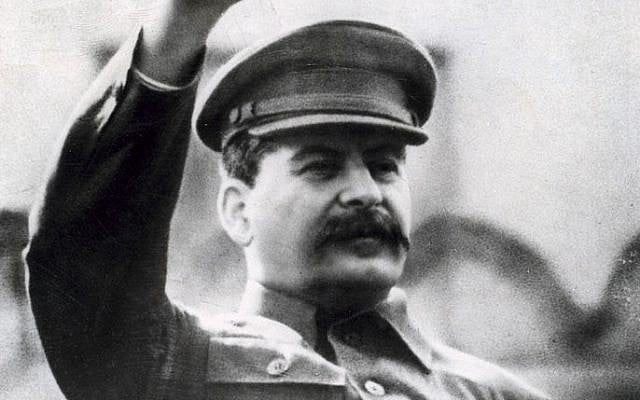
“Yes, there were many mistakes, but everybody makes mistakes.”
—–Liliya A. Medvedeva, Russian pensioner, quoted by the New York Times in “Stalin’s Image Returns to Moscow’s Subway, Honoring a Brutal History” about how many Russians regard the brutal dictator as a hero for his role in defeating Germany in World War II.
But Lily, everybody doesn’t make “mistakes” that result in the deaths or executions of between six and nine million people.
You idiot.
For the record, Lily’s rationalization is one of the most obnoxious on the list, #19, The Perfection Diversion, or “Nobody’s Perfect!” and “Everybody makes mistakes!”
 Ethics Alarms
Jack,
This is one for your cognitive dissonance scale.
You need to appreciate how strongly the Russians view their victory in WWII. My understanding is that it is a National Holiday.
The Battle of Stalingrad was a big deal for them.
They feel underappreciated for the victory when a great deal of the victories in the west were accomplished because Hitler was so tied up in Russia.
The closest analogy to illustrate the point would be the cognitive dissonance Americans expect other Americans to have based upon George Washington’s ownership of slaves. Or Jefferson’s? Or anybody’s. Granted, Andrew Jackson and John Calhoun cause less cognitive dissonance because, apart from owning slaves, they were big assholes. Some people will accept no excuse for owning slaves and any sort of defense of Washington or Jefferson looks like a rationalization. Of course, people like that see no difference between owning 200 slaves and starving millions of people in Ukraine.
So, yes, Stalin is an almost completely irredeemable paranoid psychopath, but he did defeat Hitler and save Russia from the Nazis–so he can’t be all bad. (Kind of reminds me of your defense of FDR’s dictatorial tendencies.)
-Jut
It begs the question of whether or not an evil man is capable of good; slave owning the time was “normal”, but they also recognized it was actually a problem, at least intellectually – and the first step to solving a problem is admitting you have one.
Further, slave owing is a far cry from mass murder. The goal wasn’t so much to bring about a Soviet paradise as it was consolidating it’s his absolute dictatorial power.
Lots of great Russian culture to be proud of, but you don’t get to overlook that one.
Any reasonable observer can conclude that trading one murderous dictator for another one isn’t exactly something to celebrate.
Jack’s comment is correct, she’s an idiot.
Just watched “Downfall” a 2009 production presenting the momory of one of his secretary who was in the Fuherbunker for the ast days.
I bleleive it was hisotriclly accurate portraying the devolving demnic perosnality of Hitler..
However the Secretary makes the claim at the begiingn and the end in presnt time that she was unaware of the depth of the evil her Furher over saw. She claims her awareness came to thefore recently in 2009 when she saw a plaque commenroting the life of one of the millions slaughted by the regime , the regime she worked for, willingly.
She rationilied that she wasn’t personally responsible, therefore not guilty.
In the documentary there is one line expressed by Hitler when confornted by his genrals to save teh “innocent” german cvilians. He says, “They gave us a mandate!’
I cannot excuse any German of that time fromhis collective responsibility for the tragdy. Just as I canot excuse anyone living in Gaza, for their tragedy, “they gave us a mandate”
Traudl Junge had come across the memorial to the White Rose movement in Munich several years after the war but it wasn’t as late as 2004 (when “Downfall” was released).
A documentary made from her memoirs is called “Blind Spot”. That pretty much sums up human beings in general whether it’s us today, Germans in WWII or Russians then and now. We let the pluses blind us to the minuses very often.
Decades ago a journalist named Hedrick Smith wrote a book called _The Russians_ based on his impressions of working there as Moscow correspondent for the _New York Times_. The book originally came out in 1976. Hedrick’s book is one of dozens of foreign interpretations of contemporary Russia (then still the Soviet Union) for a western audience.
It’s an uneven book. Lots of similar books were written for the American popular audience in the 1970s and 1980s. I’ve read a few, browsed some others, bought still others and only skimmed them. I can’t evaluate their quality or accuracy. I can’t read Russian or speak more than 20 words of it. I was there for a month in 1990. No need to bore you with details.
My favorite part of Smith’s book is toward the very end (in a chapter called “Convergence: Are they becoming more like us?)” He points out that Russia is a non-western country, lacking camels (for the most part), Buddhist pagodas, , or women in kimonos. It is full (mostly) of phenotypically white people (he doesn’t use that term, but you know what I mean). It lacks a rich texture of tourist exotica to signal constantly that you have left the West.
Smith observes that Russia is a country that missed the Renaissance, the Reformation, and the Enlightenment. It repeatedly opened itself to foreign influences and then closed itself off again, periodically importing western technology (but not ideas) in periods of what historians tend to call “defensive modernization.” Walter Laqueur noted in the 1990s that Russia generally lacks experience with democratic civic norms or free market capitalism.
The Soviet period was traumatic, and the political and emotional post-mortems were brief–mostly under Yeltsin. Offhand I refer you to biographies of Soviet elites by Dmitri Volkogonov. Did Russians read them? Beats me. These days they are probably just watching State managed TV.
In my uninformed impression, it’s still a semi-closed society. The news is generally managed. Being outspokenly critical of state power does not usually improve the life of the common citizen. Keeping one’s mouth shut can lengthen one’s life expectancy even now.
If you refer to Albert Seaton’s book _The Soviet army 1918 to present_ you will lear that the Soviets had a different history curriculum. In passing Seaton mentions the things Soviet school children were taught about the invention of the steam engine, the telephone, the electricity, the internal combustion engine, etc…all by Russians, not by the names we associate with such things.
The country is different–vast, full of extremes, full of surprises. Nor would I necessarily take at face value the public statements of a Russian citizen regarding the latest rehabilitation of Stalin.
JutGory’s observation about the association of Stalin with Soviet victory in World War II reads correct to me. The “Great Patriotic War” is still a thing in the mind of many Russians. Eighty percent of Nazi casualties were on the Eastern Front. As Stalin may have said, “The British provided time, the Americans provided money, and Soviet Russia provided blood.”
Thanks for reading.
charles w abbott
rochester NY
I was pondering this issue further since my earlier comment above.
Jack, I think you may be thinking that Russians (1) have the civic right of freedom of speech, and (2) they know they have it, and (3) everyone (mostly) believes in it and supports it, and (4) it’s rare for people to suffer negative consequences for being publicly outspoken about political and historical matters. Maybe Russians don’t actually all agree about that.
Stalin’s reputation in the Russian Federation may be not simply a matter of historical debate, but a live political issue.
Russia (and the other 14 former Soviet Republics) is full of people who remember stories of people who, in Soviet times, had their lives destroyed because of a careless remark.
Liliya A. Medvedeva, who is quoted by the NYTimes to start this post, may simply be assuming that the old system is still slumbering and may erupt again.
She is identified as a pensioner–she’s not a young woman. She remembers the old system. We don’t have to have lived under Soviet rule to understand what the old system was, at its worst.
“Watch what you say. Others are listening. Be bland. Dissemble. Don’t draw attention to yourself. Avoid controversy. Don’t appear to oppose a government initiative. Always fear that being outspoken with your opinions may lead you to ruin. The most casual remark may destroy you. Why take chances?”
When we were in Russia to adopt our son, we stayed with a very bitter woman who was a widow of a WWII Russian general. She thought Stain was a hero. (She also begged us to take her teenage daughter with us back to the US.)
That anecdote doesn’t surprise me.
A serious analysis of the “Stalin was a hero” syndrome would take more time and competence than I can provide.
I find the phenomenon discouraging and peculiar, but at this point probably not really all that surprising. It may be fair to say that I am resigned to the fact, and the explanation (if such a thing is possible) is beyond me.
I forgot that you have a son adopted from Russia. If indeed I had ever actually paid careful enough attention that the reality sank into my memory.