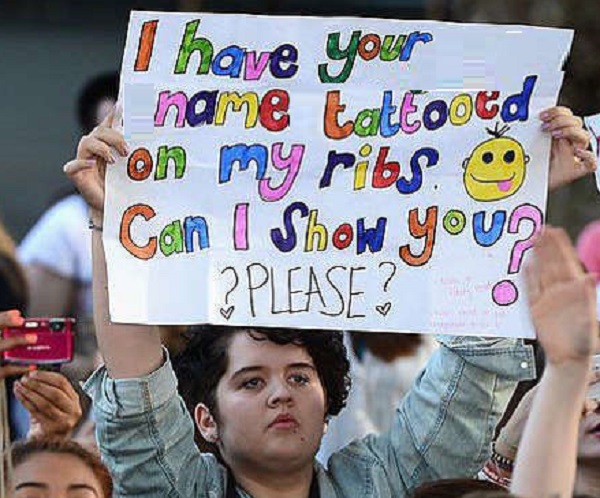
Guest column by AM Golden
[From your host: This scary, poignant guest post sat un-noticed in my in-box for many weeks. I would have posted it immediately if I hadn’t missed it. Regular commenter AM Golden paints a vivid picture of how celebrity worship, then pursuit, can lead down dark alleys and perhaps to tragedy. At the end of this cautionary tale, AM writes, “Joe can obviously handle this situation himself.” I’m not sure it’s so obvious. Rebecca Shaeffer couldn’t handle it. Jody Foster didn’t handle it sufficiently wee to prevent her fan from nearly killing Ronald Reagan. John Lennon couldn’t handle it. Among AM’s provocative questions at the end of this case study is what ethical obligations an observer has to try to persuade someone in the throes of a dangerous obsession to change course, back off, or seek help. My reflex instinct is to say there is such an obligation, as there always is when one is in a unique position to prevent harm and fix a serious problem. That is a far easier position to defend in the abstract than in reality.–JM]
About 18 months ago, I made a comment about the importance of one’s Good Name – one’s reputation – that was honored with a Comment of the Day. Among the stories related in that comment was the recent crushing experience of a fan I called Diane, who had a less-than stellar encounter with her favorite actor whom I dubbed “Joe Darling”.
It seems that Diane had been sending Joe emails through the public contact option on his website. Many emails. She had also been sending gifts to his private residence: All unsolicited; all unanswered. This had gone on for three years before she met him at a pop culture convention. Her thinking seems to have been that he would have told her if he wanted her to stop. She’d also ordered a Cameo from him that had gone unfulfilled. I’d admitted back then that I had gotten vibes from her social media comments that she was a little fixated on Joe, who by all accounts a happily married man. It had never occurred to me that she had been contacting him directly.
When she went to his table at the convention, he figured out who she was. He told her that he considered her behavior borderline stalking and that it needed to stop or he would take further action. Mortified, she apologized and assured him she would leave him alone. She admitted online that she feels like she ruins everything.
Admittedly, I felt sorry for her. No fan likes these kinds of stories. They reflect poorly on all of us. I also felt that she had probably overlooked warning signs along the way that would have spared her such embarrassment. Could there have been a misunderstanding? Curious, I looked over her public social media page. Sure enough, there was enough evidence there to indict her as an obsessed fan and a particularly obtuse one. Her behavior since then has not changed my opinion.
“Diane” insists that her messages were not love letters, but I’ve noticed that her comments about Joe are never about his talent, aspects of his performances, interpretations of his characters or even his charitable work. She seems little interested in clips or videos of most of his work…unless it features his body (think shirtless scenes, et al.). She admitted to sending him a photoshopped picture of her head on the body of an actress from a scene in which Joe’s character is nearly nude. She admitted to sending it “a few times.” She claims to have asked him personal questions or questions about his family. The one time she got a reaction or comment from him on his social media was in response to a slightly inappropriate cartoon she posted. She thought his reaction was funny; I’m not convinced it was meant that way.
When Joe cut back on his posting on social media at the end of the pandemic (clearly, he was back to work), she fretted that he might be sick. So, she reached out to the fan community asking if anyone knew him personally. In fact, Diane seems to have accumulated herself a nice little collection of people who know him or can give her information about him. Not co-stars, mind you, who are probably a little too savvy to pass on such data, but industry people here and there, interviewers, other fans. Sadly, she has been successful at getting little bits and pieces of information this way.
Prior to her experience with him, other fans appear to have warned her to leave the actor alone. Instead, she rationalized her behavior. She argued that her health issues made it hard to travel so she could only communicate with him this way. Until, of course, the day he made an appearance in her city. that is. Oh, and the Cameo request? She told him she’d love to get to know him better and invited him to have a drink with her when he got into town.
Egad. What was she thinking?
Never mind. It doesn’t matter what she was thinking. It doesn’t even matter if she didn’t mean it the way it sounded. It only matters what he thought she meant. According to her, he told her it had been the final straw.
Diane did stop sending him emails and gifts to his home; she seems to be under the impression that the gifts were all that upset him. After pausing for a couple of months, she began commenting on his social media again, though he never responded. On her own page, she now laments the misunderstanding, expressing how awful it is that other fans have made him paranoid. How sad it is that he is the only one out of the many celebrities she’s contacted since childhood who reacted this way (I wonder how many sexually-suggestive photoshopped pictures she sent as a kid?). How she wishes that someone out there who knows both of them would tell him she’s not dangerous. In fact, she wishes that a lot. It’s almost as if she’s really hoping that one of her contacts will volunteer to speak to him on her behalf. Last year, he came back to her neck of the woods for another convention. She bought a ticket. She pre-bought a photo with him. A week before the show, she received an email from the convention that her photo with Joe Darling was cancelled, and she was sent a refund. She was told that she could still attend the show on the condition that she not attend any appearances by Joe Darling. She could not watch any Q&A sessions, any photos or any events at which he was scheduled and she could not approach his autograph table. Clearly, Joe put her name on a list of fans he wanted to avoid and provided it to the convention. This is fairly common with celebrities who have problem fans, Diane was told.
Diane couldn’t understand why she wasn’t even allowed to attend a Q&A panel as long as she didn’t ask a question. She was urged by fans to find something else to do because there were many other guests and plenty of activities to keep her busy. She was told to follow the instructions she had been sent.
Instead, she went to the show and tried to convince one of the event coordinators to let her attend the panel. Unfortunately, the resulting argument caused confusion. The event coordinator led her to believe he had a personal grudge against her because of online comments she’d made about the show’s prices. Perhaps he does have a grudge against her. Perhaps he just pretended to be the bad guy instead of telling her Joe wants nothing to do with her. Perhaps it’s a combination of both. I have no doubt the guidelines for her were made at Joe’s request.
So, Diane, feeling now that it was the Convention itself that had it in for her and not Joe, decided to go to his table and drop off yet another gift. Fortunately, he was not there yet, so she gave it to the staff member manning the table.
Refusing to listen to others, including me, she has reached out to a business owned by one of Joe’s relatives to ask if the rules put in place at the convention were at his request or the event coordinator’s. When someone interviews him, does charitable work or other appearances with him, she contacts that person for information. Recently he did a live chat interview on his birthday. She registered for the chat and wished him “Happy Birthday” three times. Apparently, the interviewer read someone’s else’s birthday wishes and not hers.
She got on the interviewer’s social media under the guise of giving feedback about the interview, included a couple of points about other parts of the chat and casually mentioned that her own birthday wishes hadn’t been acknowledged. And she made sure to also post the Birthday meme she made for him and had already posted twice on his social media with no acknowledgement.
A few months ago, she sent him a letter via the studio asking Joe to forgive her.The sad part is that, at some point, angry at a fan for confronting her about her behavior, she went searching online for information about stalking behavior, and realized what some of the sources described was what she had been doing. But she hasn’t changed anything. So here we are.
Question #1: Is it reasonable for someone who considers a person to be a borderline stalker to want to have anything to do with that person again? Why does Diane not realize that he does not want to interact with her?
Question #2: Is it reasonable for someone who has been called a borderline stalker by someone to think that a relationship with that person is still possible?
Question #3: Should it matter that Joe Darling is an actor? Would it be more serious or less serious if he were a fireman, a successful businessman, a wonderfully talented carpenter?
Question #4: Should it matter that he is male and she is female?
Question #5: Should his marital status make a difference? Would it be more acceptable if he were single?
Question #6: If it were you who had exhausted all attempts to clarify the situation for Diane, would you consider it your ethical duty to confront her or would it be acceptable to just pop some popcorn for the inevitable smackdown?
Question #7: Would you try to warn some of the people she’s contacted, such as the interviewer, to let them know that her feedback was not left in good faith and to be careful not to let her use them to get information about him or send messages to him?
Joe can obviously handle this situation himself so I’m not concerned with reaching out to him. I don’t want him thinking his fans are nuts. I don’t want him and his family to be hassled, especially since Diane seems intent on finding ways to circumvent his instructions to her.
I don’t even know this person! By their nature, internet associations aren’t the same as in-person contacts. Yet, you can come to feel compassion for those you’ve never met as I have come to value some of you here and feel for you when have struggles. With Diane, it’s like watching someone jump into a car, pull down the shade, put on dark glasses and drive at top speed toward a cliff edge.
 Ethics Alarms
Thanks again, but, wow!, I’m cringing at the wordiness, the grammar and the occasional missing word. I usually try to be better than that.
Diane has a disability that makes travel to any show outside her area difficult so the only time she’s likely to see Joe is if he makes a public appearance at a convention in her city. After her antics last year, the convention may well ban her from attending. Frankly, I’m surprised Joe hasn’t arranged a Do Not Contact order.
My fault: I did some light editing, but I was constantly interrupted. Send me your fixes and I’ll add them.
I’ve resubmitted with corrections for the most egregious errors. It was definitely not you. I checked the original submission and it was my own sloppy typing at fault.
Fixed!
Yoikes, and the main reason I hide my…um…celebrity under a bushel…
PWS
I’m interested in knowing what the commentariat thinks of the questions I posed at the end, particularly those dealing with Joe’s status as an actor and the fact that Diane is a female crushing on a male instead of vice-versa.
In Jack’s introduction, he mentioned Rebecca Schaeffer, Jodie Foster and John Lennon. All of them were menaced by male fans. Very little publicity is given to crazed female fans (I think the woman who kept claiming to be David Letterman’s wife or the fan club president who murdered Selena would be notable exceptions). Furthermore, society seems to give a pass to women with crushes on unavailable men, but condemns men lusting after unavailable women.
I remember an article from decades ago discussing this double standard by pointing out that people thought Rosie O’Donnell openly lusting after Tom Cruise was cute instead of creepy. The author pondered whether it’s just because we don’t treat females the same way or because Rosie’s…well…chubbiness and other atypical Hollywood features caused us to take her crush less seriously because she was clearly not a threat to Cruise’s then-wife Nicole Kidman.
I’d also like to read your thoughts on why it seems to be more acceptable to treat celebrities this way. A talented married man in the community at large would not be faulted for curtailing a woman’s interest in him early on; whereas, a celebrity might be cautioned not to interact at all with fans that exhibit red flags since some people thrive on even negative attention and, of course, because the internet gives an offended person the opportunity to spread a one-sided version of the conversation that makes the celebrity look bad.
What is it about the celebrity culture in the United States that the public consciousness believes it’s acceptable to treat famous people in a way that they would never tolerate being treated themselves and fault the celebrities for responding negatively. After all, we seem to think that being hassled by fans is part and parcel of the job and that people shouldn’t go into performing if they don’t accept it.
Historical note: the only example I know of where a crazed female fan shot the object of her obsession was a famous baseball incident.
“On June 14, 1949, former Chicago Cub Eddie Waitkus was shot at the Edgewater Beach Hotel by 19-year-old Ruth Ann Steinhagen in what is thought to be one of the first recognized cases of criminal stalking in the United States….in 1946, the first baseman was a popular player with the media and a solid hitter, with a .304 average. It was that season when then 16-year-old Steinhagen saw him play and became obsessed. She frequently attended Cubs games, and her mother later said he was all she talked about. Waitkus was traded to the Philadelphia Phillies after the 1948 season, which did not quell Steinhagen’s fixation. She later told the felony court, “I kept thinking I will never get him and if I can’t have him nobody else can.” When the Phillies came to town to play the Cubs in June 1949, Steinhagen booked a room for three days in the Edgewater Beach Hotel, where Waitkus and the Phillies were staying. She attended the afternoon game on June 14, in which the Phillies beat the Cubs 9–2 and Waitkus got a hit. Later that night, Steinhagen gave the bellhop $5 and asked him to give Waitkus a note asking to speak with her on “something of importance.”When he got to her room, she reportedly said, “For two years you’ve been bothering me and now you’re going to die” and shot him with a .22-caliber rifle. She missed his heart but did hit his lung. She called the desk to report the shooting herself, and Waitkus was taken to the hospital.”
You may recognize this fact pattern from “The Natural,” which used the story in its plot.
Waitkus did not press charges against Steinhagen, but a criminal court judge ordered her committed to Kankakee State Hospital, where she stayed for nearly three years. Further charges were not brought against her.
I’ve never seen “The Natural”. I did, however, recently watch Redford in “The Candidate” which is a great film to use for ethics discussions.
Never seen “The Natural”??? Oh fie, FIE.
Redford, to his credit, has always gravitated to ethics movies, especially as a director.”The Candidate” holds up very weel after all these years.
AM,
My wife and I have debating this one, and we don’t have the clearest of answers. I’m going to start by telling a story on myself.
When I was finishing my fourth year of college (I changed majors from Computer Science to Math Ed to Math, which necessitated a fifth year to get my bachelor’s degree), I was a depressed, nerdy young man who had only had a girlfriend for a couple of weeks years before, and who was still trying to figure out the dating scene. I dropped by the Newman Center on a whim towards the end of the school year (I had fallen away from my Catholic faith during college, so had not been attending Mass except for random, sporadic moments) and I was surprised to see a female acquaintance there with whom I had gone through all of public school, though we had never been friends. In fact, for a few years, she was in the periphery of people who spread hurtful rumors about me. But we sat together and made pleasant conversation before and after Mass, and I thought it might be possible to pursue this a little further.
Since this was close to the end of the semester, and she was graduating and would be leaving Laramie, I felt there was little time to see if a relationship could spark. (This should have been hint #1.) I found her phone number in the university directory (looking up a number instead of asking for it and being given it should have been hint #2) and gave her a call. No answer. I left a message. After a few hours of waiting, I called again, in case she had been out. Still no answer. I left another message. (This should have been hint #3.) Over the next couple of days, I called probably a dozen times and left a few more messages. Still no answer, and still no call back. I decided to reach out to one of her friends to find out what was going on. No answer, there either (hint #4), and no call back. Finally, after a week of this, she did finally answer the phone. And when she did, she told me to shut up a listen, that what I was doing was freaking her out, and to never, ever talk to her again. So, on glaring hint #5, I got the message, and I left her alone.
Sometimes people need big glaring hints to finally get the message. I tell this story because it still haunts me a little bit even today, that I distressed this girl out so much in so little time. But I did get the message, finally, and I altered course. If someone shows he can do this, he can be reasoned with and convinced to surrender his obsession. Some people, though, cannot. For whatever reason, the obsession is so strong there is simply no safe way to move forward without keeping the object of the obsession far away. It seems to me that this Diane is in the latter category.
I could be wrong in this analysis. She has obviously rationalized all the events going on as coming from factors around Joe, but not Joe himself. So her obsession might still be fueled on the hope that if she could just reach him (and maybe even be alone with him for a time) he’d see her for who she is and allow her into his inner circle. Maybe the rebuff needs to be strong, and directly and unequivocally from Joe. Maybe that would finally hit her hard enough to shake her out of this obsession. But given the duration this has been going on, the number of times she has been given fairly direct messages to drop her obsession, and the way she practiced deceit to get what she wanted strikes me as someone who will not listen, and will keep at this until forcibly prevented.
So, let me turn to your questions. If Joe thinks Diane is a stalker, why would Diane want to have anything to do with him? I think the answer to this is what I said above, that Diane thinks that all of Joe’s rebuffs are not actually coming from him. Either they came from second parties, or those second parties were forcing Joe to rebuff her. Or Diane thinks those second parties are poisoning Joe’s perception of her, and thus her need to get close and explain herself. In other words, Diane does not believe that Joe actually thinks she is a stalker.
Question 2: Is it reasonable for Diane to think she could have a relationship with Joe? I would answer firmly and unequivocally in the negative. There are many factors that would make it unreasonable even without the stalker context, and the stalker context just makes it absurdly unreasonable. This is why I think Diane is not going to catch any hint at all, and will continue stalking until forcibly detained.
Question 3: It doesn’t really matter that Joe is an actor. The reason that actors and other celebrities get a certain amount of stalkers after them is because they are in the public eye and are exposed to far more people, typically in a very positive way. People want what they know, are familiar with (or think they are familiar with), and people often think they know a public figure like an actor, especially since so much is written about them, they seem to have a known personality (instead of hiding it behind drug-fortified smiles), and often interact with adoring fans at events. I would hazard that firefighters get occasional stalkers. I believe that random Joe on the street might have dealt with a stalker sometime in his life. But these are less frequent that those that have the limelight just from the standpoint of exposure. What is really important is that public figures like actors are at higher risk, and should take extra precautions to guard against stalkers.
Question 4: I don’t think it should matter whether a man stalks a woman or a woman stalks a man. Both create uncomfortable, even dangerous situations. I would probably agree that men would create far more violent and sexually aggressive situations, but I could believe that an obsessed woman could abduct the target of her obsession, imprison him in a remote location, cut off his foot to keep him from escaping, and torment him until he writes a satisfying sequel to his previous novel. I think we hear about women stalking men far less because men don’t like to admit to harassment from the weaker sex. But either way, stalking should be discourage, and women should not get a “ah, that’s so cute” pass.
Question 5: The fact that Joe is married is one of the biggest red flags in all of this. I know our culture has devolved to the point that we practically expect marriages to fall apart, or spouses to be unfaithful, but to obsess over a married man is bad. He is already unavailable. Seeking a relationship with him means Diane already has discounted his wife and family, which means her focus is so inward focused that she can’t see daylight. It would be slightly more excusable if Joe were single, because theoretically that means he’s available. Aside from all the stalking issues, that is.
Question 6: What is the duty to confront in this situation? Given that your familiarity with Diane is exclusively online, and that you and others have repeatedly warned her, I think your duty to confront Diane is about exhausted. Without regular, face-to-face interaction, your relationship is still a distant one, which limits your influence. You can speak out more forcibly, and that might risk you being unfriended, at which point you have no further influence. But I have a strong feeling that no matter what you say, Diane will not listen. She will have every excuse at hand to explain why your concerns are wrong.
Question 7: That being said, if you feel there is a larger risk than just embarrassment and being banned from future conventions, I would warn Diane that if she does not cease and desist you will try to warn Joe Darling, or his handlers, to make sure she stays away. But I would hazard a guess that Joe’s handlers might look at such a warning in askance. I don’t know what quantity of messages they receive, but I think such public figures receive a gamut that runs from adoring fan mail to death threats to fantastical warnings. Thus I would recommend against reaching out to Joe or his handlers unless you strongly suspect Diane will engage in something dangerous.
Question from comments: Why does our culture believe it is acceptable to treat celebrities so poorly? I think that is because celebrities put themselves out for public consumption. Their professional role is to convince their fans they have a connection with them in some fashion. For actors, that connection is with the personas in the movies or plays. Couple that with our culture which is increasingly starved for meaningful connection, and we have an environment where people are craving connection, and there are people whose roles portray a connection. (I don’t know how much attention-seeking actors actually engage in, but that might be part of it, too.) And then there is a great deal of money to be made by fueling that desire for consumption by revealing every sordid private detail possible. That then breeds more familiarity, or the perception of familiarity, which then makes all these fans feel they have a true connection with their idols. So to sum up, celebrities put themselves out as a commodity, they are marketed as a commodity, they are consumed as a commodity, because there is a true desire underneath that is being fed and fueled by treating celebrities as commodities.
Ryan, thank you for your comment. I think you are right on the money on much of what you wrote. The hope of success is a strong motivator that drives people even if there’s the possibility of severe negative consequences if they fail. It’s what motivates child molesters to continue to reach out to children on the internet because the desire to be successful outweighs the risk they surely know they’re taking.
I wonder if Diane is willing to risk a restraining order if it means there’s the slight possibility Joe might become her friend despite everything that’s happened.
Your comments about how actors put themselves out there for public consumption is true of many performers. I would suggest, though, that not every actor or actress wants to be commoditized. Tabloids regularly release juicy details that violate the privacy of unwilling subjects. I think there’s a difference between an actor who is a publicity hound and the many other actors who just do their jobs, take their paychecks and go home to their wives and kids.
How much of our perspective on actors and why they get into their professions is predicated on our own misconceptions?
As for Diane, I must consider her to be not an entirely-reliable narrator; however, she did state that Joe told her in person that he considered her a borderline stalker so it would appear that he was direct with her. His tone and volume is unknown (so I cannot gauge the firmness of his message), but a threat to take further action should not be interpreted by any rational person as anything but a serious command from him, and not someone else, to Knock It Off.
Of course, this doesn’t appear to be a person behaving rationally. Like in your own personal story, Diane overlooked a number of red flags leading up to her experience. Emotion causes us to make foolish mistakes, especially if there is a deadline involved. It’s why phishing scams that make us think we’re going to lose something important are so profitable.
It sounds like the fan got some benefit from reading stories about other obsessed stalkery fans, so she was able to judge her own behavior from an outside perspective, but that wasn’t enough.
I’m just spitballing here, since I have limited experience with talking people down. I prefer to avoid homunculi, but they do deserve mental help, and I like building the tools that make that sort of help possible.
I use the word “homunculus” to describe someone who has only one, maybe two major motivations (inspired by the cortical homunculus, a distorted caricature of a human that illustrates the distribution of nerves for input or output). A motivation does not have to be an obsession per se; it could be something like a freedom, a role, an addiction, or even an aversion. Having very few motivations means that a person has very few ways to pursue joy, happiness, satisfaction, and/or fulfillment. That’s not a healthy way to exist. If a person has a single path to happiness, then if something threatens that path, the person becomes desperate. As they are currently, they have no other options for a tolerable existence. That’s why it’s important to cultivate diverse interests and passions, as a matter of habit. It’s fine to be more inclined towards some motivations than others, as long as one has plenty of options to seek personal satisfaction and fulfillment.
For an obsessed stalker fan, explaining boundaries at the beginning is likely to lead to interminable arguments litigating those boundaries. Instead, I’d probably start with deconstructing the motivation behind the obsession: the motivation of idealization. What, exactly, does Diane want to happen? What, exactly, does she expect to happen? She will need to realize that a real relationship entails skillfully handling the messy, difficult parts–which are 100% inevitable, curated public images notwithstanding. That means it’s largely pointless to try and connect with the people who have those airbrushed celebrity personas. If the relationship is a bad fit, the public persona won’t help, and if it’s a good fit, the public persona is unnecessary. One might as well just date normally.
(When feasible, it might also help to remove the idol from their pedestal by getting to know them as a person rather than as a shadow. Apparently that worked once for Robert Pattinson. On the other hand, there are multiple reasons why celebrities don’t want to share enough of their personal lives to be seen as ordinary people.)
It seems likely that Diane’s motivations are based on personal insecurity and some troubling formative experiences that warped her internal narrative, convincing her that she cannot be happy unless she has the love and attention of some ideal person. That’s something she may need to unpack with a therapist or some supportive friends. She may need to learn how to have fulfilling relationships with the people around her.
Overall, I think a large part of the problem is that many people don’t know how to truly understand each other, so they only see what they are shown. They can’t look deeper unless they know what to look for, so the surface is what they get attached to. It would help people to understand concepts that describe people’s character: mindsets like empathy, rapport, communication, and observation; ethical attributes like support, dedication, honor, and compassion; and motivations like idealization, celebration, and relaxation. I find having a vocabulary that describes what matters most makes it easier to make healthy decisions and set situations up to get better over time.
This is interesting because you have tapped into some areas that have been laid open to us.
She has been asked what the end goal here is. She apparently wants to be able to communicate with Joe or be his friend, someone she can email back and forth occasionally.
Absolutely, she is prone to litigating arguments. Joe was apparently not cruel or vicious when he confronted her. He signed her autograph and took a photo with her but he may not have specified which specific actions he wanted stopped. In my mind, someone who believes a fan is approaching stalker level wants all contact to stop. Diane appears to have interpreted it only to mean she shouldn’t send so many emails and to stop sending items to his home.
“It seems likely that Diane’s motivations are based on personal insecurity and some troubling formative experiences that warped her internal narrative, convincing her that she cannot be happy unless she has the love and attention of some ideal person. That’s something she may need to unpack with a therapist or some supportive friends. She may need to learn how to have fulfilling relationships with the people around her.”
From what she’s written, there have been some dysfunctional issues in her early life, she does have a mental health professional involved and she does have problems with in-person relationships.
How would something like autism be a feature in a situation like this? When I was young, autism was largely unheard of – notwithstanding “Rain Man” – until the ’90s when, like ADD and ADHD, there wasn’t a big consensus that these were legitimate issues people were experiencing (as opposed to poor parenting). Even now, autism understanding is largely confined to children and not necessarily to an adult population that grew up in a time in which they were just considered weird.
I don’t want to present autism as an excuse because it is very easy to rationalize away bad behavior on the part of someone with minor autism or high-functioning autism as that being “just the way they are”. It is true, however, that those who are autistic tend to have a hard time reading social cues (for example: If you are emailing someone who never responds, you should stop emailing that person), get fixated or become experts at certain subjects, have an easier time relating to characters on television or in video games, as well as finding isolating hobbies that don’t require them to interact with people in person. Some of these characteristics could describe Diane though I am not an expert.
Those details do provide additional clarity on the situation.
I can understand why someone would expect to be allowed to simply dial back their activities to normal fan levels, if it’s an innocent mistake based on social ignorance.
That said, part of the reason people don’t trust a fan to do that is that the fan probably doesn’t have a solid grasp of the boundaries around parasocial relationships like fandom. They may try to pin down those boundaries as semantic rules and then proceed to find loopholes, instead of understanding the principles that define those boundaries in spirit. In situations like these, what is important is not what a person literally does, but how they make other people feel, and a fan has to accept that they cannot control or calculate other people’s feelings to always get the outcome they want.
Regarding Diane’s end goal: Alright, apparently she wants Joe as a pen pal. Is that it? If we can establish that’s the extent of Diane’s goal, then that’s a good start for figuring out how she can find fulfillment.
To be clear, it’s still more than can be demanded of Joe, though. I tried to find a quote I’ve seen from some internet celebrity who stated candidly that he literally couldn’t love his fans as individuals, because the human brain biologically cannot maintain personal feelings for, or relationships with, thousands of separate people. (I believe that the vast majority of his fans appreciated his candor.) Joe still has no obligation here.
(Disclaimer: I am not a psychologist.) My impression of autism is that it isn’t just one spectrum, but a cluster of various features and functions of a mind and personality. Autism can present with an affinity for mindsets like analysis and semantics. It can present as issues with applying empathy mindset. It can present as issues with applying observation mindset, or with turning it off, the latter of which I suspect is a major factor in people being nonverbal. (People make a lot of confident assumptions in order to compose sentences and vocalize them in real time, and observation mindset is about suspending assumptions.) It can present as high responsiveness to motivations like idealization, control, or insulation. It can present as a tendency towards high intensity attribute and low adaptability attribute.
The general theme of autism is certainty, order. Many people who prefer to develop extremely detailed and high-quality mental models for navigating complex but predictable situations will experience discomfort and anxiety in situations that deviate from the models they’ve built, or in situations which they don’t know how to model in the first place.
Having written that, I now realize that Joe seems like an ideal candidate for a friend not just because he has many fans (and therefore anyone they pay attention to has a reason to feel more special and higher status than all the other people competing for their attention). A celebrity might seem like an ideal friend candidate–and not just for autistic people–because they come with documentation. Their background, history, personality, likes and dislikes, are all (seemingly) available for research, which tricks people into thinking they can bypass the social awkwardness of getting to know someone.
I’m now remembering an Andy Griffith Show episode where a guy nobody recognized showed up in Mayberry, claiming it as his hometown and trying to fit in by demonstrating he knew personal details of the residents. He had effectively stalked an entire town, just by borrowing the local newspaper that his friend (who really was from Mayberry) was receiving by mail. (He realized what he’d done once Andy explained it to him, and he got a second chance after Andy gave a not-entirely-warranted speech shaming the people who were freaked out–they thought the guy was either a spy or something from the Twilight Zone.)
Of course, the problems with research as a substitute for acquaintance are 1) a lot of what matters about a person doesn’t show up in their interviews, even if they aren’t curated and airbrushed, and 2) that person still has no knowledge of a random fan, no reason to trust them, and no reason to want to spend time learning and developing that relationship. Even if a fan wrote an autobiography, it would take time to read and it itself would be curated information, not to be taken at face value. People’s time and attention is limited.
The question that a fan should be asking themselves is, “Can I contribute something to this person’s life that the person actually values?” with the understanding that they don’t get to decide what someone else values. We only offer. Other people get to choose.
Maybe people need a more realistic sense of what actual friendship entails. A basic functional understanding of empathy mindset would help a great many people. When I teach empathy mindset, one of the first important skills I emphasize is apologizing and stepping back, and recognizing when to do that. It’s like learning how to fall safely.
Does that all make sense?
“normal fan levels“
Those would be…?
PWS
Given that “fan” derives from “fanatic”, it’s a valid question. I’d say for this purpose “normal fan levels” would be the ones that demonstrate respect for boundaries and don’t cause concern to the subjects of the fandom. People can incorporate the works of celebrities in their own lives, but they can’t demand additional participation from the celebrities themselves. Does that make sense?
It does and I appreciate the thought you have put into your comments.
The best most celebrities can give their fans is a few minutes of their time, an autograph, a photo with the fan and, perhaps, the occasional social media interaction. Most celebrities do not become friends with their fans unless, in a rare situation, they find that they have something in common. Like you wrote, does the celebrity value the contribution this particular fan can make to his or her life?
From what I can tell, she and Joe have virtually nothing in common and are polar opposites in many significant personal beliefs (politics, activism, etc). It is, therefore, highly unlikely that she is able to make such a connection with him. In this case, Diane would like to be an internet pen pal and be allowed to see Joe at his autograph table, et al, at local conventions. In and of itself, that doesn’t seem to be too bad of a goal, but there is just too much water under the bridge for that to be realistic.
You’re right about feeling as if we know these folks when we really don’t. Pulling back the curtain can sometimes be a surprise or even a disappointment as our host has written about what he learned about Danny Kaye. I’m a big fan of Joe’s. I’ve met him at conventions 9 times over the course of 34 years. He’s reasonably friendly and will take time to speak to fans and answer their questions. I don’t email him, it would never occur to me to write to him or send something to his home and I don’t pester him on social media. He doesn’t know me from Adam and that’s fine with me. There are worse things than not being recognized as we have learned here.
Another question might be the difference between an obsessed fan and a…um…disgruntled one; to wit:
Astros Pitcher Lance McCullers Gets 24-hour Security After Online Death Threats
PWS
Sometimes they can be one and the same. An obsessed fan can become disgruntled and a disgruntled fan can become obsessed.
So much to discuss here. The highly motivated reader of the bookish variety will enjoy some supplementary reading.
IMHO, the first thing to read is Gavin de Becker’s _The gift of fear_, which originally came out in 1997, so it’s almost 30 years old.
Gavin de Becker writes divinely–his book is clear and probably will hold your interest. He actually started a business providing security for people (mostly famous entertainers) who attract stalkers and various potentially dangerous admirers. He has other similar books, but _The gift of fear_ is probably the best book to start with.
One thing he discusses is the problem of “engage and enrage.” You would think that engaging with somebody who behaves inappropriately would help to “steer them in the right direction” and give them a clue that they are behaving inappropriately. In the worst case scenario, the result can be paradoxical and make things worse. Stalkers can escalate and become more aggressive.
Some individuals have a genuine behavioral problem not amenable to self-correction. Engaging with such a person can (and this is documented) simply rile the stalker up and make him or her worse. It can be hard to reason the admirer into different patterns of behavior. The behavior isn’t reasonable.
Often, de Becker suggests, the preferred (and risk averse) strategy is “wait and watch.” Or perhaps it’s “watch and wait.” Keep records, never reply, never engage, never lose patience and never rebuke the stalker in a moment of frustration. That can “hit the reset button” and rekindle interest that may slowly extinguish itself over time. If a stalker never gets any response, sometimes they can eventually lose interest. Or, they develop a new fixation with someone else.
For example, if you have a stalker who fills up your voice mail with messages, get a new number and keep the old one for record keeping. This is more work and more expensive: you have to circulate your new number to those who you wish to communicate with, after getting the new number, and meanwhile monitoring the old number.
Perhaps there is more for me to say. Not sure. Thanks for reading.
charles w abbott
rochester NY
I thought of one additional noteworthy point.
Gavin de Becker suggests that “No Contact Orders” can escalate the anger of abusive boyfriends, ex-boyfriends, and stalkers. “No Contact Orders” can precipitate violence. There is no shortage of documented cases in which they seem to have had that effect.
That is not to say that “No Contact Orders” should never be used. It is rather to observe that they are not a panacea and will not protect a vulnerable target from an admirer already fixated and now newly enraged from having been informed of the order.
For examples, read the book. Sorry to be argumentative. Your mileage may vary.
Charles, thank you for this. I have read “The Gift of Fear”. In fact, I used it to try to help Diane understand that Joe didn’t respond to her because “he who is silent is understood to consent”, but because he didn’t want to encourage more contact should she be inspired by even negative attention and because he didn’t want to risk her spreading his rebuke across the internet context free.