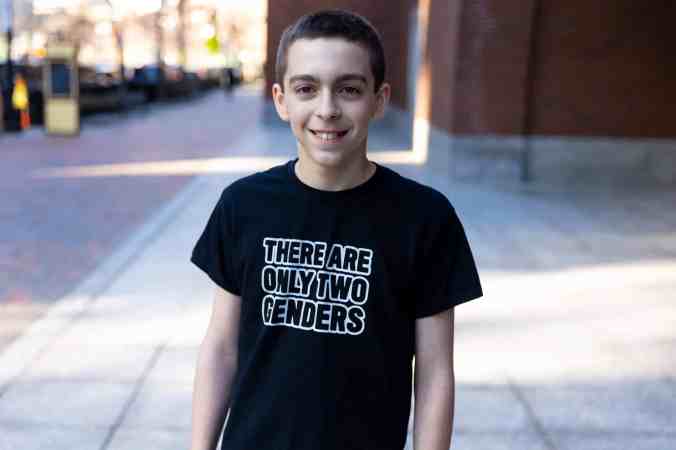
Almost a year ago, Ethics Alarms discussed the case of Liam Morrison (above), a seventh grader who was told that his “There are only two genders” T-shirt was inappropriate as school attire. A three-judge panel of the U.S. Court of Appeals for the 1st Circuit upheld a District Court decision from 2023 that the Nichols Middle School in Middleborough, Massachusetts didn’t violate Liam’s First Amendment rights by telling him to change his shirt.
Chief Justice David Barron, writing for the Court, concluded that “the question here is not whether the t-shirts should have been barred. The question is who should decide whether to bar them – educators or federal judges.” He continued, “We cannot say that in this instance the Constitution assigns the sensitive (and potentially consequential) judgment about what would make ‘an environment conducive to learning’ at NMS to use rather than to the educators closest to the scene.”
I wrote, in a post agreeing with the decision both ethically and legally,
“An environment conducive to learning is at the heart of a long line of cases stemming from Tinker v. Des Moines Independent Community School District, a 1968 Warren Court ruling holding that for a school to prohibit wearing black armbands in protest of the Vietnam war violated the students’ freedom of speech protections guaranteed by the First Amendment. The same opinion, however, held that those rights were not absolute, and that speech that “materially and substantially interfere[s]” with the operation of a school could be prohibited. Subsequent decisions have held school speech to be either protected or not based on the facts of the case.
“The facts in Middleborough case indicated to the judges that the T-shirt’s message was a direct attack upon or rebuke of a particular group of students, “transgender and gender-nonconforming” and could be fairly be seen as demeaning to a “protected class.” Legally, I could see this case being added to the endless number of gradually thinner slices of this question post-Tinker and end up before the Supreme Court. Ethically, I think the right decision is clear, and that the school made it.
“There is no benefit to the public school environment by allowing students to carry messages with them that other students reasonably could believe are hostile, and much that is potentially harmful. It doesn’t matter if the message is factual, indeed beyond dispute; the question is whether a message will create an environment that some students will feel is hostile to their comfort level and ability to learn. Should the children of fundamentalist Christians have to face T-shirts reading “Evolution is Real” or “Scopes Was Right!” ? Should children of German heritage be confronted in their classes with T-Shirts reading, “Germans murdered 6 million Jews”? Why? Factual or not, these messages are just in-your-face efforts to start arguments. Both as a matter of the school’s efficient functioning and as basic education—It’s not wise to set out to deliberately upset others!—the school was right to ban Liam’s shirt.”
I stand by that analysis. Now, the same conservative pundits who erupted in fury over the lower court rulings in Liam’s case are attacking the U.S. Supreme Court for letting them stand. SCOTUS was offered the chance to consider the case, and declined. The decision stands. Good.
Here’s the lament of “Victory Girls”:
A middle school kid gets kicked out of class for wearing a shirt that says “There are only two genders,” and the Court just shrugs. No hearing. No ruling. Just a quiet “not our problem.”
And maybe we shouldn’t be surprised. We got a pretty big clue during Ketanji Brown Jackson’s confirmation hearings, when she said she couldn’t define what a woman is because she’s “not a biologist.” That wasn’t humility. That was the moment the Court bent to the narrative.
Meanwhile, schools are free to plaster classrooms with Pride flags, host “gender expression” days, and push every progressive talking point under the sun. But a T-shirt with a basic biological fact? That’s crossing the line…So here we are: “There are only two genders” is now a dangerous idea in an American school. Not pornography. Not political sloganeering. Just…reality…
Wrong. The Court isn’t “bending to the narrative,” it is bending to the law, which their predecessors articulated. Just because a statement is factual doesn’t make it appropriate for a student to wear as a billboard in class. The issue isn’t facts or truth; the issue is whether a message is potentially disruptive, and thus could interfere with education. It doesn’t take much imagination to come up with other “facts” that would be similarly disruptive if broadcast on a student’s school attire.
I’ll add to the example I used last year. I’d put “Black Lives Matter” in that category. How about “There is no proof that God exists”? Conservatives want facts? Is a “President Trump is a convicted felon” T acceptable in school? Should a school permit a student to wear a “George Floyd was a drug-addicted lifetime criminal” shirt? Or “Blacks commit about half of U.S. murders despite being less than a quarter of the population”? I think “Kamala Harris was a DEI hire” is 100% factual, but it is also intentionally provocative, just like “There are only two genders.”
The Supreme Court wasn’t being political or cowardly by refusing to review the lower court rulings that Liam couldn’t wear that shirt in school. It was being non-partisan, consistent and responsible.
 Ethics Alarms
Interesting, and something of a slap in the face to all the “SCOTUS is in the hip pocket of Trump/Conservatives” crowd.
I still hold to my original thoughts from last June’s piece. In summary, 1) the t-shirt’s slogan wasn’t all that provocative, 2) schools (and parents especially) should teach children that 2a) different ideas – even those with which we disagree – are fine and worthy of discussion, 2b) t-shirts are clothing and those bearing slogans can be ignored, and 3) in these situations, it’s generally the conservative ideas that end up silenced while liberal ideas are allowed free run of the place, whether it’s on a t-shirt or in the classroom itself.
SCOTUS may have ruled correctly, but in the process the left-wing education system is allowed to further teach students that the right response to disagreeable speech is to cancel and silence it. Liam should start wearing pro-Gay, pro-Lesbian, pro-Trans, and pro-Hamas t-shirts to class. He better get the same response from the educators there.
And my conclusion regarding most public schools matches what John wrote in Revelation when writing about the whorish, corrupt Babylonian religious system…”get out of there!”
This. All day, every day, and twice on Sunday.
Jack typically notes that if they’re going to allow some attire, they pretty much need to allow all, or allow none. I can go with “none”, but this is one sided viewpoint discrimination; you’d be hard pressed to tell me that there weren’t kids wearing black lives matter shirts, to use Jack’s example, within that school; there were multiple stories of BLM supporters disrupting diners and other citizens with bullhorns demanding that they announce their support of BLM, as well as calling “All Lives Matter” orators racists trying to downplay their struggle. So a BLM shirt can be considered as targeting as two genders if we want to apply context.
Further, Alito wrote, “If a school sees fit to instruct students of a certain age on a social issue like LGBTQ+ rights or gender identity, then the school must tolerate dissenting student speech on those issues,” Alito said. “If anything, viewpoint discrimination in the lower grades is more objectionable because young children are more impressionable and thus more susceptible to indoctrination.”
I would’ve stopped at the first sentence, though the second is certainly a valid concern, but you can about guarantee that middleschool had all the pornographic books that alphabet mafia demands be included in a middleschool curriculum.
Finally, “School administrators… invoked a provision of the student dress code that barred “hate speech or imagery that target[s] groups based on race, ethnicity, gender, sexual orientation, gender identity, religious affiliation, or any other classification.”
What defines hate speech? Did the school give examples? The left defines anything they don’t like as hate speech, which certainly appears to be the case here.
I don’t advocate “all or nothing,” but the Court seems to think a school is the best authority to decide whether a particular message is “disrupting.” SCOTUS refused to review a California decision allowing a school to make a kid take off a T with the U.S. Flag on it. I believe that if one is in a US school, by definition the flag, a section of the Constitution, Bill of Rights or the Declaration, or a quote from a valid law, should be treated as educational, not contentious or controversial.
All or nothing only in context of what’s good for the goose; you typically exhibit a sense of equity.
I believe you’ve stated in the past if there is going to be a policy, then it allows for competing ideas. If it can’t accommodate that, then the policy should not allow for messaging on shirts by anyone.
My problem here is the school sets the ideas in motion, and creates a policy around “hate speech”, so that they alone are the arbiters of what defines hate speech.
Sorry, that shirt may be provactive to an activist, but it’s begin to the general population.
It’s a bullshit policy that let’s the school go unchallenged in their indoctrination efforts.
I’m thinking Joel Mundt and Bad Bob are on the right track here.
Jack, the Supreme Court is enabling local school administrators to say that some messages are disruptive while others are not. Why are some messages disruptive? Because the intolerant have a hissy fit and act out and go into conniptions when they see messages that intolerant people have decided are provocative.
Why do the intolerant behave in such a manner? Because they have been shown, repeatedly, that they can get away with it.
Final Point the First: It’s enough to make a free speech absolutist such as myself support mandatory school uniforms in public schools.
Final Point the Second: Periodically, when I see “Black Lives Matter” things displayed prominently (for example, on the side of the Memorial Art Gallery in Rochester NY, a museum owned and operated under the umbrella of the University of Rochester) I think of Theodore Dalrymple’s observation regarding propaganda.
The purpose of propaganda is in part to humiliate.
the link is here:
https://thisiscommonsense.org/2023/04/08/theodore-dalrymple-2-2/
charles w abbott
rochester NY
“Because the intolerant have a hissy fit and act out and go into conniptions when they see messages that intolerant people have decided are provocative.”
Bravo India November Golf Oscar!
PWS
I vote for achool uniforms inorder to avoid disrupting sesnitive souls who dimisnish truth
I think you got this wrong.
Chief Justice David Barron, writing for the Court, concluded that “the question here is not whether the t-shirts should have been barred. The question is who should decide whether to bar them – educators or federal judges.”
That doesn’t make any sense, other than as an example of question begging: assuming as true that which hasn’t been demonstrated. The question is very much whether the 1A allows barring expressions of opinion, especially keeping in mind that the school is far from silent on the issue. If the school itself presents a viewpoint, then it must allow disagreement.
The same opinion, however, held that those rights were not absolute, and that speech that “materially and substantially interfere[s]” with the operation of a school could be prohibited. Subsequent decisions have held school speech to be either protected or not based on the facts of the case.
There was no evidence presented, as far as I know, that showed even the slightest interference with the operation of the school. The school preemptively suppressed speech based on the potential of such a thing happening.
The facts in Middleborough case indicated to the judges that the T-shirt’s message was a direct attack upon or rebuke of a particular group of students, “transgender and gender-nonconforming” and could be fairly be seen as demeaning to a “protected class.”
The facts in the case is that the school was promoting an ideological position, while suppressing disagreement, in this case, in the form of a T-shirt. Hypothetical: discussion in civics class where the teacher declares there are many genders, and that sex is fluid. If this student disagrees, does he get to go to the principal’s office? If not, why not? After all, it isn’t the form his disagreement took, but rather that he expressed it at all.
There is no benefit to the public school environment by allowing students to carry messages with them that other students reasonably could believe are hostile, and much that is potentially harmful. It doesn’t matter if the message is factual, indeed beyond dispute; the question is whether a message will create an environment that some students will feel is hostile to their comfort level and ability to learn.
Yet that is exactly what the school was doing, and to which the student was expressing a dissenting opinion. It provided messages that some students could believe were hostile, and to the extent that they are separated from reality, are harmful. The issue of whether a message will create a hostile environment is a coin with two sides, never mind that it is purely speculative.
I’ll add to the example I used last year. I’d put “Black Lives Matter” …
In the event that a school is presenting that message, does a student get to wear “All Lives Matter”?
Wrong. The Court isn’t “bending to the narrative,” it is bending to the law, which their predecessors articulated.
Then it isn’t law, it is precedent — the Warren court creating law where no black letter law existed. And in so doing, it practically gave schools carte blanche to suppress expression that countering their ideology. If the school wants to stop the student saying there are only two genders, then it needs to get out of the business of claiming otherwise.
… the issue is whether a message is potentially disruptive, and thus could interfere with education. It doesn’t take much imagination to come up with other “facts” that would be similarly disruptive if broadcast on a student’s school attire.
Which is exactly the excuse universities have used to cancel speakers expressing dissenting view points.
It is called “prior restraint”. And it doesn’t wash.
That doesn’t make any sense, other than as an example of question begging: assuming as true that which hasn’t been demonstrated. The question is very much whether the 1A allows barring expressions of opinion, especially keeping in mind that the school is far from silent on the issue. If the school itself presents a viewpoint, then it must allow disagreement.
It makes perfect sense. Schools know their students, the community and the likely source of disruption. It’s not viewpoint discrimination if the position is neutral: no messages that take sides in controversial political or social matters. Yes. “All Lives Matter” would be consider a rebuke to “Black Lives Matter.”
Tinker IS Law, as all SCOTUS rules about First Amendment applications are law.
Universities are set to different standard than public schools, and that is appropriate. Speakers on campus are part of the educational process and experience in colleges and universities. T-shirts are not part of the educational experience in Middle School. College students can wear whatever T-shirts they want at Ivy League colleges with very extreme exceptions.
Jack, you fail to engage several important points: prior restraint, viewpoint neutrality, and suppression of dissenting opinions.
The school engaged in prior restraint by demanding the student remove the shirt before there was any disruption of any kind. Worse, the school was punishing his opinion a priori by invoking the heckler’s veto.
And viewpoint neutrality is plainly in view. The school is firmly on the side of gender fluidity, and expresses that view. Having done so, it rubbishes viewpoint neutrality by prohibiting the student expressing his opinion.
Finally, you fail to address whether this student would be allowed to express a dissenting opinion is a classroom discussion.
Yes. “All Lives Matter” would be consider a rebuke to “Black Lives Matter.”
That is illogical. All lives is a superset that contains within it Black lives; therefore, it cannot possibly be a refutation of the latter.
Prior restraint does not strictly apply to elementary, middle and high school, and Tinker makes that clear. So it is irrelevant to the incident. Viewpoint neutrality is not strictly required either, because the primary goal of these schools is education, including civic education. You can wish it were otherwise, but that is also irrelevant. What matters is the mission, and speech that undermines the mission can be—doesn’t have to be, but can be—forbidden. That’s Tinker and the long line of cases it spawned.
Th “All Lives Matter” argument is old, was tried, and failed, just like “It’s OK to be white.” What matters is perception. If ALM is seen as a rebuke to BLM, then it is potentially disruptive, and, like BLM, should be banned. Similarly, there is nothing wrong with “Make America Great Again” except that it is perceived by many as advocating hostility toward certain groups. “From the river to the sea” has been defended as benign: it doesn’t matter. It’s seen as hostile, ergo it can be (and should be) banned.
i was going to suggest something similar… But along the lines of modifying the .message slightly each time they prohibit the message. Eventually, he shows up wearing a shirt with the numeral 2 on it. At this point everyone knows what has. Een going on and the school now can’t ban the numeral 2, but it has now become a political symbol and any time it is used( including all of its phonemes to, two,too, et tu) the effect drowns the moron administration like or border crisis.
At the risk of being seen as contrarian… I think the SCOTUS got it wrong. This is very much a freedom of religion/ freedom of speech issue.
The statement is factually wrong, yet believed by many. It is not demeaning or harmful in the extreme, though may be hurtful to a minority. Not as bad as a T shirt stating “Kill the Jew” or “Hang the Coons”.
Nowhere near as bad as the bill about to be signed by Abbot in TX which essentially makes it a crime to be intersex or trans. There are real issues, not ones of hurt feelings.
But hurt feelings are enough in a middle school setting, Zoe B. There is literally no benefit to such deliberate provocation, and parents should know better than to let their kids be human bumper-stickers. I won’t point out that there’s no legitimate comparison between a bill and a school keeping kids’ mind on academic subjects rather than politics or social policy, because I know you know that as well as I do.
(And that bill will be struck down.)
Remember what the chair of the Harris County GOP wrote on your very site about intersex people, Jack. That we, unlike others like him, were not human and were only tolerated to a point. That point has apparently been reached in the state of Texas. Being black was never de jure illegal, only de facto.
Although I dislike the heckler’s veto feel of it, I agree that in grade school keeping a neutral learning environment should be a primary duty. This will inevitably entail suppressing some forms of expression. Sadly, I have doubts as to whether this will be done equitably in many districts, or that they’ll actually allow expressing opinions contrary to what is being taught or propagandized in the schools’ lessons touching on sex, gender, race, the civil war, civil rights, etc., etc.
I might have agreed with this seventy five years ago, when the public schools where primarily institutes of learning, and when objectivity and neutrality regarding contentious issues were still valued.
If a school shoves progressive ideas regarding sexuality and politics in the students faces, sending a child home for wearing a T-shirt that indicates that he disagrees with these values looks like viewpoint discrimination, and an appeal by the school to the need for a proper learning environment is like a heckler’s veto.
A T-shirt with the text that there are only two genders is not more provocative than rainbow flags hanging in the classroom. Both simply propagate different view points.
Banning the T-shirt also misses an opportunity of a good civics lesson, namely that in a civil society people should be able to live work together despite their differences, and that tolerance is better than censorship.
I probably wasn’t clear enough in indicating that I doubt some schools will uphold their end of the “bargain” and not continue to include (but deny doing so) leftist agenda and cant in their subject matter and instructions. If I understood the court ruling, schools could ban general advocacy as “disruptive”, but not prohibit student displays of opinion if they were expressions in opposition to something being taught or promoted at the school.
Not so sure a “practical” lesson in civility would be workable in the typical middle school, and not just devolve into a constants battle of slogans, arguments, and kids being used a billboards by their parents.
Wim, I just wanted to post directly to Jack but it ended up below your comment.
Although I dislike the heckler’s veto feel of it, I agree that in grade school keeping a neutral learning environment should be a primary duty.
Then grade schools need to keep a neutral learning environment. If they are going to restrict this student’s opinion, then they must equally restrict their own.
They don’t.
That’s a tit for tat argument. They should, and that’s independent of how the students’ opinions should be treated. Students should only venture opinions and beliefs when they are asked for them in a classroom, teaching environment. Teachers should keep political and social opinions to themselves. Always.
But saying it is independent doesn’t make it so. If one opinion is allowed wide expression and the other isn’t, then the consequence inevitably to discourage that opinion in every setting, including classroom discussions.
If this school rigorously prohibits issue advocacy by its teachers, and by agreeing students, then it is on firm ground to do so with “There are only two genders”.
My bet is that has not been the case, and that there has been very much a cause and effect relationship here.
I agree that it isn’t the case, but again, it’s a separate issue. Two wrongs don’t make a right.
In a middle school environment how does an English teacher teach the difference between singular and plural when they must use a desired pronoun reference that is in direct contradiction to proper usage. It seems to me that this is just as disruptive and confusing to children as any t-shirt.
English speaking people use three genders as described below. There are three sexes as well; male, female, and intersex. The intersex person should have the option of which side of the line upon which he or she decides to fall.
gender /jĕn′dər/noun
The American Heritage® Dictionary of the English Language, 5th Edition •
The new definition of gender speaks of socially constructed roles, behaviors and norms that people feel most comfortable in exhibiting. Thus, there is some continuum of genders according to those whose livelihoods are predicated on the study of human differences. Every human being is somewhat different in expressing emotions or exhibiting behaviors. Just as there are male bullies who prey on the weak there are female bullies who derive pleasure controlling others who they perceive as opportunities to exert power over another. Women tend to be more emotionally expressive; men less so but many are equally if not more expressive than some women.
The question I have is what are the socially determined roles for males and females. I was under the assumption that men and women do not have predefined social roles and that males and females are free to define their lot in life. Do we assume that female roles should be limited to child rearing and housework? Do we assume that males must lead solitary lives of quiet stoicism and always be the protector of the weak? I thought that thinking went the way of the dodo back in the 70’s. Why are we letting academics put us back into thinking that society determines the roles we must play?
It seems to me that gender has morphed into some sexual orientation category. However, we are still left with basically three human choices for sexual partners, one that has different genitalia, one with similar genitalia, or either. There are no other options.
While all of this seems to be arguing over a message on a Tee shirt, however accurate, might be a disruptive influence on the classroom that could lead to hurt feelings, couldn’t the same argument be made against all the rainbow flag/queer pride paraphernalia plastered all over the classroom walls?
Short answer: Yes. LGBTQIA+ is an exclusive club to which no H is permitted to be included which is whey you do not find the letter H in the moniker. I assume that one cannot include the claimed oppressor in their group.
But of course it could. However waving rainbow flags forwards the preferred narrative of LGBTQ, and and T-shirt claiming that there are only two genders does not. And as the hard left loves to use coercive methods to shut up opposing viewpoints the T-shirt was not allowed.
Prior restraint does not strictly apply to elementary, middle and high school, and Tinker makes that clear.
Does it? I went to your link on the decision.
Very briefly summarizing: Tinker held by a 7-2 majority that prohibiting symbolic protest violates students’ 1A speech protections, and that those protections do not disappear on school property. In order to justify suppression, school officials must be able to prove that the conduct in question would materially and substantially interfere with the operation of the school. In this case, the school district’s actions stemmed from a fear of disruption rather than any actual interference.
I do not see how Tinker makes it clear at all. The opinion specifically disallows prior restraint, which is precisely what this middle school did.
Viewpoint neutrality is not strictly required either, because the primary goal of these schools is education, including civic education. You can wish it were otherwise, but that is also irrelevant.
Civic education requires exposing students to civic values, which includes freedom to express opinions on contentious subjects. Instead, the school is demonstrating that only certain opinions may be voiced, and that authorities are permitted to suppress disagreement. All students need to learn that sometimes feelings may be hurt in the process, and that the heckler’s veto needs rejecting from the outset.
The “All Lives Matter” argument is old, was tried, and failed, just like “It’s OK to be white.” What matters is perception. If ALM is seen as a rebuke to BLM, then it is potentially disruptive, and, like BLM, should be banned.
So you agree that viewpoint neutrality matters. If schools prohibit BLM advocacy, then they are entitled to prohibit all expression around that controversy. However, if they fail to ban BLM advocacy, never mind engage in themselves, then there are no grounds to allow that, whilst prohibiting statements that are on their face completely true, perceived rebuke notwithstanding.
It isn’t clear that Tinker reaches the conclusion you say it does, regardless of subsequent court decisions. The issue here is whether those decisions are worthy of respect. From what I know of this case, and Tinker, they are not.
Middle school is the exactly where students need to learn that viewpoint neutrality, prior restraint, and heckler’s veto are all important aspects of civil society in the US.
Instead, you appear to advocate that schools can suppress voicing opinions of which they disapprove. Are you OK with the unavoidable conclusion that this student would be unable to express his opinion in a classroom discussion on the subject?
(OT: boy do I ever wish that WordPress wouldn’t make me log on with every comment.)
James Lindsay’s concept of the “dialectical trap” is useful in this discussion.
The title of his little “bullet point essay” from a few years back is entitled “name the dynamic.”
You may do better to file the concept of “dialectical trap” in your lexicon.
Offhand methinks what he says is relevant to the discussion. But it’s been a while since I listened.
https://newdiscourses.com/2023/06/name-the-dynamic/
charles w abbott
rochester NY
Alas there is no obvious link to a transcript, so you may have to listen.
What I am trying to communicate is the following.
If public schools (financed by public tax money and in which attendance is mandatory)
1. permit political slogans to be paraded freely while simultaneously
2. prohibiting factual statements such as
“there are only two sexes”
or anodyne statements that would have been innocent and uncontroversial until recently
“All Lives Matter”
then the public schools have fallen into a dialectical trap.
I haven’t thought about this carefully. I am welcome to be corrected in the matter.
I am re-reading Jack’s original post and I see his point better. But his point still makes me uncomfortable. My mind doesn’t run in his lawyerly groove, but then my mind was not trained to do so.
The first felony arrests have been made under “that bill that will be struck down” the very day that it was signed into law by Abbott. They are wasting no time.. It’s the 5th circuit, remember.
No minors caught in the dragnet yet. Only trans people, and intersex adults like myself.
I am confident that the law will be struck down. It’s unfortunate that laws like that have to cause harm before they get to that point, but there’s no way around it.
My trans daughter keeps me well-informed on these matters…
Given the recent ruling by SCOTUS (Skrmetti) that Trans is not a class, let alone a suspect class, do you still hold this opinion? Barrett has made it quite clear that trans people as such do not exist and so have never suffered discrimination. No one can tell what will happen in 50 years of course.
Gee, ZB, I don’t read the opinion that way at all. The Rational Basis test is a low bar, and I think a state law aiming at protecting children from controversial medical treatment clears it. I don’t think the opinion involved the trans class—it’s minors who are the issue. This is judicial restraint, through and through.
See https://www.newyorker.com/news/the-lede/was-a-right-to-gender-affirming-care-for-minors-possible https://www.erininthemorning.com/p/ohio-michigan-republicans-in-released
The Sixth Circuit held that transgender individuals do not constitute a suspect class, and it was right to do so.
To begin, transgender status is not marked by the same sort of ââobvious, immutable, or distinguishing characteristicsââ as race or sex.
â¦Nor is the transgender population a âdiscrete group,â as our cases require.
â¦The boundaries of the group, in other words, are not defined by an easily ascertainable characteristic that is fixed and consistent across the group. Finally, holding that transgender people constitute a suspect class would require courts to oversee all manner of policy choices normally committed to legislative discretion.
â¦The conclusion that transgender individuals do not share the âobvious, immutable, or distinguishing characteristicsâ of âa discrete groupâ is enough to demonstrate that transgender status does not define a suspect class.
â¦The Equal Protection Clause does not demand heightened judicial scrutiny of laws that classify based on transgender status. Rational-basis review applies, which means that courts must give legislatures flexibility to make policy in this area.
…..
I had no idea that race was so easily distinguishable. Could you give me a definition please Jack? Or for that matter, sex? What sex is someone like Petra Henderson, with testes, ovaries, penis, vagina, XX and XY chromosomes? Or for that matter, someone like me?
https://edition.cnn.com/2025/06/30/politics/transgender-health-care-birth-certificates-supreme-court