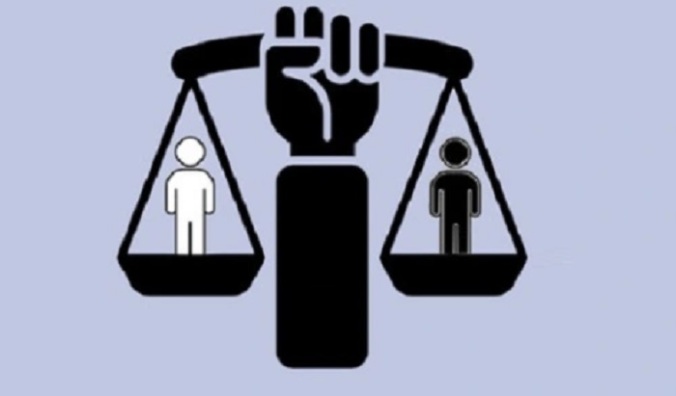
The Supreme Court yesterday sided 8-0 with a straight (okay, “cis”) woman in Ohio who filed a “reverse discrimination” lawsuit against her employer after her boss declined to promote her, preferring to promote “rainbow” staffers. In a unanimous ruling written by Justice Ketanji Brown Jackson, the Justices agreed that a federal appeals court in Cincinnati erred by imposing a tougher standard for the case brought by Marlean Ames to move forward than if Ames had been a member of a minority group.
The appellant, a straight, white woman, had filed a lawsuit in federal court alleging that she had been the victim of employment discrimination based on her not being gay. The department had hired a lesbian for the position that she had sought, she contended, as well as a gay man to replace her after she was demoted. The United States Court of Appeals for the 6th Circuit threw out Ames’s sexual orientation claim, arguing that her claim could not go forward unless she could show “background circumstances” to support her allegations of reverse discrimination, such as a “pattern” of reverse discrimination.
SCOTUS reversed, sending the case back to the lower court. Federal employment discrimination law, Jackson explained, prohibits intentional discrimination based on “race, color, religion, sex, or national origin.” Period. Minorities have no more intrinsic grounds to claim discrimination than majority groups.
Thank you!
The court of appeals in this case, Jackson wrote, incorrectly required that Ames “establish ‘background circumstances’ to support the suspicion that the defendant is that unusual employer who discriminates against the majority.’” This, Jackson wrote, is inconsistent with the text of the federal employment discrimination law which bars discrimination against everyone under exactly the same standard, without distinguishing between members of a minority group and members of a majority group. “By establishing the same protections for every ‘individual’—without regard to that individual’s membership in a minority or majority group—Congress left no room for courts to impose special requirements on majority-group plaintiffs alone.”
The Supreme Court’s precedents, Jackson emphasize, are clear that the test for showing discrimination in a case like Ames’s “does not vary based on whether or not the plaintiff is a member of a majority group.” “The ‘background circumstances’ rule flouts that basic principle,” she concluded.
Three instant ethical take-aways…
1. So much for the oft-heard canard that there is no such thing as “reverse discrimination,” and that it is impossible for a minority to engage in discrimination against a majority groups member because the latter isn’t “oppressed.”
2. The rationalizations supporting DEI are falling apart in chunks. Good.
3. It was very important for this decision not to show another Left vs Right schism. Justice Roberts was astute to hand the job of authoring the majority opinion to Justice Jackson, perhaps the most leftward jurist on the Court, and herself something of a DEI selection.
 Ethics Alarms
To answer your question: progressives.
but, in encouraging news, the decisions are more widespread:
https://www.cato.org/blog/six-unanimous-high-court-decisions
-Jut
Shouldn’t it be 9-0? Or did somebody recuse themselves in this case?
Someone recused, but I’ve been unable to find a source that says who, because the news media sucks.
I was rather surprised to see Justice Jackson joining, let alone writing, such an opinion, given her statements in the Harvard Affirmative Action case. In the latter, she seemed to argue that, by her understanding, the Equal Protection Clause required the government to apply the law unequally, so as to achieve equal outcomes. It was a position that struck me, at the time, as nothing short of insane. I hope this case signals reconsideration of that position.
I scanned the opinions, hoping against hope that “cis” did not appear. Whew. I didn’t see it.
jvb
.
I can’t help but wonder what got bargained away for all the leftist justices to support several of those opinions. Perhaps the “Assault Weapons” ban case being passed over?
Great point, because that’s how SCOTUS works. Roberts, who is under fire from the Right, deserves credit here.
Credit? Depends on who you ask, I suppose.
There are pros and cons to this sort of negotiation. Many on both sides would rather have their [fill in negotiated case] decided by a divided court than have a unanimous decision that either denies cert on a bargain for unanimity or bargains away another case for it.
But you’re right, that’s how this works. So all those “See, this is not a political court!” people should just remember that when the bargain gores their ox.
Earl Warren was especially good at this kind of thing. Certain opinions on certain issues need unanimous opinions, like Brown, in that court. I think this is another one.