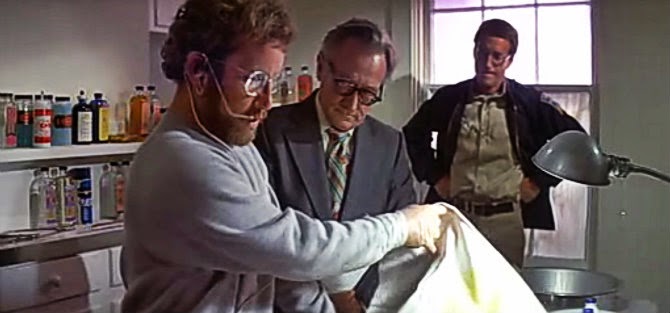
I have another classic ethics movie post in the pipeline, but this is the 50th anniversary of the Summer of “Jaws,” and attention should be paid. An obnoxious comment this morning from retired law professor blogress Ann Althouse drew my attention to the topic. She wrote,
“As for “Jaws,” I’ve never seen it. I’ve always imagined that it would bore me. I still feel that way. Waiting around for a shark to attack someone? I don’t see the point. I don’t have a tag for sharks. I have to give this post my “fish” tag. Have I ever seen a movie about fish? I don’t think so.”
Her quote isn’t exactly unethical, but it betrays an arrogance and a wilful ignorance of popular culture that does not show Ann in a good light. Althouse has some shocking gaps in her film and television literacy, and, as in this case, she often seems proud of her ignorance. As with all iconic movies and TV shows, being unfamiliar with “Jaws” means that you don’t comprehend references that have become part of modern communication: “You’re going to need a bigger boat!” and “This was no boating accident” come immediately to mind.
Someone saying, “I imagine that what so many people enjoy and remember would bore me” is a way of asserting unearned superiority; it reminds me of the snobs in Harvard bedroom community Arlington, Mass. who would say, “Oh, we never watch anything but PBS (you crass, low-brow peasants).” And they missed “Perry Mason,””The Defenders,” “The Honeymooners,” “The Hollywood Palace,” “The Avengers,” “Maverick,” “The Carol Burnett Show,” “The Smothers Comedy Brothers Hour,” “The Ed Sullivan Show,” “The Twilight Zone” and dozens more, all in the secure but ignorant belief that they were too sophisticated for such tripe.
Ann saying that she’s too sophisticated to watch “a movie about a fish” is like someone saying that they’ve never seen “Casablanca” because “who wants to see a movie about Morocco?,’ or “Singing in the Rain” because singing in the rain is a silly thing to do. A competent, curious, responsible member of society wants to see “Jaws” because 1) it is famous 2) it is a cultural touch-point 3) one should understand why people remember and care about it and 4) when the public embraces anything so completely, whether it is “Hamilton” or baseball or “The Mikado,” or Elvis or “Sergent Pepper’s Lonely Hearts Club Band,” or “Star Wars,” or “The Godfather” or Frank Sinatra or the Mona Lisa or “Oklahoma!” or John Wayne or Chuck Berry or Madonna or Taylor Swift or Bugs Bunny or Beethoven’s Fifth—the list is very long—the public’s opinion deserves respect. This why Rachel Zegler’s dissing of the original “Snow White” was so foolish and destructive. Nobody has to like or admire anything, but when a particular work of art or cultural phenomenon reaches icon status, there is always a reason. Not knowing the reason means one is just that much more incompetent as a participant in society.
“Jaws” is an important and even after 50 years, entertaining and powerful movie. Among its virtues:
1. It is an ethics movie. The underlying theme is how organizations, authorities and bureaucracies engage in wilful ignorance when they don’t like the clear implications of developing facts. “The Larry Vaughn Effect,” named after the mayor of Amity (played by Murray Hamilton), is in the Ethics Alarms list of terms and concepts:
“The Larry Vaughn Effect: Named after the hapless mayor in “Jaws,” the Larry Vaughn Effect is when a decision-maker, supplied with sufficient information to convince any objective individual that going ahead with a planned action or event is unacceptably risky to the point of recklessness and criminal negligence, still insists on going forward anyway, using denial and magical thinking while displaying gross incompetence.”
The Larry Vaughn Effect is is why the Challenger was launched even though engineers had explained that it was likely to explode. It’s why the Democrats let Joe Biden debate Donald Trump, and why they nominated Kamala Harris. These and many more preventable fiascos occurred long after “Jaws” became a classic. The people responsible weren’t paying attention.
2. The movie itself stands for a crucial principal of problem-solving and creativity: obstacles are opportunities, and often spur invention. This principle is why Orson Welles wanted disasters to strike in his stage and film productions. “Bruce the Shark,” the film’s robotic Great White, frequently malfunctioned, forcing Stephen Spielberg to improvise. In the most suspenseful scenes in the movie, the deadly predator is only suggested but barely appears. Spielberg has said in many interviews that the movie might have been just typical B horror fare if Bruce had been better. (The fake shark is still the weakest thing in the movie.)
3. Quint’s monologue about the sinking of the “Indianapolis,” in addition to being a riveting performance and a brilliant bit of scripting (which Shaw, an accomplished playwright, wrote), had wide-reaching effects. It made the W.W.II story of the sinking and the shark carnage that followed well-known and led eventually to the official exoneration of the ship’s captain, who had been blamed for the event and ultimately committed suicide in disgrace.
Here’s the clip:
4. The editing, pacing and direction of the film had a lasting impact on cinema going forward, but “Jaws” still seems fresh. Most striking of all, perhaps, was John Williams’ brilliant score, the beginning of a long and impressive run of flamboyant film themes that have also entered popular culture Valhalla….but none is more memorable or visceral than the “Jaws” “bum-bum, bum-bum, BUM-BUM…”
5. The movie includes three superb film actors perfectly cast and making the most of their roles: Robert Shaw, Roy Scheider, and Richard Dreyfus. It launched the career of one of Hollywood’s most successful and greatest directors. And it is a wonderful example of how a piece of entertainment can have immediate and lasting impact. I was on the beach at Cape Cod in 1975 when a passing group pf porpoises cased a panic among bathers just like the one in “Jaws.” The public fascination with sharks has stayed with us too, for better or worse.
I’m the opposite of Ann: I’ve seen “Jaws” too many times. As with most Spielberg, “Jaws” includes cheats that the director bets that no one will notice because they add to the drama and suspense: it’s a good bet, but once you’re aware of them, it diminishes the film. There are also irritating flaws in the screenplay that I didn’t notice, oh, the first five times I saw “Jaws.” (Why doesn’t Hooper (Dreyfus) tell Larry Vaughn that he saw Ben Gardner’s HEAD, not just that his boat was “chewed up”?)
Oh heck, I just convinced myself that I have to watch “Jaws” again tonight. Damn.
 Ethics Alarms
I remember standing in a long line one hot June evening to see “Jaws” during its opening weekend. It was probably the first movie I ever waited in a long line to see. Since it began being shown on television in 1979, I have seen it often, at least every other year or so. I don’t think I have ever mentioned the film and had someone remark that they hadn’t seen it. It’s hard for me to imagine missing such a large chunk of cultural literacy.Shaw’s telling of the saga of the Indianapolis caused me to recognize and then remedy gaps in my understanding of the war in the Pacific. It certainly has its flaws, but I still enjoy watching it even after fifty years.
I had forgotten about that line! Star Wars, ET, Jurassic Park, Raiders…we will never see the like again.
Cautionary Tales podcast has an excellent episode this week about Jaws. Filming that monolog marked a change in the previously antagonistic relationship between Dreyfuss and Shaw.
https://www.pushkin.fm/podcasts/cautionary-tales/the-shark-that-ate-hollywood-jaws-at-50
I would love to know your favorite Biggie Smalls song, your favorite Nirvana album, and your favorite Marvel movie.
Chris, Not everything is iconic. Jaws is, the Chuckie movies are not.
Biggie Smalls appeals to narcissistic youth who believe that they deserve respect just for being born. Not enough mass appeal to make it iconic. It is also typically pedestrian.
Now, who’s hot, who not?
Tell me who rock, who sell out in the stores?
You tell me who flopped, who copped the blue drop?
Whose jewels got rocks?
Who’s mostly Dolce down to the tube sock?
The same old pimp, Mase
You know ain’t nothing change but my limp
Can’t stop till I see my name on a blimp
Guarantee a million sales, call it love or luck
You don’t believe in Harlem World, nigga, double up
We don’t play around, it’s a bet, lay it down
Niggas didn’t know me ’91, bet they know me now
I’m the young Harlem nigga with the Goldie sound
Can’t no Ph.D. niggas hold me down
Cudda schooled me to the game, now I know my duty
Stay humble, stay low, blow like Hootie
True pimp niggas spend no dough on the booty
And then you yell, “There go Mase!”, there go your cutie
Nevermind, Nirvana’s best selling album is iconic insofar as it propelled Seattle’s Grunge music into mainstream culture but again it was because of Cobain’s apparent mental illness that so many disaffected teens of the 90s found solace. Again, while Nirvana sold a total of 75 million records worldwide that is a drop in the bucket compared to other more culturally relevant bands who had staying power. Only time will tell if Cobain’s and Nirvana’s relevance holds up 50 years from now like the Beatles, Beach Boys, Eagles, Stones, and of course Rush.
Marvel movies like their predecessor print comics are just good versus evil with different characters. Without Stan Lee at the helm the recent ones have just been cheap knock offs like most of Hammer’s horror flicks. You can like one more than another.
If one knows that Biggie Smalls glamorized narcissistic thug life which led to his murder that is all the cultural understanding one needs to know about his work. Similarly, Cobain’s suicide is indicative of the disaffection of youth that gets created when they find out the reality of life where not everything is how they want it to be based on their own limited experiences and understanding of what is actually the source of happiness. Apparently, Cobain’s existence and death did not cause any changes in how today’s youth can find solace and happiness. Instead his words simply causes many to act irrationally destroying other’s property as they resist the evil and corrupt 1 percenters.
Excellent points, Chris, with shining, glorious mention of the Canadian Triumvirate.
jvb
His points were awful and also ignorant.
Again: characterizations are also not arguments. Clearly, you over-reached with the “Marvel movies”: a whole genre isn’t iconic, and I can comfortably say there is no “Jaws, “Star Wars,” “The Godfather,” or “Raiders of the Lost Ark” among them. Confine your point to Biggie and Nirvana, and I’ll let that pass.
Biggie Smalls is iconic.
Assertion is not argument. Why?
Remembering that iconic in a narrow slice of the culture isn’t the same as iconic to the culture and society as a whole.
No he’s not.
😉
also lol at this
Only time will tell if Cobain’s and Nirvana’s relevance holds up 50 years
30 years don’t count?
I think Cobain is fading fast. James Dean he’s not—and James Dean has been sliding out of iconic status.
What’s really lol about this is that you complain on the other thread that Jack drives away or bans liberal commentors, yet here you are, making the exact same point that many have made to Jack in the past (that cultural literacy is in the eye of the beholder and is getting increasingly difficult as cultural content expands infinitely) but you do it in a way that will end up getting you banned for being a jerk.
But then it’s not really surprising since I think your goal here is not discussion but is to simply throw rocks.
“But then it’s not really surprising since I think your goal here is not discussion but is to simply throw rocks.”
Bravo India November Golf Oscar, Jmf; epic D!CK commenting!
PWS
I don’t listen to rap, I don’t listen to grunge and it’s “Captain America: The First Avenger”.
“It’s why the Democrats let Joe Biden debate Donald Trump, and why they nominated Kamala Harris.”
Priceless!
PWS
The cynic in me thinks the DNC set Biden up so that he could or would fail. The figured they would hold a truncated convention to nominate someone like Gov. Shapiro or Gov. Newsom, but Biden elevated Harris, leaving the DNC with little choice but to support her.
jvb
I met Dreyfus at a convention. He’s reasonably friendly and funny.
Being a native and lifelong resident of Indianapolis, I am stunned at the number of people who don’t know the story of the ship. We have a memorial downtown for it, for Pete’s sake!
Oooh, listening to a video on Typhoon Cobra, December 1944, I learn that a Lieutenant Gerald Ford, serving aboard USS Monterey, was actually swept overboard — but miraculously landed on a catwalk, averting near certain death.
Bismarck again.
Two quotes within the original post and the comments stood out to me as examples of the cultural arrogance that Jack often laments, both applying to the Marvel franchise (I include the various streaming series in this). “A competent, curious, responsible member of society wants to see “Jaws” because 1) it is famous 2) it is a cultural touch-point 3) one should understand why people remember and care about it and 4) when the public embraces anything so completely,” and “Marvel movies like their predecessor print comics are just good versus evil with different characters.”
First, regarding cultural impact, there are few as great as the line “With great power comes great responsibility” which Uncle Ben tells Peter Parker just before dying. I believe a great cultural reference is one that most people know regardless of whether they know its origin. It is not necessary to have ever read a comic book or seen a superhero movie or cartoon to know that quote: in fact, it has been applied and misapplied by many people for generations. In Jack’s own words, Marvel must be recognized as a cultural touch-point.
With regard to this blog, Marvel movies and television shows should be required viewing for their ethics implications. I have not watched all of the Marvel programs. I have no interest in Ant Man, Doctor Strange, Ms. Marvel, etc. However, the best ones represent not just conflicts between heroes and villains but within individuals and society at large, and provide a visual, cultural reference to real conflicts that have existed in our society in parallel with those of the comics and screens.
The first lies with the quote “with great power…” “Street level” heroes (Spiderman, Daredevil, Power Man/Iron Fist) as well as DC characters like Batman deal throughout with the question of vigilantism. Is it OK to act outside of the law if you turn the bad guys over to justice in the end? If you have this great power, can you look away when you see bad things happen because society hasn’t empowered you to act?
As vigilantes, the hero often spawns copycats who either wish to emulate the hero, as in Batman: The Dark Knight, or those who believe that the hero doesn’t go far enough, i.e. The Punisher. This may seem to some to be mainly a comic book issue, but it reflects the rise of terrorists, many of whom begin as activists. As activists they become frustrated by the lack of results of protests and move to direct action: bombings, hostage taking etc. (interestingly enough there was a terrorist organization named Direct Action).
Regarding the more powerful heroes (Superman, the Avengers), the question throughout the comics and movies is whether those with power should be free to use that power and decide when and where to act. What happens when the use of that power results in death and destruction? Should they be under some government control and if so, which one? What happens when you give a government, council, etc. that kind of power, and what happens when those thinking individuals refuse to be controlled? I think we can all see where these questions apply to the use of our bombers to strike the Iranian facilities. No matter which side you are on WRT the strikes themselves, most thinking people can recognize the ethical questions surrounding the strikes.
Now let’s look at the villains and their actions. The most prominent so far has been Thanos, who wiped out half of the population because he believed that the universe was over-crowded, resources were stretched too thin, pollution was making habitable planets unliveable. There are advocates of this thinking in the world today. Endgame actually addressed the effects of the population loss: the air was cleaner, whales were spotted in the Hudson river. However, the environmental effects could not compete with the depression felt by the population over the incredible loss of humanity. Humanity would prefer to restore the status quo, with all of the impacts, than kill off half of humanity to fix them. The fixing of problems did not justify the removal of half of the population.
Falcon and The Winter Soldier explored the after-affects of restoring the human population after a 5 year absence. With a need to replace the lost workforce countries invited workers from all over the world, provided housing and jobs and pay, to ensure that essential industries could continue to produce. The return of the population saw these same countries face the problem of who to prioritize: those who were missing or those who kept the economies going while they were gone? This ethics conundrum is a reflection of our own country’s experience during and following WWII. The men were shipped off to war and the essential industries turned to the only remaining workforce: women and minorities. This workforce kept the wartime industries running, built ships and planes and tanks, ensured much needed supplies made it to the front lines…and were dismissed when the war ended and the troops returned.
Nemo, the villain of Civil War and others, seeks revenge for the death of his family, caused by the actions of The Avengers in Ultron; The Kingpin, played impeccably by Vincent d’Onofrio in the Netflix and Disney+ series and just as well by Michael Clarke in the Daredevil movie, acts not only as the head of a criminal enterprise, but also from a belief that he can restore order to a dangerous city.
Throughout we see the manipulation of media, the best and worst of politicians and populations, the growth of terrorist groups, self-righteousness and revenge. We see the consequences of the actions of super-powered individuals on the common man, and we see it first from the perspective of the hero who must act against an implacable foe, then from the perspective of those helpless against the incredible forces brought to bear.
Finally, the use of CGI. I will admit that I find the use of CGI to be a bit much, but Jack dismisses the MCU as just CGI-driven, low-brow entertainment. If this were the case, Transformers would be the most popular movie franchise in the world. However, I would argue that CGI is just the latest attempt to visualize for the audience the stories imagined by their authors. From the time of storytellers creating shadows on the wall, to the use of lighting tricks for the stage, stop-motion animation (and animation in general) creators have sought greater and more effective special affects to bring their vision to life. I can imagine a theater goer in 1870 complaining about the use of lighting in the theater “in my day the actors could transport you through the strength of their voice. They didn’t need all these lighting gimics!”
But, if you would like to dive into the MCU without the CGI, I would recommend the Dardevil series. Originally on Netflix, now on Disney+.
Comment of the Day. Great work, great insights.
Thank you very much! I appreciate that.
More than ten years ago the _Chronicle of Higher Education_ (methinks that was the source) had a nice article about a professor who provided, as an extracurricular, lectures on cultural literacy of the sort that Jack believes the movie _Jaws_ fits into.
I strongly suspect that the professor was at Cornell University. He tended to cover 20th century cultural material from movies, musicals and theatre, popular music, and probably some other domains also. Perhaps he covered historical highlights of professional sports, for example. Babe Ruth, Hank Aaron, Lou Gehrig, etc.
The professor drew more than a hundred students per lecture. Students liked them because the lectures were fun and educational, but without imposing extra work besides the time to attend. The lectures provided students with some of the material that an educated person should be familiar with, and the students’ subjective opinion was that they were generally not getting such material elsewhere in their coursework.
Alas, the article has eluded me ever since. I don’t recall the professor’s name if I ever committed it to memory . I recall it being a man, likely at Cornell. I recall the article being in the Chronicle of Higher Education, but it may possibly have been in someplace like the Washington Post or the New York Times.
Searching for the article tends to draw up too many hits, pointing in the wrong direction, such as current lectures or “Cultural Studies.”
charles w abbott
rochester NY
E. D. Hirsch was working in part on this issue with his research and teaching on “Cultural Literacy.” But most of what his “Cultural Literacy” focused on was far more wide-ranging–the sort of things someone might have learned from (1) American and British History, (2) Geography, (3) a “Western Civilization” course, and (4) a bit of materials from “World History.”
The article I referred to above covered a professor telling the students that”Everybody should be slightly familiar with the movie _Casablanca_,” or “This is what people mean when they talk about “Route 66” or “what it means to read someone the riot act.”
I understand Ann Althouse’s stance, actually. We can’t pay attention to everything. Some of us are prone to what economists call “corner solutions” in which we exclude certain products from our bundle of consumption altogether. For example…
* some of us don’t drink alcohol
* some of use don’t watch TV
* some of us see at most one or two new movies in a year
* some of us decided that foreign language study is a waste of time.
* some of us hated algebra, forgot it, and think it was a waste of time.
* some of us haven’t been to a religious service in decades unless it was a wedding or a funeral, and we’ve read 50 mystery novels in the last year but think the Bible is a waste of time and can’t recognize the most basic quotes lifted from it.
Having made those decisions, we justify them, and we can come across as sanctimonious kill-joys and prideful snobs.
There’s no easy solution.
The things that help us to improve might include
1. humility
2. curiousity
3. fear of being publicly shamed for our ignorance.