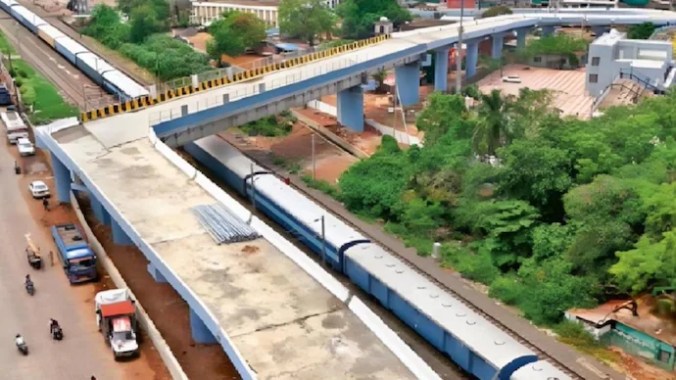
…he might have designed something like that bridge above, the Rail Over Bridge in Bhopal, India.
Central India’s Madhya Pradesh Government recently suspended the seven engineers responsible for the incompetent and dangerous design. Two construction companies have also been blacklisted, and small wonder. The bridge cost 200 million rupee ($2.3 million) and was announced 10 years ago to improve connectivity between Mahamai Ka Bagh, Pushpa Nagar, and the station area with New Bhopal. It was meant to eliminate long delays at railway crossings and shorten the commute for nearly three hundred thousand people.
VD Verma, the chief engineer on the project, claims that he and his team had no choice but to include the 90-degree turn because of land space and the presence of a metro station nearby. Of course he had a choice: tell officials that there was no way to build a safe bridge in the area available. Bhopal authorities are now trying to purchase more land, to allow the implementation of a safer turn. See, the idea is to do that before you build the bridge, not after.
I don’t understand how this could happen, do you? Nobody spoke up in either the planning or the construction stage to say, “Hey, wait a minute! You can’t have 90 degree turn on a bridge!”? Apparently these workers, so far unidentified, completed the bridge…
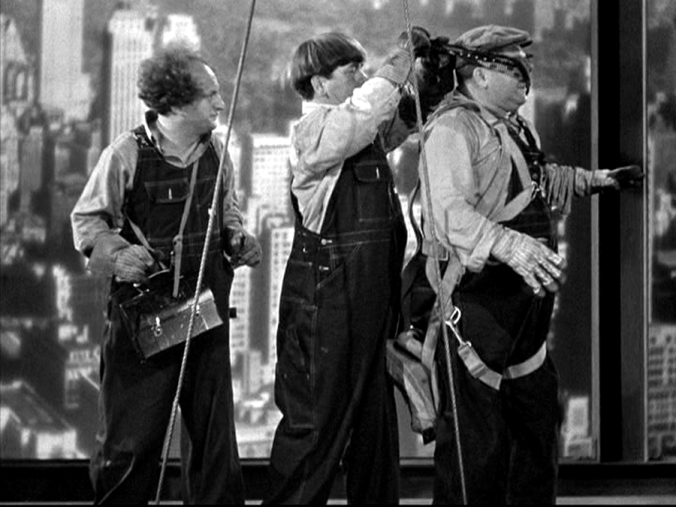
George, meanwhile, replied regarding his design,
 Ethics Alarms
“We’ll burn that bridge when we come to it” –My Mom
“I’ll drive off that bridge when I come to it.” – Teddy Kennedy
Yay, I have internet back! Spectrum crashed in my neighborhood for a while.
Sorry, back on topic. I am confused as to why this is an issue. Ninety degree turns are no big deal on highways and I have driven a lot of them. There seem to be two approaches to this. The first is that you slow traffic down to 20 miles and hour or so, and have them take the turn. The second is that you put a stop sign in, and then turn after coming to a stop. Both seem to work.
I saw the first idea implemented on I-90 in Cleveland. The traffic slows to a very slow speed, with ample warning, and we take a very sharp turn before speeding back up to city traffic speeds of 60+ mph. Every time I took this road, it was not a cause of massive traffic buildups or or accidents. There were far more accidents on other parts of the road.
Out west here, it is common to have to come to a complete stop from 70 miles an hour and make a 90 degree turn, typically when one highway ends in a T with another road. I can think of two instances of this on a route made of three separate highways that I routinely use. I have rarely seen accidents on these intersections.
Therefore, I do not understand what the issue of the bridge is. I would probably put a stop sign and require drivers to come to a full stop. This does not seem to be a hazard in my eyes. Can someone please explain what the problem is?
“Ninety degree turns are no big deal on highways and I have driven a lot of them.”
Made me think of Heath Ledger’s Ennis Del Mar in Brokeback Mountain:
One Curve In The Road In 43 miles, And They MISS IT.
PWS
Correct Link
I dunno: you miss a sharp turn on a road and you go into a ditch. You miss a curve on a bridge…well, I think it’s pretty clear why there aren’t other bridges with turns like that. And what an ugly bridge!
Given the train running underneath and the population of India, I thought this was a footbridge overpass.
If it is for vehicles, it seems horrendous at first glance, but have you ever experienced traffic there. I don’t think the 90deg turn would be much of a disruption.
From the looks of the terrain, there does not appear to be any barrier to have a curve instead of a corner.
Central India’s Madhya Pradesh Government is the guilty party, not the bridge designers, and certainly not the construction companies. Unless the construction company is hired to do a design-build contract, they are not hired to exercise independent thought. Construction companies are hired to execute a plan, period.
Regarding the bridge designers, it is common practice that designers meet with the principals throughout the design process, with the principals’ approval of the final design. Rarely do principals say I want a bridge or a house, etc. and say, “surprise me”.
I surmise the problem stems from the electorate complaining about the bridge. Politicians, being the spinless, unethical breed that they are, are attempting to shift blame away from themselves.