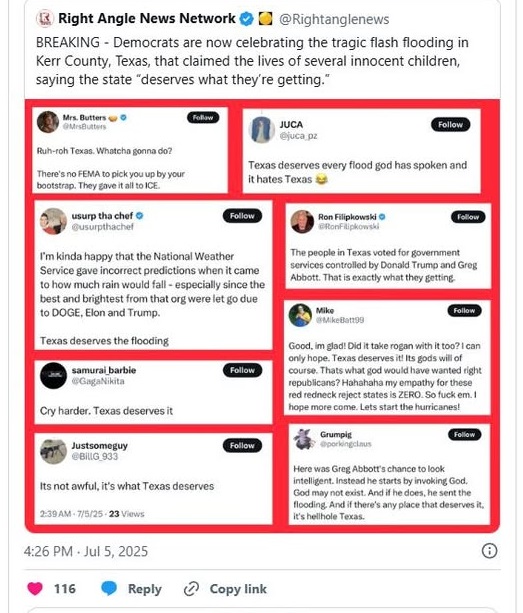
I initially was going to make those teets above the subject of an ethics quiz. The question: “Is it fair to use cherry-picked Trunp-Deranged quotes from social media to show that Democrats and progressives have lost all sense of proportion, decency, fairness and even humanity?” But the answer is obvious, isn’t it? No! Social media is a toxic waste dump of awful people and thoughtless expression based on irrational emotion. I daresay one could find many idiotic, nauseating and disgusting statements on all topics and from any ideological point of view. “Democrats” aren’t celebrating the deaths of the flash-flooding victims; sick, warped Democrats are, and they are not representative of their party or their communities.[“I hope.” “Yet.” “Ya think?”]
And yet these outliers are plentiful enough that they lead members of the hateful to blurt out their corrupted attitudes, with, frequently at least, disastrous consequences that are richly deserved. Case study: Dr. Christina B. Propst, a pediatrician, was deluded by her social media bubble and sufficiently de-brained by Axis media propaganda that she really thought she would receive nothing but plaudits for vomiting out this Facebook post:
“May all visitors, children, non-MAGA voters and pets be safe and dry. Kerr County MAGA voted to gut FEMA. They deny climate change. May they get what they voted for. Bless their hearts.”
Why, how did she think it could ever be acceptable for a medical professional to wish death on anyone, never mind a pediatrician claiming that the death of children is just desserts?
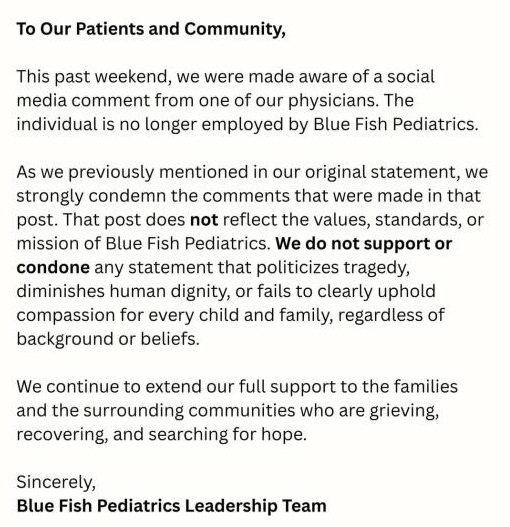
Propst’s employer, Blue Fish Pediatrics, couldn’t announce that “the individual is no longer employed” there quickly enough, posting,
 The head of the Texas Medical Board, Dr. Sherif Zaafran, tweeted, “There is no place for politicization. The entire focus needs to be on looking for survivors. Any complaints we may receive will be thoroughly investigated.”
It is frightening that once-reasonable people really have surrendered their rational thought and common sense to hate so thoroughly in the throes of Trump Derangement that they could think that a public statement like Dr. Propst’s would be anything but career ending. This was signature significance: no professional who posts such a vile sentiment even once can ever be trusted again. She has terrible judgment and detestable values.
Update: Here is another one. [Pointer: Other Bill] This woman’s comments are more than “inappropriate”…
 Ethics Alarms
“Until this moment, Senator, I think I never really gauged your cruelty or your recklessness.”. . . “Let us not assassinate this lad further, senator. You have done enough. Have you no sense of decency?”
Spoken by Jospeh Welsch at the McCarthy-Army hearings. certianly applicable to these tweets and in particular to this individual.
I challenge that those “once decent people” never were, like my deceased racist granny, they make the negative comments they can get away with targeted at whho they believe are the correct people to hate.
The question: “Is it fair to use cherry-picked Trump-Deranged quotes from social media to show that Democrats and progressives have lost all sense of proportion, decency, fairness and even humanity?”
This tweets need to be called out and highlighted mercilessly. If that sets a narrative that is unfavorable to Democrats and progressives, that is their problem. Let them correct that narrative by showing decency to their MAGA opponents, and self-police the lunatics in their midst.
What responsible parent would trust a child with the good doctor? Would she blow off medical treatment for the illness or injury of a child of conservative parents because she has decided they deserve to suffer? Would it be reasonable to believe that Dr. Probst would base her diagnosis and/or course of treatment on the personal beliefs of the parents? Would she fight as hard for insurance approval of medical for the child of conservative parents as she would for the child of progressive parents?
“Bless their hearts.” That, my Ethics Alarms Friends, does not mean what we northerners and persons of good will think it means. We from the North may find it a charming, pleasant comment, displaying concern for someone’s loss But, we would be greatly mistaken.
See, as an Ohio transplant in 1986, I didn’t realize that there were certain regional statements or colloquialisms that were gleeming knife-edges cutting your jugular. For instance, there ifs a difference between a “yankee” and a “damn yankee.” The former refers to anyone living north of the Mason-Dixon Line; the latter is a declaration of contempt – if not all out war – against anyone crazy enough to cross the Mason-Dixon Line and stay. It is a call to arms and a duel. The Civil War, alas, is alive and well, referred to as the War of Northern Aggression.
Likewise, “bless their hearts” or “bless your heart” is a rather poite and ironic way of saying “you blithering simpleton! You are so stupid you have no idea what you are doing! Do us a favor and get the hell out of here before someone takes you out to the woodshed and properly schools you. Moron.”
The Good Doctress is not sending a prayer. She is seething with derision, ismissive and contemptuous of those she deems worthy of the tragedies heaped on them. Were we to need pediatric services, we would certainly avoid this practitioner like the plague she is.
jvb
“Bless your [for emphasis, ‘little’] heart.” Often paired with “Aren’t you special!”
My firmly held belief: the U.S. is actually five or six different countries held together by a nominally common language and a common currency. Texas and the Southeast are definitely two of the five or six.
There’s a book on this by Colin Woodard. Not 5-6 but 11. American Nations: A History of the Eleven Rival Regional Cultures of North America. One of them is Deep South (which corresponds to about the area one would expect, including the Eastern part of Texas). The rest of Texas is divided among El Norte (area settled by the Spanish, this also includes much of northern Mexico) and Greater Appalachia, which stretches into the middle of Texas and has cultural roots in the borderlands of northern Britain–lowland Scotland, Scots-Irish controlled north of Ireland, and northern England. The mostly destitute immigrants from these regions descended from people who had been fighting in various wars for centuries. So, big on guns and hostile to authority generally. I live in the Left Coast (coastal strip of Central and North California plus the Western halves of Oregon and Washington up through the coastal area of British Columbia). And so on. I haven’t read the book through, just skimmed bits, but I find it very interesting. Certainly explains the strong division between Western and Eastern Oregon, which would like to join Idaho (which which it is more culturally congruent as part of The Far West).
See Holly? I’m smart! I’m not stupid like people say!
Interesting Texas is so big (and a former country in and of itself) that it is composed of separate countries. Of course, Austin is a separate planet.
But seriously, thanks for pointing out the book.
Axios reported that unnamed Democrat members of Congress is saying they are hearing from constituents that they need to up the resistance game and some should be willing to get shot. Written by Andrew Solender
source: WMAL radio program today.
members of Congress are saying… argh
How very Democrat/passive aggressive of them: OTHERS should be “willing to get shot” (which some in Minnesota recently were, so much for empathy for one’s own tribe!) as opposed to “willing to shoot” (which would be the more Republican ethos).
Nicely done.
jvb
It astounds me how some people must be living inside a bubble of crazy. A preschool teacher posted a TikTok asking if Trump would be outside on the 4th of July and that it “would be a cool time to do it”. Other people post videos asking someone to “take one for the team”. I suppose they think they’re good since none of them (that I’ve seen) actually say “assassination”, but they’re also not subtle in hinting that’s what they want.
It used to be that only wealthy celebrities were surrounded by people who agreed with everything they said. Now, with social media we can all create our own little bubble of “yes men” and believe that all smart, right-thinking people think the same crazy things we do.
I’m waiting for Extradimensional Cephalopod to arrive and say, “Now, don’t just assume that they are wrong and you are right…”
It’s more like conceptualizing things in terms of “right” and “wrong” is not very persuasive. It doesn’t help us understand why people do the wrong thing or how to influence them to change. People will either agree with you or they won’t. “Right versus wrong” is just not useful for improving the situation.
Instead, I’d say, “this option destroys trust. I understand the fear that leads people to believe this option is necessary to save things they care about. However, that fear blinds them to more constructive options. Those options take more skill and more effort, but they lead to the most generally satisfying and stable outcomes. Approaches that build trust are almost always more effective than political violence when it comes to creating a world that we want to live in.” Does that make more sense?
I can run the Values Reconciliation Workshop for Ethics Alarms, so people can see how it works in more detail. Then we can run some exercises on things that leftists have said. How does that sound?
To me?…yes. But when you have a left-wing doctor – a pediatrician…a CHILD doctor – suggesting that children that died in a flood got what they deserved, and you have leftists calling their congressional representatives and telling them it’s a good idea to “take a bullet for the team,” well…
We might be way past the point of a Values Reconciliation Workshop with an entire segment of society that has no values whatsoever except for the belief that violence – actual, literal, physical violence – is just another form of free speech.
I sadly fear – at least as far as some are concerned – we are leaving the arena of your desire for reason and measure and getting closer to Michael Ejercito’s arena.
Tell me, where on Earth did you get the idea that these people have no values? How much thought did you put into that conclusion? How much have you listened to their points of view and considered what’s at stake for them?
They’re afraid, they’re desperate, and they’re panicking. Part of the reason for that is that Trump is eating the seed corn. He’s knocking out load-bearing walls. He’s getting rid of a bunch of services and institutions without any indication he’s thought of the consequences of his actions. He’s passing up every opportunity to build trust, to make himself seem less than completely evil to anyone who doesn’t already think he’s making the right choices. He is a fool. I think the people threatening violence are also fools, but not to make the effort to empathize with them is to make the exact same foolish mistake that they are.
There is no “past the point of values reconciliation” because no matter how much violence happens, ending it entails talking. Or enough people dead that there’s nobody left to disagree, but that’s actually less realistic. It should be obvious at this point that you can’t crush ideas with violence. Values reconciliation is the only way to replace escalating downward spirals with escalating upward spirals and end the cycle of violence.
Values reconciliation works consistently for me. The relevant question is, what do you have to lose by trying?
I bet myself a million bucks that this would be your comment. You are now obligated to go beyond unsubstantiated characterizations and explain why this paragraph…
“They’re afraid, they’re desperate, and they’re panicking. Part of the reason for that is that Trump is eating the seed corn. He’s knocking out load-bearing walls. He’s getting rid of a bunch of services and institutions without any indication he’s thought of the consequences of his actions. He’s passing up every opportunity to build trust, to make himself seem less than completely evil to anyone who doesn’t already think he’s making the right choices. He is a fool”… is anything but an emotion-based, rote, unsupported assumption.
What “seed corn”? It is useless to seek trust from someone who is already determined to detest whatever you do because you’re the one doing it. The bureaucracy is bloated and corrupt, and it is impossible to fix such situations incrementally, which is why they just get worse and worse. What “services” has Trump eliminated rather than force to be more efficient? What “institutions’ that are not completely corrupt, like the news media, universities, law firms, Big Tech? The hate has nothing to do with values, other than “We liked it when we were in charge”? That’s not an ethical value, and a tantrum can’t be reasoned with.
I believe EC is using seed corn as a metaphor for government support programs. The problem with that metaphor is a substantial amount of the “seed corn” does not produce a desired result and is used only to fatten the farmers wallets who then support the politicians who promote fiscally unsound programs.
The fear EC mentions is created and instilled in the populations by progressives because it is a well known fact that fear drives people to action. FOMO or fear of missing out is what drives all marketing. It is why sales are for a ” limited time only” yet a different sale will occur in the near future.
Ironically, EC demands evidence from those who proffer opinions yet he provides mere talking points of progressives to support his positions. Yes, many are afraid because politicians and those sympathetic to the cause tell them the should be afraid.
Up until this time, I believed EC was a neutral party seeking to find ways to have constructive dialogue. It is unfortunate that this post of EC’s makes me wonder about his underlying biases that shapes how he believes constructive dialogue can take place. Trust is a two way street and fear resides on both sides of that street. It is hard for me to be willing to help develop trust when it appears that there is absolutely no inclination on the other side to do the same. In short, I have lost trust in EC’s ideas.
There’s a lot of points to untangle there, so I’ll take them one at a time.
Stipulated: Many of the institutions Trump is cutting are being wasteful and merely enriching bureaucrats and politicians. I’m inclined to agree with that.
I apologize for failing to make it clear that I’m conveying a point of view that leads sane, intelligent, reasonable people to conclude that the Trump administration is blurring the lines between stupidity and malice. I’m describing what they see. I agree with some of it (I don’t trust Trump to think through the consequences of his actions, but he’s hardly a unique politician in that respect), but I’d need further verification to criticize any specific decision.
Speaking of which, I’m also aware that people aren’t getting reliable information about the significance of what’s being cut. I just double-checked the issue I’d heard about where the Department of Defense is no longer providing weather data to NOAA (ostensibly for cybersecurity reasons), and apparently NOAA themselves said that the data isn’t strictly necessary for predicting hurricanes–it’s just that the more real-time information they have, the more warning they can give people. They’re implementing a backup plan by calibrating with Japan’s data so they can share information that way, but they thought they’d have more time to set that up. This admission was in an NPR article which leads by referring to the data as “crucial” and implying that we can no longer predict hurricanes. I’m surprised they left the truth in there at all. That established, what would you bet that conservative sources aren’t distorting the issue the other way, downplaying the utility and competence of programs that are being dismantled in the name of saving money?
I think there’s definitely miscommunication on this point. If you’re talking about just the comments on this page, I’m trying to explain why people who call for political violence are not as far outside normal human parameters as the people here assume them to be. I’m expressing their point of view and why it’s plausible even if it’s not accurate. Joel said that a group of people have no values, something I know from experience isn’t true. Of course I’ll ask for elaboration on how he came to that conclusion. Maybe by “values” he means “principles”, which would make more sense–humans understand little of principles. It sounds like you’re assuming bad faith on my part without asking me clarifying questions. That’s precisely the habit I’m trying to get people out of. If you think I’m wrong, you can just ask me to walk through my reasoning and we can see if I made any errors or wrong assumptions.
The people panicking about the Trump administration have a picture of reality that’s at least partly inaccurate. Even so, simply disregarding them and failing to address their concerns is irresponsible and naive. I assert that Trump should assign some people to transparently convey the reasoning behind cutting programs, and some others to advise people on how to stop relying on those programs. He doesn’t have to let the progressive media present an uncontested narrative. He could make a bare minimum attempt at being everybody’s president. Is Trump making any effort to convince people that it’s okay if the government doesn’t provide a particular service because they can accomplish the same goal through other means? Or is he just saying “this is a waste of money” regardless of whether the waste is due to the goal or the methods?
Does that make more sense?
(Another point I’m making is that that just because an institution isn’t doing its job well doesn’t mean the job shouldn’t be done. In my laundry list of metaphors I forgot to mention “tossing the baby out with the bathwater.” We could get rid of the whole government using the logic that it’s wasteful and corrupt, but we’d still have to put something in its place to handle national defense, if literally nothing else. If we’re going to rely on companies to provide services, we need to have some plan for holding them accountable. I don’t care whether that accountability comes from the government or from civic organizations; either way, people will need to be able to recognize what’s constructive and what’s not.)
As far as building trust from both sides goes, I’m currently helping a group of liberal/progressive people to reach out and build trust with conservatives. I’m having them do the same things that I’ve been recommending people in this group do. It is absolutely their responsibility to build trust. It’s a civic responsibility that we all have; it has nothing to do with your political position. In any conflict situation, someone’s got to make the first move towards trust, but it doesn’t have to be a big move. The question here is, under what conditions, if any, would you take action to build trust?
I keep thinking of the frog and scorpion parable. But, if a group has declared the other is pure evil or nazis there is not a lot of movement available for finding common ground and respect. “You’re evil.” “No, I’m not.” “Oh. Ok. Cool. Let’s talk.”
jvb
Not with that attitude, there isn’t. From my perspective, that’s like saying “Human flight is impossible. Have you ever tried flapping your arms? It doesn’t work.” I’m going to quote Captain Tagon from Schlock Mercenary here: “Never tell me what you can’t do as if it’s something nobody can do.”
“You’re evil.”
“I’m missing something here. Can you please clarify what I’m doing that you’re objecting to, and we can see if there’s a better approach I should be using?”
Anyone willing to call you evil to your face is probably willing to explain their opinion. To break their criticism down into something useful, I use the foundational concepts of costs, risks, habits, and trust to describe what they care about.
Then I put all of what we both care about on the table, and use the constructive principles of investment, preparation, challenge, and ethics to figure out ways to approach the problem that work within the constraints of what we both care about. Politics is more tractable than you realize if you know how to translate it into an engineering problem. It turns walls into hills. They’re steep, but they’re traversable. And once you’ve shown you’re willing and able to turn those walls into hills, you’ll have earned a lot of goodwill from the people you’ll be working with to traverse those hills together.
I’ve done this more times than I can count, professionally and socially, in person and on the internet, about politics and everything else under the sun. You think I was always this agreeable? I had to learn how to get along with everyone or else I wouldn’t be able to get along with anyone. I don’t have the luxury of hiding from people I disagree with. I’m not saying, “let’s try to be nice people because that would be nice!” I’m saying, “You people are making the same mistakes I was making, and it’s tearing your society apart. I identified the principles my solution uses, and turned them into a generalizable approach that anyone can use with ease.”
I know it’s tempting to forgo the effort of learning something new and continue to feel superior to other people, but if you do learn something new, you get to transform infuriating arguments into discussions that make other people reconsider their beliefs, and you still get to feel superior to other people! How does that sound?
Sometimes we need to outright reject values. Stalin, Hitler and Mao all had values. The most evil in the world is done by people who are zealously committed to their values, and who think they are doing good and belong to a moral vanguard. This tunnel vision leads to evil. Doctor Probst views are an example. Talking with those fanatics is a waste of time; the best you can do is to make sure that they do not have the power to do any harm.
One of the most obvious is: The Bible is the literal word of God, so, obviously, everything in it must be Absolute Truth, and every edict therein must not be defied. The value is allegedly “faith,” but the real value is social control of the ignorant. If God exists, He/She/It must certainly think “Oh, come ON, give me some credit!” when he considers some of the foolishness attributed to him. Believing the the Bible is literal truth requires ignorance of history, religion and logic, language, linguistics, science and more, including ethics. That’s not a “value.”
Jack, this thread is getting a little deep and becomes less readable as a result.
OK I am not going to take the bait, and defend Christianity; by the way I am not a fundamentalist who takes everything literal. There have been periods in history when the Church was responsible for religious persecution such as during the time of the Reformation.
The issue here is the mindset of zealots. There are people and groups of people who take a very black and white approach to reality; psychologists call this “splitting”. Everything and everyone is either good or evil; there is no middle ground. This approach is typical for narcissists and cults. When we look at politics and religion today we see the woke left and radical Islam as examples of this approach. They are utterly intolerant to other perspectives, and have no problem with cancelling and (sometimes) killing people. Trying to reason with these people and hope we change minds of these people and cults will not work. The only option is to defeat them (what Donald Trump is doing with the woke left, or kill and destroy them (what the IDF will hopefully will complete with Hamas soon). Not having seminars about values, because that requires reason from both sides.
EC,
That is patently ridiculous. They aren’t afraid, or desperate, or panicking. They ARE filled with rage at a President (Trump), a movement (MAGA), and a people group (anyone who doesn’t walk in lock-step with them) that dared to vote against, and subsequently defeat Hillary Clinton (first) and then Kamala Harris (second).
And I didn’t write that those folks have no values.
They have accepted as truth the lie that the other side is an existential threat to democracy, and that they’re fascists, and that they’re just like Hitler, and that they’re 100% irredeemably evil…and that all they do is only, ever, and always with the worst of intentions to cause the greatest harm. That’s is NOT a fear…it is a lie…the primary lie. And they have also bought into the secondary lie that the best response to the primary lie they believe as truth is violence.
Respectfully, don’t act as though you’re the ONLY one who’s put real thought into these notions. I readily admit I’m one of the dumb ones here, and I’ve given it a lot of thought. You may not like my conclusions, but those conclusions didn’t simply come from my backside. And there are many far smarter people here who have given these things a lot of better thought than I.
…and if you think this is going to get better, whether through your work (which I have no doubt can be beneficial), or the passage of time, or ideological transformation…trust me…it isn’t.
…Does believing that lie not make them afraid? That’s a pretty scary lie. Correcting a lie often requires addressing people’s fears. There’s a saying in business: People don’t care how much you know until they know how much you care. Well, if people don’t think you’d care if they were eaten by the boogieman, they won’t believe you when you say there is no boogeyman. You want people to stop believing in lies? Earn their trust. Show that you care. Help them get something they need even if it’s not how they expected to get it, even if it’s tiny. Some gesture that indicates to them that even though you disagree with them, it isn’t because you don’t care about them.
I think you might mean they have no principles, which I might agree with. Values, at least as I use the term, just means “what people value; things people care about; what people want to happen or not happen.” Principles are instrumental values that we uphold even when it’s difficult, and they make the world better over time (that is, they make it easier to get other things we want in life). Is that what you were referring to? Does the Values Reconciliation Workshop make more sense now? I explained the process in more detail in response to johnburger2013’s frog and scorpion comment, so you may want to check that out.
Appeal to authority on what cannot be done doesn’t work when you’re talking to someone who’s already done it.
Well, I don’t trust you about this prediction, but I’m curious as to why you are trying to convince me that the political situation will never get better. Sure, you believe it, but what would you expect me to do differently if I were to believe it?
Are you advising me to live a more comfortable life by adapting myself to profit from a corrupt system? I appreciate that, but I would find that life intolerable unless I somehow lost my core identity. Are you sick of hearing me talk about how we can solve problems because it makes you feel obligated to do something yourself? If so, I assure you that not everyone needs to participate. I know many people who aren’t saving the world, but they are, in many small ways, helping make the world worth saving.
Except at some point, there is a right and there is a wrong, and if you can’t look at the truth of something and recognize it, rationalizing it away with “this destroys trust” just feeds the beast.
They don’t have enough trust in reality to begin with.
Asking them if it’s right to murder them for the opinions they hold dear might be a better starting point.
The truth shall set you free.
I think a lot of people think that phrase means things will get easier. The reality is that most often seeing the truth is a really difficult beginning to a pretty long road to betterment.
Anything else is rearranging deck chairs on the Titanic.
I’m having trouble parsing what you’re saying, so I think there may be some confusion here. “This destroys trust” is something I would say instead of “this is wrong.” The reason I say it is because it actually goes some of the way towards explaining why I believe a person should not do it.
“That’s wrong” might be a justified thing to say, but it asserts a conclusion without showing the reasoning process that led up to it. That reasoning is kind of important if you meet someone who doesn’t agree with the conclusion already.
(And no, you can’t just assume that anyone who doesn’t already agree is impervious to reason. Even I’ve never been that arrogant.)
Can you give an example of a situation that you see as having a right and a wrong answer? I would like to illustrate how we can suspend the conclusions “right” and “wrong” and rederive them from scratch, which is far more persuasive.
What actions should Israel have taken after Hamas raiders killed, raped, and took hostages on the Oct. 7th attacks?
Exactly what it did, has done and is doing. And there is no other right answer.
Almost totally agree. Israel has no choice but to eliminate Hamas. There is no excuse for the terror they inflicted on Israelis on October 7th.
My only criticism is the lopsided exchange of Hamas fighters for Israeli hostages. Philosophically, there should have been no exchange. No negotiations with terrorists.
Politically, however, that would have been an impossible sell for Netanyahu. His capitulation, however, should have been more along the lines of one for one.
Absolutely. As with the idiotic handling of the Wuhan virus, there are important, logical, rational policy positions that are now politically impossible because of the weenie virus, not just here, but worldwide, and a leader who defies the weenies—like Trump, regularly, but only now because he’s a lame duck—is taking his political life in his hands.
Thank you, that’s an excellent example.
Bearing in mind that I’m not a military expert and I’m prone to hubris, please add a grain of salt as far as realistic military goals.
Premise: Hamas, a terrorist organization, commits horrible acts against Israel.
Deciding on the response: On the one hand, we do not want to incentivize terrorism, so we want to avoid enacting policies that the terrorists want. On the other hand, we also don’t want to incentivize false flag terrorism, so we want to avoid deliberately enacting policies that oppose what the terrorists want. Terrorism should not affect policy one way or the other. So what message do we want to send? “Terrorism isn’t worth it. Your organization will be struck down.” With that in mind, we can temporarily suspend questions of responsibility for addressing the conditions that lead to terrorism, since doing so in proximity to an attack would set a dangerous precedent.
Under other circumstances I’d suggest working with a government to bring down a terrorist organizations in that country. Considering that Hamas controls Gaza, we can skip straight to the “invade the uncooperative country” step. Establish a police state, confiscate any and all weapons, and root out and arrest all members of Hamas. Try them for war crimes or regular crimes, whatever seems appropriate, and give them lawful punishment. (Keep in mind I’m not averse to cruel and unusual punishment; I just prefer to reserve that for people who are guilty beyond any doubt, and ideally the punishment should fit the crime in some way so that the perpetrator can learn something.)
Then, once the cuplrits are confined and any capacity for further violence has been eliminated, we can start discussing what it is that people actually care about and how we can fit it all together in one outcome. Violence cannot be used as leverage on either side in this situation, because that legitimizes terrorism. (It wouldn’t necessarily do that in other circumstances.) Instead, people should look at what they can offer each other. What do people want from life? Wealth? Land? Political power? Religious dogma? Security? These aren’t the only human goals, but they’re the ones most often at the heart of a war. Humans are more similar than they prefer to admit, but once they start admitting it then they start realizing that trusting each other is an option.
All this is to get us to the point where we can build trust by doing what we should have been doing the whole time, without creating the incentive for more terrorism.
That’s what I’ve got offhand. You can call things “right” or “wrong” if you like. I find it far more useful to derive my ethical conclusions from first principles. When people don’t do that, I observe they are unable to meaningfully interact with anyone who comes to a different conclusion, which means they can’t resolve the disagreement and find the best option (which is likely something neither of them had thought of yet).
What do you think?
You used a plethora of words to agree that terrorism is WRONG and concur that Israel is RIGHT to root out the terrorists and remove the means for inflicting terror in the future.
After that are boilerplate platitudes on your approach to bring peace to the Middle East. Good luck with that.
Over the years, Israel has repeatedly offered numerous carrots to its neighbors to no avail. Bottom line: when you run out of carrots, the only solution is sticks.
Put another way, history shows war occurs when one or more parties want something other than peace. Once war has commenced, peace occurs when one party beats the other party into submission.
EC,
I’m late to this discussion, and there have been a lot of very good things said, so I hope I’m not glossing over points others have raised.
First, I want to start with the points where I agree with you. In terms of productive conversation between people, just stating, “I’m right/you’re wrong” is almost always counterproductive, especially if that’s how the conversation starts. Usually, if that’s how the conversation starts, it is also how the conversation ends, and it might devolve either into a bitter fight or the two parties quickly walking away.
I also agree that it is important to try to understand the motives and worldviews of the people we disagree with. This accomplishes a variety of things, but foremost among them are refraining from straw-manning the opposition, talking past the opposition, and possibly seeing problems we didn’t realize existed. At the very least, I’ve see in Catholic/Protestant debates a great deal of heat and confusions when they argue “Catholics believe in a works salvation, and Protestants believe in salvation by faith alone.” This formulation bypasses what either group really has to say about their belief formulations, caricatures the other side, and does not lead to a productive argument. If instead they discuss what each other means by faith and by works and by salvation itself, they find their positions are not as at odds as they previously believed, and the distinction between Catholic and Protestant positions actually lie in more nuanced difficulties that neither supposed beforehand was the real problem.
Now I would like to challenge you with my issue with your stance. The biggest problem I run into is getting to the conversation in the first place. The methods you propose feel to me to be a bait-and-switch, offering what seems to be a means of dialogue and understanding, but later requires me to abandon principle for some mythical compromise. And the reason I struggle personally with this is that is how I’ve viewed the conservative/progressive advance over the years. The compromise always requires a continual leftward shift, always requires the conservative to eventually abandon his principles to make it happen. This is because meeting in the middle for just one iteration requires both to leave their silos, but each iteration of the process demands that the conservative, not the progressive, continues marching leftward, with the middle always between the the progressive position and the previous compromise.
There are absolute rights and absolute wrongs out there. Murder, for example, is always absolutely wrong. Ethics is determining whether a homicide constitutes a murder, an accident, or a justifiable killing. Treating people as a means to an end rather than ends in themselves is absolutely wrong. That is why ethics concludes that socialism is wrong, because it treats the individual as suborned to the whole, and why pure capitalism is wrong, because an individual is only valued by his capital worth.
Understanding has to begin with certain principles acknowledged, where people believe absolute rights and wrongs exist. And yes, I agree with you that much of the hate is fear-based, as many people believe their principles are being compromised, abandoned, and/or derided. But that’s exactly how conservatives have felt for the past 44+ years (I’m 44, so that’s my cutoff; it could be much longer). There’s a double standard that has already destroyed my trust: if I hold to my principles, I’m a bigot. I’m sexist, homophobic, transphobic, xenophobic, racist, name your favorite appellation. I’ll admit that I’m disgusted by, for example, the pro-choice position, but I do respect opinions that are genuinely concerned with the well-being of mothers who are struggling with their pregnancies and who make good-faith efforts to dialogue on the humanity of the unborn. If I say I’m pro-life, though, I hate women, want to control them, force them in handmaid’s tale lifestyles, etc.
So there’s no effort to understand my principles, and compromise seems to be directed eventually to draw me away from my principles and to embrace the progressive stance. Is there any other issue at stake? It turns out there is. The final straw is the overt threat I witnessed conservatives endure when progressives were in power. Yes, I fear conservatives abandoning principles and enacting retribution, and there’s some fear that Trump will do exactly that. But while progressives were in power, and they remain in power in education, in law, in medicine, and in many parts of the government, they silenced and persecuted conservatives. I watched conservative sites shut down, debanked, overwhelmed with hate and vitriol from the left. If there was serious talk of violence and civil war from the conservatives, it was because of not just the fear of being excluded from government and public life, but watching the beginnings of that happening. I can understand the fear on the left of this happening to them, and it is probably all the more real to them, because they know they were doing it to conservatives and would continue doing so were they still in charge.
In the midst of all that, how do you build trust? It is already broken. Can conversation begin when there is no trust? How do you bring, to suddenly delve into metaphor, Charlie Brown and Lucy to the table to discuss how Charlie Brown should trust that this time, finally, Lucy won’t pull the football away at the last moment?
Thanks for your thoughtful reply, Ryan! I’ll respond to you and a few other comments later this week–right now I have my hands full updating a presentation. Just wanted you to know it’s still on my radar!
Thanks for leading with confirming what we agree on; that helps establish a shared reference frame. I’m also intrigued by the differences between Catholics and Protestants. I’m especially glad you brought up the questions about the terms people use to describe the disagreement; that means we’re thinking along the same lines in that respect as well.
To address your concerns, I’d first like to clarify that reaching out to engage in dialogue is not at all the same as compromising or surrendering the outcome.
As I discuss in the Values Reconciliation Workshop, the first step of understanding one’s own values is necessary because there are things you should not be expected to compromise on. Step 1 is about peeling away our assumptions about what those things are, so we can get to the core of what’s most important. By figuring out what we actually care about and what’s irrelevant, we open up common ground we didn’t know was there–common ground that we can build on without compromise. (Step 3 involves getting creative and thinking long-term so we can move towards those win-win outcomes.)
Because you have core values, any solution that satisfies you is not going to involve compromising those values. It might be that those values are fulfilled in a different way than you expect, but society would be worse off if we simply abandoned them.
Keep in mind I’m not just approaching conservatives with this workshop; I’m actually running it for a liberal group, and the leaders of that group take seriously their civic responsibility to engage with conservatives. The responsibility to communicate and understand each other is nonpartisan. It’s just a matter of which individual people on any side are willing to be the grownups in the room and go first.
Does that address those concerns?
As far as right and wrong go, I may need to use an analogy. As a Catholic, you deal with abstract ideas that are like atoms. They are clear-cut and distinct, and they seem fundamental. I’m an existentialist. I deal with abstract ideas that are like subatomic particles. They’re what you find when you split the atom and realize that what was called “unsplittable” isn’t as fundamental a building block as you assumed. They blur the lines between atoms, since under certain circumstances one element can change into another, but they explain exactly how and why that happens. Also keep in mind that the existence of subatomic particles doesn’t change how we already observe things to work on the macroscopic scale; it just helps us understand it on a deep enough level that we can do things we couldn’t do before.
With that in mind, let’s talk about murder. You acknowledge that “murder is wrong” is a tautology: it means “intentional killing which is wrong”. You pointed out that we exercise ethics to determine if a killing was murder, i.e. wrongful intentional killing. Setting aside the question of how we make that decision, what does it mean to decide that an action is absolutely wrong? From an existentialist standpoint, if we apply the normative label “absolute wrong” to an action but don’t do anything different when someone takes that action, then the label is just empty words. We lock up murderers. We take away rights previously ascribed to them, up to and including their right to life. That’s the sort of thing we do when someone does something that’s “absolutely wrong.”
Whenever you pronounce judgment on an action as “absolutely wrong”, you are describing what you think should be done with the person who did it. Now, there are still different kinds of “absolutely wrong,” and for different reasons–lying for one’s own gain could be described as “absolutely wrong” even if it might not warrant the death penalty–but here we’re just establishing that “absolutely wrong” is not a fundamental concept. Trust is a fundamental concept. (Well, close enough to one; it’s made of just a couple well-defined building blocks called “(un)certainty” and “motivation”.)
Why do we lock up murderers? Why do we punish them? Because murder is, fundamentally, a violation of trust. We want to be able to trust that people won’t kill us. We enhance that trust by creating an incentive to nor murder people–murderers will be caught and punished. Crime doesn’t pay. We keep them in a prison so they can’t murder more people because we don’t trust them not to do that anymore.
Murder is a an especially serious violation of trust because it deliberately inflicts a great and irreversible loss and harm on a person and those who knew them. People very much don’t want that to happen. Theoretically, you could have a society of people who don’t care that much about themselves or others not dying, but that implies they would not be living very full lives or living up to their potential as people. I’d file that under stagnation.
I derive “murder is wrong” from first principles, which lets me engage and reconcile with people who disagree on whether a particular killing is justified or not. Take it back to trust; how does this person’s behavior affect the trust other people are willing to extend to them? Were there better options to accomplish their goals than killing? What kind of precedent are we setting for society?
In the absence of existentialist ethics, theists have to have a transcendent being hard-code “murder is wrong” into human culture, or the fabric of the universe, or something. That means that whenever you encounter an action that looks like murder but which you intuitively know isn’t, you have to create an exception. Then the exception has to have exceptions, and you layer patches over patches on what was supposed to be a fundamental law.
Existentialist ethics is more elegant. The principles are objective and universal, but they apply a bit differently in different contexts. It’s like how gravity works the same everywhere, but different planets have different gravitational constants. It’s not because each planet is a discrete realm with its own gravitational constants programmed in; those numbers are just shorthand for what how fast we expect to accelerate while falling towards the nearest giant mass of matter.
I agree that treating people as merely a means to an end is characteristic of unethical behavior, but I’m confused as to what it’s contrasted with. What does it mean to treat someone as an end in themself? What do we do differently to live in accordance with that principle?
“Can conversation begin when there is no trust?” Can you light a fire without using a fire that’s already there? You do realize that many people on the other side feel the same way you do, right? They want to trust, they’re willing to be trustworthy, but they don’t know that most people on your side are like you, like them. You’re engaging with the worst on their side, and they’re engaging with the worst on your side, and when you finally meet each other you don’t recognize each other. The Values Reconciliation Workshop helps you not only recognize each other, but bring out the best in each other. Taking each other’s core values and concerns seriously is all it takes to start out with, and it only gets better from there.
In Charlie Brown’s place, I’d probably ask Lucy why she pulls away the football. Not in an angry, desperate, or anguished way, but just curiously. “I’ve noticed you keep pulling the football even though you know I want to kick it, and you lie and say you won’t. What benefit do you get out of that?” Personally, I suspect it’s a psychopathic combination of control and boldness–in this case, the desire to have the power to manipulate someone and to break them, repeatedly. It’s abuse, not an ideology, not even the ideology that the Left’s rank and file buy into, any more than you subscribe to Trump’s philosophy of life. All Charlie Brown needs to do is get a football of his own and find someone else to hold it.
Does that all make sense?
Yes. German genocide against Jews, gays, Catholics, and others in Europe from about 1933 to 1945. That seems pretty clearly right or wrong. Justify the Holocaust. How can you “reason” with genocidal maniacs? I am not talking about Hilter, et al. I am talking about the rank and file personnel who stuffed innocent people into gas chambers intending to kill them for no other reason than their religion and/or ethnicity. The “hey, I’m just following orders” is a cop out and lie.
jvb
Sorry for the delay; I’m just getting back to this now. This is another excellent example that deserves an answer.
If we’re talking with non-genocidal people, we can simply agree that the Holocaust was ethically wrong. In existentalist ethics terms (reasoning from first principles), killing anyone like that–let alone millions–was a needlessly destructive option in that situation and made the world a far worse place to live in, compared to the other things that the German people could have done instead of mass murder. I’m applying a fundamental principle of decision-making here: You cannot judge a decision in a vaccuum. You have to judge it in the context of the other available options. (Plug for the book Decisive by Chip and Dan Heath.) That’s why I approach atrocities with “This was a terrible option. Now, why did so many people think it was a good one?” rather than “This was wrong; all these people were bad people. Good thing I’m not a bad person!” By not taking shortcuts when pronouncing judgment on people’s decisions, I am far better equipped to understand bad decisions and therefore far better equipped to prevent people from making them.
If we’re talking with someone who doesn’t already see why killing millions of people is wrong, I’m going to assume that killing that person is not a convenient or ethical option, however tempting it may be. (They would probably defend themselves and I prefer not to assume I’d beat them in a fight. Plus, we still live in a civilization with anti-murder laws and I’d like to keep it that way.) Therefore, if you want to persuade them that mass-murder is wrong (and why wouldn’t you?), we need to take a mental approach. With this approach, we cannot simply tell someone they’re wrong. They already don’t believe they’re wrong, so all we would do is lose credibility that we could be leveraging to get them to understand why it’s wrong. Instead, we need to first privately understand why we believe they’re wrong, and then we need them to help us understand why they belive they aren’t.
Pretty much any modern genocide is motivated by fear, and the people stoking that fear are largely motivated by some combination of greed, spite, and fanaticism. Different motivations call for different tactics to address and dissolve them.
The easiest thing to do is look at the fears of the rank and file, as you mentioned: the average citizens who are told by people they trust that their economic hardships are caused by that ethnic group over there who
doesn’t worship the same deityworships the same deity differently, and whom their grandparents told them not to trust. Keep in mind that Germany was going through economic depression and ridiculous inflation after the Treaty of Versailles. Germans weren’t feeling very kind towards the finance industry, regardless of to what degree the banks could have helped them. The finance industry (and other skilled, wealthy professions) had many Jewish people working in it, ironically due in part to historical anti-Semitism excluding them from other lines of work in Christian-dominated Europe. (Leave it to humans to bar an ethnic group from blue-collar work and then persecute them as a conspiracy of elites.) Meanwhile, Jewish culture (from what I’ve observed) encourages conscientiousness, skill cultivation, and enterprise (among many other virtues less frequently observed in Christian communities), so they were able to thrive in the niches they were restricted to. The economic success of an ethnic group with which the Christians felt little cultural connection led impoverished Christians to feel shut out and oppressed. (Cue the White nationalist: “Wait, is how we feel about Jews the same as how Black people feel about us? I… I gotta think about this…”)So we’ve got people in desperate situations who are already inclined to mentally blur the lines between the wealthier classes and the Jewish people. Add in some megalomaniacal warmongers who decide to unite the country under an authoritarian and militaristic government. It’s easy to build a fascist regime when you feed people national pride (“we should be strong, not weak!”) and some convenient scapegoats who don’t conform to the way of life prescribed by that pride (“once they’re all dead and it’s only us, everything will be fine!”), and you have all the ingredients for bog-standard crimes against humanity. The German touch was industrializing those crimes.
In the process of influencing people to reflect on their fears, we will need to deconstruct some of their biases. Humans are usually susceptible to peer pressure, up to and including dehumanizing other humans. If all your friends tell you that someone else is a monster without true feelings or ethical value, then it’s a lot easier to think of that person that way and a lot harder to empathize with them. Case in point, we’re seeing the same thing happening now between the Left and the Right. Not only that, I’m giving you a step-by-step guide on how to easily empathize with people in order to reverse this trend of mutual contempt and dehumanization, and you and half the people on Ethics Alarms are still telling me “No, that can’t be the solution.” Nobody’s shoving anyone into gas chambers yet, but I see a lot of proverbial good men doing nothing. It all starts with “Why should I understand the people who are wrong? They don’t deserve it. I don’t like them.” You’re not understanding them for their sake. You’re understanding them so that you can show them that there are much better things they could be doing than mass-murder.
Back to 19030s Germany: Look at their fear. They’re starving. Do they feel abandoned by the rich? What help do they need? Why aren’t they getting it? Look at the rich, at the fears that lead them not to help. Use constructive principles to figure out better options, options that help people in the short term while rebuilding the country in the long term, both economically and in inter-ethnic trust. If we’re past that point and already in WWII, we still need to look at what we would have done differently in the 1930s, because presenting better alternatives is the only way to show someone that Hitler’s way was wrong, if it’s not already obvious to them. If they don’t see any other realistic way that the German people could have been saved, why would they think it was wrong?
“I’m just following orders” is indeed a cop-out. It’s abdication of responsibility for independent ethical reasoning. It’s also something that people in a fascist dictatorship are told is necessary for the survival of the country. If you want to get someone to stop believing that, you need to show them that a country can survive when its people have individual rights, personal choice, and independent thought, not to mention a plurality of cultures and political stances. Right now the United States is still a decent example of that. Keeping it that way requires a particular kind of work, one that I’m making it easier for people to do. It’s the work of understanding one’s own values, understanding others’ values, and exploring constructive options.
Weapons killed the Nazi Party. Understanding each others’ perspectives is what will keep it dead.
Does that all make sense?
(Dang–I should have written that in something with spellcheck.)
There is this:
https://nypost.com/2025/07/06/us-news/former-houston-mayoral-appointee-rages-at-flooded-texas-girls-camp-for-being-white-only/
jvb
I saw that. By repeating the phrase “whites only”, she is engaging in a racial dog whistle intended to evoke deliberate racial segregation based, probably, on pictures of white girls all over the news and social media. There is no evidence that Camp Mystic denied places to minority children.
Who was it recently that discussed the concept of race community traditions? White kids tend to go to Summer camps. It’s a tradition within the white community that is becoming less and less so. Yes, I would agree that the tradition of white kids being the predominate race community attending camp had its roots in some racial discrimination that barred minorities back in Jim Crow days. But they aren’t segregated anymore. What prevents racial minorities from attending now? Thinking they still aren’t welcome? Monetary considerations? Lack of interest? Going to camp is “acting white”?
For those reasons, lack of black or brown faces is not always indicative of racism. Minority communities aren’t banned from National Parks and, yet, the vast majority of park visitors are white. Somehow, someone during the Great Stupid decided that lack of black visitors meant the parks were racist. It couldn’t possibly mean that many in the black community consider the Great Outdoors to be an odd place for people to want to be, don’t consider camping or hiking fun or, perhaps, even consider this type of recreation “acting white”.
This is what grievance mongering does. Just as I would not send a black firefighter back outside and ask that a white one be sent in to rescue me, my sadness over the sudden deaths of children in a natural disaster is not limited to those with white skin. I would venture to say that most people in the U.S. feel the same way. Only a fringe group of extremists would celebrate the deaths of children as an acceptable consequence of their parents’ beliefs.
Which explains Dr. Probst and Sadie Perkins.
The cynical peddling and magnification of grievance for political purposes explains a fair amount of our politics today, methinks, on the right and the left (and presumably the center too–but those grievances get less coverage, and perhaps haven’t been as thoroughly weaponized and publicized). As a young person, I went through a relatively brief grievance phrase focused on unfairness towards girls and women (which to some degree allows me to appreciate the sometimes irrational impulses this focus inspires), but fortunately I made my way through this without falling into some kind of radical ideology. There is no category of people that hasn’t been mistreated in some way at some time. Part of the human experience. Whether it festers as grievance or helps us develop empathy and a greater perspective on the many ways that people have suffered leads to very different paths.
You inspire me. I’m going to work on a post about how the “both sides” approach to the partisan hate issue may be inappropriate in this case. With a few exceptions (M.E.), I see no widespread advocacy of violence against Democrats and progressive coming from the Right. The Axis, in contrast, has been advocating violence as a justifiable response to Trump and MAGA since 2016, and it has not abated; if anything, it is intensifying. https://archive.is/nzQ3K
I look forward to your post! As our President has said, “there are often “fine people on both sides” and there also “people behaving badly” on both (multiple) sides.
Just as fans of two teams see different events while watching the exact same game (fair referee decision, grossly unfair referee decision) people with particularly strong in-group identification KNOW beyond a shadow of doubt that their group is more virtuous than other groups (ESPECIALLY a direct rival) and other groups are vicious and deserve whatever misfortune befalls them.
My mother, alas is one of those fantasizing about violence befalling members of the current administration. Interestingly, she gets along fine with a Trump-loving neighbor in her retirement home because she sees directly how he looks after other residents. Which she respects. So it is not like people who say horrible things are horrible all the time. Or have no values, as EC would say.
Does my mother behave badly at times? Yes! Do I behave badly at time? Yes! Fantasies of violence are usually not my jam; I would also not be unhappy to hear that Putin had an unfortunate fall out of window.
It seems to me that a big part of the partisan hate we see (more of it on the “other side” of course for those who are confident about what that other side is) is directed at people who are strangers, known in the abstract (evil Trump-voters, evil woke people or Muslims) or seen on television. Like me, many of us have family members who have fallen prey to this hate (which is stoked in part by the media they consume), yet we don’t want violence to befall them as a result, do we? We are frustrated, and disappointed, any maybe try to reason with them. Sometimes successfully, sometimes not.
Also, if you are truly inspired by my actual post, what’s called for is an “All-Sides” approach. People who are centrist have grievances too! One of their jams is to hate BOTH sides–pollsters call them “double-haters” 🙂 One of the tells: talk about “the uniparty”
I call them “pox on both their houses” cowards.
Jack, given that you as well as anyone know that corruption runs deep in both the Republican and the Democratic parties, why should nobody put effort into building a movement that is superior to both in both ethics and competence? We can certainly work to reform a party from the inside, but why should we limit ourselves to doing that? Why is that more realistic, when each party has powerful and deeply vested interests?
This comes from a “faith” community, which I think we can characterize as on the “right” side (not in a moral sense!) of the continuum: “Sure Foundation Baptist Church in Indianapolis caused an uproar after a sermon in which church member Stephen Falco recommended LGBTQ+ commit suicide—and if they don’t, the Trump Administration should execute them…the backlash, which even got local media coverage, has done nothing to sway the church. Its pastor, Justin Zhong, took to Facebook to double down on its comments afterward, saying it was his Christian duty to tell queer people, or “domestic terrorists” in his parlance, to shoot themselves in the head.” So yeah, if you look you can find ugliness and calls for violence in many places in America, including churches.
Ugh, I hadn’t heard this. I looked it up and found it on our local radio station site.
Totally unChristian. Seeking and saving the Lost doesn’t work well if they’re dead.
The pastor should be ashamed of himself and anyone who stays at that church is as scripturally ignorant as he is.
Some conclusions should be self evident; the multitude of examples offered herein (the pediatrician, the mayor, doing violence and taking a literal bullet for the team) being examples that a rationally thinking person would readily agree are “wrong”.
If you ask them what “reason” they have for saying those things they assert, without reason, in the true sense of the word, that they’re combating actual Nazis.
Any rational person knows that’s absurd.
It’s the argument I have with my daughter, who comes up with “reasons” (argumentation without facts) why the Trump administration is leading us down the path of national socialism. When I argued that Trump is following US law, like any other President in the last 250 years, she asserts that’s how the Nazis started too, and THEN turned violent.
Pointing out the FACT that they were violent from the outset meant nothing.
Your method presupposes someone wishes to have an honest conversation. One cannot elicit an honest conversation with “these people” no matter how you frame the discussion, and, really, how much framing is necessary to say violence to achieve your ends in the United States of America is pure lunacy?