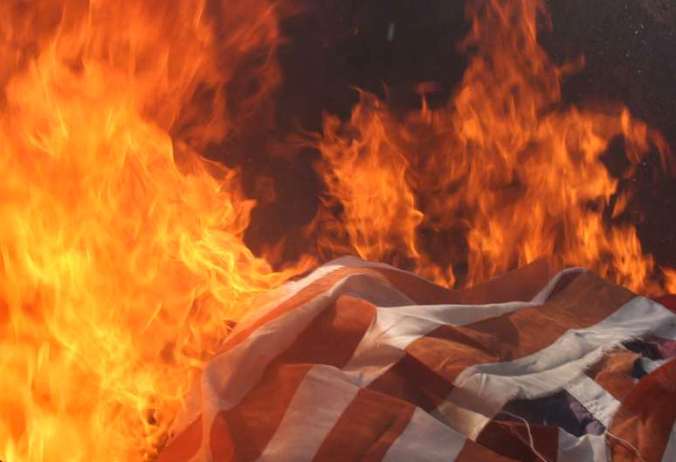
Along with a somewhat more arguable EO regarding cashless bail, President Trump just signed an executive order purporting to make “desecration” of the flag a crime and to detain and remove non-citizens who engage in it.
Ugh.
The Supreme Court in 1989 issued a 5-4 ruling that found burning the U.S. flag is protected by the First Amendment. Bush I made a big deal over this as a campaign issue; it was foolish and trivial then, and now that there is SCOTUS precedent declaring the gesture protected speech, that should be the end of the matter. Trump blathered on about flag-burning last year: I was hoping we had heard the end of it. Guess not.
I was stunned that the decision that flag-burning was protected speech was as close as it was. It has been the Left promoting the punishing of political speech (like prosecuting drivers who scuff up “Pride” symbols painted on city streets): shouldn’t conservatives see the slippery slope looming with the criminalization of flag burning?
Trump’s executive order is flagrant pandering. The Axis has been so reliable in opposing more rational measures that now he’s over-reaching. People who burn flags are telling us what they are. It’s useful information.
And it’s definitely protected speech.
 Ethics Alarms
I agree that burning a flag is protected speech as long as the burner owns the flag. There does seem to be some nuance to this EO which is confusing in that if the burning incites a riot or is done in concert with riots then it becomes a crime.
My opinion is that the flag is a representation of the freedoms we cherish. That means that the flag -if it means anything- represents the freedom to destroy it.
With that said, I must question the use of using hate as an enhancement to criminal penalties. Using a racial epithet could be easily seen as political speech when the flag is often projected to represent a racist nation in which whites oppress black and brown people. If the flag represents white oppression in the eyes of the burner does it matter if the epithet takes the form of an incendiary act or an utterance.
There is the concept of the “heckler’s veto”. That is where the government has attempted to restrict speech because the speech in question is likely to incite violence. There is significant case law on the top, and it leans heavily towards saying that it is the government’s responsibility to restrain the mob.
Terminiello v. City of Chicago is the first case on this, and many have followed.
Google AI gives the following results for “Heckler’s Veto”:
A heckler’s veto is a situation where a speaker’s ability to express their ideas is suppressed by the government, not because the speech itself is unlawful, but because of an anticipated or actual hostile reaction from the audience or opposing groups. This principle protects the First Amendment right to free speech by requiring authorities to deal with disruptive individuals rather than shutting down the speech, and it asserts that one group’s disagreement or offense should not grant them power to silence others.
Key Aspects
I await with interest the precise articulation of what constitutes desecration.
Wearing the flag as underwear? Driving around with a flag permanently mounted on your truck until it basically disintegrates into tatters? Painting it on the ground and dancing on it? Or just handing out a gazillion little paper flags that will end up strewn around the ground for people to trample on or eventually get collected by the street sweeper?
When I see the underwear or swimsuits in particular I remember the things I was taught about what respect for the flag entailed. Don’t let it touch the ground! Apparently it didn’t occur to people who were laying out guidelines to tell us we should not sit on the flag or otherwise use it as a fashion statement (gee, look how patriotic my underwear is!) in a way that would result in urine stains and skid marks on Old Glory.
I also recall that burning a flag (not at a protest, presumably discreetly in one’s back yard) and burying the ashes was actually considered a respectful way to dispose of a flag when it got threadbare (do not throw in trash!).
You make a great point. The EO does require however that any prosecutable “desecration” would need to be during the commission of another crime. That would preclude a desecration charge for wearing a flag as underwear but littering with paper flags could be.
I think any citizen of any country should have a right to burn their or any other countries flag. That is simply free speech. But if visitor to another country burns their host country’s flag then they should not be surprised if they are kicked out of the country.
Jack wrote:
And it’s definitely protected speech.
Is it, though? First of all, it isn’t speech, it is conduct. Now, I grant that the SCOTUS has classified it “expressive conduct,” and I don’t necessarily disagree with that.
Further, despite the fact I am a veteran, I don’t really care if people burn or desecrate the flag as long as their intent is to protest the United States or its policy. To me, the physical flag is not sacred — the ideas it represents are. Reverence for the flag is something we owe to ourselves as citizens, and certainly those in the military owe to the government, but I don’t think it’s necessary to criminalize its desecration by private citizens. In fact, I think such a law shows more weakness than strength when it comes to faith in this country and what it stands for.
However, as a mater of constitutional text, the First Amendment is silent about “expressive conduct” and is explicit about speech and writing. Further, the government may restrict “expressive conduct” and does so quite frequently, particularly in the area of protests.
I think Trump’s executive order is unconstitutional because it attempts to create a criminal penalty without the benefit of Congress or a lawful regulation. But I am not sure a carefully-crafted flag burning prohibition would fail at the Supreme Court these days — it might, and it would probably be closer than you think. But it also might not.
Clarence Darrow once stated that “In order to have enough freedom, it is necessary to have too much.”
Donald Trump says a lot of things that are performative in nature, and throwing red meat to the base. We will see if he wants to bring a case to the Supreme Court.
My opinion is that the country does not need any restrictions on speech, or conduct that qualifies as expression. There are some unprotected categories of speech such as incitement to violence, true threats, defamation, child pornography, obscenity, fraud, and fighting words. Some of these are legally impossible to define. The phrase “I know it when I see it” was used in 1964 by United States Supreme Court Justice Potter Stewart to describe his threshold test for obscenity.
Both the left and the right have categories of speech they hate. The left hates speech deemed “hate speech”, and the right hates “obscenity” and flag burning.
We have seen enough of the lefts cancel culture in the previous decade to gain a profound distaste for any attempts to shut down speech, with or without help of authorities. We also need to look at UK and EU to see how they handle free speech, and conclude that that is not the direction in which the US should move.
Without the Supreme Court reversing previous court decisions on flag burning, this will go nowhere and everyone knows it. As much as I personally dislike burning of the stars and stripes in protest, it’s the law. I believe the law as it stands right now is that you can buy your own flag and burn but you cannot burn someone else’s flag which is arson. My opinion on flag burning is that it’s very intentional incitement and there are far better and if the protest is actually trying to accomplish something other than to just piss off people off there are far better ways to protest. I think flag burning is equivalent to vulgar internet trolling and getting in someone’s face screaming vulgarities; flag burners are trying to incite extreme negative emotional reactions to create situations where they can condemn those they incite.
Personally I think this flag burning Executive Order is President Trump intentionally trolling the political left into extreme negative emotional reactions. There will likely be the usual unhinged Democrat politicians and pundits making the case for impeachment.
I was driving through my neighborhood the other day and noticed a small yard sign with the US flag. The first time I saw it, I didn’t notice if there was anything other than the actual flag on the sign — it’s not the usual thing in this area, it runs more to the “Black Lives Matter” type of yard sign.
So I watched for it next time I came that way. Sure enough, there was a message (this is a very small sign, by the way, perhaps 8″ square). Above the flag it said “Pro USA”, below the flag it said “Anti Trump”.
Oh well. At least they favor the USA. And they also have a sign stating that they compost.