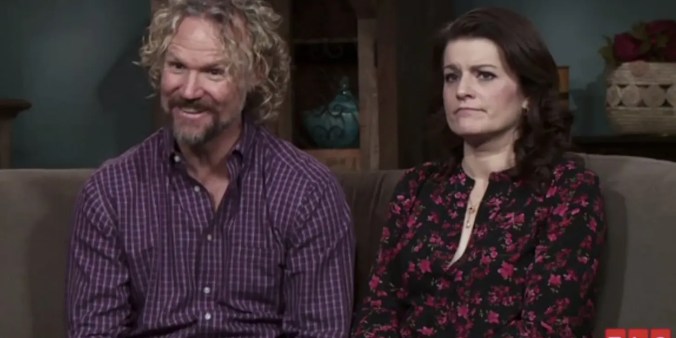
The substacker “Holly Mathnerd,” not for the first time, has a well-written and interesting post about her reaction to a book by the “star” of a reality show I had never heard of and definitely never watched. Christine Brown Woolley’s memoir “Sister Wife: A Memoir of Faith, Family, and Finding Freedom,” released today, is about one of the “stars” of “Sister Wives,” a reality show that has been running for 15 years, including 20 seasons. The show centers on Kody Brown, a fundamentalist Mormon man with twelve children from three wives. His “family” dwells in what Holly calls a “polygamist house”with three apartments branching off a shared common space. That’s Kody above with one of his other wives.
Yikes.
I really don’t care about the details. Polygamy and polyamory (the same thing but without bothering with the marriages) are unethical; never mind the morality issues. Like adultery and prostitution, these are practices that undermine families, real marriages, subjugate women and harm children. Libertarians see nothing wrong with polygamy, or at least think it should be legal, which adequately tells you what’s wrong with libertarians.
I can’t imagine buying a book by a woman who voluntarily submitted to a polyamorous relationship and now wants to make money by writing about what a mistake it was. Gee, ya think? I put Woolley’s memoir in the same category as I would a book by someone who used to shoot nails into his head but who now realizes it was probably a mistake.
From Holly Mathnerd’s account, it seems like the better part of the book is its account of just how phony “reality” shows are, not that this should be a shock to anyone who is familiar with the genre. Holly writes in part,
“…The memoir also peels back the curtain on how fake “reality” really is. Watching the show, you’d think you were seeing the Browns’ daily life: family dinners, arguments, weddings, tears. But Christine makes clear that what you’re really seeing is a carefully curated product — sometimes scripted, sometimes manipulated, always edited with an eye toward what would get people talking on Twitter.
Kody, in particular, seemed to understand this instinctively. He weaponized the cameras. He would drop painful revelations on air — things Christine was hearing for the first time along with millions of strangers — and then claim that the wives couldn’t “control the narrative” because they weren’t “being honest enough.” Meanwhile, what they were really up against was the power of editing: hours of footage boiled down into forty-two minutes that could make anyone look like a saint, a villain, or an afterthought depending on what the producers wanted.
It reminded me of the gaslighting built into the whole setup. The audience was constantly asked to question its own eyes: “No, you didn’t see favoritism; you saw family unity. No, you didn’t see cruelty; you saw tough love. No, you didn’t see neglect; you saw the noble sacrifice of plural marriage.” Christine’s memoir blows a hole in that façade by admitting what fans always suspected: our eyes weren’t lying, the edit was….
Another benefit of the post was that the blogger introduced the term “parasocial relationship,” which I had never encountered before. She didn’t define it, but I looked it up: Google’s bot says that “a parasocial relationship is a one-sided, one-way connection in which an individual develops a strong sense of intimacy, familiarity, and emotional investment with a public figure or fictional character they don’t know personally. These relationships are common and often occur through media, such as television, social media, or podcasts, where an individual feels like they have a personal connection with the person or character on screen or in their feed. While these relationships can be a natural part of human behavior and even provide positive influences, they become unhealthy if they interfere with real-life interactions or daily functioning.”
Good to know! You can read Holly’s post here….
 Ethics Alarms
parasocial relationship, aka celebrity loves, or celbrty squeezes. all of us have or had them as teens they were idientifiable by the posters on the walls. However, most outgrow these fantasy relatioships. some do become obseesive and pathological limiting normal interaction. That is why a iask couples who I ma preparing for marriage who their celebrity squeezes are to see if there are any patholiglca sembalnces to the parther they are choosing,
BTW- a disclaimer, My parasocial relationship has and remains to be Sophia Loren. However I married and remain marreid to a blond blue eyed celtic woman.
deacondan86:
I think it is a little more complicated than that. It does not have to be squeezes or loves. I notice it in myself with people I just like. A good example would be radio personalities.
I have listened to local “morning drive” stations for years. There was one that I listened off and on for 25 years. I felt that I knew the host because I did (sort of). I knew his family members, his work history, where he grew up, etc. I heard the same story over and over that I barely missed him when he went off the air.
But, if I were ever to meet him, I can imagine saying something stupid out of a false sense of familiarity. I may know him very well, but I am a stranger to him.
I bet Rush Limbaugh had that problem all the time.
Radio people often put their lives on the airwaves and create an imbalance of familiarity.
Any celebrity annoyed by an autograph seeker is getting that.
And, different celebrities handle it differently.
But, that is one reason why they say you should never meet your heroes. They don’t know you the way you know them–and they might just be a jerk to people they don’t know.
Hell, Jack probably has that to some degree.
-Jut
Wait. Reality TV isn’t real? Huh. Who knew? I might be an outlier, but I have not watched any of thes shows because I am completely uninterested in the Osbournes’ daily life. Why do I need to watch that? I don’t watch “Big Borther” or “Sister Wives” or “The Biggest Loser.” If I want reality TV, I will simply ask my wife what is going on in our humble abode. She will tell me the dog needs to go to Petco because he is getting a bit pungent. Or, she will tell me that the hummingbird feeders need new water. Or the hot water heater just gave up its spirit while depositing 50 gallons for scorthingly hot water in the laundry room. That, my learned friends, is reality for me.
jvb
“Reality” shows are a blight. They are scripted! What else do you need to know.
On a related front, I just became aware that ESPN is reporting on professional wrestling on Sports Center! Can you believe there was no one anywhere at Disney who had the cojones to say something like, “Uh. Guys? Pro wrestling is not an actual sport?”
Is a parasocial relationship a limerent relationship one step intensified and removed?
A limerence is often one-sided, highly volatile, and marked by obsessive thoughts, usually involving someone that is unavailable. The false reality of TV and social media provide a sense of knowing and connecting with the object of desire/infatuation/obsession that fosters and encourages this “intimacy”.
I’m old enough to remember gossip magazines, TV shows, etc. But for most of us we knew we were always removed from the realities of celebrity life. Yet, in this day when we make celebrities out of Kardashians and polygamists, that false intimacy is encouraged. Because they are “real people.”
Ugh. On a light hearted note. I will recommend last Donald E. Westlake’s Dortmunder novel, “Get Real.” A TV producer convinces the thief and his crew to film a reality show about their next heist. Hilarity ensues.
My sister knew a couple who want on Jerry Springer or Maury Povich or one of those terrible shows under the theme, “If you don’t give birth to a boy, our marriage is over” nonsense. In truth, the husband didn’t care about the sex of the baby. He and his wife just went on the show to get a free trip. He played it up big time on tv and the studio audience hated him.
We had an internet acquaintance who went on Stan Lee’s “Who Wants to be a Superhero”. In one scene, she interacted with someone on the street (convincing her to give our friend an article of clothing) and the show played a voiceover of our friend saying, “Oh, this is so dirty.” After the episode aired, our friend was confronted by the mother of the woman who was offended that it was implied her daughter’s clothes were dirty. Our friend explained to her that the voiceover was recorded ahead of time, along with a lot of other statements, and that the show played them wherever they wanted in episodes. She apologized to the woman and assured her that she did not consider the daughter’s clothes dirty. She admitted she’d been upset when she saw the episode but there was nothing to be done as she’d signed the rights to her voice, appearance, etc, away when she went on the show.
I remember someone from “The Biggest Loser” telling viewers that confessions and other scenes are often shown out of order and out of context. One participant was so hated by audiences because of how the show was edited that the network took down the participant’s photo and information on the website which had been generating very negative comments.
Believe it or not, there are people who do not know that these types of shows are scripted, edited and the participants manipulated in order to hype the drama.
I’ve seen endless commercials for “Sister Wives”. I have never watched it nor do I plan to do so.
I actually enjoyed Who Wants To Be A Super-Hero? at the time because it, seemingly uniquely, was encouraging the contestants to do the right, ethical, heroic thing rather than the high-ratings-fueled lying, betraying, anti-social behavior we usually see.
I guess I should have known better.
–Dwayne