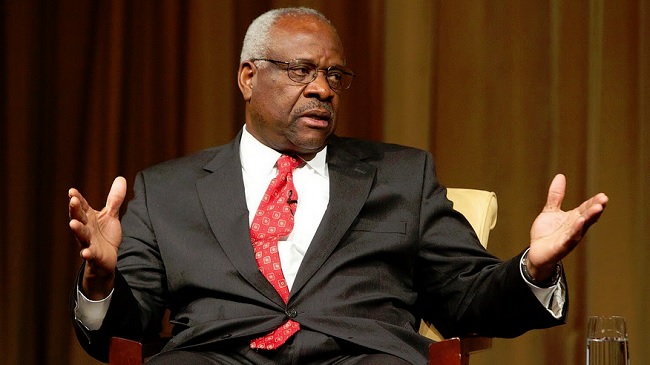
“If it’s totally stupid, you don’t go along with it…”
—Supreme Court Justice Clarence Thomas, in comments at Catholic University in Washington, D.C., as he explained why he thinks the traditional reverence for Supreme Court precedent (stare decisis) makes neither legal nor logical sense
In discussions with some of my more fair and rational progressive lawyer friends about the Dobbs decision overturning Roe v. Wade, several of them admitted that Roe was a terrible opinion, badly reasoned and sloppily written. This has been the consensus of most honest legal analysts since the 1970s, but never mind, Roe declared the right to kill unborn children for any reason whatsoever a right, so for abortion-loving feminists and their allies (including men addicted to promiscuous sex without responsibility), Roe was a “good” decision. But my colleagues who knew it was not just a poor decision but a terrible one condemned anyway, because, they said, it violated stare decisis, the hoary principle that the Supreme Court should eschew over-turning previous SCOTUS decisions even if they were outdated or clearly wrong, in the interests of legal stability, preserving the integrity of the Court and insulating the institution from the shifting winds of political power.
Like many principles, that one sounds better in the abstract than it works in reality, and Roe is as good an example as one could find short of Dred Scott. Roe warped the culture and turned living human beings into mere inconveniences whose lives could be erased at whim. How many millions of human beings don’t exist today because of the ideological boot-strapping logic of that decision, which bizarrely equated the right to contraception to the right to kill the unborn?
Reverence of bad decisions as beyond reversal is also a handy political weapon: as several wags have noted, stare decisus is mandatory when the precedent at issue is progressive cant (like Roe), but when the Left passionately believes a SCOTUS decision was wrongly decided, it’s time for an “exception” to stare decisus. In his recent appearance at D.C.’s Catholic University, where he taught at the law school until protesters against Dobbs in his classes forced him to stop, Justice Thomas pointed to Brown v. Bd. of Education, the landmark decision that overturned a well-established Court precedent holding that “separate but equal” was a principle that allowed segregation in the public schools as he neatly eviscerated the intellectually dishonest position that SCOTUS precedent must be sacred.
I believe Thomas’s flagrant violations of basic judicial ethics with his close relationships with conservative moguls disqualifies him from sitting on the Court, but that doesn’t diminish the validity of his position on stare decisus.
“It’s not some sort of automatic deal where you can just say, ‘Stare decisis,’ and then turn off the brain,” the George H.W. Bush appointee said during an event at Catholic University Law School. Thomas described the legal principle of following precedential rulings as similar to a series of railroad cars on a long train. New cases hook on to the train, following it wherever it goes.
“We never go to the front to see who’s driving the train or where it is going, and you could go up there to the engine room and find out it’s an orangutan,” Thomas said. Later in his remarks, he pointed out that many past decisions, terrible ones, have just been ignored by the Court rather than overturned. One such case was the infamous Buck v. Bell, a 1927 ruling upholding forced sterilization of “mental defectives,” in a majority opinion by SCOTUS icon Olive Wendell Holmes. The case was cited by the defense (of Nazi judges) during the Nuremberg trials. “Do we believe that you can go around sterilizing people just because the case has been decided?” Thomas asked.
Similarly, a then-liberal Supreme Court found the internment of American citizens of Japanese descent constitutional during World War II (it wasn’t), but the case has never been formally reversed. Major League Baseball has a Court-approved exemption from anti-trust laws while the other professional sports leagues do not, thanks to a ridiculous opinion by the same hack judge who wrote Roe, Harry Blackmun. Of course that precedent should be overturned, no matter how long it has stunk up the law and the sports world.
Thomas said that respect to precedent had to run both ways. “I do give respect to the precedent, but the precedent should be respectful of our legal tradition and our country and our laws and be based on something,” Thomas said. The Justice said that he first realized the hypocrisy behind the Left’s reverence for stare decisus as a student at Yale Law School after his professor, a civil liberties lawyer, mocked the reasoning in Griswold v. Connecticut (1965), which established the right to contraception under the rubrik of the Ninth Amendment, which acknowledges unenumerated rights. Thomas said he “didn’t understand how someone could take seriously something that he was ridiculing.”
This, of course, is exactly what I heard from my abortion-loving friends and relatives regarding Roe: “It may be bad law, but it advances the progressive agenda, so we love it anyway.” The ethical principles are integrity and responsibility.
Good for Clarence.
 Ethics Alarms
Jack, is this passage above necessary to your point on Stare Decisus? It seems to be a needless and distracting element?
Which passage above?
I swear this was in the above…..
“I believe Thomas’s flagrant violations of basic judicial ethics with his close relationships with conservative moguls disqualifies him from sitting on the Court, but that doesn’t diminish the validity of his position on stare decisus.“
Yes, I think it is necessary. If our host had left out Thomas’ conflicts of interests, his critics would mention it or would have called him on his previous statements rebuking the justice for those conflicts, alleging hypocrisy (As if one must throw out the baby with the bath water, so to speak.).
Acknowledging that, yes, he thinks Thomas is unethical and that, yes, he thinks Thomas should resign does not mean that he cannot agree with Thomas on a matter of law.
These types of acknowledgements have become ubiquitous because far too many people on the Left cannot see the forest for the trees. They have been ingrained to, just as Justice Thomas said, blurt out, “stare decisis” and then turn off the brain. Their automatic arguments have to be addressed.
“These types of acknowledgements have become ubiquitous.”
Yes, and I hate them. It is a dumb-headed form of virtue signaling. You can’t say anything positive about someone without disclaiming a completely unrelated point about that person. It is the intellectual equivalent of being unable to chew gum and walk at the same time.
It’s imbecilic.
J. K. Rowling, who has come under fire for transphobic remarks, said she prefers Coke to Pepsi.
Mel Gibson, whose antisemitic rant during a traffic stop in 2010 tarnished his Hollywood career, has remarked that he likes the direction taken in the recent installments of the Mad Max franchise.
Adolf Hitler, who plunged Europe and the world into war, directly and indirectly causing the deaths of more than 20 Million people, including the genocidal slaughter of 6 Million Jews, was really nice to his German Shepherd, Blondi.
(okay, maybe that last one makes sense.)
-Jut
…and by the way, this would be the perfect time for Justice Thomas to retire and take one major “conflict-of-interest” target off the back of SCOTUS.
And hopefully “strict constructionist” fans of Constitutional interpretation would get another appointment for the next generation.
I hope that last sentence makes sense.
Ah, See, in the format I see the comments, it isn’t “above.”
And yes, I feel that acknowledgment is necessary, because even though I am told that I discourage non-conservative readers, I know they re out there, and will think or write that I am a hypocrite for praising the legal philosophy of a judge whom I have said should be removed from the Court. They don’t understand the need to fight that cognitive dissonance thingy…I do.
thank you.
It was required due to circumstances, a reflection the state of current discourse.
Adding a list of the decisions over the course of American History (232?)
https://constitution.congress.gov/resources/decisions-overruled/
to give some perspective on the decisions thus overturned
The Dred Scott decision was never actually overturned by the Court? It was mooted by the 13th-15th amendments?
Right. But nothing stops the Court from issuing a blanket opinion that the following terrible opinions—Dred Scott, Buck v. Bell, Korematsu v. United States and others—-are hereby overruled and we’re terribly sorry.