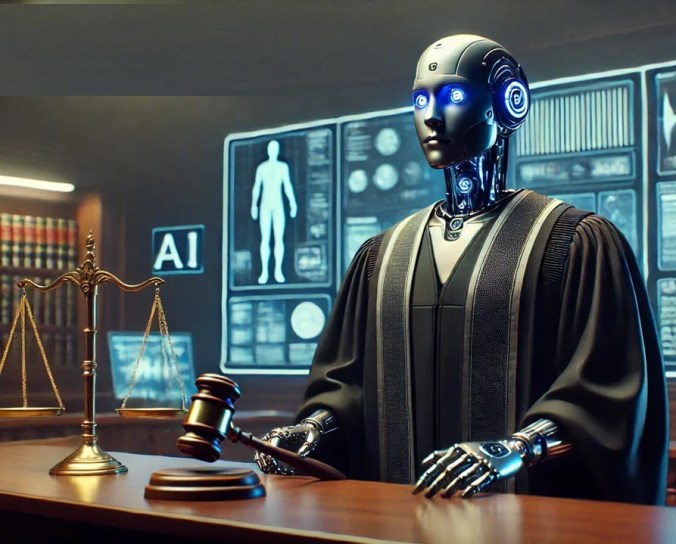
Google “AI judges” and you will see many links to news articles and even scholarly treatises about the use of artificial intelligence in the judiciary. There are already bots trained as “judicial opinion drafting tools,” and manuals written to help judges master them.
There have already been incidents where judicial opinions have been flagged as having tell-tale signs of robo-judging, and at least two judges have admitted to using AI to prepare their opinions.
I hate to appear to be a full-fledged Luddite, but I am inclined to take a hard line on this question. The title “judge” implies judgment. Judgement is a skill developed over a lifetime, and is the product of upbringing, education, study, observation, trial and error, personality, proclivities and experience. Every individual’s judgement is different, and in the law, this fact tends to imbue the law with the so-called “wisdom of crowds.” There will be so many eccentric or individual analyses of the troublesome, gray area issues that cumulatively there develops a learned consensus. That is how the law has always evolved. In matters of the law and ethics, an area judges also must often explore, diversity is an invaluable ingredient. So is humanity.
Oh, I’m sure that we will see bots developed that absorb the writings and opinions of great (or reputed to be great) jurists so we can choose from among the Oliver Wendell Holmes AI, the John Marshall AI, the Cardozo AI, the Brandeis AI, the Hugo Black AI, the Ruth Bader Ginsburg AI, and even, God help us, the Sotomayor AI. I can see the use of suck fake judges for research purposes, but I would support an addition to the Judical Canons of Ethics banning the use of AI by judges, and a judge’s signing an opinion drafted in whole or in part by a bot justifying suspension or removal from the bench. I would also support a constitutional amendment adding the right for all citizens to have their legal matters be judged by human beings as the essence of due process.
Is it likely that a bot will be a “better” judge than many currently on the bench due to elections or careless appointments? Of course it is. I can imagine AI being used to vet potential judges: I’m sure they can assist in definitively flagging idiots. However, turning over the judging function to SkyNet seems to be a line we dare not cross. Human beings should pass judgment on human affairs and other human beings. Like cloning, there is nothing inherently ethical or unethical about artificial intelligence. But allowing it to become a crutch for the lazy, incompetent, under-qualified and unethical is irresponsible for the law and the society it supports. We should find better human judges, not turn over our justice system to machines. That is a super-greasy slippery slope that we should stay far away from, no matter how strong the temptation to seek perfection through science.
 Ethics Alarms
Jack: “Sotomayor AI”
isn’t that just “Sotomayor”
-Jut
Generally speaking, I agree wholeheartedly that we should have human judges, but that the use of AI could be justified in trying to test someone’s judicial knowledge and judgement, to see if they are qualified to be a judge. However, I worry that training the if-statements would be an issue. Certainly, I would want something that was trained on many different court cases, with many different opinions, majority and minority. I’d want Roe and Dread Scott (with the corresponding reasons why these were not good opinions) as well as some of the most brilliant responses. I would want to make sure we have multiple opinions from some of the most brilliant legal minds out there, from both sides of the political spectrum. If at all possible, I’d want to skip the Sotomayor/Brown Jackson entries, but as I’m not sure that could be even applied, I would prefer to keep them in rather than bias the data too much with biased input. I would want assurances that these tests would be as central and focused on the law as possible, rather than judicial activism toward either side of the spectrum. As I am uncertain that this could be attained, my overall opinion is that we should keep AI out of the judiciary. Honestly, my own field of engineering has too many calls for judgement that need a human that I wouldn’t want an AI calculating catalyst life or pressure drop. After all, the AI is not going to be standing out there in -25 weather with 60 mph wind and having to hold its breath while great green clouds of insta-death neurotoxin are blowing past if it calculates wrong. That’s what the human is for, and I’d hate to let Skynet decide when I have to hold my breath.
That being said, I can see the temptation to add robots to the services we need. There are too many people who are incompetent, corrupt, or just accident prone to make us confident that we can get the help we need. My husband has a petition we’d like to make to the court. We found a lawyer who has the best track record in our area and price range. He has spent 9 months drafting us a 5 page petition, and once it was complete, sent us the wrong petition meant for a different client so that we could get things signed. The mistake was due to the two clients having the same initials, we think. When this happens with a so-called professional who charged us as much money as we paid, it is hard to feel like a robot could do a better job. I am sure that others could point to many other professions with the same issues. Of course, my issues make my top paragraph no less true, just that I see the temptation to let robots screw it up rather than humans. “Shirley” they couldn’t be worse, right?
Article 3 would Need to be pretty much ignored to have a judge replaced by an AI, but stupider things have been found constitutional before
Maybe this segment isn’t so far-fetched:
https://www.youtube.com/watch?v=OGxdgNJ_lZM
I’m pretty sure I don’t want AI making these types of “judgement” calls, however, I’d like to see some sort of dispassionate, Constitutionally-based review over some decisions.
When judges ignore legal and Constitutional precedents and standards to serve whatever ends they wish to attain, a review that doesn’t take years to work it’s way up the court system may not be a bad idea.
One of the channels on YouTube that I listen to discussed the potential of computer program judges. Basically, he believes it’s fairly likely that computer judges would be used to quickly decide small, civil cases, such as the burden of responsibility for a fallen tree. The advantage is that the judgement would take hours, but it’s not decided by a human. Criminal trials would still be judged by humans.