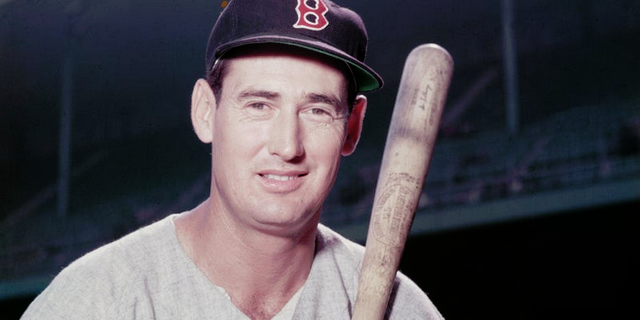
Baseball has an potential ethics problem involving baseball legend (and Red Sox icon)Ted Williams that I don’t think can be resolved.
Williams, or “Teddy Ballgame” as he liked to call himself (He also called himself “Ted Fucking Williams the Greatest Fucking Hitter Who Ever Lived”) is renowned as the Last of the Four-Hundred Hitters, Batting .406 in 1941. (He also lost the MVP vote that year to Joe DiMaggio because Joltin’ Joe hit in 56 straight games, a statistical anomaly.) That .406 average looks especially impressive in 2025, when only one player in the National League, Trea Turner, even managed to hit .300.
But just for fun, let’s imagine that Turner hit exactly .400. Ted Williams would no longer be the last of the .400 hitters, right? But there is a problem. When Ted hit .406, baseball counted sacrifice flies—when a batter makes an out with a fly ball that is deep enough that a runner on third base can tag up after the catch and score—like any other out. They counted against a player’s average. In 1953, though, baseball changed the rule so a “sac fly” didn’t count as an out. If Williams’ sac flies had been hit under the new (and current) rules, his average (he had 8 that year), would have been .413. If Turner were playing under the 1941 rules—-he hit 2 sac flies this season—those two outs would drop him below the .400 mark.
So what’s fair? Baseball once decided that Babe Ruth’s famous 714 lifetime home runs should be adjusted upwards because he played in some seasons when a walk-off homer would only be counted as the hit necessary to score the winning run; for example, if Babe hit a homer in a tie game in the bottom of the ninth at Yankee Stadium, it was only counted as a single in the record book. Then the statheads realized that they would have to change the scores of all those games, meaning the records of the pitchers involved would have to be changed as well. And it wouldn’t make sense to just give Babe back his lost homers—-every other player who hit one of those walk-off home runs would have to have their stats revised too. The whole project was abandoned.
A player’s stats can only be based on the rules in force when that player played. But ironically, that makes fairness impossible when a modern day player is being compared to a past player whose fame in part rests on a unique achievement. Should Ted Williams lose his distinction as the last .400 hitter because a modern day batter hit the mark with an advantage Williams never had? But should Hypothetical Turner not get credit for being the new “Last of the Four-Hundred Hitters” when he had in fact, hit .400 by the rules baseball plays by today?
It’s ethics zugzwang. There is no ethical option, just two unfair ones. All we can do is hope the situation never arises….but gee, it would be so cool if a player finally did hit .400 again….
 Ethics Alarms
This feels an awful lot like the slavery issue – the one where we hold participants of two-hundred-plus years ago to the standards we have today.
Washington and Madison and Jefferson and Jackson and Adams lived when rules were different and social constructs were different and culture was different. They should be judged according to those times. When we look at politicians of today and compare them, the Founders are still greats. In fact, they still tower above most, despite the flaws some try to unfairly project on them through time machine that doesn’t really exist.
Ruth and Gehrig and Williams and Hornsby and Cobb played when rules were different and the game was different and box-scoring was different. They should be judged according to the rules of the day, without a bunch of machinations to “translate” their numbers to today’s equivalents. Hornsby hit .424 in 1924…that’s astounding in any era. Williams hit .406 in ’41…also astounding. When we look at hitters of today and compare them, those early hitters are still greats.
I don’t suppose that’s saying much, but I guess it translates to “it’s more unethical to try to make direct comparisons across so wide a gulf.”
…and by the way, I had no idea that baseball statisticians had attempted this “numbers reconciliation,” so this was completely new to me.
Thanks for sharing it!
But, someone did have a batting average above 400. Aaron Judge had 541 regular at-bats, adjusted to 665 at-bats when including his walks, and adjusted to 672 at-bats when including his sacrifice flys. He had 179 hits (and some think this gave him a .331 batting average, but that must be adjusted to include the 124 walks (effectively, singles) giving him a total of 303 hits in 672 at-bats for an average of .451.
I suspect (but am too lazy to check) that others were well above .400 as well.
Ugh. You are conflating batting average with on-base-average (walks are not as good as hits). Williams’ lifetime OBA is .482, highest of all time, and his 1941 OBA was a record .553. His 1941 record was surpassed by two steroid-tainted Barry Bonds season (when he was so pumped up with steroids that he broke all record for intentional walks, a Josh Gibson season that wasn’t in the Major Leagues and doesn’t belong in the MLB record books at all.
Aw heck, Jack, I thought we were using flexible stats. If sac flies can change, then why not walks? Maybe half a hit then for a walk, since, as you say, they’re really not as valuable as a hit.
In the sense that batting average is considered archaic by modern sabermetrics principles, you are quite right!
A philosophical question about Ethics Zugzwang. I came across the statement a while ago “If you do not have options you do not have a problem”. The implication is that if you do not have ethical options because of zugzwang, you also do not have a real ethical problem. So from an ethics perspective, it might not matter which option you choose. So if the hypothetical Turner comes around, that theoretically would make the process of making the choice between the two options easier, and the focus can be directed to finding a process to maximize the buy-in from the baseball community for whatever option will be chosen. Does this make sense?
That motto is the favorite line of my cynical but wise friend Tom Fuller. But it refers to the situation where there is only one choice, so you can make a wrong one. In ethics zugzwang, you have to choose among unethical options. That is a problem.
What would be in this case the ethically proper way to navigate the ethics zugzwang?
Stick to the integrity of the rules, rule that a .400 average is a .400 average, and the variations in the rules over time don’t change that.
For my money, pre-1961vvs. post-1961 is the leading statistical bugaboo by a long shot. How many statistical categories are screwed up by increasing the number of games played from 154 to 162? (And it was done to make it easier for everyone to play all the members of the expanded leagues! With interleague play making schedules ridiculously arbitrary and random, this is irrelevant.)