It is stunning how the Axis-biased legal analysts attacking the recent indictment of NY Atty General Letitia James for mortgage fraud manage to forget, or ignore, or intentionally omit how James campaigned as AG on a promise to somehow, some way, “stop” Donald Trump, meaning to lock him up or cripple him financially so he couldn’t run for President.
The day after she was elected in 2018, Letitia James was asked by a community activist if she was gonna sue President Trump. She said, “Oh, we’re definitely gonna sue him. We’re gonna be a real pain in the ass. He’s gonna know my name personally.” James didn’t hide the fact that she would be emulating Stalin’s henchman Beria, who infamously said, “Show me the man, and I’ll show you the crime.” She wasn’t the only Democrat looking for ways to use political lawfare against Trump: it was basically the primary strategy of the Biden Administration and the Democratic Party as the 2024 election loomed. (Back up strategy: Claim Trump is Hitler.)
James ultimately settled on charging Trump with loan fraud, alleging that he inflated the value of his properties to get bank loans. It was classic selective prosecution (at the trial, the banks agreed that indeed “everybody does it”) and the evidence showed that there were literally no damages: Trump’s organization paid back the loans with interest, the banks made money, and nobody was harmed. Never mind: thanks to a flagrantly partisan judge, Trump was hit with more than a half-billion in damages, which was ridiculous. As every objective commentator predicted, they were thrown out as “excessive.“
Meanwhile, as James was doing her party’s bidding, she was tweeting statements like this: “Roses are red. Violets are blue. No one is above the law. Even when you think the rules don’t apply to you. Happy Valentine’s Day!” How professional. Then there was this:

Boy, talk about putting a “Kick me!” sign on your own back!
Condign justice arrived in the form of a Federal indictment because James repeatedly listed her Virginia home as an “investment” property in financial disclosure forms. Those claims to a bank obtained a favorable loan that barred her from using the house as a rental property. The three bedroom Norfolk, Va., home James purchased in August of 2020 was listed in the “real estate” section of James’ 2020, 2021, 2022 and 2023 disclosures to the New York State Commission on Ethics and Lobbying in Government as an “investment,” valued at between “$100,000 to under $150,000.” But in her 2024 ethics filing, she raised the estimated the value of the single-family home to “$150,000 to under $250,000” and designated the Norfolk home as “real property,” rather than an “investment.” Federal prosecutors allege that James misrepresented how she would use the property when she obtained her $109,600 mortgage loan, backed by Fannie Mae, to purchase the $137,000 home in 2020. James agreed to a “Second Home Rider” when she took out the loan, which required the attorney general to “occupy and use the property as her secondary residence, and prohibited its use as a time-sharing or other shared ownership arrangement or agreement that required her either to rent the property or give any other person any control over the occupancy or use of the property.” Yet the Norfolk property “was not occupied or used by James as a secondary residence and was instead used as a rental investment property.”
James, then, obtained a mortgage rate that would not have been available had she informed the lender that she planned to rent the property. James also represented on a homeowners’ insurance application that the house would be “owner occupied.” But in her federal tax forms James treated the Norfolk home as “rental real estate,” reporting “thousand(s) of dollars in rents received” and “claiming deductions for expenses relating to the property,” according to the indictment.
James’s defense is apparently going to be a lack of mens rea (it was all just a big misunderstanding) and that Trump’s Justice Department is engaging in vindictive and selective prosecution. Hmmmm, where have I read that phrase before?
It’s pretty simple. You can pronounce both Trump’s prosecution and James’ as politically motivated or neither. However, there is little doubt that the case against James is the more valid one. There were real damages resulting from her misrepresentations. She profited, and the public lost money as a result.
And there is another point: the use of Tit-for-Tat, usually an unethical motivation (and on the Unethical Rationalizations List, #7), has a utilitarian exception. Knowing that if you engage in an unethical tactic against an individual that same unethical tactic will later be used against you is a powerful incentive not to engage in that tactic. In litigation, for example, a legal ethics expert admitted on his blog that he prevented himself and his clients from being the victims of discovery abuse, an unethical litigation tactic but a common one, by making it clear to adversaries that if they did not play fair in responding to his discovery requests, neither would he when responding to theirs. He wrote that without the threat of retribution and Tit for Tat, discovery abuse would be the rule rather than a taboo.
That is a justification for prosecuting James. Unlike in litigation, however, I doubt that Trump’s revenge, and his various (stupid) tweets on the matter leave little doubt that this is what his pursuit of James is, will prevent a further deterioration in politics and law that the Biden/Democratic Party targeting of Donald Trump launched. They broke an important unwritten rule (or democratic norm, as it is called when Republicans breach one). It’s not going to be fixed any time soon, and until it is, I’ll be happy to see Letitia James get what she deserves.
_____
Sources: Victory Girls, PBS, Daily Caller
 Ethics Alarms
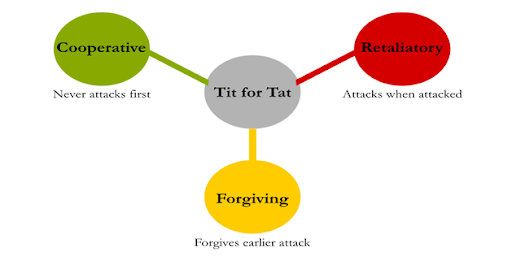
We need to discern the tit-for-tat rationalization from the tit-for-tat strategy. The tit-for tat strategy is a cooperative strategy that is used to enforce cooperative behavior from your opponent. The strategy is called cooperative as the first move in the tit-for-tat game is always cooperative. It will take a long post to explain the in’s and out’s of he tit-for-tat strategy as part of game theory; as I am traveling now that may come at a later day, as there is a loth of math involved and I also want to address how biologists use the tit-for-tat strategy as an explanation for why altruism and ethics even exist.
The Trump administration is following the tit-for-tat strategy. The reason why Trump, and the MAGA Republicans are following this strategy is that they never want to see the Democrats use the lawfare as practiced by Democrats during the Trump I and the Biden administration again. In other words the tit-for-tat strategy is used for the value of deterrence in the case of Laetitia James. The argument used against this strategy is that if the Republicans use lawfare against the Democrats, the Democrats will use lawfare against Republicans when they come back in power. The counter argument is that the Democrats have already practiced lawfare against Trump to the maximum extend possible during the two previous administration; they will jump at the chance to do further lawfare against Republicans whenever they get the chance regardless of the strategy of the Trump administration.
The situation is similar to a boy (let’s call him Rick) who is being bullied by another boy (let’s call him Dave). Dave hits Rick with a stick almost every day, with Rick protesting that it is wrong to hit someone with a stick. At one day Rick is able to grab Dave’s stick, and now start hitting Dave. Dave protests “You always said that it is wrong to hit someone with a stick”. Rick responds “Wong answer, it was wrong for you to hit me with a stick”, and keeps hitting with demands to apologize and a promise that Dave will never hit Rick again.
When the tit-for-tat strategy does not work as intended, and the opponent keeps defecting than the game actually becomes an iterative prisoner’s dilemma. In a prisoner’s dilemma game the only optimal move is to defect. In an iterative prisoner’s dilemma the optimal strategy is to continue defecting until the opponent breaks the doom loop with a cooperative move.
The tit-for-tat rationalization appears in situations where no real strategy exists. It often includes the use of prima facie unethical behavior such as violence and criminality. The Hatfield and the McCoy families are a prime example of this. I would think that the Proud Boys and the Oath Keepers operate in tit-for-tat rationalization territory more than in tit-for-tat strategy territory, with the events at J6 as a prime example.
My take is that the Trump administration acts perfectly rational according to the tit-for-tat strategy. And I consider rational behavior to be ethical and irrational behavior stupid and unethical.
Terrific comment. Comment of the Day,CVB!
I highly appreciate this Jack, and it gives me the chance to add separate comments regarding the math and the biology.
Congrats, CVB! The COTD is well-deserved and I anxiously await more details.
“The counter argument is that the Democrats have already practiced lawfare against Trump to the maximum extend possible during the two previous administration; they will jump at the chance to do further lawfare against Republicans whenever they get the chance regardless of the strategy of the Trump administration.”
This is the money quote. The Democrats have done so many things that they accuse the Republicans of doing, only to protest when it’s done to them in return. Hillary Clinton is shocked and appalled that Donald Trump hints he won’t accept the results of an election he thinks is being stacked against him, then refuses to accept the results herself when he wins. Election denial is fashionable for a time, as it was in 2000 and 2004 when the Democrats didn’t win. When he loses in 2020, suddenly election denial is evil and only practiced by wannabe dictators. They do what they want and demand that their opponents play by Marquess of Queensbury rules or they will tar those same opponents as Hitler.
Is there an error in the statement of facts? Didn’t she list a house as her primary residence and then rent it out? When it was in fact an investment property? Maybe I’m confused. Please delete after reading.
There are multiple facts as I understand for at least two properties, one in New York and one in Virginia.
Ahah!