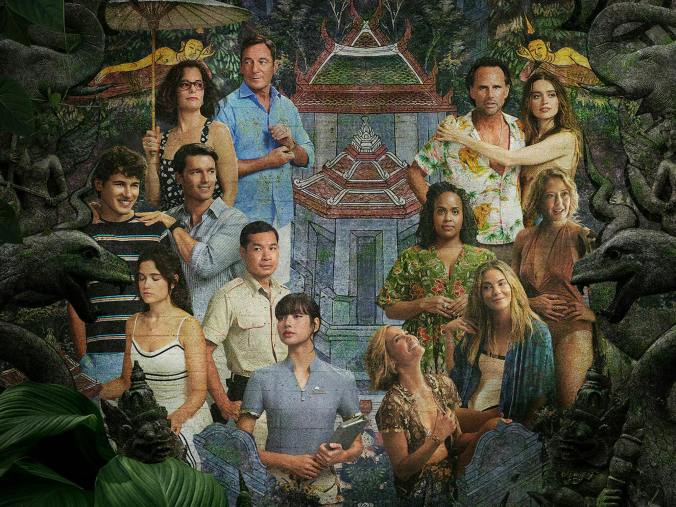
[Warning! Lots of spoilers ahead: if you haven’t see all three seasons of HBO’s hit series “The White Lotus” and want to be shocked, surprised, amused or nauseated, you may want to skip this post.]
I just finished watching the third season of HBO’s “The White Lotus” after reviewing the first two. The show is virtually a cult at this point, a black “dramedy” in which each season follows the multiple story lines involving wealthy guests during their stays at a different resort hotel in the fictional international “White Lotus” chain. (Think Four Seasons.) Season One took place at a luxury hotel in Maui; Season Two was in Sicily, and the 2025 season (a fourth is in production) featured a White Lotus in Thailand.
There are scant ethical or admirable people in any of the three seasons, and that assessment spans a lot of characters. Yet the show’s dialogue, plotting and acting style are not pitched at a satirical level so these flaws are amusing; me, I found it depressing. We meet a wide range of people with a wide range of problems and challenges, but I didn’t leave any of the seasons feeling like I had met a single character who was both memorable and likable. Dead ethics alarms and warped values are the rule at the White Lotus hotels. At least there were moral and ethical lessons built into “Fantasy Island.”
The greatest disappointment for me came in the first season. The newlywed bride of a honeymooning couple gradually realized that her rich husband was a shallow, spoiled jerk (they got married in a fever, hotter than a pepper sprout) and that she had married into a wealthy family in which her expected role would be trophy wife. By the end of their stay, the young woman had realized her mistake and told her clueless husband that she didn’t want to be married to him, a decision that any viewer of the season’s episodes had to enthusiastically endorse. Then, in the final moments of the last episode, she gave up her principles and reunited with him at the airport, a sell-out. Nice.
The second season, in Sicily, centered on two conniving and manipulative (but beautiful) prostitutes who con a gullible young idealist and his father out of $50,000 while having sex with both of them. There was also the saga of two college friends and their wives vacationing together, in which both couples were unfaithful to each other with the other couple, and somehow this strengthened both the friendship and the marriages. (Sure.) Finally, the mysteriously popular Jennifer Coolidge, the one carry-over main character from the first season, ended up dead after her husband launched a conspiracy to have her murdered by a group of charming gay men so he could inherit her half-billion dollars.
There were a couple of other entwined subplots as well, involving various betrayals and manipulations. I think we were supposed to be rooting for the two charming hookers, who were textbook sociopaths.
Season Three was the least funny and the most depressing (and violent) of all. One of the few sympathetic characters from Season One, a hotel masseuse whom Coolidge had enticed with a promise of helping her start her own business and then changed her mind, discovered her dead friend’s ex- on the island where the Thailand hotel was, and realized he was on the lam from the investigation of her friend’s murder. With the encouragement of her business grad school-attending son, she extorts the man responsible for killing her friend out of five million dollars, thus becoming an accessory after the fact in Coolidge’s murder.
A wealthy businessman on holiday with his wife and three grown children learns that he is about to be prosecuted for embezzlement and will be headed for prison and penury as soon as he returns to the U.S. He is certain that the whole family is so addicted to wealth and privilege that they would be better off dead than poor, so he plots to kill them out of kindness. This fool chickens out after almost killing his youngest son by accident, then doesn’t have the guts to tell his family what lies in store: he lets them read the breaking news on their cell phones as they ride the boat way from the resort. Then a hotel security guard, berated by his girl friend for not being ambitious enough, gets a plumb job as the hotel owner’s driver and body guard by showing her his “toughness”: he shoots an unarmed man carrying a wounded woman in his arms in the back as the man runs for help. True, the guard’s victim had himself just shot several people, including the hotel owner’s husband, but still, that’s not what police in this country call “a good shoot.” It’s murder.
Season Three, in short, had no admirable and ethical characters at all. The few who weren’t corrupt were idiots.
What fun. The ancient Greeks believed that drama must enrich the soul, teach vital life lessons, and inspire the audience even as it horrified them. Increasingly, I don’t see values being conveyed and taught in our entertainment, not ethical values anyway. “The White Lotus” depicts a human species slipping into cynicism, greed, dishonesty and corruption.
I find it difficult to laugh at that. If each episode had a round-table ethics discussion following it (instead of HBO’s fatuous “Let’s talk to the actors and ask them if they prefer to check luggage or carry it onto the plane post show garbage), the soul of viewers might be salvaged.
 Ethics Alarms
I have not watched this show, but have had several comparable experiences trying out some popular shows and finding the opening episodes so devoid of admirable characters I didn’t continue. There needs to be SOME light in the darkness for me to want to revisit a fictional world.
The one series that my partner and I watched recently that had characters who were genuinely struggling with ethics and trying to figure out the right thing to do in fraught situations was Tokyo Vice. It also does an amazing job with its multifaceted portrait of Tokyo.
Anyone else have any positive recommendations?
Just came back for a weeklong meeting. Whenever i am staying at a hotel I amuse myself by channel surfing the regualr staions. I always come away reacknowledging the dismal , banal televson fare offered by ABC, NBC, and CBS
I am 1 ep. away from the end of Season 3 of The Diplomat on Netflix. While the dialogue, acting, sets, etc. are amazing, the lack of ethics in nearly every character on both sides of the Atlantic is asstounding.
They all justify their conduct on some higher goal, purpose or ideal. We need to achieve X so we will do anything to get their. Classic ends justifying the means. In the end, they lay waste to supposed colleagues and friends and, in this season, the dead.
For the characters, the journey is sacrificed for the destination. The destination is rarely worth it.
But I am still watching, so that’s on me.
Damn typo – “get THERE” not “get their”
Oooh. I forgot that Season 3 had dropped: thanks. My diplomatic corps friends hate the show and say it is ridiculous, but I enjoyed Seasons 1 and 2. It’s been nice to see Keri Russell evolve from a teen star known mainly for her hair to a competent dramatic actress, and Rufus Sewell is always superb.
I love how you don’t let fictional ethical lapses get in the way of a good time!
Sewel is great in this again and such a superb job with his accent. Even when the dialog is fast and furious and so emotionally charged!
He’s a brilliant actor. Did you see him as Prince Andrew?
Reminds me of why I stopped watching Sopranos after a few seasons–I acknowledged the amazing acting, the strong writing…but…there was no moral center, there was no one to root for…oddly enough, I loved breaking bad and better fall saul, and I’m not sure I could define the difference?
Interesting. Breaking Bad was one of the first shows I remember watching and thinking “where are the good people?” and had no interest in continuing watching it. It has, of course, snowballed to the point that very few stories being written these days have any redeemable characters or ideas in them.
Not sure what to make of this, but in my experience, the only people making TV shows with explicitly aspirational stories these days are specifically being marketed towards right wingers.
I think you’re missing one of the all time most uplifting TV shows in modern memory–Ted Lasso. I don’t think it was directed at Rightwingers (it probably was a little on the woke side with its positive portrayal of a couple gay characters, the endorsement of therapy) and yet it had such a heart and soul and there were SO many people to root for. In fact, the “villains” are treated with such humanity, even the philandering billionaire bully team owner…and especially the young coach who stabs Lasso in the back to facilitate his own rise, gets to power, and realizes….it’s all empty if you don’t have a moral center.
Never watched it, as I am not on Apple TV (not sure whether you can stream it elsewhere yet). But it’s good to know that there are still exceptions to the general rule of darker and grittier.
Ooo, both “The Sopranos” and “Ray Donovan” explored the ethical conflicts faced by men born into a culture and tradition that required them to be sociopaths when neither was a sociopath. That kept me watching. both.
Oh, and Fleabag, in its odd way, had an uplifting message, although you have to be pretty tolerant of graphic sexuality, constant obscenity, a priest with a rampant sex drive…but the end…I think, had a message about acceptance and family.
I, for one, am grateful for the spoilers. I had heard much about “The White Lotus” but wasn’t sure if it was worth watching. Now I can skip it with confidence.