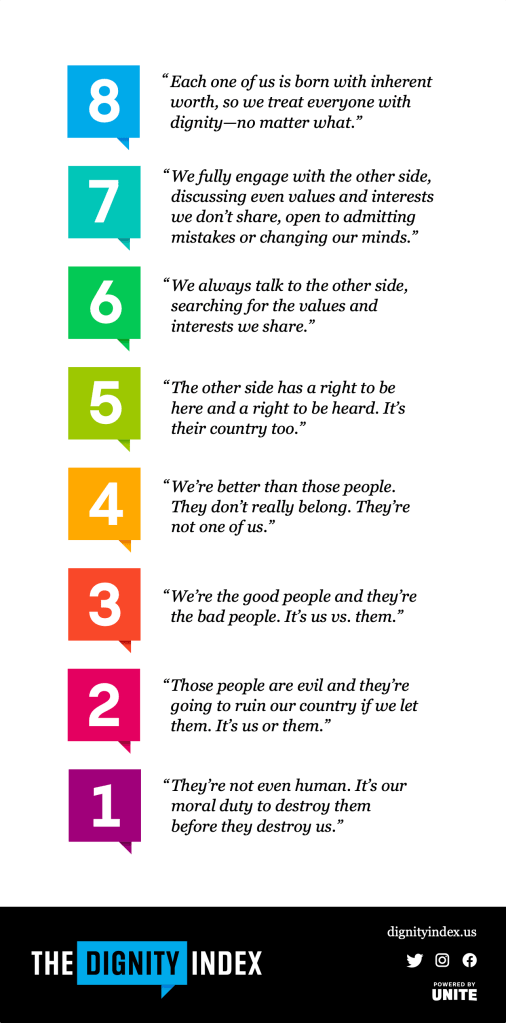
I had not encountered “The Dignity Index” before today. You can imagine why it would catch my interest, as Ethics Alarms has presented several such scales, including The Knight Scale, The Apology Scale, The Protest Ethics Check List, and others.
The Dignity Index is the creation of UNITE, an organization founded in 2018 “to find ways to help ease divisions in the country.” The Index, say its creators, is based on these contentions:
- “Contempt causes division; dignity eases division.”
- “If we put a spotlight on dignity and contempt, we will use more dignity and less contempt.”
- “If we show Americans how they can help ease our divisions, they will jump on it.”
The Index was publicized in Utah during the 2022 mid-term elections, with UNITE scoring political speech with the numerical values on each level. “The Index was seen as reliable, fair, and intuitive,” we are told. By whom? Its creators? The score-keepers? “Voters from opposite ends of the spectrum were able to agree on scores” UNITE says. All voters? Some voters? (I am suspicious of that kind of vague validation.) “The media covered the Index eagerly on TV, newspapers, and radio.” I bet they did.
UNITE says that it has identified three findings that “give us confidence the Index”:
1. “The Electrifying Effect” (yechh!) “The Index triggers a striking demand among people for briefings, training sessions, public speeches, curricular materials, and workshops.”
Translation: We can make money out of this!
2. “The Mirror Effect“At first, observers treat the Index as a tool for judging others, then find it is a mirror for seeing themselves.”
Translation: “Let’s call it “The Golden Rule”!
3. “The Agency Effect” “When people spend time with the Index, they discover that contempt is the problem, that they contribute to it, and they can take action to help solve it.”
Translation: “Don’t be Judgy McJudgeface!”
As you might have discerned, I am dubious about the index. I am always dubious when someone names something using an inappropriate adjective. Dignity is usually defined as the state of being worthy of respect and honor, based on an individual’s intrinsic worth or value. “We treat everyone with dignity” is a weird phrasing. Doesn’t that mean, “We treat everyone with respect”? Or does it mean, “we interact with everyone in a dignified fashion.”? My guess is that the authors of the thing knew everyone would yawn at another civility scale, so they chose “dignity” because it sounds nice, even if it doesn’t really fit the index.
Over at the conservative blog Instapundit, a tweet by a Utah lawyer and politician is featured saying, “Watch out Utah! The Dignity Index social credit score is coming. Utah is the pilot program for this scoring system rating one’s speech. It’s very Orwellian. This is one of greatest threats to our religious freedom (see # 2). And our freedom of speech. I have personally seen it being pushed in our schools, churches, universities, State PTA, State Bar Association and our government. It is aggressive indoctrination. And it’s everywhere.”
That reaction seems a bit overblown, but the Dignity Index does set off some ethics alarms. Let’s see:
Level 8: How does society enforce its norms and values if “everyone” is treated as if they are intrinsically a boon to society “no matter what”?
Level 7: Even if “the other side” refuses to do the same? Then what?
Level 6: Again, as my Dad used to say, “It takes two to tango.” There is nothing wrong with Level 6, except that, as with 7, the other side isn’t playing by the same rules. What is the other side will punish or “cancel” you for so engaging?
Level 5: Really? Illegal immigrants too?
Level 4: Yikes! THAT deteriorated quickly! Seems to be a missing step there…
Level 3: Is this never true? Take it away, Burt:
Level 2: Is the idea here that nobody is evil? I am sensing ethical relativism creep….
Level 1: Okay, that’s indisputably over the line.
In general, however, the Dignity Index has the whiff of self-censorship and societal apathy about it. Sometimes contempt is appropriate and the expression of contempt a valid means of social policing.
 Ethics Alarms
To be honest I have the same problem with the Golden Rule. Sentencing a criminal is not how you would be treated yourself; some criminals even deserve the death penalty.
And about level 1 “They are nor even human. It is our moral duty to destroy them before they destroy us” would be perfectly appropriate for Hamas.
I would consider this dignity index as a good example of lefty virtue signaling and moral preening.
One can defeat an opponent, even to the death, while still respecting said opponents’ basic humanity. If I was a soldier in wartime, I would have no problem shooting at those who are shooting at me, but I would never do the following:
None of these points are contingent the enemy’s morality or lack thereof. Winning an armed should be about protecting what you care about, not gratifying your bloodlust, no matter how much the enemy might provoke it.
*contingent on the enemy’s morality
*Winning an armed conflict
Please keep in mind that terrorists like those of Hamas, ISIS, Al Qaida do not have the same status and protections in laws concerning warfare as soldiers of a regular army belonging to a true nation.
I don’t find that relevant. The lines I listed were about what I believe to be moral/ethical, not what is or isn’t legal. It doesn’t make a difference to me whether or not I can get away with treating an enemy combatant like an animal pest instead of a human being, I have my own conscience to answer to. Also civilians will still be watching, and I believe that it we want to have any chance of winning hearts and minds away from the terrorists, we need to show they can trust us more than the people who use them as human shields and such.
I concur that fighting a mortal enemy is not mutually exclusive with basic respect. Respect means acknowledging their humanity and going no further than what is necessary to defeat them. Just because killing someone may be ethically justified does not mean it can be taken lightly.
Also, as you point out, ethics builds trust, which makes it practical rather than a luxury. (As far as I can tell, building trust is what defines ethics.) Ethics isn’t about giving yourself a handicap when fighting terrorists just because someone said it’s honorable. As you say, ethics is about communicating and upholding deliberately chosen standards when fighting terrorists because doing so shows others that we’re trustworthy and that therefore there are better options than terrorism for dealing with us.
Legal norms do not exist in a vacuum; they are most often informed by ethical considerations. It is not legal to kill regular soldiers made prisoners of war as ethics related to warfare has evolved. Insurgents, rebels, and terrorists do not enjoy that protection and can be executed on the spot. I do not have any ethical problem with that myself. Exchanging over a thousand Hamas terrorists against one Israeli soldier (Gilad Shalit in 2011) created an incentive for Hamas to commit the acts at October 7, 2023. Exterminating Hamas terrorists as the vermin they are is the more ethical course as it both incapacitates Hamas, and creates a strong incentive for the inhabitants of Gaza to mend their ways. It is also ethical in the sense that the Israeli government has the duty to protect its own population.
I used the word “vermin” deliberatively. There are people whose moral value is negative. The world is better of without people like that. These people have by there acts forfeited their humanity and their right to live. I may quote Genesis 9:6 here for Biblical support.
I think both responses posted by EC and GameReg are too optimistic about changing hearts and minds, and are too concerned about public opinion. Thanks to this philosophy Israel and the US have been unable to win wars decisively in the last decades. Japan’s hearts and minds only changed after Truman dropped the bomb on Hiroshima and Nagasaki. And Israel should stop caring about the opinion of people who do not have their best interests including survival at heart.
Israel would have been better off if they had starved Gaza into submission like they did up to the Middle Ages when besieging a city, or ended Gaza as an entity like Rome ended Carthage.
I can understand taking such extreme measures for practicality’s sake, but (and call me nitpicky), my concern about describing the enemy in terms like “vermin”, hints at a desire not to merely win the conflict and secure peace, but to satisfy bloodlust, which strikes me as a dangerous motivation. It can lead you to taking measures that aren’t actually necessary, because you’ve given yourself permission to remove any checks on your actions.
Also, aside from the practical considerations, I think there’s the state of one’s own soul to consider. Let’s say somebody attempts to kill me or my loved ones. I would at least like to think I could defend myself, and if I killed my assailant in the process, I doubt I’d lose sleep over it. But if he got to my loved ones and I wasn’t there, I’d support giving him the death penalty, but apart from that I’d let the law handle it, and not hunt the perp down myself. Now let’s say they sentence him to death and I just so happen to be on the execution team at the prison. It’s not a job I’d seek in real life, but in this hypothetical, I would actually feel better throwing the switch on death row inmates I don’t know at all, then throw the switch on my loved ones’ killer. Even if nobody objected to it, even though it’d be perfectly legal, it would still feel like vengeance to me if I was the one who did it, and I would not want to take a life with that mindset.
Yeah, this is just an outline for a social credit system. Unethical, unconstitutional, and basically evil with a capital “E.” The proverbial wolf in sheep’s clothing.
Perhaps the top one #8 should read each of us is born with inherent dignity, unfortunately many squander it.
Yes, going from 4 to 5 escalated too quickly. This alone suggests insincerity or lack of aptitude.
After having criticised, I realized I should provide the missing transition. After reviewing 4 and 5 again, it struck me that they are not opposites. Regarding politics 4 is nonsense. Regarding citizenship, illegal presence in a country makes 5 nonsense.
This is a list for nonthinkers who can have their minds fuddled with.
Extra credit for “fuddled.”
I think it is a mistake to interpret #5 in the context of illegal aliens, because it is saying they have a right to be here when illegal aliens literally do not have a right to be here.
I think #5 is meant to address the retort, “if you don’t like it, move to Canada,” or, in the case of Rosie, Ireland. (Of course, Rosie’s stupidity does not seem to appear on the Dignity scale.)
-Jut
I dunno…. An awful lot of progressives argue that illegal immigrants DO have a right to be here.
I agree. Many progressives do think that and may interpret this in that way. I was simply trying to infer the problem for which this is the solution. It is, at least, A RESPONSE to the “Love it or Leave it” mindset.
-Jut
Where is EC’s comment on this, I figured he would have been all over this one?
In fact, I nearly wrote that in the post! Yes, that is surprising, but remember, as an extraterrestrial, he has to worry about ICE…
Don’t be suckered. Cthulhu is not to be trusted; Its priorities are not ours.
Don’t be suckered by a cephelapod’s suckers?
Sorry couldn’t resist…
The dignity index isn’t well thought out. As I read 8 through 5, I’m thinking is there really a difference between 8, 7, 6 and 5? Then it goes totally negative. As I read through the Jack’s commentary it occurs to me that people seem to have different definitions of dignity or respect. For example, where is the line between calling out bad behavior and being rude? How do we behave when someone else endangers our life or our property; how much dignity or respect do we give them? These are not areas that are addressed in the index.
Since people are asking, though, here’s my take on the “dignity index”:
Yes, “dignity” is not a great word to use here, since it can refer to both the esteem that others have for person (or “dignify” them with) and the seriousness and discipline that a person displays in their behavior. Does someone always have dignity? Can they earn or lose it? Do other people confer dignity upon them? Are they obligated to?
“Human dignity” is, as far as I can tell, a glittering generality that can mean anything you want in order to support your assertions about what people must or must not do to each other.
This scale seems to be more of a “respect/contempt across political divisions” scale. How do people see and interact with their ideological opponents?
With that in mind, the scale itself seems fairly solid.
8. Universal love. I’m assuming “inherent worth” doesn’t refer to people as being valuable for a purpose, but to people as the source of value, a la Kant’s principle of treating people as ends in themselves rather than as means to an end. While I believe breaking things down to means and ends is a bit simplistic, I do feel it’s a good rule of thumb.
“Treating people with dignity” means treating them with respect, I assume. As I understand respect, there are degrees of it, and there are times when it is not obligatory, or even advisable. However, respect never demands that we allow someone to get away with crimes. Convicted criminals are addressed with respect in court. Respect can mean that we go out of our way to make someone comfortable, or at least that we don’t actively make them uncomfortable. Respecting a dangerous person means harming them no more than necessary to subdue them. Respecting a person who defies norms can mean being firm and clear on what you’re not going to accommodate. If you do disrespect people, it’s important to show them that they can earn respect that they would recognize, without losing their own self-respect.
7. Earnest engagement. Seeking understanding on points of disagreement is good. I don’t see the difference between this and 8. I hope they’re not implying that the highest level of dignity is moving beyond the need to discuss things we disagree about, because some of those things are important.
If the other side refuses to engage, we don’t have to constantly spend time trying to engage, but we do have to make it clear the door is still open. If someone claims to be sincerely engaging but seems to be wasting your time, you’re entitled to set boundaries. I suggest referring them to other resources and other people who would be more interested in talking with them, rather than just shutting them out. A good test of whether someone is worth talking to is if they can demonstrate they understand your concerns. I still offer a workshop to make discussing concerns easier. I’ve also got an article in the works about how you aren’t seeing the reasonable side of the opposing faction, and they aren’t seeing the reasonable side of yours.
6. Civil interactions. This is a logical step down from 7: We just stick to talking about what we have in common and politely ignore our differences. What I said about 8 and 7 applies here: actively making people uncomfortable often makes your own life harder, but you are entitled to set boundaries and impose consequences. I advise doing so as clearly as possible, because humans are often need the consequences of their own behavior spelled out for them.
5. Grudging tolerance. I don’t think they meant to step into the illegal immigration issue–it seems like a poor choice of words. This level seems to indicate resignation. “Well, we can’t kick them out and we can’t silence them. We have to let them speak, but we don’t have to like it and we don’t have to listen.”
4. Social segregation. This does seem like a bit of a jump. “We’re better than those people” is not the same as “they don’t belong,” although I guess it depends on the context. A classist might think that someone from a lower class certainly belongs in their country, but not at the same social event. “They don’t belong” could be moved down to
3. Nefarious evildoers. Now we’re seeing opponents not just as flawed or inferior, but as “bad people,” without legitimate motivations that we can identify and empathize with. They still have rights under the law, though. These are the bad guys in old cop shows and classic Westerns, and the good guys are still expected to behave honorably. We have to let the villains do something wrong before we can lock them up. Some of them might reform.
2. Witch hunt. This one is similar to 3, but now the bad people are an existential threat. There’s still a veneer of equal treatment under the law, but it’s slipping because of Rationalization 31: The Troublesome Luxury, often invoked with the excuse that “desperate times call for desperate measures.”
1. Kill on sight. Now the bad people are Chaotic Evil monsters or vermin, not subject to the same ethical treatment as people.
Overall, I’d say the scale is a decent framework for describing how people regard and treat those who disagree with them.
(After writing all this, I checked out the actual website, and it does clarify the quotes along the lines of what I described. Their 5 and 6 are more charitable than I thought they would be, which makes 4 seem like more of a jump down from 5.)
Thoughts?
(Ah, please disregard “though,” from my first sentence. I deleted a sentence that came before it, but forgot to propagate the change.)
Pingback: Politically Correct ‘Dignity Index’ Would Inject Social Credit Scores Into Public Education – Hellbound and Down
Pingback: Politically Correct ‘Dignity Index’ Would Inject Social Credit Scores Into Public Education - Citizens for Free Speech