I wish Ann Althouse would stop publishing her conversations with Grok, Elon Musk’s chatbot. Is she on Elon’s payroll? Yesterday, the quirky retired progressive law prof turned blogger was writing about the Netflix series “Death by Lightning” based on the excellent “Destiny of the Republic: A Tale of Madness, Medicine and the Murder of a President,” which EA discussed several years ago. (The books main character, James Garfield, is one of my favorite Presidents, as is the man who succeeded him after he was assassinated, his VP Chester A. Arthur.)
Noting that Garfield was a reluctant Presidential nominee, Ann decided to once again ask Grok’s opinion, as she has been doing almost daily for months now. “I’m interested in the Presidents who have not wanted to be President, who have felt bad about winning. I asked Grok to list them in the order of how much they did not want to have to do it.” Well, I wouldn’t have had to ask that, and Althouse, by publishing Grok’s ill-informed and sloppily reasoned answer, has made her readers less informed than they already are. Here was Grok’s terrible answer:
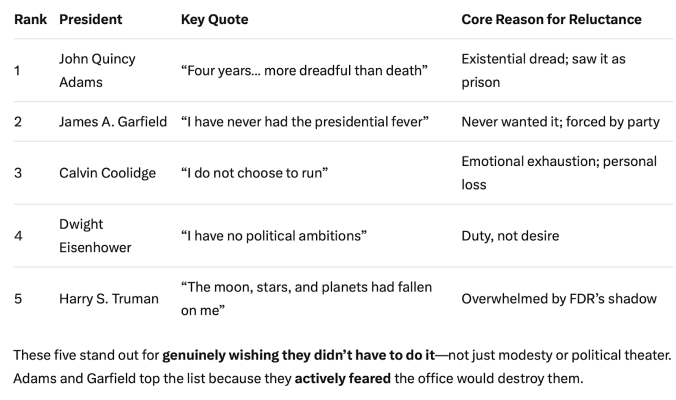 Ann just let that garbage “fake history” stand. Here is why it’s terrible:
1. The list omits the most reluctant President of all, George Washington! Washington longed to get back to his beloved Mt. Vernon after the Revolutionary War, and only accepted the Founders’ insistence that he be the new nation’s first President because he was convinced that he was the only one who could keep the strong personalities among them from tearing the nation apart, and because he had supreme faith in his own ability and judgment.
2. If John Adams’ son John Quincy hated the Presidency so much, why did he run for a second term? It’s not like there weren’t qualified competitors for the office: in his own party Henry Clay and Daniel Webster, among others, had both national fame and deep qualifications.
3. Claiming Ike was a reluctant Presidential candidate is mythmaking. Eisenhower was a natural leader and had his eye on the only job that wouldn’t be a huge demotion from his previous one as Supreme Commander of the Allied Forces. He accepted the presidency of Columbia in what was widely seen as part of a strategy to have a platform to run for President from once Truman was out of the way. Like John Quincy Adams, Ike had a qualified and determined rival for the GOP nomination in 1952, Senator Taft. He didn’t have to run for President, and he could have hardly been upset when he was elected. He was the most popular public figure in America after the war. Heck, both parties wanted to nominate him.
As I wrote in my honors thesis about Presidential character, one of the illusions the public long required of its Presidential aspirants was that, like Washington the exemplar, nobody worthy of such power actively sought it. This was one reason why the few losing candidates who relentlessly returned to run again usually lost: Clay (three times), William Jennings Bryan (three times), Thomas Dewey (twice), and Adlai Stevenson (twice, both against Ike). It took unusual confluences of circumstances and luck to let Grover Cleveland , Richard Nixon and Donald Trump break that mold.
4. Grok includes two Vice Presidents, Coolidge and Truman, who were not initially elected as President on its list, which is cheating. A couple of Veeps who entered the White House upon the deaths of their President were thrilled at the opportunity, notably Teddy Roosevelt and LBJ, and a couple of others leaped at the opportunity (Tyler and Fillmore), but the reactions of the rest—Andrew Johnson, Arthur, Coolidge, Truman and Ford— and ranged from reluctance to horror. Grok apparently didn’t read “Destiny of the Republic..”: Chester Arthur, as the book makes clear, was probably the most reluctant President of them all.
5. If you’re going to include the Vice-Presidents, who literally had no choice but to take the top job, how can you leave Gerald Ford, who knew he was in over his head (and proved it), off your “reluctance” list? Harry Truman surely didn’t relish taking over for a beloved super-President in the middle of a World War, but he found himself suited for the job, and ran for re-election with energy and passion. Does this look like a “reluctant” President who “felt bad about winning”?
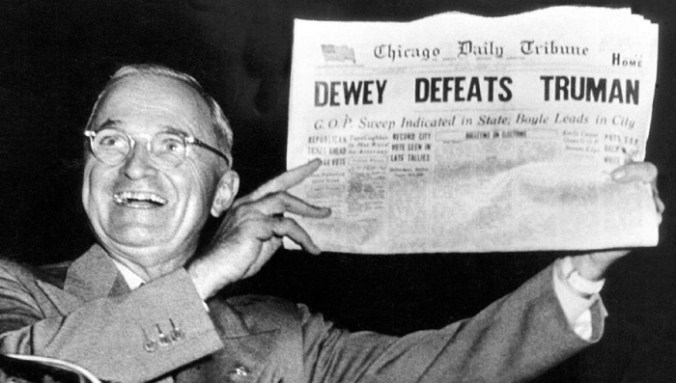
Yeah, Harry’s just miserable in that photo.
Grok obviously relied on the various President’s public statements to show their “reluctance” rather than their conduct, situation and history. Yes, Garfield was genuinely forced by the Republican convention of 1880 to accept the nomination to break a deadlock when he had arrived as a loyal supporter of Ohio Senator John Sherman, the famous Civil War general’s brother. (Now William Tecumseh Sherman meant it when he said he didn’t want to be President: his “If nominated I will not run, if elected will not serve” (a paraphrase of what he said) is known as “a Sherman,” and Presidential aspirants claiming not to want the job used to be asked, “Will you take a Sherman?” Today most Americans are too historically ignorant to know what that means. But public statements before running and after a President has left office should be taken with massive metaphorical grains of salt. “Yes, I hated every minute of it, but I nobly did my duty for the American people!” is standard post-White House baloney.
Leaving out the Veeps (as Grok should have), my assessment of the Presidents who least wanted to serve is…
1. George Washington, by far.
2. Garfield.
3. Franklin Pierce, who was a half-hearted candidate to begin with, and who arrived at the White House in clinical depression after seeing his son crushed to death in a train accident on the way to Washington.
4. William Howard Taft, a natural judge by temperament, training and inclination, whose wife pressured him to take the Presidency rather than a Supreme Court seat when Taft was offered the choice by his pal and President,Teddy Roosevelt.
5. There’s steep fall-off in “reluctance” after Taft, but if forced to name five, I’d settle on Warren G. Harding. He was a weak, insecure man who allowed himself to be manipulated by Republican power-brokers. I have always felt that Harding knew he was not suited to be President, but he was always eager to follow the path of least resistance and to make as many people happy with him as possible. That path led, weirdly enough, to the White House. I believe that the stress of doing a job he wasn’t fit for is what killed Harding.
Another possibility, unlikely as it seems, is Trump 1.0. I have always believed that he ran in 2015 as just another branding stunt, and that both the nomination and his lucky election were a shock to him. He had no choice but to take the job once he was elected, but it involved accepting a lot of public animus and sacrifice.
Trump 2.0, in contrast, would be on my list of Presidents who relished the job. That’s a much longer one. I’ll probably include it in the comments.
 Ethics Alarms
1)The question I read was what presidential candidates felt bad about winning the election. I cannot imagine there were any, nor would it ever be likely that there would. I can think of one hypothetical — if someone were to replace a candidate who died before the election, he or she might feel bad about it. But that’s never happened — thank goodness we were spared that last year.
2)I think Washington may have had a good point. Look at what happened as soon as he left office: the 1800 election between the incumbent Adams and Jefferson has to rank as one of the nastiest we have ever had, and may well have ultimately been settled with a bribe.
3)If you want presidents who felt bad about their time in office post facto, there’s another list.
Lyndon Johnson — he really wanted to be president, but I’d bet his last several years left a really bad taste in his mouth.
Nixon. Hoover. I don’t know, but surely Taft. And what about Woodrow Wilson? Surely James Buchanan, as the president who presided over the splitting of the Union.
4) And then there would be the presidents who were simply devastated by defeat: Surely both Adams, TR should have been in 1912. Perhaps Eisenhower after Nixon’s loss? This is a short list because few sitting presidents have lost reelection bids. Perhaps Johnson after the NH primary?
Presidents most thrilled to become President, in no particular order: John Adams, Thomas Jefferson, John Quincy Adams (to redeem his family name), , Andrew Jackson, John Tyler, James Buchanan, Teddy Roosevelt, Woodrow Wilson, FDR, LBJ, Nixon, Reagan, Bill Clinton, Barack Obama, Donald Trump (second term).
You put Jefferson down twice here, and did you mean to have that first “required” in
“one of the required illusions the public long required”?
No. I proof read my comments even less carefully than the posts. But unlike you, I can correct them both. So now I can say, “I have no idea what you mean!”
Um . . . I’m pretty sure those ARE in a “particular order”: Chronological.
–Dwayne
Point taken.
“I have always believed that [Trump] ran in 2015 as just another branding stunt, and that both the nomination and his lucky election were a shock to him. He had no choice but to take the job once he was elected….”
Took the words out of my mouth. A little like a dog who ends up catching the car. Probably the most amazing accomplishment in the history of elections. A one hundred percent rank amateur won the biggest electoral prize on a wing and a prayer. And even more remarkably, unlike Hillary Clinton and Kamala Harris and the entire professional political industrial complex, Trump’s an idiot.
Perot may have done that, but he backed out. That’s not really Trump’s style.
-Jut
Mr. Golden and I attended a live spoken-word performance by musician Henry Rollins back in 2017. Rollins was careful to assure his audience that he was trying to be nonpolitical but that his first impression of seeing Trump on Election Night 2016 was that the newly-elected President had not expected to win and looked completely thunderstruck.
One of the best things (for me) about EA is how much I am learning about the Presidents — thanks!
What the GROK drek illustrates most vividly for me is that unlike data mining (which can actually find useful patterns in data, generally following algorithms written by people who are actual data analysts familiar with the domain of the data to be mined) AI Internet mining seems to be incapable of discernment.
Maybe that will change? These tools do seem to be evolving quickly, so maybe? We truly live in interesting times.
BTW, don’t know if this is included in your expertise on presidential history, Jack, but your comment on Taft’s wife got me wondering how the First Ladies might be ranked re Most Eager for their spouse (Jill BIden seems to have actively pushed her husband to run for a second term) to be POTUS vs Most Horrified and Reluctant….
Wonderful question, Holly. There seem to have been three types of Flotuses: the ambitious, politically engaged fully committed partners (Abigail Adams, Dolly Madison,Nelly Taft, Eleanor Roosevelt, Ladybird, Nancy Reagan, Hillary, Michelle.) The passive, supportive, traditional loving wives (Edith Roosevelt, Bess Truman, Mamie Eisenhower, Martha Washington, Julia Grant, Sara Polk, Lucy Hayes, Edith Wilson, Barbara Bush, Laura Bush, Rosalynn Carter, Betty Ford, Pat Nixon…), the arm candy (Florence Cleveland, Jackie Kennedy, Melania…) and the burdens (depressive Jane Pierce, abusive Mary Lincoln, epileptic Ida McKinley). Which ones were the most insistent on their husbands advancing to the White House is in the data, but I’ve never focused on it.
Thanks for refocusing on the actual point of the post, which I lost in my usual obsession with the Presidents. It was supposed to raise exactly the issues you have, about how AI “thinks.”
just skimming your response, but I like Holly’s question.
there are too many obvious questions about Presidential spouses.
that creates its own category regarding presidential aspirations.
the fact that so many (or even few) First Ladies of significance (Martha Washington, Mary Lincoln, Wilson, Eleanor, Jackie, and pretty much every First Lady since Nancy Reagan) have been incorporated into this conversation is interesting
have you looked at this Jack? (Presuming the answer to be yes)
-Jut
Maybe the focus of a future post? The category that interests me most is the passive/traditional (or at least, more passive seeming?) category. If the times (and one’s husband in particular!) favored a traditional spouse role, I could imagine a FLOTUS cultivating this as a public image while also being quite ambitious on behalf of her husband.
My guess (without having any academic background on this topic but having lived through the era) is that Barbara Bush might fit this? As FLOTUS she was in the background re the public eye; I also got the impression she was quite active in offering advice to Bush Sr.
Florence Harding almost certainly belongs on a list of ambitious First Ladies.
Yes, good catch. Harding would not have been anything notable, perhaps never a politician at all, without others pushing him forward. Florence kept a relatively low profile, but she was more ambitious (and probably smarter) than her husband.
I think the fundamental problem is that AI only fulfills half of its name — Artificial.
There is really no Intelligence to go along with it, just whatever its programmers have coded into it.
If and when that starts to change……….do we get HAL or something else?
regarding Garfield and artur, I recommend the recent series “Death by Lightening”