Guest post by Steve-O-in NJ
[This excellent commentary by Steve-O was waiting in moderation when I woke up this morning, and I immediately decided to move it directly into a guest post–JM]
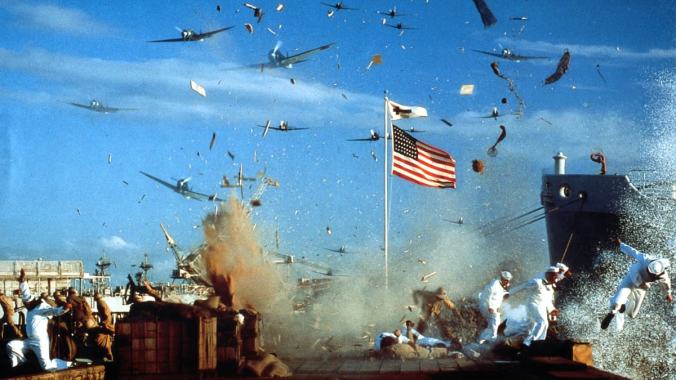
The Japanese knew themselves, or at least those with any sense knew, that after the attack they had about 6 months to win an overwhelming victory and force the United States to the peace table before the American production machine ramped up to full capacity and overwhelmed them. Their fatal mistake at Pearl Harbor was not to order the planned third strike which would have targeted repair facilities, fuel facilities, and so forth. As already pointed out by many it was only by great good luck that the carrier fleet was not present.
The damage to the battle fleet was extensive, but not total destruction. USS Pennsylvania was in dry dock and was hit by only a single bomb that caused moderate damage. Tennessee and Maryland occupied inside berths and so could not be hit by torpedoes; they received only moderate damage from two bomb hits each. Both were back in service before the end of 1942. USS Nevada took one torpedo hit, but was also back in service before long, although she rather quickly found herself moved to the Atlantic where she covered the Normandy landings. California and West Virginia were the real miracle repairs, both having sunk onto the mud and West Virginia having been hit by seven torpedoes. Oklahoma, which capsized, and Arizona, where a magazine exploded, were the only US battleship losses in World War II. Arizona accounts for almost half the American casualties at Pearl Harbor, including Rear Admiral Isaac Kidd, the highest ranking officer killed.
The following days were the darkest for the Allies, as the Japanese also sank two British battleships, forced the surrender of Hong Kong, and took Singapore and the Philippines. The Americans were fighting back with outdated equipment, a consequence of FDR’s understandable focus on domestic issues since his election in 1932. You don’t hear much about that, and only sometimes do you hear about how near a disaster Midway was, with almost the complete failure of torpedo bomber attacks.
However, the Japanese had made a few critical mistakes too. Most importantly, they had decided to train a select group of elite pilots rather than large numbers of competent pilots. The real blow struck to the Japanese at Midway was not the loss of one small carrier, but the losses among the air groups of INS Shokaku and Zuikaku, which resulted in them missing the Battle of Midway and restocking with pilots who were very green. Midway is what really broke the Japanese pilot corps, with four carriers and most of their pilots lost. By the end of 1942 the United States was on the offensive at Guadalcanal, and you know the rest.
The American rebuild resulted in 8 battleships that outclassed anything the Japanese could put to sea except for the white elephants Yamato and Musashi (and maybe those too; it was never put to the test since both those huge battleships were destroyed by aircraft), 24 fleet carriers and a huge number of escort carriers that enabled convoys to carry their own air support wherever they went, more cruisers and destroyers than you could shake a stick at, and aircraft designs like the Hellcat, Corsair ,and Mustang fighters and the B-29 Superfortress, unfortunately arrived too late for a lot of Americans.
The fact is that the United States and Western Europe had put too much faith in disarmament treaties that the Germans and Japanese signed with a smile and quickly broke, pipe dream promises to outlaw war forever. I think our esteemed host said it best when he said that we were never going to do away with war or hunger or other issues that are just part of the human condition and that idealists needed to “grow the hell up.”
Exactly. There really is no excuse for allowing your defenses to get weak while you hope for a peace that never comes
 Ethics Alarms
Huzzah, Steve! Sometimes the course of history turns on what seem to be very small decisions but have long-lasting consequences.
Si vis pacem, para bellum…
At least the Yamato was eventually sunk in shallow water, leaving it able to be repaired, refitted and later launched for a mission to retrieve the Cosmo-DNA from Iscandar to end the war with the Gamilas.
. . . or, at least, that’s something I remember seeing on TV when I was a kid.
–Dwayne
The Yamato wreck is more than a thousand feet down and broken in two pieces. It’s also been rusting for 80 years. No one is turning it into a space battleship. It had not been located by the time anime studios created Uchu Senkan Yamato.
Great stuff, Steve-O!!
I would offer up an opinion on a potential Iowa-class vs. Yamato-class engagement.
On paper, the size difference between the two classes – both physical size and the caliber of the main rifles – would seem to give an obvious edge to Yamato. But the Iowa-class battleships had vastly superior (for the time) fire-control systems, including primitive radar. The Japanese equivalents were more rudimentary, and many Imperial Navy commanders still relied more heavily on the eyes of the scouts and spotter planes than the “voodoo” of electronics. Iowa-class battleships were roughly 25% faster.
And given that an any engagement would probably have taken place at significant range (such that shells could be lobbed at greater angles onto the thinner deck armor), it stands to reason that the Iowa had a better chance to land the first blows. And it would have needed that, since Iowas were not made to withstand a 3,200-pound 18″ shell.
Thanks. According to a talk given on the USS Wisconsin the last time I visited, the steel armor of the Yamato class was less pure than that used on US battleships, and tests after the war showed that the 16 inch guns of the Iowa class would have in fact pierced it. I’ve seen a few scenarios run through on the internet. Although the odds of a single US battleship going toe-to-toe with the Yamato and winning are not good, against more than one the odds shift decisively in the US’s favor. In one scenario, where battleships USS Iowa, New Jersey. Washington and Alabama remain to guard the Surigao Strait while Halsey takes only South Dakota and Massachusetts north with him to destroy Ozawa’s decoy force, it ends pretty badly for the Japanese battle line. This is because other than Yamato, the other three Japanese battleships present are decidedly inferior to their US counterparts. Two of them, which are WWI battlecruiser reskinned, are quick work, the third takes a little longer, but before long Yamato is fighting four American battleships on her own and goes down like a wounded elephant fighting four Siberian tigers. New Jersey takes a beating too but does not sink.
Fascinating! Thanks for sharing that. Another interesting factoid I discovered when reading Malcolm Muir’s book on the Iowa-Class battleships many years ago: the Navy had 18″ guns in the inventory and considered mounting them on the Iowas during planning. But doing so necessitated dimensional changes that would have negated one huge requirement: the ability to go through the Panama Canal. As it is, they only fit by a couple of feet.
The subsequently planned but never laid down Montana class, 58,000-ton leviathans with 12 16-inch guns each, wouldn’t have gone through the Panama Canal anyway. However, they also would have been too slow (only 28 knots) to keep up with the carriers, protection of which was the newer battleships’ job. The next ships to bear the names of any state would be submarines, putting aside the short-lived nuclear cruiser program, which ended due to costs outstripping returns.
…and speaking of Midway…a synopsis I wrote years ago in another life…
https://todayshistorylesson.wordpress.com/2008/06/04/the-six-minute-miracle/
“As already pointed out by many, it was only by great good luck that the carrier fleet was not present.”
It was not merely good luck, it was Admiral Halsey who was in command of the carrier fleet, intercepted Japanese transmissions and ordered the carrier fleet into a wartime zig- zag posture. What this did was to delay the carrier fleet’s expected arrival at Pearl from December 6th to December late in the day 7th. That the Enterprise wasn’t present during the attack on December 7th caused Japanese Admiral Yamamoto much distress, because he knew any follow-up attacks would have been met by carrier aircraft.
Daddy was a Marine, wielding a portable machine gun that used a small tripod. His shoulder was shattered by a treetop sniper in Saipan. He didn’t talk about it, but Mom related that if he had not insisted on transferring to a ship hospital, he might well have been killed on shore, as Japanese routinely walked among the waiting injured to shoot them.
An uncle was a Navy medic. After he was shot, he was patched up and back to work the next day.
Danny’s uncle was a sailor who witnessed from his ship, the raising of the flag on Iwo Jima. We didn’t learn about that until his funeral eulogy.
WWII Veterans were something else.
Amen.
Beauty, Steve. You will henceforth be known as “Dial-A-Memo.”
If yall haven’t had a chance- give Dan Carlin’s 6 part “Supernova in the East” a listen-
Here’s a link to part one:
https://overcast.fm/+AAG0A2JWMVY
I’ve listened to some of his work and it’s magnificent.