Well, the majority of the Supreme Court, anyway.
Yesterday the U.S. Supreme Court hosted arguments in Trump v. Slaughter, which challenges the constitutionality of the “independent agencies” Congress has voted into existence over many decades. Their leaderss are not under the control of the President of the United States, though they are considered part of the Executive Branch. Go figure.
President Trump fired FTC Commissioner Rebecca Slaughter, not for cause, as authorized by the FTC statute, but because her service was “inconsistent with this Administration’s priorities.” Slaughter refused to leave office, setting up a constitutional showdown.
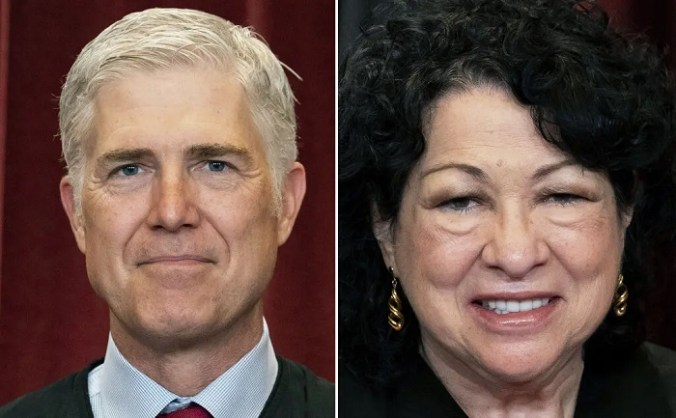
The New York Times concluded from the argument, “Justices Seem Ready to Give Trump More Power to Fire Independent Government Officials.” The momentum shifted when Justice Gorsuch (above, left) said, “I’ll put my cards on the table. Maybe… there is no such thing in our constitutional order as a fourth branch of government.”
Ya think? Article II is devoted to the executive branch and its first sentence states: “The executive Power shall be vested in a President of the United States of America.” Where’s the confusion? Congress’s establishment of supposedly “independent agencies” within the Executive Branch seems plainly unconstitutional, but big government fans love having unaccountable bureaucrats making the equivalent of laws without public interference, and the public isn’t educated sufficiently about the Constitution to know what’s going on.
Justice Sonia Sotomayor (above, right) whined to the Administration’s lawyers that “you’re asking us to destroy the structure of government” and to “take away from Congress its ability to protect its idea that a — the government is better structured with some agencies that are independent.” Now there’s an astute legal analysis. This long-running hijacking of our founding document has always been based on the ends-justify-the-means logic that its too hard to amend the Constitution so lets just violate it and pretend we’re not. Sotomayor’s opinions about how the government should be “structured” —that is, like her favorite party wants it to be—are irrelevant. The question is whether the Constitution allows that structure. It doesn’t, and it never has.
The imaginary Fourth Branch, comprised of the unelected “independent” federal agencies without accountability, are not permitted in the Constitution. Whether this extra-legal system “works” is a matter of opinion, but the Court will not be expanding the power of the Executive if it rules in the Administration’s favor, because the President will still only be able to implement his or her policies throughout the Executive Branch, as explicitly directed by Mr. Madison and Mr Mason’s masterpiece. I’m sure most of the public assumed this was what was happening all along.
Nope. And SCOTUS is finally catching up.
Good.
 Ethics Alarms
The complaint not being voiced here (which is valid) is that Congress is lazy and has granted too much of its own authority in crafting agencies by law to the executive, with very general mission statements and leaving pretty important details up to the executive branch to decide on a whim and as the political party of the presidency changes.
(And yes I know the progressive complaint here has nothing to do with that. They just want to be able to do end runs around republicans)
Is it more fundamental than that? Slaughter’s lawyer seems to be arguing that Trump can’t fire her because they (Legislature) made a law that say he can’t fire her, but shouldn’t that law be considered unconstitutional under Article 2?
They couldn’t make a law that said that the President can’t execute laws and thereby completely neuter one of the branches of our government, so how can they make a law that says he can’t fire a member of the Executive branch?
In this instance yes. But most of America’s complaints about “too much executive power” or “too much ability for the executive branches to get away with stuff” is actually a complaint about Congress but nobody knows it because 3 generations have grown up in this quagmire of “this is just how it is” since the FDR revolution.
Bingo. The Depression was the ultimate example of Rahm’s “Never let a crisis go to waste.” We cut through Constitutional boundaries to deal with a crisis, and it became a habit and a tradition.
Thank you all so much for explaining this in a way I can latch onto and understand. It’s much appreciated!!
I’m suspicious of this argument, not because it is irrational but because it presumes too much good faith on the part of Congress.
I believe that the ambiguity and delegation of it’s authority has a partisan purpose, mostly from the Left. They count on leftist judges to defend the side of the argument where the bureaucracy usurps ever more power from the Executive with the arguments substantially parroted by leftist Supreme Court justices.
Most of these agencies were created by majority Democrat congresses with either Democratic presidents or big government Republicans like Nixon. Ambiguity in their formation or operation is the literal air they breathe, because they are happy to usurp as much executive authority as they can.
The instant case is a long-overdue attempt to claw back executive authority that has been gradually but consistently eroded and signed away to the so-called “expert” class. For some reason, these days, all the “experts” seem to be on one political side, which again was probably a design feature of the agencies’ creations. Republicans, rightfully nicknamed the “stupid party,” were only too happy to participate in what I believe to be a flagrant ongoing Constitutional violation in the name of “bipartisanship.”
Experts can be useful, but the cannot be placed beyond the reach of the executive if they are exercising significant executive authority. Rule-making authority certainly qualifies, as these so-called “rules” are little more than extra-constitutional laws, especially when exercised by agencies beyond the reach of the executive.
I do not entirely agree Glenn Logan.
Preface: I do not know which agencies are “independent.” I know the Fed is, but I believe the independent agencies are the exception, with most agencies not being independent.
Where I don’t agree with you is that this is not about the expert class. All the bureaucrats are experts, regardless of whether the agency is independent.
The importance of independence is to make something not political. With the independence of the Fed, they are trying to protect the money supply from the influence of politicians. This is supposed to protect the integrity of the dollar and make the dollar a safe currency for international use. I firmly believe that the independence of the Fed is a good thing because it insulates it (to some degree) from politics. If that independence is taken away, a very rudimentary game theory analysis would tell you that the dollar, interest rates and the money supply are political fodder; everyone will (or should) view them in that light.
(I do not know how this might apply to the other independent agencies, though I suspect it would.)
Of course, while I think it is a good thing that the fed is independent, my gut instinct is that, yeah, that is probably not constitutional.
-Jut
Jut
In theory that is the way it is supposed to work. Unfortunately, when Congress deficit spends it seems to rely on the Fed not the market to buy the debt. This is known as monetizing the debt which is an inflationary practice as was seen in the last few years. Despite rising interest rates the government kept going to the well because any profit from interest mad by the Fed is returned to the treasury. Nonetheless, the money supply increases velocity remains constant and the price level rises in spite of Fed targets. Now if the Fed refunded the excess profits from government borrowing to the people I might concur that it is used to protect the store of value of our money.
I am sure you are right. AOC famously said we could just print more money (she majored in Economics, don’tcha know).
Still, an independent agency affected by 535 congress people is better than an independent agency affected by a single person.
An independent agency can realistically “punish” a profligate Legislative Branch. It is much harder to punish a single Executive that can fire you.
-Jut
good point
JutGory wrote:
Where I don’t agree with you is that this is not about the expert class. All the bureaucrats are experts, regardless of whether the agency is independent.
Yes, I understand that. My point was that the intent of the legislation by Congress was to turn over part of the President’s Article II powers to experts likely to politically align with them (meaning the Democrats and big-government Republicans) that had no accountability to the executive. The structure of Congress makes effective accountability to Article I impossible even if it were constitutional to delegate Article II powers that way.
As you say, whether or not such delegation is a good thing or not is irrelevant to whether or not it is constitutional. As you point out, I think we are likely to discover it is not.
I am guessing is that the Court will require that an office or agency with removal protections have an analog in the Founding era which had removal protections and exercised substantially similar authority , or was enacted due to an exceptional grant of power to the Congress, in order for it to be able to constitutionally exercise executive power independently of the Presidency.
The Supreme Court did that with respect to tribunals and courts organized by Congress outside of the Article III structure. See Ortiz v. United States, No.16-1423 (Jun. 22, 2018) (noting historic nature of courts and tribunals outside Article III)
That written, I am unaware of an independent agency or officer dating back to 1800 or so, exercising authority akin to the present-day FTC, or even the 1934-era FTC.
Congress is not lazy, though; there is serious thought into how to advance agendas through these sorts of agencies – the EPA, the Consumer Finance Protection Bureau, etc. These agencies are set up independent of the legislative and executive branches, with no oversight of their actions or budgets. Removal of agency directors solely for cause is a major problem for an adiminstration because simply not doing what the President wants is not “cause” under federal law. The agencies are set up to advance a party’s ideological leanings to prevent a President from coming and overturning the proverbial apple cart.
jvb
D.C.’s going to have to be turned into a cider mill to deal with all the escaped apples rolling around everywhere. I’d analogize this more to a depth charge having been set off under the district.
JVB
I wonder if this case will have any effect on Senate “Blue Slip” rules that allow a given state’s senator veto power over nominated federal prosecutors.
Such veto power by a sitting senator gives that individual senator the indirect ability to deny an opposing president the power to have the president’s DOJ investigate violations of law that the senator may not want investigated.
It seems to me that advice and consent requirement/limit on executive power does not give each state’s senators the right to block a presidential nominee by him or herself alone.
We always hear that this judge or that prosecutor was appointed by this president or that president and people assume that the prosecutor or judge is politically aligned with the president but the Blue Slip rule is relatively unknown by the public and in a state whose senators are of the opposing party the president’s choices are narrowed considerably.
The Senate has great discretion in making its own rules.
If Congress could do this, couldn’t one controlling party just create enough “independent agencies” to push the president out completely?
Or why can niot Congress create an Office of the Second-in-Command, and place the entrirety of the rest of the executive branch under this Second-in-Command?
At most, if exceptions exist, they must be deeply rooted in our nation’s history and tradition, or rooted in the text of the Constitution itself.
There is no express text allowing Congress to create an independent agency with FTC-like powers, nor do any such agencies have been shown to exist during the Reconstruction period, let alone the Founding.
Wow! A huge bomb is set to go off in D.C. when this decision comes down! It’s 1933 all over again. The biggest development in government and politics in my lifetime. Huge!
Now we need the President to sue the Congress to explicitly support Legislation with the portion of the Constitution applies.
Congress is too busy investigating rather than legislating.
Sad to see Humphrey’s Executor go. One of the alltime great case names.