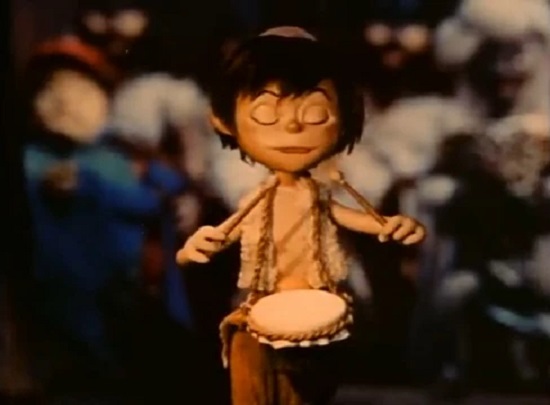
I was pleased to see today that bloggress Ann Althouse devoted a post to how awful “The Little Drummer Boy” is. She wrote, quoting from a post from an earlier Christmas season,
“[I]f you ever feel like giving me a gift, and you think all you’ve got to give is that drum number you’re threatening to perform, realize you are making a mistake. There’s also the gift of silence. I’d prefer that. I know baby Jesus reputedly appreciated the gift of drumming — according to that nasty song — but consider the possibility that Jesus was just being nice. I know, politeness is a quality alien to infants, but — come on! — it was Jesus! Put the damned drum away.”
I know I have written on EA in the past about how I rank Christmases by how many times I have to listen to the Harry Simeone Choir recording of that song. Ann also quotes Washington Post satirist Alexandra Petri’s column condemning “The Little Drummer Boy, in which Petri wrote in part,
“I cannot stand it. Nothing will fix it, even the application of David Bowie to it. Every year I say, ‘I hate this song,’ and every year people say, ‘Have you heard David Bowie’s version?’ Yes. Yes, I have. It is still an abomination.”
EVEN the application of David Bowie to it? That is, beyond question, the worst rendition of the song in existence, and I would rather pluck out my eyes and puncture my ear drums rather than experience that monstrosity by Bowie with Bing Crosby’s complicity ever again. Here’s what I wrote about the “creepiest totalitarian lyrics to a Christmas song that was already bad” in 2022:
“That would be the 1977 duet between Bing Crosby and David Bowie singing “The Little Drummer Boy.” In Bing’s last (and posthumously broadcast) TV Christmas special, he sang “The Little Drummer Boy” while Bowie sang something that sounded like John Lennon on a bad day blathering about world peace in counterpoint. I found the song retchworthy when I saw it in ’77, but some people actually like it, perhaps because of the spectacle of the greatest American popular music auteur singing with a much younger pop music icon. Or maybe because they have no taste. I tend toward the latter explanation.
“Here are the lyrics of Bowie’s section, which were apparently jotted down on a napkin by some nameless neuro-divergent intern during a five minute break in taping:
Peace on Earth, can it be
Years from now, perhaps we’ll see
See the day of glory
See the day, when men of good will
Live in peace, live in peace again
Peace on Earth, can it be
Every child must be made aware
Every child must be made to care
Care enough for his fellow man
To give all the love that he can
I pray my wish will come true
For my child and your child too
He’ll see the day of glory
See the day when men of good will
Live in peace, live in peace again.
“The couplet, Every child must be made aware, Every child must be made to care is, I wrote in 1n 2018, ” insidious, creepy, totalitarian, arrogant, and redolent of what we are currently seeing in the schools, with various state and media-approved thought-control efforts…in lesson plans.” Yes, let’s make children care about peace, banning guns, banning fossil fuels, permitting abortion, LGBTQ rights. Make them care about what their programmers care about.
“I didn’t expect much out of Bowie, but it was Bing’s show, and he didn’t 86 those lyrics as he should have, perhaps because Bing, at least when raising his first family, was big on “making children care” about what he wanted them to care about by physical force if necessary. “
Parrumpapapum!
Bite me.
 Ethics Alarms
I have a problem with contemporary choral music. Mrs. OB and I attended our granddaughter’s university Christmas choral fest (which was way too long). What is it about Christmas music that makes composers put together arrangements that are, evidently in their minds, spiffed up. I want to scream, “Can’t you just leave this repertoire alone?” (And of course the same applies to too much of the stuff played on the radio for weeks.) Fortunately, the program included a properly performed Bach cantata. Literally, music to my ears.
We had that Burl Ives album, “Have a Holly Jolly Christmas”, with the album jacket that looked like a wrapped Christmas present.
I liked his version of “The Little Drummer Boy” and “Have a Holly Jolly Christmas”. I think you didn’t like either of those songs.
Well, my mother used to play that album on Christmas and we enjoyed almost all the songs. I guess it’s just a sentimental element.
https://en.wikipedia.org/wiki/Have_a_Holly_Jolly_Christmas
Oh, I get sick of “Holly Jolly” but I never get sick of Burl Ives’ sweet tenor voice. He sings out “Have!” with special verve that gets me every time, and yes, if I had to pick the most tolerable version of TLDB, his would be it. Burl was always popular in the Marshall household, especially his folk songs.
I’ve enjoyed a lot of Burl Ives’ songs, including Holly Jolly Christmas. One of my favorites is his — supposedly the first cover — rendition of “Ghost Riders in the Sky” from 1949.
And, of course, that inspired this, which I heartily recommend:
A Facebook friend of mine recently posted her opinion of rocked up traditional Christmas hymns with this statement: “All I am asking for this Christmas is a couple of un-modernized Christmas carols. No, worship leader, we do not need a fancy new bridge to this song.”
I agree with this statement. We are told all the time that people are more likely to come to church at Christmas and Easter than at any other time of the year. Some of those classic Christmas hymns are still sung by people who are unchurched or who do not attend often. Should we really add extra rock-n-roll verses and deviations to these songs? Making it harder for these folks to participate in the Christmas service seems counterproductive?
I can’t say I have had any objections to “The Little Drummer Boy” in particular. However, I do remember my former senior pastor dressing up as Joseph for a special Christmas sermon one year and giving his message from Mary’s husband’s point of view. At one point, “Joseph” admitted, “You know that song that says, ‘The Little Lord Jesus, no crying he makes?’ Well, let me tell you, that kid had the loudest set of pipes I’ve ever heard!”
And then there’s my perennial favorite Facebook Christmas meme: “Mary, exhausted, and having just gotten Jesus to sleep is approached by a young man who thinks to himself, ‘What this girl needs is a drum solo!'”
A M Golden,
We say exactly the same thing almost every Sunday…”why does ‘How Great Thou Art’ need a drummable rhythm?” “And ‘Jesus Paid it All’ doesn’t need a modern bridge and sub-choruses thrown in!”
But then I also have to remember that “the heart of worship” does not include a continual critique of the music style. Yes, I like things a certain way, but if I just focus on worshipping the Lord, I can do that regardless of what’s being sung or how it’s being sung.
May I be so bold as to ask what denomination of church you attend? We attend an Assembly of God church…one that has a very good, biblical grasp of the manifestation gifts and maintains order.
Anyways…”The Little Drummer Boy”, bad as it may be, is still (if one can quantity such things) 10x better than McCartney’s “Wonderful Christmastime”, which is the worst Christmas song ever and is near the top of the heap for worst song ever.
EDIT: I just listened to the Crosby/Bowie version of “The Little Drummer Boy” (I had never heard it before) and I will revise my statement. That version is just as bad as “Wonderful Christmastime”, but not worse.
“May I be so bold as to ask what denomination of church you attend? We attend an Assembly of God church…one that has a very good, biblical grasp of the manifestation gifts and maintains order.”
Non-denominational – evangelical Christian.
And I agree that the heart of worship isn’t about me and my preferences. It’s sure hard to overcome that, though.
Following up on this discussion, our Christmas Eve service was an hour long and contained five songs: three were contemporary Christian pop tunes that I did not recognize and, thus, could not sing along. The fourth was “Joy to the World” with extensive lyrical additions that are not part of the traditional song and to which I also could not sing along. The fifth was “O Holy Night” with lyrical or instrumental composition changes.
What? What changes?
Yikes! You know how many times I read my comment before hitting submit?
I apologize for the typo. There were no alterations to “O Holy Night”. If there had been. I might’ve used the cheap candles we all helped each other light to fire up the first torch and go in search of a pitchfork.
Lets let Dave Barry chime in here https://open.substack.com/pub/davebarry/p/the-dave-barry-2025-holiday-gift?r=2544s5&utm_campaign=post&utm_medium=web&showWelcomeOnShare=false
An excellent protection against vapid lyrics is to listen to carols in languages you don’t understand. Here is Shchedryk in the original language (strictly speaking, it’s a new year’s song, not a Christmas carol). Americans know it as the Carol of the Bells. https://www.youtube.com/watch?v=p6RlLKvR2u8
I’m looking for a version of “Drummer Boy” in Esperanto….
Italian tenors? https://www.youtube.com/watch?v=Bhl3FAGA4B0
ugh sorry they switch to English part way through….
Beautiful – thank you Holly
Grandma Lisa
I vividly remember the day when my then-5-year-old son came home from school in raptures telling me that he had just learned the greatest song ever. I knew without asking that it would be “The Little Drummer Boy,” which we ended up singing together every night for the entire Christmas season that year. He still loves it at age 15, even though he admits that the idea of playing drums for a baby is absurd.
Likewise, he came home from a friend’s house a year or two later telling me that he had just eaten the most delicious bread ever: Wonder Bread. Luckily, he outgrew that one.
That is how I picture the song: Mary with the patience of a saint, grins and bears while a little five-year-old boy shows up and starts playing the “greatest song ever!!!”
I have to take issue with all the dunking on The Little Drummer Boy that I’m reading here.
It’s a favorite of mine, and the reason has nothing to do with the ridiculous scenario.
The reason is that this song is a microcosmic allegory of the Christian experience.
I don’t normally speak of my faith and religious beliefs here. I’m a firm believer in the notion that Truth stands on its own; it doesn’t need the support of religion in order to be true. So this post is definitely a bit of a departure for me.
“Come, they told me.” “A newborn King to see”
This is how it begins. We learn from others about the Gospel of Jesus. We are encouraged to come along on the journey.
“Our finest gifts we bring” “to lay before the King”
“So to honor Him” “When we come”
We begin the journey and quickly learn that, to those who invited us on this journey, it’s a big deal. There are songs we may or may not have heard. There are responsive readings that we almost certainly don’t know. There are people here whose whole lives are dedicated to their faith and their church. Am I expected to do that too? What IS expected of me? What does Jesus actually want from me?
“Baby Jesus” “I am a poor boy too”
“I have no gift to bring” “that’s fit to give the King”
I’m not worthy of all this. I can’t do what all these people around me are doing.
What CAN I do?
“Shall I play for you” “on my drum?”
DRUM SOLO!!! But seriously, this is the pivotal moment in the song. The drummer boy has nothing to give because he’s poor, but he just begins to realize that to say “I have nothing” isn’t true at all. He does have a skill, and perhaps this is the truest gift he can give.
I should point out right now that “giving a gift” in this context is metaphor for dedicating one’s life to serving Jesus as one’s Lord and Savior.
So is using this skill to serve the Lord the right path to take?
“Mary nodded.”
Of course it is. It’s the whole point of the song.
“The ox and lamb kept time.”
…and the others around correctly offer encouragement. This is one of the main jobs of your brothers and sisters in Christ: to help you find that path that God laid out for you and to stay on it.
“I played my drum for Him.” “I played my best for Him”
So the drummer boy not only starts down this path of finding ways to use his God-given talents in service of the Lord, he does it to the best of his ability.
I’m sure his “best” was not an awe-inspiring jazz drum improvisation that would make Buddy Rich, Neil Peart, and AN-I-MAL!!! bow down in humility before the undisputed master of the craft.
But that’s not the point, really.
“Then He smiled at me” “me and my drum”
Finally, the REAL point: the encouragement to live a life of taking the things we’ve been given, no matter how bizarre they might be, and using them for His glory rather than our own.
Jesus is happy with what the drummer boy has done.
…and in fact, this is the beginning of the personal relationship with Jesus that the drummer boy has been seeking all along. The end of the song is the first moment that Jesus interacts with the drummer boy directly.
In many ways this story has echoes of the parable of the Widow’s Mite, in which (now adult) Jesus scolds those who make a big show of their large donations to the synagogue that are more about self-aggrandizement than about charity. Jesus points out to them that the widows donation of (in our currency) a few pennies meant MUCH more than their large donations because it was all she had, yet she still donated all of it in the belief that it was the right thing to do.
Musically, my favorite rendition is the 1988 version from Christian rock band White Heart. It starts very light and quiet and gradually builds, adding instruments along the way, and features some excellent drum work (which I think is appropriate to the song) that walks a line between rock and jazz rhythm for what would otherwise be a simple 4/4 time song.
Merry Christmas, everyone!
–Dwayne
Dwayne,
That’s a wonderful analysis of the song. Thank you!
The only thing I might add is an emphasis on the line “Shall I play for you?” The drummer boy doesn’t just starting pounding away unwelcome. He makes his offering, knowing it could be rejected. Mary might be tired. The baby might need some sleep, especially after all these people showing up and exclaiming over the infant. (My wife and I now have a six-week-old, and after Mass each Sunday, there are multiple people who want to see the baby, see how she’s doing, and ooh and aah over her admitted cuteness.) The gift is offered with the possibility of rejection. But, “Mary nodded.” She graciously acquiesced to the gift, and only then does the drummer boy begin to play. I know people who exult in their given gift, and will share it you whether you want them to or not. Some will share even when explicitly told their gift is not wanted at that moment. Some will insist that you don’t know what you’re missing by rejecting the gift, and will continue to insist on sharing, or will never let you forget what you missed. Contrast that with the humility of a little boy who self-consciously asks if his gift might be wanted.
Comment of the Day, Dwayne. It is only fair to give the drummer boy equal time.