I had missed this story until one of Trump Deranged Facebook friends made an arch comment about me teaching “Presidential pardon ethics.” Huh, I wondered, what this old fool blathering on about now? It can’t be Biden’s advance pardons of his whole corrupt family because this guy never criticizes Democrats, so it must be something Trump did!” The Deranged have their uses: if Trump has done anything that by any possible stretch of the imagination could be bitched about, these people are like human Geiger-counters.
Sure enough, an op-ed in the Times came out yesterday called “The Pardon That Represents the New Era of Corruption.” [Gift link!] Wait, would that be President Clinton’s outrageous pardon of international fugitive from justice Marc Rich in exchange for a huge donation to the Clinton Library by his ex-wife? No. Democratic federal prosecutors Molly Gaston, who was part of the “Get Trump!” DOJ prosecution, and J.P. Cooney, special prosecutor Jack Smith’s deputy at DOJ, wrote the opinion piece because the President pardoned Representative Henry Cuellar, a Texas Democrat awaiting trial on federal bribery charges. Or perhaps it’s more accurate to say the wrote the opinion piece because they could see the potential in the story to impugn President Trump.
For good measure, to style the partisan hit job as “non-partisan,” the two prosecutors also attacked Hakeem Jeffries for praising Trump’s pardon of a Democratic House member. “Rather than be critical or perhaps stay silent, the House minority leader, Hakeem Jeffries, welcomed the pardon and engaged in shameful pandering, apparently to maintain Mr. Cuellar’s party loyalty,” they write. “Most disturbingly, Mr. Jeffries did so by attacking the legitimacy of the criminal case against Mr. Cuellar, publicly dismissing the indictment against him as “very thin.” As former federal prosecutors who spent our careers rooting out public corruption, we see this for the wagon-circling that it is. The jury’s detailed, 54-page, multicount indictment against Mr. Cuellar was anything but thin, and he should have had to stand trial before a jury of his peers.” They continue, “Mr. Jeffries’s embrace of Mr. Cuellar was a disturbing sign that Democratic leaders, when it is politically advantageous, may be willing to join in Mr. Trump’s degradation of the justice system.”
Jeffries’s “embrace” of Cuellar was nothing more nor less than standard partisan team-play that has been repeated ad nauseam almost every time a member of Congress has been accused of having his or her metaphorical hand in the cookie jar. “Everybody does it” is not an excuse, but when everybody does do it, a critic’s credibility is blown when he or she says, “I’m shocked, shocked that Congressional leaders defend members of their own party! This is a terrible new development!”
I believe their pointless swipe at Jeffries is a tactic to give credibility to their imaginary case that Trump pardoned Rep. Cuellar as apart of a quid pro quo deal. After all, “pandering” is not a crime, nor even corrupt. But the authors link to what they say was Trump’s acknowledgment that he had issued the pardon to induce Mr. Cuellar to switch parties. When I clicked on it, I reached a Trump Truth Social post that did no such thing! See…
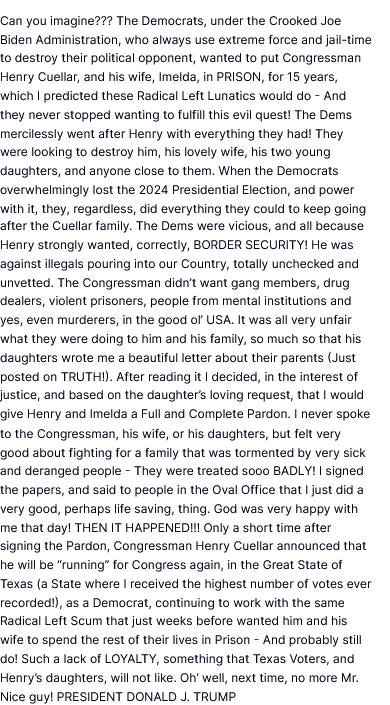 More extreme confirmation bias? Hallucination? What the Hell? Where’s that “deal”?
Trump absolutely does not say or even imply that he gave out the pardon as part of a bargain to have Cuellar flip parties. What he says, as you can read yourself, is that he believes Democrats set out to use lawfare against one of their own who consistently has supported Trump’s illegal immigration enforcement, that he identified with his own ordeal at the hands of unethical Democratic prosecutors, and thus issued a pardon. Then, after bestowing this unrequested gift, he was disappointed that Cuellar didn’t change parties in gratitude. There is no hint of a quid pro quo, and Trump says he never spoke to Cuellar. Nor does he say that he issued the pardon with the assumption that Cuellar would go GOP.
The link does not back up the two prosecutors’ assertion: if they tried that stunt in court, it might justify a mistrial or sanctions. I have seen their tactic more and more frequently in the Times and elsewhere: an author uses a link to support a statement, and the link doesn’t say what he or she claims it says. I suppose the assumption is that most readers don’t use links and enough of those who do are so suggestible that they’ll see what they are told to see.
The Rep. Henry Cuellar Ethics Train Wreck can be seen as an extension of the Biden Presidency Ethics Train Wreck. To rescue the Worst President Ever and his party from the just desserts of their catastrophic reign, Democrats set out to use lawfare to remove their most dangerous adversary. When the strategy failed and Trump was elected, he was naturally drawn to those he felt had been similar victims of political prosecutions, like the J-6 rioters. Trump issued an impulsive pardon—hardly uncharacteristic—to a Democrat he decided was being punished for supporting him. I very much doubt whether Trump read the indictment or the evidence: this is the same man who said Pete Rose was as innocent as Goldilocks. Then two partisan prosecutors pounce, literally lying about Trump’s motives. He’s a renowned deal-maker: is it really plausible that he would think he had a quid pro quo deal with Cuellar without communicating with him?
Oh sure. See, the President was lying in his Truth Social post, see, because everyone knows he always lies.
Pardons are low-hanging fruit for critics aiming to tar a President with “degrading the justice system.” By definition, anyone receiving a pardon is a miscreant in someone’s eyes. This pardon may have been a political stunt, it may have been a stupid pardon, it may have been an ill-considered pardon. What it wasn’t, at least by any evidence revealed in the op-ed, was a corrupt corrupt pardon.
The “new era of corruption” revealed by this episode is the partisan corruption among prosecutors.
 Ethics Alarms
“Mr. Cooney and Ms. Gaston were corruption prosecutors in the District of Columbia U.S. attorney’s Office and in the Justice Department.”
Emphasis added.
I assume they already have juicy partnerships at big D.C. firms?
Sometimes, even when the prompt is labeled as an ethics look at a partisan hit job, as this one is, the ethics issue in question is not entirely clear. Here, it appears it is the NYT article and not the pardon of Cuellar. If that is the case, then I guess it comes down to whether or not there was a quid pro quo, the real essence of the Times’ story. Trump’s post (opinions will vary here) does suggest that just such a quid pro quo did exist. Following on to a statement that Cuellar was going to run again as a Democrat, Trump said, “Such a lack of loyalty.” That statement, of course, could refer to Cuellar’s disloyalty to Trump, loyalty to himself being something Trump prizes greatly, or it could refer to the Democratic Party’s disloyalty to Cuellar. Well, fill in the blanks as you prefer. To me, the context suggests disloyalty to Trump. As to Trump’s statement that he had no conversation with Cuellar about a pardon, well, maybe, maybe not. There is a pattern regarding honesty with Trump as there is with his opponents. I trust neither side.
If the ethics issue is the pardon (seems unlikely here), then the ‘whatabouts’ (Clinton, Biden) may be appropriate, but, I don’t think so. The legitimacy of the pardon of Cuellar should stand or fall on it’s own.
As to the actual Times article, I immediately go to my fall-back position, which is ‘Do not trust any one second-hand source’, or, if you have a favored source, then go with The Gipper, ‘Trust, but verify’.
If there was no quid pro quo, than any pardon is by definition legitimate, or do I have to quote Portia again? Fact: there is no evidence of a quid pro quo, but the author states as fact that Trump said there was. He simply did not. Ergo, I don’t see your point.
Yeah, I should have said justification, not legitimacy.
I love the phrase, “There is no evidence”. Years ago, that usage convinced me the Clintons were innocent of all wrongdoing. Sure, some, wrongly, I’m sure, claimed they just were good at hiding the evidence.
Trump’s claim that it was a politically-motivated prosecution is 100 per cent credible.
The fact is that the photos offer no evidence of wrongdoing. I don’t see how you or anyone can :legitimately” argue with that. No, the absence of evidence doesn’t mean there isn’t evidence of wrongdoing that hasn’t been uncovered, but that’s the logic of people who insist that there’s a Loch Ness monster out there, or that Bus and Cheney took down the Trump Towers.
There is no question in my mind that if Trump were not a threat to run again or be politically influential, he would not have been prosecuted in any of those four bogus cases. They were 100% political prosecutions. That doesn’t eman there was no evidence in any of them to support a prosecution, but political considerations pushed shaky cases over the line in all four cases.
The prosecution in question was Cuellar’s, not any other. It is a bit of a stretch, for me at least, to believe Trump’s pardon of Cuellar was simply to end a politically-motivated prosecution of a Democrat initiated by a Democratic administration.
The guy is the rare Democrat who opposes open borders. To someone like Trump, that’s ultimate virtue. I have no trouble believing that was enough even if Trump believed he was a crook. He’s a crook with integrity!