[Good morning! Was Santa good to you? I might as well repost this essay about the Christmas truce; since I only have published it on Christmas Day, some readers might have missed it, and EA, believe it or not, sometimes gets new followers from time to time…]
One of the weirdest events in world history took place on Christmas 1914, at the very beginning of the five year, pointless and stunningly destructive carnage of The Great War, what President Woodrow Wilson, right as usual, called “The War to End All Wars.”
World War I, as it was later called after the world war it caused succeeded it, led to the deaths of more than 25 million people, and if anything was accomplished by this carnage, I have yet to read about it.
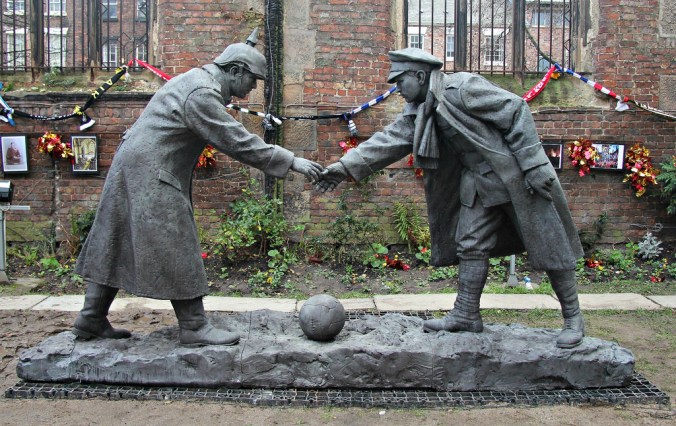
The much sentimentalized event was a spontaneous Christmas truce, as soldiers on opposing sides on the Western Front, defying orders from superiors, pretended the war didn’t exist and left their trenches, put their weapons and animus aside, sang carols, shared food, buried their dead, and even played soccer against each other, as “The Christmas Truce” statue memorializes above.
The brass on both sides—this was a British and German phenomenon only—took steps to ensure that this would never happen again, and it never did.
It all began on Christmas Eve, when at 8:30 p.m. an officer of the Royal Irish Rifles reported to headquarters that “The Germans have illuminated their trenches, are singing songs and wishing us a Happy Xmas. Compliments are being exchanged but am nevertheless taking all military precautions.” The two sides progressed to serenading each other with Christmas carols, with the German combatants crooning “Silent Night,” and the British adversaries responding with “The First Noel.“ The war diary of the Scots Guards reported that a private “met a German Patrol and was given a glass of whisky and some cigars, and a message was sent back saying that if we didn’t fire at them, they would not fire at us.”
The same deal was struck spontaneously at other locales across the battlefield. Another British soldier reported that as Christmas Eve wound down into Christmas morning, “all down our line of trenches there came to our ears a greeting unique in war: ‘English soldier, English soldier, a merry Christmas, a merry Christmas!’” He wrote in a letter home that he heard,
“Come out, English soldier; come out here to us.” For some little time we were cautious, and did not even answer. Officers, fearing treachery, ordered the men to be silent. But up and down our line one heard the men answering that Christmas greeting from the enemy. How could we resist wishing each other a Merry Christmas, even though we might be at each other’s throats immediately afterwards? So we kept up a running conversation with the Germans, all the while our hands ready on our rifles. Blood and peace, enmity and fraternity—war’s most amazing paradox. The night wore on to dawn—a night made easier by songs from the German trenches, the pipings of piccolos and from our broad lines, laughter…“
A Smithsonian article opined that several factors worked together to produce the conditions for the strange spontaneous ceasefire:
“By December 1914, the men in the trenches were veterans, familiar enough with the realities of combat to have lost much of the idealism that they had carried into war in August, and most longed for an end to bloodshed. The war, they had believed, would be over by Christmas, yet there they were in Christmas week still muddied, cold and in battle. Then, on Christmas Eve itself, several weeks of mild but miserably soaking weather gave way to a sudden, hard frost, creating a dusting of ice and snow along the front that made the men on both sides feel that something spiritual was taking place.”
Fighting continued throughout Christmas in many places. It was the German troops, then regarded as “easy-going,” that made the first friendly overtures, shouting to their British adversaries, “We are Saxons, you are Anglo-Saxons! What is there for us to fight about?” That would not have worked during the next war. But then the trusting British were soon leaving their trenches, and as one British soldier wrote in a letter home—”literally hundreds of each side were out in no man’s land shaking hands.”
On the Eastern Front, the Russians, still using the old Julian calendar, believed Christmas was almost two weeks away. The French were in no mood to let bygones be bygones even for a day, since the Germans occupied a third of France.
In maybe two-thirds of the British-held trench line that ran across southern Belgium Christmas was the Most Wonderful Time of the Year. Both Germans and British soldiers reported that soccer games took place, mostly between pick-up teams of the same nationality, but in a few places, perhaps there were a few Krauts vs. Limeys contests.
The soldiers understood that the truce was only going to last through Christmas, and many officers on both sides were furious that it lasted that long. Most soldiers were determined to practice Peace on Earth at least until midnight. In one spot presents were even exchanged. That seems absurd to me, but there is documentation.On December 26, the fighting and killing resumed. There would be no further truce until the Armistice of November 1918.
I read one article that said that this bizarre event demonstrated “the importance of choosing to see past our momentary hatreds.” How does it demonstrate that? The “truce” saved no lives; it didn’t shorten the war, lead to more mercy and compassion or promote understanding. The victors in the First World War still enacted such punitive measures against the Germans that it seeded World War II.
Soldiers who operate under the delusion that warfare is a noble pursuit tempered with honor and mutual respect are deluding themselves. The idea is to kill people, and to end the war as quickly as possible. The “Christmas Truce” was incompetent and naive.
I should add that my attitude toward this famous tale was greatly influenced by an episode in my father’s World War II memoirs. He was relieving Allied troops that had taken a town, and was startled to see that the area appeared to be partitioned, with American soldiers on one side, and German soldiers going about their business on the other. “Oh, yeah,” he was told by the commanding officer he was relieving. “We made a deal to let Jerry alone on that side of the town, and they promised not to bother us. It’s great.”
My father had his troops march in and capture the peaceful Germans as soon as he took over. “The German commander was furious,” Dad wrote. “He said this proved you couldn’t trust Americans.”
 Ethics Alarms
I have always felt the annual retelling of this Romance was itself unethical. On this day we celebrate the incarnation on this day we celebrate the incarnation of the Prince of peace. It is only he who can bring peace. This is not a day mealie of kindness. To go forward and play soccer with another who you knowingly will strive to destroy. It’s not only unethical, but it is hypocritical. As you point out, the purpose of war is to destroy your enemy as quickly and as efficiently as possible so that the war may come to its end. That to me is the ethical road to take.
But the Lord can work in mysterious ways.
As long as men have free will there will be violent disagreements. To assume that the Lord would not seek a temporary peace by putting good will in men’s hearts even if only briefly would mean that peace can only be had at the second coming.
The retelling of this story reminds us that we have the capacity for peace if we want to. Contention is not a permanent condition of life unless we make it so.
ethical truce?
or unethical?
I thought you said unethical, but the title says otherwise.
typo?
or are you just mellowing with age?
-Jut
At the level where wars actually are fought, the impulse stop the war is understandable. It is even more so when the opposing sides share a part of a culture that, seasonably, at least, proclaims peace on earth, good will to men. When it seems to be the case that yielding to that impulse would have no impact on the war aims, then it’s difficult to see such yielding as unethical.
“… the delusion that warfare is a noble pursuit … .” Maybe it’s a delusion, but many believe, for example, that countering and then defeating Naziism was a noble pursuit.
“The idea is to kill people, and to end the war as quickly as possible.” If the idea is to end the war as quickly as possible, then immediate surrender would accomplish that. Achieving the war aims would have to come before ending the war, unless those aims became, or were perceived to have become, unachievable. And, killing people is the idea only insofar as it enables the primary goal of achieving the war aims.
… facilitates the primary goal … , not enables.
If the song “imagine” is unethical because kumbayah utopian solutions are impossible, could then be said that their is at least one war that would be ethical, though not WW1.
As I understand it, WW1 was a George Floyd level freakout by the world with militaries involved.
If there is a legitimate authority which is resisted to the point of death, how do we know which side of the force/resistance clash is legitimate without the armed conflict? Dinner wagging does not stop a Putin or Mao.
Determining the nobility of war is difficult at the outset, as in many other challenging situations. Some clarity may come later.
I spent most of 1967 as a soldier in Vietnam, and our purpose early on, stop the spread of communism, seemed noble. Four years later, I was back again in what now what was a war we were not determined to win. In addition, we were fighting for a government which we then knew was untrustworthy (take your pick here, RVN or USA, both fit). Nobility, to the extent we even thought about that, was questionable.
It must be somewhat similar for those who fought in the so-called First Gulf War, and then the Second, and then GWOT.
There’s an old saying, “Walk a mile in my shoes.” Hmmmpphhh. It’s not a mile. It’s far more than a marathon.
To the point, yeah, I know, finally, if you weren’t there, STFU.
OWFII, I read your comment several times before my mind woke up. And, I have to agree on how we determine which side is right. Often enough, I await further information.
So, legitimate authority? A tough one.
Which side is legitimate. Another tough one.
Dinner wagging??? Too esoteric for me.
“I should add that my attitude toward this famous tale was greatly influenced by an episode in my father’s World War II memoirs. He was relieving Allied troops that had taken a town, and was startled to see that the area appeared to be partitioned, with American soldiers on one side, and German soldiers going about their business on the other. “Oh, yeah,” he was told by the commanding officer he was relieving. “We made a deal to let Jerry alone on that side of the town, and they promised not to bother us. It’s great.”
My father had his troops march in and capture the peaceful Germans as soon as he took over. “The German commander was furious,” Dad wrote. “He said this proved you couldn’t trust Americans.””
Was this for one day or was it intended for the duration of the war? I don’t begrudge the trench soldiers on either side allowing one day to recognize their common humanity. If the commanders in your father’s time decided they were just quitting the war and letting the enemy sit it out, too, that was unethical.
Sorry, I just learned that my phone died swiping better than typing.
Oh, “Finger wagging” like Obama or or other NATO nations while they allows their cultures to collapse because of their canabalistic altruism.
Without the broader experiences of others, I tend to err on the long to side of patience determining guilt because my initial conclusions always have changed when presented with the messier context. Most of my life has involved thinking someone was wrong for their decisions because of their reasons when the very same decision needed to be made because it was the only path forward regardless of reasons.
I only presented the questions because
1. Jack seems to have a very simple conclusion that war is unethical.
2. I do believe that there is legitimate authority. Which one? Regardless of the manner of establishment, the one that is established.
As a christian, I am called to honor the existing authority, even a Maoist one. Yet, I am American and part of our system is resistance.
Also, I do not find war intrinsically unethical.
Either one side surrenders to avoid war or both sides agree to discover how the sovereignty of God plays out raising some nations and tearing down others.
I think my phone is on incoherent christmas food coma mode today.
Died should be does… Office mate looked at me like i was out of 1995 for not knowing what swiping is.
During the American Civil War, there were innumerable episodes of informal truces between the armies.
Keep in mind that these were citizen soldiers, not professionals, for the most part volunteers. American soldiers tend to have somewhat different outlooks on war and soldiering than some other nations.
In this case, the civil war soldiery, being practical men, had the idea that, even though they would do their darndest to kill each other come the next battle, that wasn’t a reason for them to refrain from a little horse trading.
So, almost any time opposing armies were camped close to each other, at night there would be informal trading parties out to improve their lot. The yankees looked to get some southern tobacco, while the rebels were after coffee beans. I’m sure there were lots of things traded, but I think these were prime commodities. As well, if memory serves, the soldiers would trade gossip on generals, on the chances for the upcoming campaign or battle, etc. The next day, though, they were ready to kill each other in job lots.
I’m sure the higher authorities were annoyed by all this, but they were never able to stop it. It seems to me that there were also occasions where the two armies would serenade each other with songs.
To me, it says that the soldiers had a lot more in common as Americans than separated them. They worshipped the same gods, they sang a lot of the same songs, they thought a lot more alike than not. I think it was also one of the factors that enabled us to knit together the nation after such a bloody war.