Last night I found myself bereft of several food items, basics like bread, spaghetti sauce, milk, hot dog relish and grape soda, so I took a jaunt over to the local grocery store to re-stock. The place was almost literally deserted; I thought of Dick Van Dyke, on his show’s famous flying saucer episode (“Unny Uffs!”) working late in an empty office and saying to himself in his best Boris Karloff impression that he felt like “the only living thell in a dead body.”
But one human being was in evidence…a short, slight little middle aged man with slicked down hair who is apparently on the job all day and night, all week long. I see him every time I visit that branch. He is always bustling about, restocking shelves, giving directions to customers, and generally hurrying up and down aisles like the White Rabbit in Disney’s animated “Alice in Wonderland.”
I had thought before, in past visits, that he was as hard working and professional an individual as I had ever encountered anywhere in any occupation, always cheerful, always cheerily greeting me and anyone else he came across. My only discourse with him before last night was to answer his “How are you today. sir?” greetings and to answer, “No, I’m okay, thanks!” when he asked. “Can I help you find anything?’
Last night, however, when we passed in an aisle and briefly ended up face to face, I noticed that he had a blackened, swollen eye and a large bandage over his cheek beneath it. So I inquired, “What happened to your face?” His expression immediately brightened, his demeanor relaxed, and he began telling me that he had that week an operation on a basil carcinoma. Animatedly, the man, whose name I did not know and still don’t know, told me about his history with skin cancers, the experiences of his three sisters, the size of the small growth removed, and more: where he grew up, how much time he has spent in the sun as a child, and his favorite sports and activities growing up. I stood there for 20 minutes listening to him. It seemed that he was so grateful to receive a caring response from one of the hundreds of Harris Teeter’s shoppers he must encounter every day, most of whom treat him as if he were a mannequin at Target, as I always had.
Then he finished his brief life story, smiled broadly, shook my hand, and said, “Well, better get back to work! Have a wonderful weekend!” As I walked down the cheese aisle, I found myself thinking, “Jeez, Jack: that didn’t take much time. Just a few minutes of thoughtfulness, and you probably made that guy’s day. You just have to remember this, and reach out more often.”
And I suddenly recalled—how could I have forgotten?—that my father, Jack A. Marshall Sr., used to do that all the time, and it drove my Greek-American mother crazy (if you weren’t family, you were an alien as far as Mom was concerned). He was always striking up conversations with strangers, especially clerks, gas station attendants, waiters and repair men.
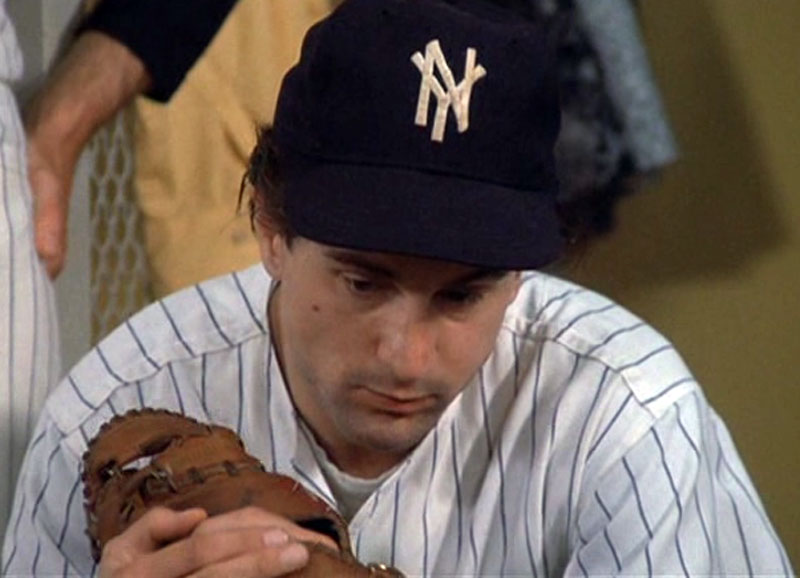
As usual, my father had it right. I remember when we saw the 1973 baseball movie “Bang the Drum Slowly” together he was moved by an exchange in the film between the slow-witted third-string catcher (Robert DeNiro) and the protagonist and narrator of the story, star pitcher Henry Wiggin (a pre-“Law and Order” Michael Moriarty). The catcher, Bruce Pearson, has a fatal disease he tried to keep secret but the secret got out, and now instead of being generally treated as a nuisance by his teammates, the he is feeling appreciated and respected for the first time in his life. He is playing better than ever too. The catcher attempts to minimize his newfound popularity, telling Henry, his roommate and once his only friend on the team, “Everybody’d be nice to you if they knew you were dying.”
Henry replies, “Everybody knows everybody is dying; that’s why people are as good as they are.”
Everybody, including me, needs to remember that, certainly better than I have.
 Ethics Alarms
” ‘You just have to remember this, and reach out more often.’ ”
Yer damned skippy! Random acts of earnest, compassionate human decency cost nothing yet are worth their weight in gold.
“He was always striking up conversations with strangers, especially clerks, gas station attendants, waiters and repair men.”
I do the same, it was once called being a People Person; Dr. Rick would have field day.
PWS
Boy, I hate, hate, hate that campaign. Would that more young people would grow up to be their parents.
Earlier this week, I cracked the tank on one of our toilets by unwittingly over tightening a bolt. I ended up driving into Tucson twice (an hour and a half roundtrip) to first get a gasket (that didn’t fix the problem) and then a new tank. It was such a joy consulting with Guillermo, a local plumber, Mike, the guy at Ace (although he sold me a gasket that wouldn’t work) and the guys at the plumbing supply store in Tucson. So much more enjoyable and humanizing than searching and ordering stuff online. So enjoyable talking to guys who know their stuff.
“Boy, I hate, hate, hate that campaign.”
This I knew, and knowing that assisted me as I contemplated a comment.
We unequivocally agree that being like your parents ain’t no bad thing; quite the opposite…from where I’m sittin’, leastways.
PWS
Thanks, Paulie. Attention should be paid to that commercial.
And by the way, when I was at the plumbing parts store, Andre, the guy who was waiting on me and solving my problem, pulled up the price for the part, said, out loud, “One hundred and fifty-seven dollars. That’s too much. I can’t charge you that. A hundred and seventeen, that will do.” So, he charged me the wholesale price that all their plumber customers get. Then he gave me a piece of paper with his cell phone number on it so I could call him if I had any problems.
Best practices strongly recommends that you make sure your lawyer, accountant, AND your plumber, are well paid!
PWS
Should add that part of the compensation packages I provide to my professionals includes beau coup (arguably) world class Organic Heirloom Tomatoes
PWS
And the response to Governor Evers: Milk your own damned cow, Tony! Churn your own butter!
My Dad did, too. He’s go out for a few things at the store and be gone hours. After he passed, more than one person wrote on my Facebook page that it was sad they wouldn’t run into him at Hanniford’s/Shaw’s/Ace Hardware anymore. That shopping wasn’t the same without ‘running into Tom’. I talk to people. Drives my son a bit crazy (it’s really not done here)but he humors me.
My uncle rose to the challenge of achieving rapport with strangers, although perhaps its was successful only halfway. Sure, h e’d talk with people and staff of the places he would visit, but the reactions were mixed. For example in restaurants he would ask the waitress “Do you serve alcohol to minors here?” And then he’d explain that he was a coal miner, blah blah blah. Then when the check came he’d ask the waitress if she could cash a small check. If she said “yes” he would pull out a small check — half the size of a postage stamp. Then he’d sometime stare that the menu and when it was his turn to order he’d ask her “Do you have chicken legs?” which would inevitably have him bending over from his seat to pretend to examine her legs for any evidence of feathers. It wasn’t until he asked “Do you have chicken breasts?” that she finally dumped a plate of hot spaghetti in his lap.
A famous family incident involving my mother came during a period when we were getting a lot of wrong number calls: apparently ours was one digit off from a local fish market. One night the phone rang and Mom picked up. “I BEG your PARDON!” she shouted indignantly, and hung up the phone. Then she started laughing. “I think I over-reacted,” she said. “Why, what did he say?” my father asked. “Do you have lobster bodies?” she answered.
Last Saturday, I ended up taking my mom to the emergency room. We got there early and shared the waiting area with a couple of men. One was holding his head and regularly asking if there was a room ready. My mom asked if he was okay. He said he was dizzy and hungry.
Neither of us had food on us, though we’d each separately considered bringing crackers or chips or something. But I’d brought an individual bottle of orange juice unopened in my bag so I offered it to him.
Eventually, he got into a room and my mom got into a room. Several hours later, she was sent down to the pharmacy area for a prescription. As we walked toward a set up doors, a man opened the door for us. We thanked him. He acknowledged our thanks and then thanked us for the orange juice.
We hadn’t even recognized him. He looked 100% better.
This is a uniquely American trait, and a very admirable one at that.
At our core we are wired to be social creature,s even myself. I’m decidedly introverted but it’s good to make an authentic connection to the masses. More difficult now that everyone is so busy staring at screens.
Well done and a good reminder that being present — really present — in one’s interactions with a fellow human being is sometimes that best present one can give.
And it costs nothing but a little time (much of which I spend daily on far less important pursuits…)
Thank you for this.
I had a similar experience on Saturday. I am the director of pastoral music at a small rural parish. My choir, counting me, is made up of three people, with a new singer who is looking to join us and lead the new Spanish-language Mass starting next week, so I guess I get to say four from now on. We cover a total of two masses a weekend, plus the Spanish Mass once a month, funerals, Holy Days, etc. With so few musicians, running a music ministry is quite unique. I plan music and coverage for Masses, I record music for our player piano or player organ can play on command, and I pass along communication as needed. However, with such a small group of diverse people with VERY diverse schedules, there is very little opportunity for team building, musical enhancement or even practices, and really, everyone goes their own way.
Advice on how to turn a solely volunteer organization with no incoming folks into something that has rehearsals would be sorely appreciated, as no one is really interested in having rehearsals or meetings, which limits my ability to expand our musical abilities if nothing else. But that is beside the point.
This Saturday, I finally got the organ and specifically the new control computer up and running, allowing the organ to be played without a live organist. I held a training for one of my singers. As this was a solo training, we had no need to spend every second handling the training, and so we chatted a bit. Not only did she and I enjoy this opportunity to connect as humans and not just musician and director, but she needed someone who was outside of her current work structure and school system to vent to about how rough things were. Thirty minutes of venting later, and she seemed to be an immensely happier person. I was gratified that I could offer that minor service to her, and reminded of the value of human connection.
I was reminded in the midst of the conversation, as if extra words were spoken by the Holy Spirit himself, that being a person to listen and react to someones concerns is such a wonderful gift one can give, and it costs nothing but enhances our own humanity. There is also a Golden Rule aspect of this. When I need to vent about an issue that is driving me crazy, I like having someone listen and sympathize. Since I enjoy that, I can only work to be that person for others. I am an introvert by nature, as well as someone who is not very socially adept, so I find in-person interaction to be extremely difficult to agree to. However, these interactions, which seem so hard in theory, become a joy to ourselves and others when we attempt to push ourselves out of our comfort zones and interact with others. I think many people forget this in our increasingly digital world. I know I do.
Sarah, you perfectly articulated this ethics issue, and it is one that creates an ethics conflict for me. I had an office organizer here for a few months to try to help me, as my business, finances and schedule have been a disaster since Grace died. I am perpetually behind in my work, because this is at least a two person job, and I’m lousy at the half Grace did. My office organizer said that she won’t come back until I promise not to take personal calls during the work day. Well, 1) my work day is all day and night. Second, almost all of my friends as well as my younger sister are retired. When they call, they need to talk, and I always have felt that I should demonstrate that listening to them is important. There are exceptions, but this is a lifetime commitment with me. But my angry organizer is right: this takes up time that isn’t “productive” and curtails my income-related efforts.