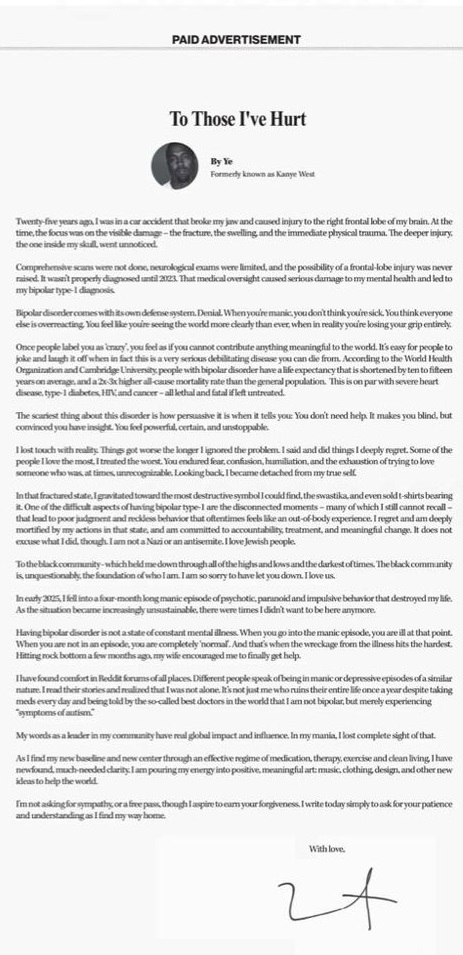
That’s the full page ad that “Ye,” aka. Kanye West, paid to have placed in, of all papers, the Wall Street Journal. I wonder what percentage of WSJ readers even know who the hell he is? Never mind; he did it. Here’s what the ad says (I hesitate to put down “he wrote’):
“Twenty-five years ago, I was in a car accident that broke my jaw and caused injury to the frontal lobe of my brain. At the time, the focus was on the visible damage – the fracture, the swelling, and the immediate physical trauma. The deeper injury, the one inside my skull, went unnoticed….”
It wasn’t properly diagnosed until 2023. That medical oversight caused serious damage to my mental health and led to my bipolar type-1 diagnosis. Bipolar disorder comes with its own defense system. Denial. When you’re manic, you don’t think you’re sick. You think everyone else is overreacting. You feel like you’re seeing the world more clearly than ever, when in reality you’re losing your grip entirely.
Once people label you as crazy, you feel as if you cannot contribute anything meaningful to the world. It’s easy for people to joke and laugh it off when in fact this is a very serious debilitating disease you live from….
The scariest thing about this disorder is how persuasive it is when it tells you: You don’t need help. It makes you blind, but convinced you have insight. You feel powerful, certain, and unstoppable.
I lost touch with reality. Things got worse the longer I ignored the problem. I said and did things I deeply regret. Some of the people I love the most, I treated the worst. You endured fear, confusion, humiliation, and the exhaustion of trying to love someone who was, at times, unrecognizable. Looking back, I became detached from my true self.
In that fractured state, I gravitated toward the most destructive symbol I could find: the swastika, and even sold t-shirts bearing it. One of the difficult aspects of having bipolar type 1 are the disconnected moments – many of which I still cannot recall that lead to poor judgment and reckless behavior that oftentimes feels like an out-of-body experience. I regret and am deeply mortified by my actions in that state, and am committed to accountability, treatment, and meaningful change. It does not excuse what I did, though. I am not a Nazi or an antisemite. I love Jewish people.
To the black community – which held me down through all of the highs and lows and some of my darkest times. The black community is, unquestionably, the foundation of who I am. I am so sorry to have let you down. I love us.
In early 2025, I fell into a four-month long manic episode of psychotic, paranoid and impulsive behavior that destroyed my life. As the situation became increasingly unsustainable, there were times I didn’t want to be here anymore.
Having bipolar disorder is not a state of constant mental illness. When you go into the manic episode, you are ill at that point. When you are not in an episode, you are completely “normal.” And that’s when the wreckage from the illness hits the hardest. Hitting rock bottom a few months ago, my wife encouraged me to finally get help.
I have found comfort in Reddit forums of all places. Different people speak of being in manic or depressive episodes of a similar nature. I read their stories and realized that I was not alone. It’s not just me who run [sic] their entire life once a year despite taking meds every day and being told by the so-called best doctors in the world that I am not bipolar, but merely experiencing “symptoms of autism.”
My words as a leader in my community have real global impact and influence. In my mania, I lost complete sight of that.
As I find my new baseline and new center through an effective regime of medication, therapy, exercise and clean living, I have newfound, much-needed clarity. I am pouring my energy into positive, meaningful art: music, clothing, design, and other new ideas to help the world.
I’m not asking for sympathy, or a free pass, though I aspire to earn your forgiveness. I write today simply to ask for your patience and understanding as I find my way home.”
It’s time to check the old, Ethics Alarms Apology Scale to see where this whatever it is fits.
According to the scale, this is the hierarchy of apologies, their function and their motivation, from most admirable to the least credible:
 Ethics Alarms
“My words as a leader in my community have real global impact and influence. In my mania, I lost complete sight of that. ” I doubt the veracity of that statement. It certianly reveals he, like all celebbreties, are Narcissistic .
However, his desription of Bi-polar Disorder is spot on. Almost like he had a copy of the DSM in front of him.
If he dad a trauamtic brain injury, as he said, this also can lead to behavioral and congnitive chanes. You, Jack, have pointed, that out freqeuntly, regarding the effects of a career in football.
The “apology” sounds sincere, based on fact. But there is that “sale” motivation to contend with.
#5 For sure he was on some really potent stuff to bring him down to everyone else’s sober reality if he wrote this.
#6 Is this him leveraging cognitive dissonance?
I’m no psychologist, but my grandmother has manic depression and when she is on the manic phase, she is INCREDIBLY self destructive. When she hits the depressive phase, she seems to have no sense of what she has done. Things have gotten so bad with her decisions when manic, and her denials of them, over the years that I’ve been asked if I can play “Ding Dong the Witch is Dead” at the funeral, and I’m not sure the requester was joking. I am also unsure if I’m able to resist the temptation.
I don’t know if mania can cause anti-Semitism. I personally, with no expertise, believe that when a person is in mania, they just turn off the filter we all have on our words and behavior and become the loudest, most obnoxious version of themselves. As this is a totally uninformed opinion, it should be treated as worth two cents at most. But that’s how I look at these folks.
I personally look at what Kanye is saying here and conclude that he probably did not remember doing these things. He may be an anti-Semite, but knows to keep that to himself, normally. I know there are things deep in my brain that I don’t let past the filter and refuse to act upon that make me a less than noble person, but I also don’t have a manic phase that turns off my self control. Therefore, I am willing to give him the benefit of the doubt, assuming he has been treated for and is probably on medication for his illness. Of course, his music is nothing I will ever be interested in, so as a non-consumer, I may be able to afford magnanimity when someone else who is considering what to do with their money may have a harder time believing him.
A good friend’s husband is manic depressive, too. When in a mania, he spends like there’s no tomorrow. She’s had to send items back, close credit card accounts, freeze their credit so he can’t take out more card accounts and, when his father was alive, freeze his credit because her husband opened accounts in his father’s name.
In a depressive state, which is where he is now, he lays around and does nothing.
I don’t know if it makes people say things they wouldn’t ordinarily say either.
Mania classically causes disinhibition and often psychosis. Disinhibition is manifest in a variety of self-destructive behaviours, including reckless spending, polyamory, dangerous driving, etc, though it can also lead to brilliance (ie not sleeping and being unusually productive). Psychosis is detachment from reality: this can include thinking one is God’s chosen instrument, lizards have infiltrated the government or any number of anti-Semitic/Holocaust-denial beliefs.
All this is to say, Kanye’s ad could reflect the genuine and unfortunate experience of someone with Bipolar I Disorder. There’s no way for us to tell if he’s being truthful, but I’m inclined to give the benefit of the doubt.
Is the ad timed to help improve his public image in time for a new music release? I find it likely; however, this doesn’t, to me, make the ad too much less believable.
It makes no difference whether I believe his sincerity, because his culture and mine do not intersect. I recognize his name, but I don’t think that I’ve ever seen his image. But I think his apology is a public service, to inform people about the causes and behaviors associated with bipolar disorder, to understand the frailties of the people around us.