…and anyone who admits to using that network for news should be ashamed of themselves, as well as ignored when they opine on political issues.
Just when I think the news media cannot get more biased, unprofessional and dishonest, something like this happens…usually on CNN, MSNBC, or in the New York Times.
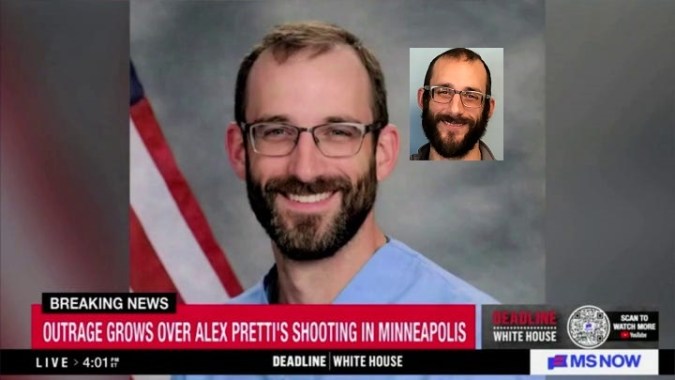
MS NOW used an AI-enhanced image of Alex Pretti, the anti-I.C.E. activist who was killed by a U.S. Border Patrol agent during an immigration enforcement operation. Naturally, the faked photo made him look better than he really did, a public opinion manipulation tactic as old as photography and unethical to its core. This is cheap Cognitive Dissonance Scale game-playing, because “lookism” is embedded in our DNA. A nicer-looking figure is more likely to land in positive territory on the scale than a fat troll: remember how much sympathy there was online and in the media for the handsome young terrorist who maimed all those innocent people in the 2013 Boston Marathon bombing? The alteration of Pretti’s image was subtle, but the point is why do it at all? Anything to make attacking Trump and supporting open borders more persuasive, I suppose.
 Ethics Alarms
“A photo altered to build sympathy, however, is deliberate misinformation.”
In those halcyon days of yore, when news outlets wouldn’t/couldn’t use altered images, they simply hit the Way Back Machine button, like they did with George Zimmerman and Trayvon Martin in 2012.
White Hispanic Zimmerman’s photo du jour was a 2005 booking mug shot: “(H)e was 22 in the photo, which was taken after he was arrested for assaulting an officer. (The charges were dropped.) He looks unhappy, if not angry.” He was also Orange Jumpsuit clad and 60 pounds heavier.
Martin? Was it the current angry, tatted, gold-toothed, purple drank swilling, thug wannabee flipping off the camera?
Not exactly; “(t)he dominant photo of Martin shows him 13 or 14 years old, wearing a red Hollister T-shirt. Other photos, NONE OF THEM RECENT, depict a young Martin in a youth football uniform, holding a baby and posing with a snowboard. HE IS THE PICTURE OF INNOCENCE. (bolds/caps/italics mine)
What might the parable of “The Dishonest Waiter” suggest?
PWS
Didn’t they do this with the Good woman who was shot for driving towards officers and fleeing arrest? I don’t recognize the picture they use for her as the woman in the video.
“Didn’t they do this with the Good woman who was shot for driving towards officers and fleeing arrest?”
Yes, they did.
“I don’t recognize the picture they use for her as the woman in the video.”
You’re by no means alone.
PWS
A better contrast. From the Snopes article. I’m not exactly what the green and red emblems are supposed to indicate, but the image on the right is the enhanced image. His face is more ovoid and broader, his smile is more handsome, his shoulders are broader and (not shown here) he’s been given larger biceps! N.B. The Snopes article says MS NOW says they didn’t manipulate the photo; they simply used a manipulated photo they got off the internet. Is that excuse more or less damning?
Yes, this is manipulation, just like the White House’s altered photo of Nakima Levy Armstrong to make her appear disheveled and weeping after her arrest at the church in St. Paul, MN. A much more radical alteration, in my opinion. I am NOT defending the protest at the church. I am pointing out that it is done by both sides and it needs to be acknowledged.
Jan: “Both sides” means finding photo manipulation by Fox News, or, in regard to the Nakima Levy Armstrong case, the White House’s deceptive editing to make Joe Biden look like he was “sharp as a tack.” Political organization and officials routinely engage in propaganda and deceit: it’s unethical, but there is no professional ethics code that draws those lines. Journalist have a different mission and are obligated to uphold higher standards. I missed the photo manipulation you mention. I will check it out. Thanks.
Update: Holy Crap! Just checked: yes, that is egregious and unforgivable. I will post on it as soon as I can. Again, thank-you.
Jeez. I try to take an early and well-deserved break, and then I’m drawn right back in.
If we can separate the image from the narration — okay — no ‘if’ here. I (an experienced photoshop user) can see the image without hearing the talking head. The altered photo is the original slightly darkened and stretched a bit wider. Done just to make Pretti look prettier or for some other innocent reason? Who knows?
Should we trust the explanation from MSNBC? To ask that question of a biased medium is a waste of time. My answer (also experienced in journalism) is a resounding “No!”
Fortunately for me, I grew up in the Groucho era, before influencers gained mind control, when we all knew the correct answer to, “Who do you trust?” was nobody, not even our own lying eyes.
“Jeez. I try to take an early and well-deserved break, and then I’m drawn right back in.”
PWS
Hah! This site is like a drug, friend!
Nah. With drugs, you can quit any time you want to.
This comment is so diabolically clever that I can’t even begin to process it. Bravo.
Meh who cares. Trump posts fake AI images all the time. Apparently the photos of Maduro being in custody couldn’t evennbe verified. Much more important and influential, but you haven’t written an article about that
Trump posts obviously faked stuff to troll his opponents. MSM posts fake stuff as truth to narative.
Not obvious to Marisa, because she doesn’t care about reason, only trolling and insulting the site.
Bravo India November Golf Oscar!
PWS
Trump does both, which is much worse, considering ya know, he’s President.
This is brushing up against the EA “Stupidity Rule.” See, the issue is journalism ethics, not “what other people fake photons who shouldn’t.” Trump is not a news source nor a reporter, nor a researcher, nor an expert. What he does doesn’t make a news organization’s obligations any different, nor does it change its conduct making it better or worse. The President is 100% irrelevant to the post. Either you recognize that but just keep raising him because you’re obsessed, or you are too dumb to understand the ethics context of the issue. If there is a third, less damning explanation, I’d love to hear it.
ALERT! That gets you a “rip.” Official warning: One more bit of insulting assholery and you’re banned.
I’m not taking any more “but Trump!” crap from you. I have also stated that anyone who denies the news media’s bias is on thin ice. I have posted about Trump’s stupid fake memes, I have said they are unprofessional, obnoxious and indefensible; I have repeatedly said that trolling people (like you) who flip out over such conduct is stupid and self-destructive.
1. Trump is not the news media. No President is.
2. I don’t read Truth Social so I don’t see his idiocy.
3. They are completely different issues, and one doesn’t justify or affect the other.
Your next post better be impeccable or an apology.
Marisa,
Would you be willing to write to what you know about the issue, analyzing for the ethical implications, and offer it to Jack as a guest post? Or post it on the Open Forum? Jack has frequently called for guest post submissions to help with topics he hasn’t (and often doesn’t have time to) covered, so this would be an excellent opportunity to offer up something you find very important.
This is a kind and generous response, Ryan. But I see no evidence that Marisa is capable of or interested in genuine analysis.
Jack,
I figure it was worth a try. Sometimes a polite, personal invitation motivates people. Assuming Marissa isn’t actually a bot, of course. I know I’ve held a very negative view of her mostly substance-free comments, but should she accept the challenge, I would applaud, even if I disagreed with every word, including “and” and the “the”. Of course, she could try to generate something via AI, like what follows:
Generated from Microsoft Copilot, with the prompts “write and essay describing the current issues with the pictures of Maduro in captivity”, followed by “adapt this essay to match Jack Marshall’s (of Ethics Alarms) writing style, and remove headings from each section.”
That doesn’t sound like me at all, and I have expressly written (many times) that in an ethical analysis, intent DOESN’T matter in most cases.
There are moments when the AI text comes close to your voice, but yeah, it doesn’t sound like you for most of it. The vocabulary isn’t consistent with your writing, which means it obviously hasn’t been trained extensively from Ethics Alarms. Some of the sentence structuring, though, is where I think it follows your style a little closer. Anyway, my point was that nowadays someone should be able to put together something reasonably close to an argument with content without too much effort, especially if you take the week to put it together and post it on the Open Forum. I just wanted to be 100% open about using Copilot to generate the text, and what prompts I used.
I sure don’t want to end up with bots debating each other…Alizia’s bad enough.
The narrative that accompanied the altered photo was far more offensive, in my opinion. “…. another killing of a nonviolent bystander by ICE agents in Minneapolis[sic] This time, it was 37-year-old Alex Pretti, an ICU nurse who cared for veterans… ” , says the news wench. And the video clearly shows Pretti inserting himself into an ICE arrest scene and physically engaging the officers and attempting to rescue a female protester. When additional ICE personnel arrive he chooses to continue physical involvement, this time resisting his own arrest. This is not the behavior of a “non-violent bystander”.
The full video, from his standing alone in the middle of the street to the firing of the shot, shows someone who is anything but a non-violent bystander.