A British personal trainer and fitness coach named Sama Hoole posted this on “X”:
1866: Cotton seeds are agricultural waste. After extracting cotton fiber, farmers are left with millions of tons of seeds containing oil that’s toxic to humans. Gossypol, a natural pesticide in cotton, makes the oil inedible. The seeds are fed to cattle in small amounts or simply discarded.
1900: Procter & Gamble is making candles and soap. They need cheap fats. Animal fats work but they’re expensive. Cotton seed oil is abundant and nearly worthless. If they could somehow make it edible, they’d have unlimited cheap raw material. The process they develop is brutal. Extract the oil using chemical solvents. Heat to extreme temperatures to neutralise gossypol. Hydrogenate with pressurised hydrogen gas to make it solid at room temperature. Deodorise chemically to remove the rancid smell. Bleach to remove the grey color. The result: Crisco. Crystallised cottonseed oil.
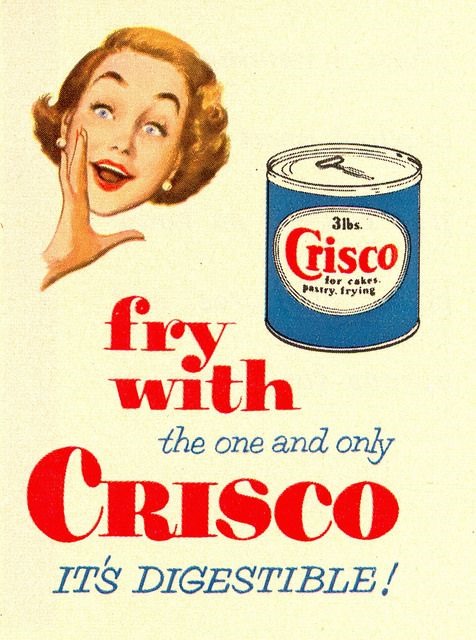
Industrial textile waste transformed through chemical processing into something white and solid that looks like lard. They patent it in 1907, launch commercially in 1911. Now they have a problem. Nobody wants to eat industrial waste that’s been chemically treated. Your grandmother cooks with lard and butter like humans have for thousands of years. Crisco needs to convince her that her traditional fats are deadly and this hydrogenated cotton-seed paste is better. The marketing campaign is genius. They distribute free cookbooks with recipes specifically designed for Crisco. They sponsor cooking demonstrations. They target Jewish communities advertising Crisco as kosher: neither meat nor dairy. They run magazine adverts suggesting that modern, scientific families use Crisco while backwards rural people use lard.
But the real coup happens in 1948. The American Heart Association has $1,700 in their budget. They’re a tiny organisation. Procter & Gamble donates $1.7 million. Suddenly the AHA has funding, influence, and a major corporate sponsor who manufactures vegetable oil.
1961: The AHA issues their first dietary guidelines. Avoid saturated fat from animals. Replace it with vegetable oils. Recommended oils: Crisco, Wesson, and other seed oils. The conflict is blatant. The organization issuing health advice is funded by the company that profits when people follow that advice. Nobody seems troubled by this. Newspapers report the guidelines as objective science. Doctors repeat them to patients. Government agencies adopt them into policy. Industrial cotton-seed oil, chemically extracted and hydrogenated, becomes “heart-healthy” while butter becomes “artery-clogging poison.”
1980s: Researchers discover that trans fats, created by hydrogenation, directly cause heart disease. They raise LDL, lower HDL, promote inflammation, and increase heart attack risk more than any other dietary fat. Crisco, as originally formulated, is catastrophically unhealthy. This takes 70 years to officially acknowledge. Procter & Gamble’s response: Quietly reformulate without admission of error. Remove hydrogenation, keep selling seed oils, never acknowledge that their “heart-healthy” product spent seven decades actively causing the disease it claimed to prevent. Modern seed oils remain. Soybean, canola, corn, safflower oils everywhere. Same chemical extraction process. Same high-temperature refining. Same oxidation problems. Just without hydrogenation so trans fats stay below regulatory thresholds. These oils oxidise rapidly when heated. They integrate into cell membranes where they create inflammatory signalling for months or years. They’re rich in omega-6 fatty acids that promote inflammation. They’ve never existed in human diets at current consumption levels. But they’re cheap. Profitable. And the food industry has spent a century convincing everyone they’re healthy. The alternative, admitting that industrial textile waste shouldn’t have been turned into food, would require acknowledging the last 110 years of dietary advice was fundamentally corrupted from the start. Your great-grandmother cooked with lard because that’s what humans used for millennia. Then Procter & Gamble needed to sell soap alternatives and accidentally created the largest dietary change in human history.
We traded animal fats that built civilisations for factory waste that causes disease. The soap company won. Your health lost.
I have no idea if this is all true, partially true, a matter of dispute, or complete fantasy. But I bet RFK Jr. likes it. The story, which certainly has the ring of truth, also raises the issue of trusting science and experts, especially when business interests and money are involved.
My personal favorite use of Crisco was when people would mix it with food coloring and sugar and call it “frosting.”
 Ethics Alarms
The triggering event for the dietary guidelines wat President Eisenhower’s heart attack. Harvard concluded that the culprit was saturated fat. The role of sugars as a cause of heart disease was overlooked. Since then the USA embraced low-fat, high-carbohydrate diets, with margarine and seed oils replacing butter and animal fat. The result has been an obesity and type-2 diabetes epidemic.
https://www.bu.edu/articles/2016/when-science-and-industry-collide/#:~:text=In%20the%201950s%2C%20heart%20disease,of%20this%20seemingly%20indiscriminate%20disease.
Immediately thought of LEMONS…
PWS
YES! Good for you—the comparison is spot on. I should have made that connection myself.
First time seeing this – awesome!
“First time seeing this – awesome!”
Yeah; Greenwood nails it.
My lovely and long suffering wife LUVs Double Jeopardy…’specially the end.
PWS
Yes, Bruce Greenwood is appealing in everything he does, even playing the Bad Guy. Too bad Ashley Judd has become so vile …
And Tommy Lee Jones – what a hottie – I refer you to Eyes of Laura Mars, the Fugitive … just about any one of his 50 movies.
And then they tell us to use paper towels to absorb bacon fat when cooking it, instead of pouring it off and saving it to make biscuits and pie crust… anywhere you might use butter. I use the fat that roasts out of chicken, too. Next story: how the sugar lobby got their products into everything?
Like bread!
I don’t know if the Crisco story is true, either, but I suspect a lamentable number of food products have been foisted upon the gullible public by dishonest advertising like this.
Organic is the biggest marketing success I’ve ever seen. You can buy organic chips but they’re still chips made with the same unhealthy ingredients. The “traditional” way of growing crops (I’ve raised both ways) is close enough you wouldn’t know the difference. We did lose about 80% of the organic crop to aphids. Not because there isn’t organic chemicals (some of those pesticides are more dangerous than traditional ones) we just couldn’t get it in time. There’s nothing noble about losing crops to pests or letting an animal suffer because you don’t like antibiotics.
Here is an article that describes the marketing and lobbying efforts of ADM to promote high-fructose corn syrup. The federal lobbying affected favorable tariffs to ADM, but hurtful to producers of cane sugar.
https://thehustle.co/originals/how-corn-syrup-took-over-america
I believe much of this Jack. That said, I have to re-train my olfactory sense to overcome the smell of beef tallow, duck fat, suet, or lard. Not so easy. I do love butter though. Since the pandemic’s onset, I’ve have 2 eggs every morning, over easy, cooked in butter. Never felt better. The food companies and their chemists who developed hydrogenated fats (to preserve food on the shelf until it’s sold) are guided by the pursuit of profit more than health.
Where does olive oil fit into this?
olive oil has been used as long as butter and lard. It’s a Greek classic! I have suspicions too about evoo as it’s more processed. Also there’s cold pressed oils and heat pressed oils. If possible, get cold pressed. Olive oil wins here too because it’s chemically a more delicate fatty chain and so it’s all cold pressed. Heat ruins it. As you know if you’ve ever accidentally tried to fry with it. Cold pressed oils are better because the heat causes rancidy (and a lot of chemistry I don’t quite understand) but the oil becomes unhealthy. Plus the oils like corn, canola soy are chemically washed as well when heat pressed. Sunflower oil is also typically cold pressed especially if you can find a smaller processor. The oil story is just the tip of the iceberg. As a farmers my husband and I seem to be caught in the whirlpool that’s been around for a long time. Do you continue to raise the same things no one wants anymore? (Wheat) or do you try something new without the substantial governmental support? Economics dictates you stick with what you know that has the least risk. It’s not like I can get crop insurance to grow chia seeds or other specialty crops that I’ve never raised before.
Thanks. Goddess of Ag. Our current olive oil says it’s “extra virgin” and “extracted solely by mechanical means.” But Mrs. OB uses Crisco to make her delicious pie crusts and has been for the last fifty-two years.
I’m also going to try unsweetened apple sauce as a substitute for oil in cakes.
As with much of the food we eat, it’s about the quantity and consistency. You and Mrs OB don’t make and eat pies daily. It’s treat so it’s not a big deal. The trans fats in Oreos that were mindlessly consumed daily in portions that were too big anyways… that’s where we have the issue. Also olive oil is a monounsaturated fat which, according to people who are supposed to know more than I do… “experts” is generally better for your body because it’s more digestible. I personally use the kitchen test. I can’t make crisco. But with some effort and education, in my kitchen, I could probably make sunflower, butter or olive oil.
Wait until you discover through a credible channel that a diet 70% saturated animal fat and 30% animal protein is the healthiest diet.
My dad’s West Virginia farm boy diet.
This single confluence of corporate profit and government policy accounts for 40-50k premature deaths of Americans per year.
It’s an interesting number to compare against the 20-30k “gun deaths” driven by “profits of gun manufacturers” talking points that are much more often heard.
Crisco can be useful in frosting. You can pipe with it and it will hold the shape at warmer room temperatures that would cause a buttercream to start sliding off the cake. Also, you can get a pure white that you can’t get with butter.
It’s not what I would pick for a cake I make, but I don’t have the patience for piping and other decorations. I just want to slather on a chocolate buttercream and start slicing.
It’s made from soy and palm oils now, in case anyone is wondering if they still use cottonseed oil.
“Science is the belief in the ignorance of experts.” Richard Feynmann