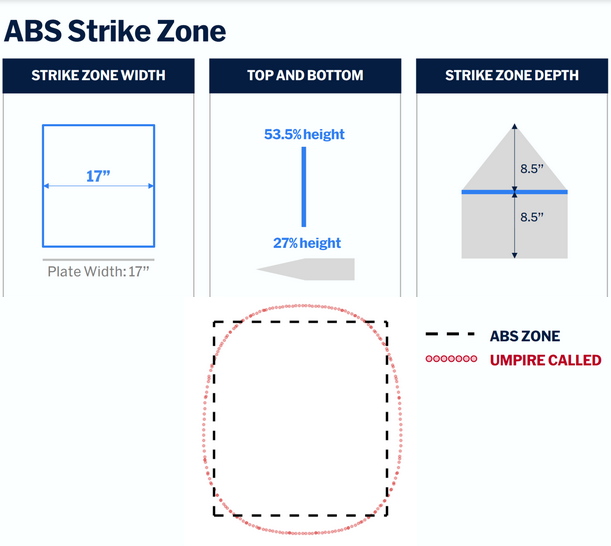
Finally, Major League Baseball has conceded that with technology available to call balls and strikes accurately, it makes no sense to permit bad calls by human umpires to change the results of at-bats, games, careers and even whole seasons. In 2026 the “ABS” system will be in play, adding integrity, accuracy and, yes, strategy to the game. Good. It’s about time.
I’ve been advocating computerized ball and strike calls at least since 2017, when I wrote,
In the top of the eighth inning of a crucial Dodgers-Cubs NLDS game, Dodger batter Curtis Granderson struck out. The pitch hit the dirt, and Cubs catcher Willson Contreras, as the rules require when a strike isn’t caught cleanly, tagged Gunderson for the final out of the inning. Granderson argued to home plate umpire Jim Wolf that his bat had made slight contact with the ball. It didn’t. The replay showed that his bat missed the ball by at least four inches. Nonetheless Wolf, after conferring with the other umpires agreed that the ball was a foul tip. Gunderson’s at bat was still alive….
After the game, Wolf watched the video and told reporters that he had indeed, as everyone already knew, blown the call.
As it happened, his embarrassing and needless botch didn’t matter. Gunderson struck out anyway. That, however, is just moral luck. The call and the umpire’s refusal to reverse it was just as inexcusable whether it resulted in ten Dodger runs or nothing. The point is that such a call could have changed the game, and the series. If it had, the screams from Chicago fans and anyone who cares about the integrity of the game would have persisted and intensified until baseball abandoned its archaic rationalization that “human error is part of the baseball,” and made use of available technology to make sure such a fiasco can’t happen.
This scenario will occur. Human beings being what they are, however, it won’t play out until a championship has been lost after a strike three right down the middle of the plate is called a ball by a fallible human umpire, and then the lucky batter hits a game-winning, walk-off grand slam on the next pitch. Then, after the horse has not only fled but trampled the barn-owner’s children, Major League Baseball will put a lock on the door.
The barn door, however, is wide open now, and the lock is available.
Two years later, I complained about this foolish attitude by the baseball powers- that-be again, writing,
 Ethics Alarms
The challenge system will be a disaster. Teams will run out of challenges in the first inning. There’s simply no reason whatsoever not to go to ABS on all pitches. I’m guessing ABS will call every pitch starting next year, or maybe by this year’s all-star break.
I fully agree. There is no reason I see to not do so.
With this system, it is only time until a scandal comes along of someone signaling in a challenge based on independent analysis of the ball / strike accuracy.
As in the challenge system on the basepaths, the challenge system on balls and strikes will also add to baseball’s greatest feature: suspense. Bases loaded, 3-2 count, bottom of the 9th, two outs, home team behind by one run..BALL FOUR! Wait! There’s a challenge!
Ugh. And what happens then? The umps huddle in front of a video screen with headsets on talking to someone in Secaucus, New Jersey for ten or fifteen minutes as they do in NBA games and Premier League Soccer games. Ugh.
Imagine what that “umpire called” graphic would look like if Angel Hernandez was still behind the plate. In fact, I blame much of this switch to computers for balls and strikes on his abysmal ability to call them correctly.
I have to say, that ellipsoidal area pretty darn accurately outlines the strike zone as it’s called today, although it tends to shift around between umps. Sometimes they’ll cut off the inside strike, or the low strike or the high strike or the outside strike, other times they will go in the opposite direction. And all the announcers and commentators know it and then they say, “All I want is consistency (in being incorrect). Dumb.
I agree about the use of technology to improve the game.
That said, I do not like this challenge system. You could have 10 different people initiating challenges (pitcher, DH and every other batter on the team). I can see a dumb prima donna burning through the challenges on a single trip to the plate.
It is also unclear whether there is a limit on challenges. “If the team succeeds with a challenge, it keeps it.” Does this mean you could have a dozen challenges if they are all correct, whereas the NFL limits it to one additional challenge if the first two are successful.
And, the NFL limits it because it is a timed game where challenges could be used as a time-out. Here, it sounds like there will be little delay so more challenges should be allowed. The NFL has turned challenges into a strategy. For MLB, there is no real strategy to the challenges. (Which if fine.) But, if the whole point of adding challenges is to improve the game, the limit on the number of challenges just means that the MLB is still willing to tolerate a degree of error when it could be prevented.
The better way would be to make all calls automated. We already see it on the TV. It could be so easy to implement, as opposed to the NFL, where there are more moving pieces in a game. Adopting an NFL-style challenge system is stupid.
I suspect that it is not being fully implemented because of pushback from the umpires. They don’t want their duties diminished. And, once the technology reaches a certain point, all calls could be automated. You would only need one umpire to handle the whole game. The umpires would not be happy about that.
And, if that was at all a part of the consideration, its implementation is not ethical.
-Jut
Remember, in every at bat, only the batter and the catcher (now that it looks like pitchers will be muzzled) can challenge. Any egregious miscall will always be challenged. Teams are going to use Spring Training to figure out when to risk losing challenges on close calls. If teams win 50 challenges against a sigle umpire, I’d say that would raise issues about that umpire.
The data shows that literally any bad call can be game changing. The relative batting averages and OBA on even 1-0 counts cs 0-1 counts, or 1-2 counts vs 2-1, are huge. Also the biases against generally wild pitchers vs. control pitchers, where confirmation bias can lead to bad calls. I think the system has been well-vetted, but players will need to pay attention.
“Remember, in every at bat, only the batter and the catcher (now that it looks like pitchers will be muzzled) can challenge.”
Yes, I get that. The problem is that every batter is going to compete for those challenges. I would expect some batters will challenge more frequently, especially if they have certain performance incentives in their contract. Old Bill thinks they would be used up in the first inning; that may not be unrealistic.
And, if every bad call can be game-changing (I agree), have the system call the whole game. No reason to say: “we will correct no more than 4 bad calls per game.” (Or however many possible challenges there could be.)
-Jut
Managers can’t challenge, but the can say, “Hey asshole. I’m fining you 10 grand for every irresponsible challenge.” And they will.
How often do hitters think they failed to swing at or foul off a strike? Never. These guys have egos so big they have to leave them next to their cars in the parking lot so they can fit through the locker room door. The umpires’ union is obviously responsible for this Rube Goldberg “system.” All robo calls will speed up games like you won’t believe. I can’t wait. And they can just let the umps stand there and announce the call they can hear from an earpiece. The owners can afford to still pay the umps their current salaries. They’ve got all that bookmaking money!
I don’t know, Jack.
you convinced me that technology should fix the problem.
I was fine leaving chance to human error.
you were right. Technology could fix it.
this solution is stupid.
it takes away one error in human judgment and replaces it with another.
batters, pitchers and catchers making calls?
no. Let technology do the job, subject to booth oversight, if you need it. The NFL has done well with booth review for obvious mistakes/close calls.
make pitch-calling completely technological.
challenges in pitching is stupid for the MLB.
-Jut
The image of the home plate umpire standing behind the catcher and calling STEERIKE is too embedded in the lore and legend of the game. Moreover, you will always need a home plate umpire-to call check swings, to call balks, to call out or safe at plays at the plate, to call hit by pitch and the rest. Having one wait around is just not wise: it will lead to more mistakes in those other plays. On average, umps are right about 97% of the time. How many borderline calls are missed that affect the game? A catcher and a batter can see the obvious ones, and the obvious ones are the ones that most need to be addressed.
Jack: “The image of the home plate umpire standing behind the catcher and calling STEERIKEis too embedded in the lore and legend of the game.”
that is where you fall into the “it’s part of the game” nonsense you complained about.
you are right. You always need an umpire with a full supply of clean balls, etc. hit batters and checked swings could all be booth-reviewed.
Balks? Sure. Give it to the umpire.
you want to improve baseball as the most ethical sport (golf is close), make it the most tech-regulated sport. It is easier to do that in baseball than in football, basketball or hockey.
MLB should lean into this if it really wants to pretend it is better.
-Jut
Second.
(I find the 97% right number very hard to believe. That certainly does not fit with what the little strike zone on television shows.