This time, not only does “The Ethicist,” aka. Kwame Anthony Appiah, give a bad answer to a reader’s ethics advice request, but I agree with it. [Gift link here.]
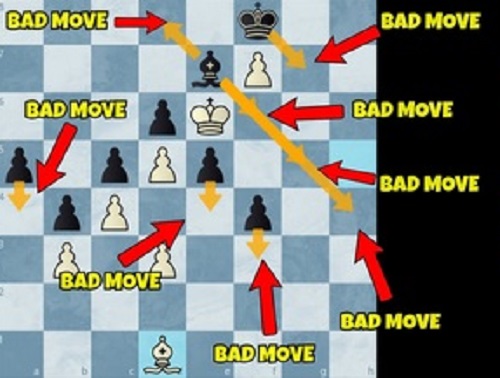
That’s because I don’t have a better answer, and that’s because there is no good answer. They are all bad; terrible in fact. The reader is in ethics zugzwang, from the term common in chess commentary, a situation where a player has no good moves available, only disastrous ones.
But I’m making this an ethics quiz on the chance that one of you out there in Ethics Land may have better answer than either of us.
As usual, it’s the pesky “Name Withheld” writing (What messes that poor boob gets into, with new ones every week!),
“My wife and I recently became the legal guardians of a teenager, and we are struggling with how to ethically navigate the emotional complexities of this arrangement.
“We met this person through our children’s athletic community. They come from an extremely difficult situation involving neglect and emotional abuse. A year ago, we offered them our home temporarily. As we learned more about their circumstances, we decided to pursue legal guardianship until they turn 18. We have no familial ties — we simply wanted to offer stability, safety and a chance at a better future.
“From the beginning, we agreed with our ward that we would treat them as we treat our own children — same expectations, same privileges and full support. For a few months, this arrangement seemed to be working: Our ward’s grades improved, they joined family activities and outings and appeared to settle into the rhythm of our family life. Then, little by little, they withdrew from us, no longer spending time with the family, and started getting worse grades again.
“Our ward has indicated that we intervene too much in their life and has complained to others that we’re “suffocating.” We’ve made adjustments — offering alternative meal arrangements, allowing them to stay with trusted friends on occasion and making space for their independence. Still, the distance has widened.
“My wife and I are about to engage in therapy with our ward. I am not looking forward to it; I worry that even in that safe space, I will not take well the possible complaints and criticisms we may hear from them.
“What obligations do we have — beyond the legal ones that we’ll meet — to our ward, and to ourselves, as we navigate a painful emotional landscape? And what moral, economic and emotional obligations should we anticipate when they turn 18 and become independent with no real support network?”
Yikes.
Your Ethics Alarms Ethics Quiz of the Day is…
What is the most ethical course for the couple to take now?
All I can offer, at least this early in the morning before a shot of coffee into my jugular, is “No good deed goes unpunished!” Somehow I don’t think this desperate couple will appreciate Oscar’s wit in their current dilemma.
 Ethics Alarms
My answer hinges on the writer telling the truth about the situation. This family welcomed this child into their home and treated them the same as everyone else in the family. Now, this child is demanding more.
How old is this teenager? It makes a difference in my answer. If the teenager is 13, I would tell them to get with the program. They are not a special snowflake and if they think they are somehow better and deserve more than my own children, they are sorely mistaken. I would tell them that they are acting spoiled, selfish, and ungrateful. I would offer them therapy to help them adapt to family life. If they refuse to behave after that, then other arrangements for their care need to be made. If they are 17, then I would just ask them if they want to be here anymore. If not, goodbye.
This family did a lot to agree to take a stranger into their home and care for this child. However, this child does not appreciate it or, apparently, want it. This family’s choice is to damage the relationship with their own children to try to ‘save’ this unrelated child against that child’s own wishes, or cut the child loose. Well, you can’t save people who don’t want to be saved. You can do a lot of damage trying, however. I don’t see what is unethical about this. This family tried to help someone, and the person doesn’t want help. It is unfortunate that the person is not an adult, but that fact remains. If you are trying to rescue a drowning person and they refused to stop thrashing about, risking your life too, there is nothing unethical about stopping the rescue.
I have a friend who was in the same situation. It put serious strain on the family to try to help this young man. It cost them a lot of money they didn’t have. They fed him, housed him, treated him like family for 3 years, and got all the paperwork done so that the state would pay for his college. All the did was take. When he graduated, he said goodbye and never spoke to them again. Luckily, their children were young enough that they could repair most of the damage done to their relationship. Sorry, take care of your family first. Don’t neglect your own family because someone else didn’t take care of theirs.
“Well, you can’t save people who don’t want to be saved.”
As Zig Ziglar was fond of saying: “You Can’t Climb A Fence That’s Leaning Toward You, You Can’t Kiss A Girl Who’s Leaning Away From You, And You Can’t Help Someone Who Doesn’t Want To Be Helped.”
PWS
I fear that there are irreconcilable cultural differences at play between the ward’s original family values and friend set and the new family values. My recommendation would be to have a little conversation with the whole family, the ward, and the therapist. My prescription would be tough love, which is tough on everyone, but having a new family member act outside of the family values will do nothing but tear those values asunder for the whole group. I have little doubt that without adopting the new family values, there will be little stability for the ward in the future. Time to fish or cut bait. I believe that the questioner has a greater duty to their family than they do to the ward who will not/can not adapt to the new circumstances in his/her life
I agree with this answer. The teenager may have come from a home of neglect, but it was also a home that gave him or her a lot of freedom from expectations which the teenager has confused with overall liberty/space. Some talks with a therapist about what the teenager experienced in the biological family home may clarify the culture clash you mentioned.
The reason I believe the situation is irresolvable is that once a family has taken on the responsibility of treating a disadvantaged child as one of their own, there is no going back. The situation reminds me of the adoption scandals where a family “returned” a Russian orphan to Russia after adopting him. I know a kind, wonderful caring woman who took in a teen who had been abandoned alone in his home by his mother, a drug addict. She fostered him, then adopted him, leading him through all of the predictable problems The Ethicist’s inquirer describes. The decision to foster the kid alienated her daughter and her husband, and the family fell apart: he biological child no longer speaks to her and sent back her Christmas card. The foster child still is in contact with her (since she’s putting him through college) but also still has toxic behavior patterns. She did a kind, generous thing taking him in, and it probably saved his life. But it wrecked her life: she’s lonely, bitter and angry at…well, life and the world, essentially. Her #1 duty was to her own family until she brought another child into it. From then on, there is no way to have a Second Class kid.
This is a tough one, and im not sure how successful the course i see would be, but I see it as the ethical choice. They should do as they first said, treat the new child as one of their own. Hold to the rules they’ve always held to, and don’t bend the line one iota for the newcomer. Making special allowances for a child is what really got them in trouble to begin with. They should not even move forward with a “if you don’t like it, then you can leave” attitude, because their children don’t have that same escape route. If the fledgling can’t stand it, they can leave, but should do so with the knowledge that there is an expectation that they will not, and that leaving will have consequences.
Of course, I suspect that they are not nearly as draconian as they have been made out to be, if they were willing to bend the rules to begin with. I hope they learn from this mistake.
My answer would be to get back with the original program. Don’t make special allowances for this foster child; the agreement was he ( and need I go tangential on the singular “they”?) would be treated no differently than the other children. However, by giving some leeway, and then a little more, and then a little more, the parents have demonstrated that he can get away with more than the biological children.
It is also likely that the distancing has to do with falling back into old habits, old crowds, old troubles, and feeling like he has to keep that away from his adoptive family. Maybe it is shame that after the good treatment he’s received, he’s still not in a good place; maybe it is feeling that now that things have stabilized, the new life is restricting him from the old vices he really wants to engage in, however destructive they are. Either way, the message from the parents should be unwavering: we support you and offer our unconditional love, but you will follow the rules of the house and comport yourself with the expectations laid down when you came in.
Oh wow a teenager rebels against reasonable boundaries! What a concept! First of all “if you only knew what they’d been through, you’d understand.” is nonsense. Yes the guardians can be compassionate and understanding and frankly family suppers as a sacred family time are not something we do, (I suggest they try breakfasts for a bit to see if that’s better) but there is value to “my house, my rules”. First off, decide what your hard rules are for everyone and make them absolutely non negotiable. If that is family dinners 3x a week that’s what it is. Second it’s absurd to treat “all kids the same” they’re not the same. They can have the same curfew but they’re not going to be treated the same, ever. It’s a lie we tell ourselves if you believe it’s true. Thirdly. The teen needs to realize it’s not all about them. They need to have a “come to Jesus” meeting with the guardians. Hopefully it happens with the therapist “look xyz behavior is causing me stress I’m tired of it. This is what we need from you.” It’s unfortunate that these circumstances have happened as they did but it’s not surprising. The parents need to be the responsible adult and quit letting the teen treat them like a toy they can appreciate or ignore at their whim. Will this cause conflict, probably. But clearly the current passive situation is also causing conflict. Better to have conflict than anger and resentment. Also for their own child. They need to have individual time with them and explain that while they wanted to treat everyone equally they are different people and what is working for their own kids isn’t working with the other one. Ask them what they’d like to see happen as teens they’ll have ideas what they think is a good solution. If they behave like adults, treat them as adults, if not, they get kid rules.
Disclamer… it’s easy for me to say these things when I don’t have a new teen in the household, but I’ve raised 3 children and not even they were “treated the same”. What is effective for one was ridiculous for the other. That’s what I would do. I would be fairly blunt. “You’re making things miserable for all of us, I need you to do xyz. What specifically are you unhappy with here?” There’s a book. “How to talk so kids will listen and listen so kids will talk.” That is extremely useful for communicating.
As for future support. That’s entirely up to them. I know children who were told to get out of the house the moment they graduated high school. They have no commitment past 18 unless they want it and the kid wants it which they may not. I know kids who were adopted and had a falling out with their adoptive family and cut ties completely. It’s a problem for future guardian to deal with. Likely dependent on the behavior of the teen.
From the beginning, we agreed with our ward that we would treat them as we treat our own children — same expectations, same privileges and full support.
Any parent who has more than one child knows its impossible to treat each child the same. Each child has agency and with agency comes different personalities, outcomes, and styles that must be addressed as they come up. Good parenting requires flexibility, but flexibility does not eliminate expectations. It does not negate what this parent feels is the vision of the household: chores are completed, bedtimes are honored, respect is practiced.
A house is a mini society. Each person in the house is expected to do there role for the rest of the house to function to the best of its ability. When a member of the household deviates from their role (often out of selfishness, fear, immaturity) it creates tension within the rest of the members of the household. When a parent abdicates their role, the damage is profound. But it is also painful when a child refuses theirs. The strain ripples outward. No one is unaffected.
I bring this up because, as someone who has walked through the foster system as a parent, I have seen how common this tension can be.
For the first time in a long time, the foster is given stability. Children need stability. They need predictable meals, predictable discipline, predictable affection. They need to know that bedtime means bedtime and that consequences mean something.
While this is largely a good thing, foster children (mostly without realizing it) see it as loss of agency. What may begin as relief slowly becomes disorientation. They realize they are changing. The habits that kept them safe don’t fit here. The coping mechanisms that once worked now create friction. And change, even good change, can feel like loss. A lot of times a child might find themselves asking, “If I let go of the way I’ve always survived, will I still be safe?”
But the solution is not to enable destructive tendencies. When a parent continually pulls back from structure in order to avoid conflict, the message unintentionally becomes, “You were right. You’re better off on your own. I won’t hold the line.”
At least in this case, I’m going to assume the parents didn’t know what they were getting into to, but most who go through the foster training do so for at least a year before they even get their first child. They know, at least intellectually, that this road will not be easy. And if they choose to receive that child as their own, they must also recognize that parenthood does not come with an escape clause when things become difficult.
But if they took this child in as their own, they should realize you don’t get to give up on it just because things got hard. If it is your child, you wouldn’t just kick them to the curb. It might make things difficult for a while, but doing the right thing isn’t often easy.
As Peter writes, “Love covers a multitude of sins.”
To obtain legal guardianship of a child of any age requires the intervention of the Court. I would return to the Court who allowed this to occur, seeking their legal advice concernign the ending of the guradianship.
Their are many adages that can be apllied ot this situation, e.g.
“you can lead a horse to watere but you cannot force him to drink” which dates back to the 12 th century
“a stubborn mule will not be led, but will follow its own path”
“He who is too stubborn to change will remain in the sameplace”
“stubborness is the enemy of progress”
Since you have already applied
“a gentle answer turns away wrath” and “You can catch more flies with honey than with vingar.”
The antidote to stubborn people is
“Dont wrestle with a pig; you cna both get dirty”
Remembering that you can proffer but not force,
Then I would look to scripture and follow the advice Jesus gave his disciple when they ( an actual plural group) confornted a simialr situation. He simple advised them to turn away and shake the dust of their town form the their (actual) plural) sandals.
I don’t know enough about legal guardianship to comment on the situation this family has gotten itself into. They fucked up. Disengaging is the best solution. I’m just not sure if or how they can go about disengagement.
I’m intrigued by the use of “they” in referring to this child (sorry, Ryan 😉 ). It obscures possibly relevant information, and raises questions and suppositions that may be clues to at least part of the problem. What is the sex (and race?) of this child and their other children; are their ages similar? Especially as they hit their teens, the concerns and priorities of children can differ widely between the sexes. Are the couple used to dealing with the combination they acquired in this child?
Is their use of “they” a clue in itself? Do these people have an “In This House We Believe” sign in their front yard? Did they acquire this child as an ornament for their virtue signalling, and the child is sensing their pandering? Is there a subsequent lack of appropriate structure and discipline? Etc., Etc.
Perhaps this is entirely irrelevant to the case, but, IMO, there are too many unaddressed details to form a useful answer.
Adoption is risky. Children who are put up for adoption come from troubled parents and carry those parents’ genes. We’ve lived too long in an environment where it’s all about nurture over nature. I’m afraid this is simply wrong. I’ve had some personal experience and seen the problem manifested in other families as well.
This reminded me of the politically incorrect blog “West Hunter” by Gregory Cochrane and the late Henry Harpending. Harpending has been dead for some years now. Cochrane posts very infrequently. He could be described as “irascible.”
The comments following the initial post are fun if you can fplow through them to get the “signal” out of the “noise.” Some noise is discussion of Polish jokes, for example.
This is from July of 2018, in response to an _Atlantic_ article written by a journalist who seemed to not to believe in the heritability of personality traits, intelligence, health, impulse control, etc.
tl, dr: You never know what you are getting when you adopt someone else’s children. “Adverse selection” may be an issue.
final musings from moi: I wonder if things were different when most orphans were the product of combat fatalities, the Spanish Flu of 1918, mining accidents, etc.
charles w abbott
rochester NY
link below. Comments not for the faint-hearted.
https://westhunt.wordpress.com/2018/07/10/why-adopted-children-still-struggle-over-time/
“…there is no going back.” Spoken like an ethicist, trying to impose universal parameters on idiosyncratic problems. What’s ethical in these cases is contingent upon local circumstances. Just ask my tapeworm…
There is, in fact, no going back. Taking on responsibility for a child cannot be ethically undone. Absolutism wins the ethics battle here. It wasn’t a conditional acceptance.