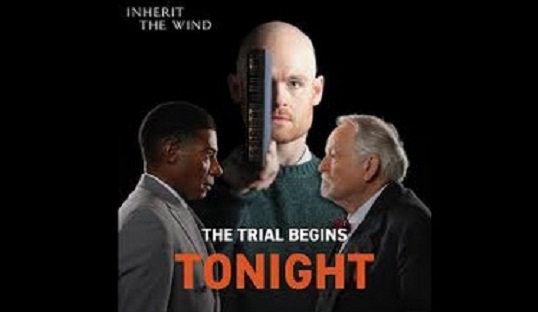
I’m sorry to return to the topic of theatrical casting ethics so soon after my last deep dive (here), but The Arena Stage’s new production of the Lawrence and Lee classic “Inherit the Wind” has opened in Washington D.C., where that company is revered beyond all others. It is a travesty, theatrically and historically, and especially directorally, since the director, Ryan Guzzo Purcell, has apparently done no research into the history behind the drama or, in the alternative, has decided that virtue signalling and DEI sensibilities are more important than fairness to the authors and an unquestioned American classic.
I suppose, he could be just plain nuts.
“This classic courtroom drama, inspired by the 1925 Scopes “Monkey” Trial, explores profound themes of intellectual freedom, religious conviction, and scientific discovery. Witness the gripping narrative unfold in the nation’s capital,” the Arena says on its website. Right. That’s what the play is supposed to be about. It also is a fictionalized version of a famous historical event involving three famous and important American figures: Clarence Darrow, generally believed to be the greatest trial lawyer this nation ever produced (I know a little bit about him), William Jennings Bryan, the famous orator, statesman, and three-time loser as the Democratic nominee for President, and H.L. Mencken, the brilliant, acerbic, misanthropic writer who covered the trial for the Baltimore Sun. Lawrence and Lee, the playwrights, ethically decided that rather than falsely represent real historical figures whose words and characters they might need to manipulate for dramatic purpose, made it clear who their characters were based on and gave them suggestive but different names so there would be no confusing the fiction with fact. (I say “ethically” to contrast their conduct with the writers of “Death by Lightning”). Thus Darrow became “Henry Drummond,” Bryan became “Matthew Harrison Brady,” H.L became “E.K. Hornbeck” and Scopes became “Bertram Cates.” Nonetheless, the historical connection to the real figures is central to the show.
But not to the Arena Stage. The actor playing Bryan/Brady is made to resemble Colonel Sanders for some reason, in a Kentucky Fried Chicken goatee and a white plantation suit. Bryan was famously a Mid-Westerner, so this appearance is jarring, especially since the play has a long running bit about the court calling Bryan/Brady by the honorific title,”Colonel.” This choice is approximately as disorienting as casting a character based on Abe Lincoln with a jockey. Knowing that Brady is Bryan is important: a major speech by Brady’s wife laments the pain the character suffered from being defeated in three runs for the White House. Bryan is the only man since 1844 to run for the office three times. In the classic movie version of the play, Frederick March played Brady taking pains to evoke Bryan’s speaking style, his posture, expressions and body language. His performance was finger-lickin’ good.
 Ethics Alarms
What are the local reviewers saying?
I don’t really care. This is DC and no one would dare tell the truth about woke casting.