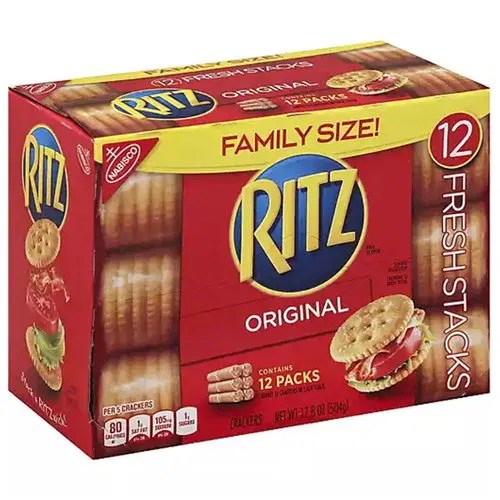
For some reason, a grocery store sale led me to purchase an absurd number of Ritz cracker boxes in late 2023. Those crackers lasted until just a few weeks ago, so I only had to buy another box last week. I knew immediately that the new box was smaller and lighter than the ones I had been staring at for over two years.
Sure enough, Nabisco replaced cracker packs with smaller packs in 2024 resulting in about 30% fewer crackers by weight while keeping the same price. But that’s not what most annoyed me. The crackers themselves are noticeably smaller, and also thinner. I’ve been eating Ritz crackers, the favored crackers in the Marshall family, most of my life. I knew their size like I know my nose. I can’t find a good photo that demonstrates the difference, but it is dramatic.
That means, of course, that the “ORIGINAL” label on the front of the box is a lie, and false advertising. The weight is on the box as required, and if an alert consumer is paying attention, he or she knows that the price is the same for fewer crackers. But there is no way the smaller Ritz can accurately be called the “original” version.
Who knows what other hidden surprises will be in store for cracker aficionados in the years ahead?
This was my last purchase of Ritz crackers.
 Ethics Alarms
If I had to hazard a guess, the “Original” is not to imply the very first recipe and form Ritz used whenever it began business, but that this is their “base” cracker, as opposed to any of the varieties that add flavor or bake the cracker in some alternative style. Without doing any research, I’ll bet the recipe has been updated a few times over the company’s history, with the intent to improve flavor or substitute in cheaper ingredients while holding the flavor relatively the same.
Okay, brief research completed, and it does seem that the most recent recipe change was in 2024, with the result that the crackers are less salty, less buttery, and crumble easier. But there were earlier changes that moved from lard to hydrogenated soy bean oil, from sugar to high fructose corn syrup, and to including some GMO ingredients (the horror!).
Overall, I’d say if the crackers still satisfy, I wouldn’t let the “Original” label be a stumbling block.
The question of shrinkflation overall is one that I ponder from time to time. Is shrinkflation a means of tricking the customer (such as by making the bottom of a plastic container convex so that there is less volume in the container, while it seems the size of the container is the same)? Or is it a means of keeping the product within the price range of the general consumer? I could argue that providing a smaller amount for the same price keeps customers purchasing, whereas if the company kept the amount the same and allowed prices to increase, customers might stop buying altogether. On the other hand, the methods of hiding the decreased volume still seem pretty sketchy to me at times.
And there is the problem of the inconvenience of having to re-vamp recipes because many were designed around, for example, a 12 oz can of a particular ingredient, whereas now it comes in a 10.5 oz can.
Coffee is one — you used to buy a ‘pound’ of coffee, and the can was actually a pound (go figure). Now it’s typically 12 ounces, I believe. What is more, the brand names will have difference strengths or flavors of the base coffee and some will be 11.5 ounces, I think they go as low as 10.5 ounces. The price for all these cans might be the same, but price per ounce is different.
The other staple I mentioned below — Wheat Chex — has both gone down in weight and way up in price over the last few years. It is also unique: Wheat Chex is a much denser cereal than Rice Chex or Corn Chex (and the box is correspondingly smaller). I have never found an equivalent store brand to Wheat Chex, as you can find for the other varieties.
If I could find one, we’d try it, but I got my sister hooked on Wheat Chex 15 years ago, and there is no substitute.
Wheat Chex is no in a little box, like Grape Nuts, another dense cereal.
I agree. In this case, “original” means “plain”, as opposed to the Whole Wheat Ritz or Jalapeno Ritz or, I dunno, Candy Cane Ritz.
Then they should put out a glossary. If I see an ad for “the original” “High Noon” I don’t expect to see Adam Sandler playing the sheriff because it’s the original script and in black and white.
Original is definitely the right word to use. However, only in the right context. Is it the original flavor? Yes, as opposed to cheese or peanut butter Ritz sandwiches, or some other added flavor (as I recently annoyingly discovered when I returned home and found that I had accidentally bought the cheese sandwich Ritz instead of the original Ritz). Is it the original size? I don’t think there is an original size, as you’ve always been able to buy Ritz crackers in a multitude of number of sleeves per box. Is it original color on the packaging? Probably not, but original would still be the correct word to use if that’s what they were advertising.
But if you look around at all the different snacks and cookies and crackers and chips in the aisle with the Ritz you would probably see a trend: the flavor of the snack is prominently displayed just around the name of the snack.
Dang. I’ve run into the box shrinkage before (I’m thinking of Wheat Chex going from 16 to 14 ounces), but not that kind of chance to the actual product. That is, I agree, actually worse than just shrinking the package.
I may have some Ritz crackers in the pantry. I’ll have to take a look.
Have you looked at a frozen pizza lately?
A number of things, including some processed meats like sausages, have gone to a “pound” being 14 ounces. This also messes with recipes, as Ryan noted above.
I have never been guilty of brand loyalty, and therefore have regularly purchased crackers of other brands which were similar to Ritz crackers, usually whatever was a better buy at the time. You may want to try Keebler’s Townhouse crackers, or the house brand “Ritz clones” at Aldi, Target, Walmart, or wherever you do your grocery shopping.
Townhouse crackers are vastly inferior. Just like the knock-offs of Saltines. Or Hydrox cookies compared to Oreos.
Interestingly, Hydrox cookies are the original, and Oreos are the knockoff. Hydrox were introduced in 1908, and Oreos hit the shelves 4 years later in 1912. Hydrox even originated the elaborate floral pattern on the cookies which oreo duplicated. Oreo didnt take over the market until the 1950’s.
That’s fascinating! I just assumed that Oreos were the originals, because I always thought they were better (and they sell more, and have for a long time.) Oreos have less sweet wafers around the creme.
An Aldi is the closest grocery store to us (I love them, & finally got my grocery-store-snob wife going there somewhat regularly, too), & we get their “Townhouse” crackers (and the Ritz types) there. A while back, I noticed that the “headspace” between the box lid and the cel-wrapped sleeves of crackers had become noticeably larger than necessary. My first thought was they might just be using up existing packaging stock with the lesser fill , but then realized they had to have already changed the weight noted on the package, so not reducing the box size was a deliberate move.
The four words you need to know in Aldi: Clancy’s Jalapeno Kettle Chips.
Oh yes the incredible shrinking package. This is common in consumables at the grocery store because people are extremely unwilling to pay more and will substitute to another product. I bet you are deciding if club crackers or the generic ritz will be your next cracker, right? When prices rise (idk what ritz has to complain about, grain prices and oilseeds were at multi year lows across their products throughout 2025, fuel was definitely better too. What’s higher? Packaging? Wages certainly. Insurance certainly. Equipment repair costs, if they’re like mine, are up by roughly 150% since 2020.) That’s why we have the case of the incredible shrinking package. Oddly enough I know of one instance where it didn’t work. Tampax tampons tried it and it was an epic fail. Turns out women need a specific amount of sanitary products and when they were shorted a few they switched products en masse. Tampax added them in, added “now with more!” On the package and everyone was happy.
Mr. Marshall, looks like The Ritz is putting you on… ; )
(I should’ve posted a pic of the scene from Young Frankenstein…)
I think those companies making products for grocery stores are acutely aware that many shoppers roaming the stores are seeing items that have gone up a lot over the past few years. That $3 cookie was $2 5 years ago. Hamburger has zoomed in price, to the point where packages that are marked down because they’re close to the sell-by date cost more now than regular priced meat a few years ago.
And prices seem to just keep going up! There are so many items where you can remember how much cheaper they used to be. It’s not hyper inflation, to be sure, but I would wager it is a significant reason why consumers tend to have a sour outlook.
Hellooo boys. Open the pantry, pull out some ingredients, and bake your own cookies. Soft and gooey straight out of the oven!
They don’t call me Grandma for nothin’.