Further evidence that there is a conspiracy to drive me crazy…
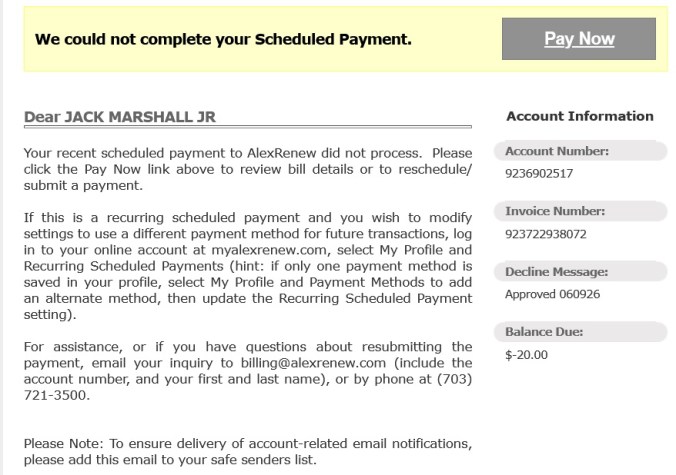
Alex Renew, the Alexandria wastewater service, just sent me an emergency email beginning with “Your scheduled payment did not go through.” You can see the email above. I was directed to click on a “Pay Now” button. That took me to my invoice, which stated that my balance was “0.” See?
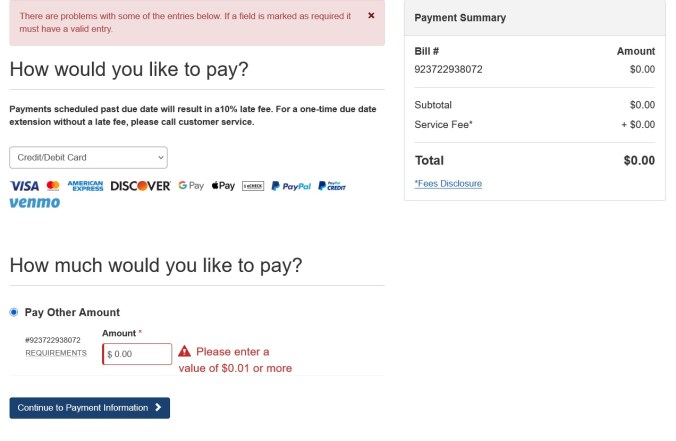
I called AlexRenew and finally reached a manager, who checked my account. She confirmed that I don’t owe anything. She confirmed that my last payment went through.
“So why did I get this alert?” I asked.
“Honestly, sir, I have no idea.” was the answer.
 Ethics Alarms
I hear you, Jack. I’ve tried to pay my electric bill on-line (since we can’t trust the postal service to handle checks in a timely and secure manner). After going through the usual multi-screen process, the final step produces an error screen: “We cannot accept electronic payments on this account.” NOW you tell me? You had my account number five minutes ago! So, I called the electric company, eventually got through to a live assistant, and THEY have no idea why my account won’t accept payment, either. Oh, well. Try again next month.
Lathechuck
Jack,
I’m growing more and more paranoid every day when it comes to messages like this. I’d be worried first off that someone was faking a message from Alex Renew in order to get you to provide sensitive information. If I get a message from any source saying my payment has been declined, or my payment was on hold, or whatever the case may be, I never click any links provided in the e-mail, but instead go directly to the actual website for whatever business it is.
On the other hand, if the quote “balance due” of -$20.00 was actually correct, the system might not be set up for processing negative balances and it errored out on that.
Yes, never click links in emails. ALWAYS go to the website. Best if you use a password vault with the website link saved, so it is just reflexively part of the login process.
The best way to avoid scams is to use three email addresses: The first one is your regular email you use everywhere. The second is financial institutions only. The third email is all for your bills. The second and third should never get out so scammers don’t know them. If you ever get a suspicious email in the second and third, it is time to change the email and update where you use it. That way any email coming in about banking or bills to your first email can be easily ignored, and any email in the other two can be trusted.
“I’m growing more and more paranoid every day when it comes to messages like this.“
I don’t know if I’m paranoid, I’d call it cautious or skeptical of any email I receive. The policy in our house is that we never click on any link in an email. If we receive an email from anyone claiming anything we go to the account or service in question outside the email like we would normally do to login to an account and check for ourselves about the email claim.
Just yesterday we got an email from Spectrum, our cable provider, saying that some TP-Link routers have a security flaw flagged by the FBI. It turns out the email was legitimate but we didn’t click on the link(s) in the email. We checked the Spectrum website, FBI bulletin and TP-Link then took action. Our model wasn’t affected.
It’s simple: Pay them $-20 to bring your account current.
There is a software testing joke that goes:
“A QA Engineer walks into a bar. He orders a beer. He orders 0 beers. He orders 99999999999 beers. He orders a lizard. He orders -1 beers. He orders a ueicbksjdhd. Then a real customer walks in and asks where the bathroom is. The bar bursts into flames, killing everyone.”
Since the email says you can get in touch with them by providing your account number, first name, and last name, I would consider redacting the account number from the screenshots, and perhaps the invoice number too, unless they have some secondary layer of proof-of-ID like a secret code.
Just in case someone with malicious intent sees this and wants to try messing with your account?
I recall, in my early 20s after college graduation, one of the most shocking revelations I had regarding the working world was how many people were just remarkably bad at their jobs, and yet still held those jobs.
Is it getting worse? I don’t know, but the easy and universal availability of instant information and communication seems to have encouraged the people who design systems and processes to bump up the complexity. At the same time, the constant stream of real-time information ensures that every screw-up gets brought to our attention.
My wife and I recently bought a used car. Before the test drive, the salesman copied our IDs and punched them into his computer. “Um… You’re not coming up here,” he mumbled. “Not coming up where?” I asked. “What database is this that you’re looking us up in, and why ought we to be in it?” He had no answer. He just puts names in, and they come up. It never occurred to him to ask where the information came from or why it’s there.
In any case, we did decide to buy, this kicking off a veritable bacchanal of computerized paperwork. We were paying cash. I get presented with a form where I’m supposed to acknowledge, as co-signer, my joint liability for a debt. Another ackowledges the dealer’s secured interest in the vehicle. There is no debt, there is no secured interest. I refuse.
This caused no end of headaches. They claimed there was no way to remove the forms from the package. I told them I very much doubted that. After a few minutes they were able to figure it out.
One of the first forms we saw was a cost breakdown. In a large box on the side was a chart that showed the remaining balance to be financed for various down payments. This much for $1000 down. This much for $2000 down. It was literally a straight subtraction. Of round thousands.
So what we had was a system that simultaneously assumed that dozens of pages of legal and financial jargon, living on a computer system locked behind 2-factor authentication, was a workable level of complexity that people could understand, but also that they couldn’t count back by thousands without help.