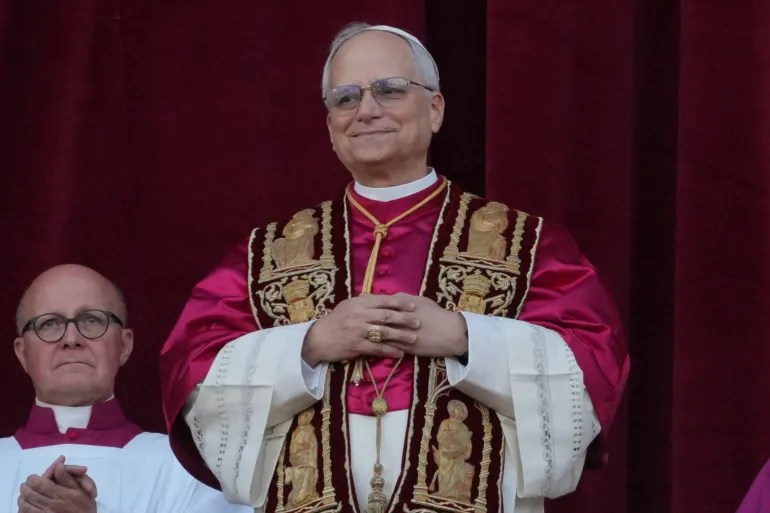
The big news this morning is that Pope Leo XIV issued an A.I encyclical titled “Magnifica Humanitas,” or “Magnificent Humanity,” his first such document. These things are supposed to impart authoritative teachings on moral or social challenges, but fall short of the legal status of a papal bull, which is a formal declaration of an article of faith or moral law. Catholics are supposed to use encyclicals to guide their lifestyles and choices. You know, like devout Catholic Joe Biden believing abortion is murder while supporting the practice so Democrats won’t lose the the single female vote.
I started to read the thing, which is over 200 pages, and officially feel bad about giving up 25% through, especially since I routinely criticize people who attack court decisions without reading them. Do I trust the various reporters and pundits who are supposed to summarize and explain the document? No. However, unlike court decisions, which I am accustomed to reading and have the experience and training to understand, a Pope’s declaration about how we should work with new technology has as much relevance to a non religious question as his opinion on one of the legal controversies settled by a Supreme Court decision: none whatsoever. He is not, by any framework, an expert on technology. He has a bias, indeed many biases, that he has already made clear, and the Pope’s view on A.I. is exactly as valuable as the opinion of of one of my next door neighbors, and maybe not as well informed.
The document has some significance because it will doubtless be used as an appeal of to authority is future debates over A.I. policy even though it shouldn’t be.
Ironically, one of my first substantive uses of A.I. is to ask one of the things to summarize “Magnifica Humanitas.” The result is below, so those of you who are not speed readers or who actually have lives so spending the time necessary to read what the Pope has wrought isn’t practical can prepare for the Ethics Alarms reaction to come. I suppose there is always the possibility that the bot read it, thought “Oh-oh!” and slanted its summary to advance its own welfare and evil plans…
Anyway, here is the summary, which is presumably objective, but who knows? I’ll be back with ethical observations in Part 2. (I couldn’t figure out how to get rid of the hanging letters in some of the sentence breaks without WordPress getting funky. I’m sorry.)


When Pope Leo gave a perfunctory response to Iran murdering thousands of its own citizens but decided to grandstand against Trump, that said enough.
I really believe the Catholic Church is being subverted from within. It’s way more effective to destroy an institution in the name of “reform” then it is to throw rhetorical bombs from the outside.
I suspect the Catholic Church will have a schism soon.
Just scrolling through what you posted, this encyclical seems very left. In a different world where less bloodshed would be possible, countries like North Korea, Iran, and Cuba would be invaded by the United States and the despotic rules face justice. These countries are run by evil people. Where is the denunciation of the cause of much of the evil in the world?
I am as concerned about AI as anyone. Working in higher ed, I see it being pushed harder and harder. English departments that have spent so long being centers of social justice and leftist propaganda are going to pay for turning what should be a great literary discussion on the human condition into Democratic party talking points where the most extremes of the left seem to find a home.
One thing I do like from what you posted is the fear of transhumanism. There are tech bros that would be fine if we all uploaded our consciousness into the cloud and lived in an entirely digital world. These are the people who have no skepticism of any technology.
Yes. Marinated in “social justice” I’d respond with one of my Vatican I mother’s most trusted lines, which I think is from the New Testament: “The poor will always be with us.” Amen. And she did more good works in her life than any three people combined.
Seems to be how it always works
Even the summary is long. Is there a summary of the summary I could look at?
That’s the executive summary. Hah!
Of course, the encyclical was not written by this guy Leo. It was probably written by a bunch of junior priests, using AI.
Perhaps we could get an AI pope….Matt Frewer could voice him.
The summary is already dense; I can only imagine what the entire document looks like. Why is a papal encyclical addressing both AI, and treatment of migrants and refugees? As the papal encyclical appears to lack focus (judging from the summary) it does not touch the ground on AI with moral guidance that is specific and practical; it stays stuck in an overview of generic Catholic doctrine on social issues.
That’s about right. What I read, have read in various sources and the summary tell me that AI was just an excuse to issue the usual Vatican propaganda while pretending it was something new.
How the mighty have fallen. St. Augustine must be rolling in his grave. You could get this stuff in any Unitarian church on any Sunday, together with a helping of Black Lives Matter. and no one is illegal. By the way, the Unitarian church near us still has a large Black Lives Matter billboard on the side of their building. I guess they haven’t heard about that hustle.
I hope to comment more about this encyclical once I’ve actually read it. I’ve made it through the introductory paragraphs, and one comment I’ll make regarding the AI summary. If there’s a way to take a heartfelt, reflective narrative and reduce it to a soulless jumble that includes nothing in the way of actual content, the AI summary has stumbled upon it.
One question for the time being. Catholic social teaching is grounded on a number of principles. First is the fundamental dignity of the human person. Second is the universal destination of goods, by which the Church means that all of creation was given to all of mankind, and not to some select few, so that while private property is to be respected, that does not mean that we can ethically withhold our excess when others are in dire need of subsistence. Third is the preferential option for the poor, by which the Church insists that we actually care for our poor and not surrender them to soulless machines (by which I mean the State, or the privations of nature, or some system that sees them as dust in the gears). Of more recent vintage is the fourth concern, which is really a subset of the first, but has become more important in the view of human activity that destroys the environment and the amount of devastation war can wreak on not just the battlefield, but even to miles and miles around (and in the case of nuclear war, a good chunk of the whole earth). Now, in all of this, is there really a solid case for rejecting any of these four principles? We can haggle over the details, over effective solutions, and whether “climate change” should or should not be considered in the fourth principle, but as to the principles themselves, is there any disagreement?