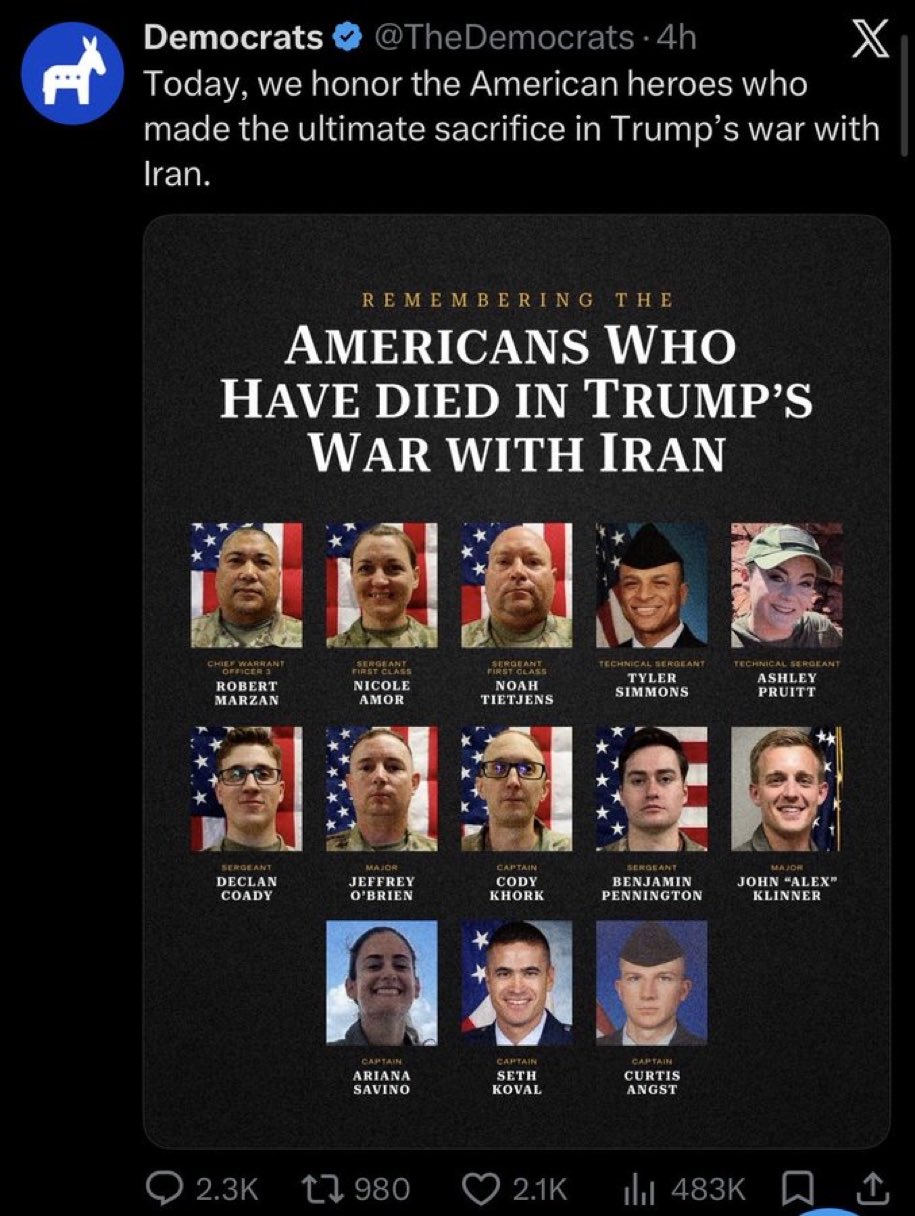
Nice.
The Democratic National Committee decided to use Memorial Day to attack the President of the United States. Of course it did. Despite all of the party’s rhetoric about saving democracy (while it was undermining it to a degree never before seen in U.S. history—go ahead, challenge that!), this is a party that literally doesn’t like the United States (maybe hate is too strong).
That tweet was so offensive, even Democrats objected. Sen. Tammy Duckworth, (D-Ill.) tweeted, “It is incredibly distasteful to use our heroic dead for a political attack on Memorial Day. I’m a Democrat and I condemn this post by the DNC.”
And the DNC pulled it, replacing it with this…
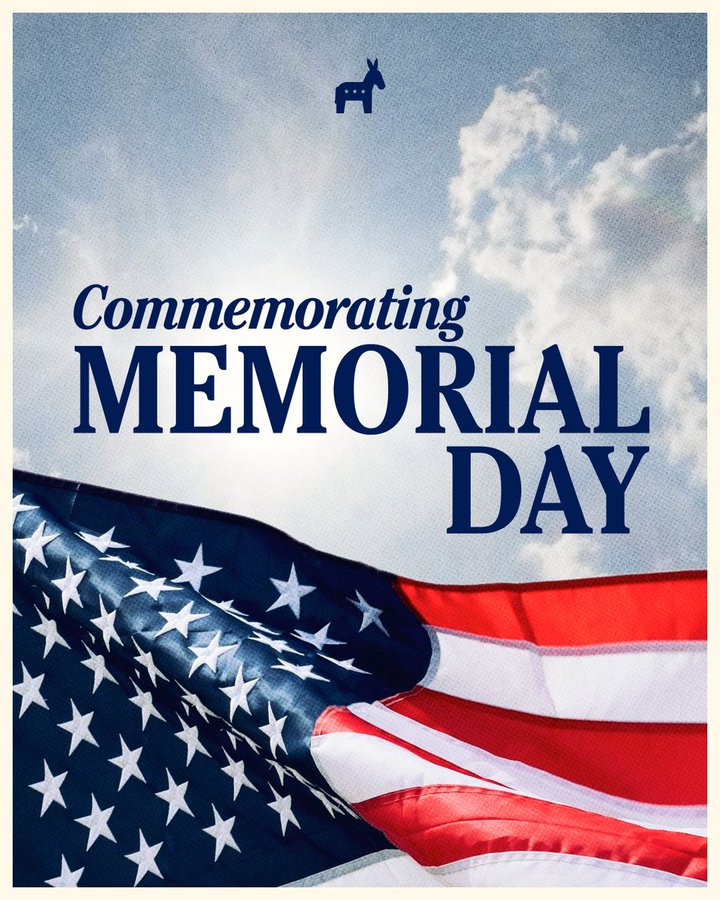
…without comment, apology, anything. Tweet? What tweet? But it was the fact it could be tweeted at all that is signature significance. The party is blaming the “kids” that it had in charge of social media during the holiday, but this just means the Gen Z radicals the party has indoctrinated in our schools and with its media don’t yet understand that the mask has to stay on a bit longer or else…

Can’t have that.
The DNC was just one example. I wrote yesterday about Democrats declaring the holiday “Celebrate a Dead Arrest-Resisting Street Thug Day,” including Minneapolis’s woke mayor, who had to be reminded it was also a holiday to honor patriots and heroes. I note that Fark, the often funny, left-biased satirical news aggregator, posted this yesterday…

If challenged, I’m sure Fark would say that it was satirizing the Trump Deranged progs who still think the Epstein files hold damning evidence against the President. You know the old saying though…”Fool me once..”? I’ve checked Fark for years. It’s about as non-partisan as Stephen Colbert. As for Fark’s favorite party—well, do you remember the Memorial Day message posted by Kamala Harris—you know, that whizbang, smart-as-a-whip candidate for President who only lost because American are racists and sexist? Here , let me refresh your memory…


Being a Democrat means never having to say you’re sorry.
Most Democrats these days offer, at best, lip service to veterans. They really don’t like them much because they tend Republican, and are therefore evil MAGA orange man supporters that they would very much like to see sanctioned via social credit systems, arrested, or killed.
It’s telling that the Twitter (X) kids at the DNC have not even the slightest respect for service members lost in combat. To them, if you are in a group not sufficiently supportive of Democrats, you deserve to be used in an attack ad.
Most holidays have gradually been stripped of their significance, except maybe black history month, which still gets a ton of remembrance by every TV channel under the sun. It just goes to show you how deeply the woke mind virus has infected the American psyche, and how it’s eating away our traditions and culture. I keep reading, “Woke is dead”, but trust me — it’s very much alive. Bad ideas never seem to die (See also: Socialism, communism).
I’m sorry, but you have to be kidding me.
Military deaths are not only fair game, but they have been for a very long time, and the RNC knows it. After Autopen’s withdrawal from Afghanistan, the RNC ran ads nonstop with the families of the men who died. They invited everyone to the convention. What? We care about Gold Star families until it becomes inconvenient? We’re only honoring the dead if we’re attacking Democrats? What’s the principle here? Or is it just vibes?
Yet there is a critical distinction between serviceman deaths in the course of a military operation, and needless military deaths as a result of a sudden, ill-prepared. ill-conceived withdrawal, no?
Are you sure?
Because the people who died in Afghanistan were also serviceman deaths, and I think there are great arguments for America’s involvement in Iran, particularly the involvement that led to those deaths, was just as ill-prepared and ill-conceived as Afghanistan was.
Trump has been doing some really stupid things in his second term, and I think at some point he’s worn out the benefit of the doubt. People are dying for reason directly attributable to his decisions.
There are no “great arguments” for kicking the deadly Iran can down the road for a single second, and it was irresponsible for the US not to take that country out after the Marine barracks were bombed. There have been 13 US military deaths, tragic all, but amazing, given the scope of the operation. If that doesn’t show excellent prep, I don’t know what would. The weenies and the pacifists think all wars are wrong, and they would have maintained this right up to Iran turning Israel into a parking lot. Trump having the guts and fortitude to brave the polls and do the right thing by neutralizing Iran is one of his very best initiatives.
Ha. I was so triggered I left out the primary reason your comment is ill-advised! No Republicans used Memorial day to criticize Biden’s Botch by evoking those deaths. That’s the issue at hand.
I wouldn’t argue against that, but the comment I was responding to didn’t make that point. The point was that using military deaths in attack ads, particularly deaths seen as preventable or wasteful, is kind of time-honored.
Are you talking about the Beirut bombings of ’83? Well, I’m sorry that America didn’t take the opportunity to attack Iran 43 years ago, but at some point, the statute of limitations kicks in… Maybe sometime around the point the entire regime was replaced by the next generation?
The excuse to war can’t be as weak as “I don’t like them and our allies were going in anyway”.
Look, America is in a rough place right now. Part of the reason why Trump won the first time around is because after 20 years of consistent military action, the results were in, they weren’t good, and there wasn’t a lot of appetite for intervention in wars that don’t effect you.
This needs to be stated: Your military budget grew from 300 billion to 700 billion after the war on Terror was engaged, and has ballooned to more than a trillion. Could you imagine what America would look like if instead of bringing democracy to Afghanistan (and look how that went), you diverted even half the increases, for 26 years? What would America look like if you hadn’t spent 12 trillion dollars?
I’ll bite, current Canada, current Europe, current Africa, oh wait they look like that since they have sheltered under the USA’s umbrella for the last 70 years. Remove damn near every medical advance since 1945. Restore the USSR, delete South Korea. Likely add a few more uses of Atomic Bombs to settle disputes.
‘you seriously think the world would be a better place today if the USA hadn’t meddled in world affairs since 9/11/2001? You are sitting in judgement of 25 years of history with the hubris of all the knowledge you have, today.
I mean… That’s stupid for a couple of reasons…. I don’t even have to chew on the meat of it, I could just say I don’t see why not spending trillions on forever wars in the middle east post 2001 would wipe out medical advances from 1945.
If you wanna try again, maybe actually engage with what I said and not some jingoistic wet dream of a scarecrow that you want to spout American exceptionalism to, I’ll respond.
This isn’t a “forever war” HT. You discredit yourself by stooping to partisan talking points.
You’re failing to recognize the change in American military policy post 9-11. It doesn’t matter if the specific conflict has an end, the reality is that America has not been at peace for 26 years. That is a complete deviation from history. An entire generation of young people, including, I think, your son, has never known a single day of their life where America isn’t sinking blood and treasure into someone else’s backyard.
Part of the reason why Trump’s position of “no new wars” was effective in his first (and to an extent his second) campaign and why the populists on both the left and the right are developing isolationist wings, is because rational people can look at what the extreme bloat of the American military budget has done to you and want a return to normalcy, Again… I don’t know what the exact number America has sunk into fighting useless overseas battles, but it’s in the tens of trillions of dollars at this point, and you don’t need to continue to do it.
“forever war” is kind of an amusing slur since there’s never been a time in the history of mankind that one tribe hasn’t been in conflict with another tribe.
There hasn’t been a time in the history of mankind where the biggest tribe isn’t being attacked, threatened or undermined for the majority of its time as the biggest tribe by a diverse set of smaller tribes.
Clausewitz said war is a continuation of policy by other means – that is – all states are forever in competition with each other. Someone eventually got around to modifying this to “politics is just war by other means”. With the key takeaway here is that international competition isn’t just the “norm”, it’s the reality. Nations, even friendly nations, even trading nation, compete with each other. This competition ultimately takes a “whole of government” character and part of a government’s tool chest for power assertion is it’s military. Sometimes the military is part of the power projection and pressure applied to a competitor, sometimes it isn’t.
I think it’s somewhat utopian to think that the biggest game in town can avoid the fact that being the biggest game in town tends to mean even the smallest disturbance somewhere affects its equilibrium – sometimes to degrees that warrant corrective or preventative action.
And since there are small (and large) disturbances everywhere always, by definition, the biggest game in town is going to be affected.
There is no statute of limitations on acts of war. It is correct to say that Iran has been waging war against the US since 1979. Hundreds of American service members and civilians died in the interim in attacks orchestrated by Iran or its proxies. The best estimates are about 1000. There were the 1983 Beirut bombings, the 1996 Khobar Towers attack, and over 600 U.S. troop fatalities attributed to Iranian-backed militias in Iraq between 2003 and 2011. In the meantime, Iran has been open about its hostility to the US, and has been broadcasting “Death to the Great Satan!” (us) since 1979. I’d have to go to Steve-O to find another example of a major power that tolerated such acts by a foreign power for so long without finally retaliating. I believe the lesson taught by Trump finally doing what should have been long before is the right one. Attack the US or its citizens, and sooner or later, you’ll pay for it. My guess is that Reagan promised not to bomb Iran to get the hostages back. Bush, Clinton, Bush 2 and Obama have no such excuses, nor did Joe, except being senile and gutless.
Let’s see: 11 US soldiers being killed was the impetus for the Mexican War. 268 deaths on the Maine sent us to war with Spain. The deaths of 128 Americans on the Lusitinia put us on the path to war in WWI. I’d say Iran, by all previous precedents, was way overdrawn on the US restraint bank…
I’m going to ignore the ridiculousness of asserting that there is no statute of limitations to war acts. While there’s no objective standard for this, obviously the further away we get from something the less legitimate it is to say that that something is the justification for a current military act, and I’m not sure exactly what that timeframe is, but it’s obviously less than 50 years.
And you better hope that’s true, because America has been killing people the world over, sometimes with literally no justification past a goal of destabilizing an area, for longer than you’ve been alive.
I even think that bringing up Lebanon in the 80’s is bad for your argument, although to be fair, you could have done worse. Why was America there? Why does Iran call you the Great Satan?
“Look, America is in a rough place right now.”
It really isn’t. But enough of America’s loudest voices have convinced themselves they are.
I don’t know…. There’s a few things that I’m looking at which scare the piss out of me in Canada, and the rates are all strictly worse in America: The average household credit card debt, the mortgage foreclosure rate, and the new housing start rate.
Economies are complex systems, so there usually aren’t single sources to problems, but I think the trillions of excess dollars that America diverted into foreign sandboxes with very low ROIs is one of the larger contributors to the current market problems. Those are trillions you could have spent on damn near anything else.
“Are you talking about the Beirut bombings of ’83? Well, I’m sorry that America didn’t take the opportunity to attack Iran 43 years ago, but at some point, the statute of limitations kicks in… Maybe sometime around the point the entire regime was replaced by the next generation?”
I don’t have a problem with the idea that a nation can shrug off an attack by another nation and eventually, if normalcy returned between the two nations in the mean time, there’s a sort of “too late” aspect of this.
But war isn’t just about “you hit me, so I get to hit you”. There has never been a time when US-IRGC relations have been normalized. They have always been belligerent. There will not be a time when they do not hold an “our way or doomsday” mindset over the area of the globe they share with many other states, and despite any hopeful attitudes otherwise, that means that US interests (and frankly Europe’s, and China’s and the Middle East’s, and … Canada’s whether they will admit it or not) are tied to the IRGC being in or being out of power.
The IRGC question should have been answered years ago – decades ago.
If we think dealing with an IRGC that can close the Strait of Hormuz is difficult, wait until we have to deal with an IRGC that can close the Strait of Hormuz AND has nuclear weapons.
That the rest of the Western World would rather throw an anti-Trump temper tantrum to feel good about themselves looking down their noses at more “American adventurism” is Prima Facie proof that none of the other countries can be taken seriously on international security topics.
When they say that America is becoming an “unreliable” partner they couldn’t be further from the truth – it is they that are unreliable.
HT, would you like to react to Tammy Duckworth’s post?
Tammy Duckworth is a Senator from Michigan who lost both legs in the war in Iraq, as is not in favor of the ongoing war efforts in Iran.
I think the discussion at the post about the war in Iran is besides the ethical point of the post. That point is that Memorial Day is a National Holiday to remember and honor the sacrifice of our fallen soldiers. All of them. Irrespective of whether you agree with the wars in which they died. Using the thirteen fallen soldiers in Iran as a prop in an attack ad against Trump exploits Memorial Day for political purposes. Politics is what other days are for.
No, Tammy nailed it. There’s a place and a time.
But let’s not pretend that’s what I’m taking issue with. If everyone here was saying some variation of “You know, merits aside, they just really should have said it on any other day of the year” I’d agree with you, that’s not what’s happening, so I’m not agreeing.
Based on this comment I think you agree that the original ad by the Democrats criticized in the post was unethical as unbefitting Memorial Day. The Democrats wisely (but too late) withdrew this ad. Then the question becomes why the Democrat party felt that they need to publish that ad in the first place. And when you delve into that you find that for many people politics trumps everything.
There are certain dates on the national calendar that have a solemn nature. Not only in the USA. In many countries they have Armistice Day at November 11th. The Netherlands has its Memorial Day at May 4th, the day before Liberation Day at May 5th, when the Nazi’s in the Netherlands capitulated in Wageningen. At those days certain words and actions are required, others are inappropriate and off limits. The last years there are groups and individuals who hijacked the day by vandalizing memorials, disrupting ceremonies all because their cause is Palestine, and remembering the Jewish deaths in WWII does not fit the narrative.
I think a nation needs to treat national holidays as precious. These holidays tell a story about the nation as a nation, and what being a citizen of that nation means. So citizens should try to be united in their celebrations.
Here is where the problem is; are the United States of America still united as a nation? Or are Americans in the first place Republicans and Democrats?
Fair game for political ads, sure, but not as a Memorial Day remembrance.
Sorry if you can’t see the difference, but in my humble opinion, there is one. Ethically, it is a no-brainer.
If you want to say that running the ad on that day was tasteless? Sure. But you made your entire point without ever once mentioning Memorial Day.
So I did.
THe original article certainly did, but he is correct that you didn’t, shame on you for not restating the context, again.
Heh. I know, right? How careless of me. 😉
Thanks, Jack for an excellent reminder of Memorial Day. My Dad, several uncles and an aunt served in WWII, and Danny is a Marine, served in Vietnam, returned in 1969. I remember learning to respect these holidays in elementary school, where we also learned to sing a variety of patriotic songs (even the songs that mention God), including the Marine Corps anthem (which mentions Heaven).
Somehow the left has convinced everyone that patriotism is evil. I do hope that we can overcome that obstacle. Perfection doesn’t exist on Earth, but at least we are still striving, still aspirational, still a great place to live. And we owe our existence to those who served, and owe honor to those who perished in our defense.
Thanks again for the shout-out to the military.
I read an article a couple of years ago (I wish I could include the link, but I didn’t save it anywhere) entitled “Is it time to rethink the holidays?” I was skeptical when I opened it, but the main idea the author had was designed to restore the gravitas of Memorial Day. His suggestion was to move Memorial Day to July 3rd. His aim was to make July 3rd a day to remember all those who had given the ultimate sacrifice and July 4th a day to celebrate what those sacrifices had given to us.
I find that people tend to confuse it with Veterans Day. At least there, it’s more towards its intended purpose, even if it is misguided.
Though, it is weird getting a lot of Thanks for your service texts from friends and family at this time.
I have mixed feelings about the military, yours and mine.
I have family who served, I have family who are serving. But it’s been a very long time since we’ve been in a war that was truly just. A lot of what we’re seeing right now is this quasi-mercenary work where we go around the world putting out fires that very likely would never concern us. More than that, service has changed. We aren’t charging Vimy Ridge anymore, we’re sitting behind a screen watching the drone targets get obliterated.
Between the lack of righteous action, and the almost complete mitigation of risk…. Frankly, I don’t think that the job is the same as it used to be. I don’t think there’s as much of a difference between someone who serves in the armed forces, and people that do their 9-5. I don’t blame kids for not having the same level of respect as previous generations did. It’s still necessary work, it’s definitely insurance against worse things from happening, and it’s still one of the more dangerous careers out there, but I’d love for someone to articulate why they should.
“I don’t think there’s as much of a difference between someone who serves in the armed forces, and people that do their 9-5.”
So long as the United States remains the sole hyper-power, under which a large number of other allied militaries can nominally shelter, then yes, this is a …. sort of …. accurate statement.
When and where we can, our navy can park safely out of harms way and our air force can practically deploy from *the United States* and strike enemies who can essentially shoot back at about a 1 in 10,000 success rate.
But there will come a day when the United States will again have to fight, *on the ground*, an enemy with infantry on both sides pulling the trigger. Something as “low” level as Iraq/Afghanistan where the technological differences are understatedly stark, yet the enemy still engaged in close quarters combat or eventually something as more brutal than even what the Ukrainians and the Russians are slugging it out in.
No matter the technological advances one side ever has, history has shown the “other side” eventually catches up, an equilibrium is met, and battlefield decisions inevitably boil down to guys in trenches trying to stay alive longer than the guy in the other trench.
So, whether or not our superiority in tech has allowed the current generation to have fairly unserious attitudes about various Memorial Days, doesn’t mean that they are right in losing respect.
And when that day comes, I’ll re-examine my thoughts. But follow the thread up to my original point: Reality asserts. We can’t just look down the bridge of our nose at the youngs who don’t believe that service is as dangerous now as it was in WW2, particularly when they’re right.
Go read the poem “Tommy” by Kipling. You even say this is necessary in your own words. Are soldier’s saints? Not by a long shot, but they have all signed an IOU for an amount up to and including their life. That is the difference to a 9 to 5 job. Does every soldier understand that? No, they are generally young, with the invincible optimism of youth. Reality doesn’t care if they understand, that is what they have done.
Some gave all is Memorial Day
All gave some is Veteran’s Day
Without soldiers people like you would do just fine, until someone who doesn’t care what you think comes along and decides things for you.
You don’t have to understand soldiers, they often don’t understand themselves, but you should be thankful such people exist and do what you cannot or will not.
you can bet that Tommy see’s….
No, I’m sorry, but you’re wrong on this.
I said this before: We aren’t storming Vimy Ridge every other week. Serving isn’t even in the top 10 for most dangerous jobs anymore.
There are about 400 deaths per year in the military, about 250 accidents, about 70 suicides, and about 80 natural cause deaths. There are entire years where someone doesn’t see a combat fatality. This makes the average fatality rate about 20 deaths per 100,000 personnel.
The fatality rate of roofers is more than twice that. The fatality rate of Garbage collectors is 50% higher. There are all kinds of people assuming higher rates of risk the country over, and no one sings songs about them.
The decisive difference is the boss of a roofer cannot tell his worker that he *will* repair the roof in the face of imminent death – well he could try and the roofer will walk away from the job freely.
The company commander most certainly can tell the private soldier that he *will* stay at that street corner despite the approach of enemy soldiers intent on killing him and the soldier cannot get out of that obligation freely.
That’s why we don’t sing songs about roofers.
Why does that matter?
If the average roofer is in more danger of death and injury than the average soldier, why does the voluntary trek up the ladder not mean just as much as the order to stand on the corner?
You don’t see a difference in a soldier, legally bound under all associated penalties of violating orders to stand a post where death is imminent on behalf of a mission mandated by the constitutional authorities of is nation and thereby imbued with the sacred trust of the body politic, and a roofer who can walk away from a job for a single client for virtually any reason he feels like, with the only consequence at worst being, looking for a new job and at best, a reprimand and trip to HR?
You don’t see a difference there?
“Well when you put it THAT way….”
Of course I do, most jobs have differences. A plumber also works on a very different set of rules than a lawyer. The question is… Does that difference matter? And no, it doesn’t.
There are all kinds of positions where there are legal problems if you quit wrong – A doctor can’t walk away from the surgery table. A nurse can’t walk away if they’re mandated. A lawyer can’t walk away from a client…. The list goes on: Pilots, air traffic controllers, police, prison guards, teachers, anyone with a non-compete, anyone who signed a contract that allows for a wrongful resignation suit… The inability to quit on your own terms at will obviously isn’t differential.
I think this is the kind of thing we tell our kids, but unlike Santa, we never tell them that it isn’t real, and so we grow up believing it. Take a step back and actually think about it. The job is different from what it was 50 years ago. It’s never been safer. It hasn’t responded to a true threat, even arguably, in over 20 years. It’s a job. One that almost every young man, regardless of educational attainment can participate in.
I don’t know why you’re dancing around the salient point – which is the combination of requirements.
Other professions face consequences for not doing their job, other professions’ jobs involve danger, other professions jobs involve work for the government (which is, vicariously, a trust of the body politic).
The soldier’s job IS to face the *life ending* danger on command, without the liberty to walk away from it, on behalf of the nation.
I can scream at a lumberjack all day long to climb the tree that is clearly about to topple and he can walk away from it and I probably can’t do a think about it because I can’t knowingly put my workers in a deadly situation.
A surgeon can walk away from a surgery and will face a lawsuit – but his life isn’t and never was on the line in the surgery. If by some weird circumstance a life threatening situation arose in the middle of a surgery – exactly zero people would be right in condemning the surgeon leaving.
The point of the role of a soldier *is* to go into harm’s way, on command of his government with no option not to do so because he sees the danger. No other professions would be faulted if they saw the imminency of death on the line and backed out at that point.
I don’t think I can explain the distinction more and would probably have to assume you’re being willfully obtuse if you can’t see what makes soldiering different at this point (and therefore the remembrance of soldiers who died in harms way).
You last paragraph – the salad of throwaways are subtly worded rationalizations:
Believe it or not, we tend to tell our kids things to pass on the importance of it. Whether or not you get it (apparently you don’t) doesn’t mean the rest of us don’t get it.
It doesn’t matter if soldiers face different threats than previous generations – the soldiers of the 1990s arguably had the easiest time of all soldiers in United States history, but 10 years later that changed. You can argue all you want that Veteran’s Day is somehow “cheapened” by soldiers who didn’t actually see the elephant, but here the topic is Memorial Day. What matters is that regardless of how safe or how dangerous any particular era of war is, soldiers are still on call to go die with only the mercy of their commanders’ as an option to avoid it. If something goes kinetic with China, we can almost guarantee it will be far more hazardous than the past 2 decades of taking on Iraqi and Afghani militias.
Not sure what the weird “regardless of educational attainment” throwaway is supposed to mean at the very end.
I don’t know how else to say this except to say this… I think you’re projecting. I actually think you’re rationalizing, and I think that if you honestly took a step back and started from a neutral place and asked yourself some very basic questions, you’d have to come to some very obvious answers, and failing to do that exercise has left you in a couple of really weird places.
Just as an example:
Really? You can’t think of another profession? I’m not sorry: Bullshit. You just chose not to. I’m old enough to remember how much shit the cops got when they dragged their asses going into Uvalde. How would you feel about firefighters who didn’t even try to go into an orphanage on fire? What about a bomb crew that refused to respond to a bomb? A lifeguard that was afraid of drowning?
There’s this running theme in the responses to me… Like soldiering is somehow more sacred because they might actually be called on to do the thing they signed up to do, but what all of these jobs have in common, and so many more, is the thing you’re refusing to actually grapple with: These people sign up to do a job that they are going to be paid for, and they’re expected to actually do the job, not just when it’s easy. And if they don’t, depending on the severity, they can be held liable.
Not only is this not unique to soldiering, but soldiering isn’t even the profession with the highest risk of death.
But I suppose there is a point in this:
This is undoubtedly true, but I think it highlights the other fatal flaw in your reasoning: You are dogmatically committed to the idea that whatever metric you’re using to make your point effects all soldiers equally.
Think about that. Diego said that the guys fighting in Korea didn’t think they’d see service after WW2. I don’t know if that’s actually true, but let’s assume it is… What does that say about those guys? They assumed they’d be able to do very little and get paid? That their gamble didn’t pay off? Sure, most of them settled up and went, but what about all the guys that sign up thinking that and never see combat? These things are obviously different.
And if we get to a point where things get kinetic with China, and we get to a point where our guys actually have to stare down barrels on a battlefield, then yeah, toss out everything I’ve written here, the guys on the ground are going to be called on to be heroes, and they will probably answer the call, and that is brave.
Are there professions that are “military-like” enough to warrant respect and recognition akin to Memorial Day? I’m open to the idea (Hint: there are those days). But this discussion about your unusual fervor in tearing down the significance of Memorial Day, not necessarily raising up others. But that’s a side topic that can always be hashed out.
I appreciate you asking me how I or others might personally “feel” about those professions not performing in the face of danger. But it’s the legal repercussions that matter here. That’s one of the key parts of the salient difference you keep dancing around. I’m open to the argument that police be held liable for not wading into gunfire in the communities they swore to police…but it seems like that was answered awhile back. I’d expect firefighters to do the same with a fire in an orphanage. Does the law?
Your record player seems stuck on the “highest risk of death” claim as if it wasn’t answered. It was. To hash it again – it’s the nature of the obligation. None of the other professions are obligated by government to face death they aren’t even obligated by their employers to face death even if work accidents happen. You can keep harping on statistics but that doesn’t change the obligation to face the risk.
Men signing on to be soldiers under the impression they’re in the most peaceful time in society doesn’t un-obligate them when those conditions change. It really makes no sense why you think that matters. Guess who isn’t being memorialized on Memorial Day? The random dudes who somehow worm out of their obligation if they somehow pull that off.
If you think Joe Shmedlap who wanted to capitalize on the military’s pay and benefits thinking he would be relatively safe hasn’t made the same sacrifice as Johnny Stalwart who wanted to serve before serving when they’re both shot through the heart in Fallujah despite Joe’s failed attempts to resign his contract, then I really don’t know what to tell you.
I’m not convinced personal motives here change the fact that both die in a mortal obligation they could not get out of, imposed upon them by the larger society.
“toss out everything I’ve written here”
If you’re current conclusions about there being no value in honoring those who died in military service won’t mean anything in that future…then those conclusions don’t mean anything now.
I’ll respond below.
Just google’d your 400 number….I see 1000. Oh wait you meant Canadian…
The other jobs you use aren’t exactly equivalent not many roofs or garbage trucks are actively trying to kill them.
Comparing the number of combat deaths is pretty tough since each conflict is a unique set of circumstances.
You also don’t seem to understand the difference between a civilain job and being under orders. A soldier explicitly gives those appointed over them the ability to send them in harms way, which includes someone else actively trying to kill them.
https://dcas.dmdc.osd.mil/dcas/app/summaryData/deaths/byYearManner
I have a mea culpa to make: You’re right. I googled for American numbers specifically, I think the search engine gave me results based on my location, which were in fact Canadian numbers.
The American numbers are worse. Of your 2 million or so members, about 800-900 die a year, which brings your rate to about 45 per 100,000, which makes them about as safe as roofers, and slightly less safe than garbage truck drivers. And puts them on the top 10 of most unsafe professions.
I think there’s wiggle room towards my point though, because about half of those are accidents or natural causes, and those only get counted because people serving serve 24/7. If a roofer has a heart attack in bed, or was in a car accident, the deaths wouldn’t get counted, if a serviceman did, they would. I gave that to the other side when I thought the numbers were lopsided because I could easily make my point despite that, but it is what it is.
On this though, I’d have a hard time putting into words how little I care. The likelihood of something happening matters, and probably matters more, than just identifying that the possibility of something happening. There were less than 100 combat deaths over the last decade. In a population of 2 million. You are literally more likely to die on the highway while driving.
That’s what the teenagers serving in Japan thought in June, 1950. No one told them that being in the Army might entail being in a war. They thought all that was over and done with.
And yet, when called upon, they stood and fought. And some of them died.
(an ethics movie, close enough to the actual history also, inspite of the tropes and liberties)
Between Zulu (1964) and Glory (1989), I’m not sure which is the greatest war movie. (and yeah, I realize I’m opening a can of worms with Saving Private Ryan fans here by not making it number 1)
Equating our military deaths in combat to construction workers’ deaths is sophistry on steroids. As Jack stated, Decoration Day, the precursor to Memorial Day, was started to remember, honor, and appreciate the sacrifice of the Union Soldiers who died preserving the Union. Its expansion to encompass all military deaths in combat is recognition that the freedoms we enjoy today have come about and been preserved by the sacrifices of those who have come before us.
All my male relatives of my parents’ age served in WWII. A 5-foot-tall aunt was an actual Rosie the Riveter who built bombers used in WWII to secure freedom for millions in Europe, Asia, and perhaps the Americas.
Had my grandparents not braved the Atlantic in the early 20th century, I might well have not been born or born behind the Iron Curtain. They arrived at Ellis Island with not much more than a few changes of clothes. I am not suggesting that my ancestors should be honored on Memorial Day. Rather, I am explaining a state of mind or moral compass I possess. It is the epitome of egocentric hubris to not respect and acknowledge that risks, work, and the sacrifices of those who have come before us contributed to much of what we enjoy today.
The Democrats’ use of Memorial Day for political attacks is so beyond disgusting. They don’t deserve the freedoms they enjoy. But enjoy them; they will, because better souls than them have sacrificed everything for them. We should all take to heart Charles M Province’s poem.
The Soldier
“It is the Soldier, not the minister
Who has given us freedom of religion.
It is the Soldier, not the reporter
Who has given us freedom of the press.
It is the Soldier, not the poet
Who has given us freedom of speech.
It is the Soldier, not the campus organizer
Who has given us freedom to protest.
It is the Soldier, not the lawyer
Who has given us the right to a fair trial.
It is the Soldier, not the politician
Who has given us the right to vote.
It is the Soldier who salutes the flag,
Who serves beneath the flag,
And whose coffin is draped by the flag,
Who allows the protester to burn the flag.”
Just as funerals are for the living, not the dead, so too is Memorial Day. Our nation’s war dead could care less whether they are honored or not. They are dead! Honoring our war dead reinforces that it is virtuous to defend the principles upon which our country was founded. The downplaying of honoring our war dead is just one of the many tools and propaganda devices progressives use in their never-ending quest to change the culture of our country.
No, that’s the conversation you’re desperately trying to have because the one I’m actually having is harder for you to interact with, I’ve mocked the strawman twice now. For clarity: I never said anything about the significance of Memorial Day, you coming back to it is either an inability to read or an inability to understand. My original point, the one I made at 2:33PM, was:
And I still don’t think you have. You’re not even making the best argument I can think of for your position. And I think that the reason you’re not is because you aren’t actually thinking about what you’re saying…. It’s all just a bunch of catechisms… But I obviously don’t go to the same church you do. This isn’t a situation where you can wave your hand and say something about strange and unknowable means.
Yes. Not only are there legal penalties for people in those situations, sometimes those penalties are actually worse than those for desertion.
You can repeat this, but that doesn’t make it true. I gave a list of people who are obligated, some by the government, to risk their lives as part of their job. But I also don’t understand how the threat of force makes that somehow more noble. People take on all kinds of obligations, ones that risk physical harm, willingly, and follow through, every day of their life. Every roofer who’s ever died climbed that ladder every morning without the threat of prosecution.
Well I’m very glad I didn’t say any of that then.
You are insisting here, in a discussion about Memorial Day and why it is significant, that you discussing why the things making it significant shouldn’t be significant means it isn’t actually about Memorial Day….? Phenomenal. I’d ordinarily stop the discussion after that level of shrimp crawling.
Your insistence that the significance attached to military service is just some sort of “thing we tell our kids” is a little dull at this point. “Catechisms” however is a poetic use of language, I’ll give you that.
I’ve explained several times now, each of which you’ve avoided the salient point: Soldiers are told by legal authorities to stand in a spot where not only is death imminent, but is actively being sought out by their opponents, all on vicarious behalf of the people of their nation, and can face significant legal consequences if they refuse. You’ve not once addressed that *confluence* of conditions. You’ve attempted piecemeal analogies, which, while useful, aren’t decisive to your point.
https://ethicsalarms.com/2026/01/22/from-uvalde-the-message-is-dont-criminalize-incompetence-and-cowardice/ It would appear that there aren’t legal consequences for police officers who choose not to wade into gunfire.
“Well I’m very glad I didn’t say any of that then.”
Unless someone hacked your account, these were your words:
“if we get to a point where things get kinetic with China, and we get to a point where our guys actually have to stare down barrels on a battlefield, then yeah, toss out everything I’ve written here”
If principles matter in one generation, they matter in all generations. If they don’t, then they aren’t principles and I’d pretty much have no reason to take much of anything you say on the topic with any seriousness.
No, I expect you to be able to walk and chew gum.
With any other topic, if something tangential to the main point but still relevant comes up, we can discuss it. And we can do that without this steady drumbeat of “but the main topic”. I think we’re experiencing this here, because you’re like…. emotionally blinded to what I’m saying. Either that, or you know what I’m saying, but would have a harder time making the point outside the emotional blackmail of Memorial Day. Or you tell me: Why can’t you separate what I’m saying from what you’d like me to have said?
For the record, the chain of the conversation was:
Jack:
“The party is blaming the “kids” that it had in charge of social media during the holiday, but this just means the Gen Z radicals the party has indoctrinated in our schools and with its media don’t yet understand that the mask has to stay on a bit longer”
Glenn:
“It’s telling that the Twitter (X) kids at the DNC have not even the slightest respect for service members lost in combat. To them, if you are in a group not sufficiently supportive of Democrats, you deserve to be used in an attack ad.”
And from here, I went a couple of Directions, but two in particular:
Me: (On Forever Wars and the Cost of what America’s military is)
You’re failing to recognize the change in American military policy post 9-11. It doesn’t matter if the specific conflict has an end, the reality is that America has not been at peace for 26 years. That is a complete deviation from history. An entire generation of young people, including, I think, your son, has never known a single day of their life where America isn’t sinking blood and treasure into someone else’s backyard.
Part of the reason why Trump’s position of “no new wars” was effective in his first (and to an extent his second) campaign and why the populists on both the left and the right are developing isolationist wings, is because rational people can look at what the extreme bloat of the American military budget has done to you and want a return to normalcy, Again… I don’t know what the exact number America has sunk into fighting useless overseas battles, but it’s in the tens of trillions of dollars at this point, and you don’t need to continue to do it.
Me: (On why young people in particular don’t value the military)
But it’s been a very long time since we’ve been in a war that was truly just. A lot of what we’re seeing right now is this quasi-mercenary work where we go around the world putting out fires that very likely would never concern us. More than that, service has changed. We aren’t charging Vimy Ridge anymore, we’re sitting behind a screen watching the drone targets get obliterated.
Between the lack of righteous action, and the almost complete mitigation of risk…. Frankly, I don’t think that the job is the same as it used to be. I don’t think there’s as much of a difference between someone who serves in the armed forces, and people that do their 9-5. I don’t blame kids for not having the same level of respect as previous generations did. It’s still necessary work, it’s definitely insurance against worse things from happening, and it’s still one of the more dangerous careers out there, but I’d love for someone to articulate why they should.
And if at any time you were confused and thought I was talking about Memorial Day and the people who paid the ultimate sacrifice, you could look to what else I’d written, like this response to Cees:
No, Tammy nailed it. There’s a place and a time.
But let’s not pretend that’s what I’m taking issue with. If everyone here was saying some variation of “You know, merits aside, they just really should have said it on any other day of the year” I’d agree with you, that’s not what’s happening, so I’m not agreeing.
Yeah. You’ve been playing advocate for a generation that doesn’t seem to care about Memorial Day.
So long as you are standing advocate for them, you’re making their arguments.
…….
About why Memorial Day might not be a big deal to them.
……
That sort of involves talking about why Memorial Day is important regardless of how much you want the tangent to be divorced from the overarching topic.
Speaking of walking and chewing gum. Try it.
The problem remains… You’re refusing to look at these things separately. And if you can’t do that, why should they?
The “issue” from your perspective is that the kids don’t feel the same way you do about Memorial Day. The problem with that is that they feel that way about an awful lot of things, of which Memorial Day is just one of them. We can at least agree on that, right? It’s not that they have a particular apathy for Memorial Day, they just generally care less about things that you care about?
Thing is, sometimes they have a point. I can’t think of a reason why they should care as much about the military in 2026, particularly since how their quality of life has been directly negatively impacted by the way it’s operated for the entirety of their lives, and how little we can gesture to that offsets that cost. That Memorial Day suffers by getting dragged down the cognitive dissonance scale with the rest of it is unfortunate… But what’s the alternative? Are they required to support the troops unconditionally because Memorial Day exists? Are they supposed to thread the needle of supporting Memorial Day while being critical of the military?
I have bad news for you, they aren’t going to do the former, and even you, so inclined to revere Memorial Day aren’t able to do the latter.
So…. Figure it out.
“Are they required to support the troops unconditionally because Memorial Day exists?”
I think your hyperbole here is a subtle admission.
Memorial Day exists to remember soldiers killed in the line of duty. This doesn’t require some sort of unconditional support of soldiers (however: General animus towards soldiers is really an ignorant person’s way of protesting the government policies that employ those soldiers. Which is interesting, a general apathy towards Memorial Day as a way of shortcutting a larger disgust of the government’s recent war making is really just an even more boring emanation of the wretched hippie’s spitting on soldiers returning from Viet Nam)
But you are right, I personally cannot fix the current young generation’s anomie, as if my ability to fix that is even remotely germane to whether or not I’m right about the significance of Memorial Day (I am right). I can however work on my own children’s value sets, ethical foundations and priorities.
If it’s hyperbole, articulate the more reasonable position?
Assume that what I’m saying is true, or at least that the people we’re talking about believe it. Assume that America post 9-11 has sunk about 15 trillion dollars into fighting a continuous rolling conflict of high-dollar-cost, low-blood-cost encounters that has returned very little to America. Assume that those dollars could have been spent on anything else, from bridges to just not borrowing 15 trillion dollars. Assume that the increased borrowing has directly contributed to both the decrease in quality of service in America and the general rate of inflation. Assume that America hasn’t fought a defensive action in more than 20 years. Assume that the fatality rate of soldiers is less than the average roofer. Assume that these people see that and believe, whether you agree with them or not, that the job of soldiering is functionally not materially different than your standard trades job.
What do you tell them?
If you agree that it’s not that Gen Z has a particular apathy towards Memorial Day but more of a general animus against the military, and that they (or at least I) can articulate why they might reasonably feel that way… What’s the message? “Support the troops”? You don’t think that comes off a little tinny? They don’t believe that the troops support them.
This is a generational problem, you can remember a time when soldiering was a noble, brave profession, protecting America from enemies that could do you harm. They don’t, because it hasn’t been true as long as they’ve been alive.
I’m not rehashing the entire discussion for you. Nor am I entertaining this continual diversion from the meaning of Memorial Day.
Memorial Day recognizes the final sacrifice of soldiers who died in service of the nation from the founding until now.
If you want to throw a temper tantrum about that including guys who died in Iraq and Afghanistan and therefore throw out recognizing the sacrifices of the men who died liberating Europe and the Pacific, men who died reunifying the Union and liberating slaves and other conflicts, you do you boo.
You kept on saying that I’m confusing Memorial Day and Veterans Day… But you realize that’s projection, right?
That I obviously know the difference between the two, because I’m trying to get you to acknowledge that very difference?
That we wouldn’t keep “rehashing” the conversation if you didn’t keep conflating the entire military complex with combat casualties?
That when I use “apathy” when referring to Memorial Day and “animus” towards the military, and describe how it’s regretful that Memorial Day is suffering from cognitive dissonance drag, it’s because I actually agree with you on Memorial Day, and I’m obviously making a point larger than that?
That I’ve never said that the ultimate sacrifice that soldiers make is different, regardless of where they make it, only that the work sure as hell is?
Do you really not see that?
Well done, Humble. You got me. Congratulations. I told myself I wouldn’t rehash the conversation for you but you gaslit me into it.
I re-read the whole thing in depth.
Again.
And I’m still right about your characterization of the discussion.
You start out commenting that “why should young people care” based on recent military history and its supposed effects on their lives.
In a discussion about Memorial Day. The day we remember war dead. “Why should young people care”.
Any reasonable person would see that as, at a minimum, advocating for “young people not caring about remembering the nation’s war dead” and at a maximum, espousing those attitudes.
This was properly rebuked with the description of why *war dead* are special case. You then carried on discussing contemporary military service in general, questioning whether or not it is worthy of honor. And that’s where I think you assumed we were all your page. Without verbally indicating a tangent, you’d mentally erased the context of Jack’s post.
We hadn’t.
Look, I’m sorry if I wasn’t clear with my first comment, but you don’t need to try to scry and parse the tea leaves, I’ve clarified what I mean since then. And pretending that I didn’t clarify what I was saying a dozen times after that is childish.
And I don’t care if you choose not to come along for the ride, if you’re so opposed to having the conversation that I am, you could just not. You don’t have to keep going back to the ever so shallow pool of pretending that I was making the point you want me to have made so you can rehash the knocking down of the strawman.
You didn’t clarify any of your original intent until late in the game when it was pointed out that you looked like you were conflating Veterans Day with Memorial Day, my man.
Since this entire conversation was in the context of Memorial Day. There was no pretending. There were no straw men.
But I am ultimately glad I went back and re read everything because for a minute I thought maybe I was the one who was off.
For the point you thought you were making, divorced from the context of Memorial Day, that’s a discussion that could be had. I think looking relatively less on soldiering because of the current government policies employing soldiers is academically lazy, I can see that connection being made.
I’m sorry, but that’s projection again… We have been able on hundreds, perhaps thousands of topics to be able to take related, but tangential topics and have conversations about them. Pretending at this stage of the game that everything mentioned in the comment thread can only be seen as a direct response to only the most overt of topic discussed in the post is childish.
I chose to respond to Jack’s point about kids not having as much respect for the military as prior generations, and pointed out there’s a reason for that. You chose to respond to me and I’ll even give you the benefit of the doubt and say that you misunderstood me, and/or that I could have been clearer. But I clarified my point, five times over the next three hours, several times directly to you. If that’s “late in the game”, I have no idea what timeframe we’re in now.
I have no idea why you were so gung ho to be bad faith about this. I have no idea why you kept going. I have no idea why, now, literally two weeks after we started, you finally admit that there’s a conversation that could be had on this topic, even if you still aren’t engaging on it past calling it academically lazy.
At any point, if this was annoying to you, you could have just… y’know… not.
Carry on as you will. There’s been no projection or bad faith. I can’t help why you “have no idea”. It’s in plain writing.
If you say so.
And on this:
“Unless someone hacked your account, these were your words:
“if we get to a point where things get kinetic with China, and we get to a point where our guys actually have to stare down barrels on a battlefield, then yeah, toss out everything I’ve written here”
If principles matter in one generation, they matter in all generations. If they don’t, then they aren’t principles and I’d pretty much have no reason to take much of anything you say on the topic with any seriousness.”
You aren’t this dumb. There is a difference between a soldier who paid the ultimate sacrifice and a soldier who never left the continental United States. There is a difference between a deployment to a frontline with a kinetic China, and a consulate in Germany. The idea that all service is identical is one of those lies some people say, and maybe even have repeated to the point where they believe it, but I expect reasonable people to recognize it for what it is.
Yes, if we get to a point where the number of military deaths per 100,000 people isn’t less than the same per capita rate of roofers in the United States, then yes, I am willing to admit that the situation has changed, and that the people being called on to take those risks are in fact doing something heroic. That’s not me being inconsistent, that’s me recognizing reality. And you thinking that this is somehow a dunk on me says more about you than it does me.
You seem to be confusing Memorial Day with Veterans Day. Memorial Day (the topic at hand) is to remember soldiers who paid the ultimate price.