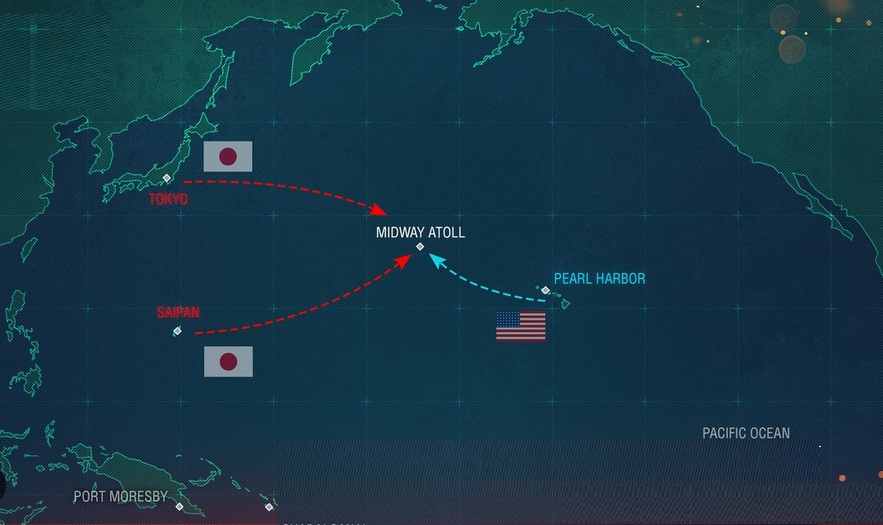
The five day naval Battle of Midway ended on this date in 1942. Midway has never been celebrated with the verve and reverence it deserves, in great part because the June 6 remembrance of D-Day, a pivotal event in the Allied victory in World War II, has just been celebrated the day before. (Another reason is that there isn’t a really good movie about Midway, though the last one, Midway (2019), with its B-list stars, was better and more historically accurate than the 1976 effort with an all-star cast and a silly romantic sub-plot.) Midway was arguably just as important as D-Day, however.
The Pacific theater of WW II, fought between the Allies and the Empire of Japan, lasted from December 7, 1941 until September 2, 1945, and was longer and bloodier than the European side of the war. On June 4, 1942 when Japanese planes launched bombing raids on the Midway atoll, a group of islands under US control. The US Air Force and Navy had been depleted in the 1941 sneak attack on Pearl Harbor: all eight of our battleships were damaged, with two lost completely and the others taken out of commission. As a result, the US had no battleships available to fight in most important naval battle of the war.
Fortunately, US intelligence knew an attack was coming. Japan’s Naval General Operational Code used book ciphers, making it much easier to break than the Germans’ Enigma and Lorenz codes. We had discerned early in 1942 that Japan was planning an attack on Midway. It was commanded by the same man who oversaw Pearl Harbor: Chuichi Nagumo, who was the vice admiral of the Japanese Navy and commander of the Japanese First Air Fleet. His successful attack on Pearl Harbor put him in charge of all his nation’s attacks in the Pacific and Indian Oceans. (He was to honorably kill himself later in the war when the tide turned against Japan.)
At the beginning of the Battle of Midway, the Japanese Army also attempted to invade the Aleutian Islands. Some believe the Aleutian attack was designed to pull U.S. attention away from the more crucial naval battle. Meanwhile, if there had been betting markets in 1942, the Japanese would have been heavy favorites. The U.S. fleet was outnumbered: the Japanese attack used four aircraft carriers, seven battleships, 150 support ships, 248 carrier aircraft and 15 submarines. The US defense consisted of just three aircraft carriers, 50 support ships, 233 carrier aircraft, 127 land-based aircraft on Midway and eight submarines. Meanwhile, Admiral Halsey was sidelined with shingles.
Japan was sure it could neutralize the U.S.’s already weakened US navy and prevent it from interfering with the Rising Sun’s aggression in the Pacific, as Japan was determined to expand its empire. But as Carnak the Magnificent might say, “Wrong, Sushi Breath!” After the four day battle, Japan withdrew from Midway on this date in 1942. The Japanese had lost nearly 300 planes, all four of its aircraft carriers and 3,500 men. Japan did sink a US aircraft carrier, the USS Yorktown, and destroyed many US aircraft and vessels, including a destroyer. Still, there was no dispute over which forces prevailed. Midway was the turning point in the Pacific. After the battle, Japan and the US reversed roles: Japan spent the rest of WWII defending its territories in Pacific as the United States attacked.
ADDENDUM: Ace commenter Joel Mundt authored a terrific piece on the battle, and I urge you to read it, here.


It’s my understanding Midway basically ended the war. I remember reading somewhere that during the course of the war the U.S. built fourteen aircraft carriers and the Japanese built … none.
Here’s to Mr. Moore, father of seven with Mrs. Moore and a Marine pilot who flew at Midway. A banker at First Federal in Miami and one of the men at St. Michael’s parish, among whom I was raised. Father of my grade school classmate and buddy Judge Kevin Michael Moore, the district court judge who returned Elian Gonzales to Fidel Castro.
The Germans had NO aircraft carriers (had begun one, but dropped the project), and concentrated on submarines. This contributed in part to events like their loss of their prized battleship Bismarck, disabled into a sitting duck by British torpedo bombers off of their carriers (slow, fabric covered biplanes with a single torpedo each, but difficult to disable without hitting a vital spot).
Excellent work, good sir!!
An interesting side story…
That little fight in the Aleutians in 1942 cost the Japanese Navy dearly. One of their Zeroes (flown by a young pilot named Koga) was damaged by ground fire and tried to make an emergency landing on Akutan Island. But he landed in a bog, flipped the plane, and broke his neck. Japanese pilots were ordered to destroy crash-landed planes, but because the other two pilots with Koga couldn’t determine if he was still alive, they refused to destroy the plane. They reported the downed plane when returning to the carrier, but subsequent events prevented the Japanese from coming back to retrieve the Zero.
A month later, an American patrol plane discovered the plane (largely undamaged) on Akutan and informed the U.S. Navy, who (in true Republican form) pounced, grabbed it, refurbished it to flying condition, and studied the dickens out of it. It gave the Navy not only key insights into the strengths and weaknesses of the plane that U.S. pilots could use, it led to direct design advancements in subsequent Grumman/Vought aircraft.
Those early days in June 1942 were catastrophic for the Japanese Navy.
I will offer up a bit of shameless self promotion…a short piece I wrote on Midway years ago.
Thanks for the essay, Joel.
Regarding the Zero, it’s my understanding that the Japanese culture’s deference for its elders led to any initial weaknesses in or less than desirable aspects of the Zero not being remedied out of a fear of insulting and diminishing the reputation of the original design team. Over the course of the war, the Zero remained unimproved and rapidly became obsolete.
From my reading, one of the reasons Midway was so devastating to Japan was not so much the aircraft carriers they lost. It was all the veteran naval aviators and crew that were lost. In addition, they lost many of their best technical aviation seamen who manned the aircraft carriers.
Japan did have other aircraft carriers, not sure how many, and they could build more planes. But they didn’t really have a plan or method for replacing the pilots and Japanese aviators were less and less experienced and skilled as the war went on.
Before Midway, it is probably fair to say that the American pilots were the rookies and the Japanese the experienced veterans. After Midway, the balance shifted drastically in favor of the Americans. I think you could say that churning out pilots was a part of the overall industrial effort the United States put forth in WWII.
So yes it makes sense to say that Midway was the turning point at sea for the Pacific War. Guadalcanal would be part of the same thing on land shortly thereafter.
Japan had only Yamamoto’s six months to run wild before their hopes of victory sank off Midway Island.
Pathetic lack of interest on EA regarding this post. Are people not interested in Midway because they know so little about it, or do they know little about it because they aren’t interested?
WW2 inaugurated the era of American global magnificence. Why would any youngster, mostly acculturated to doubt America’s goodness, be inclined to care? WW2 exists in the current zeitgeist to compare people you don’t like to Hitler.
Lack of interest? Perish the thought! As a retired naval cryptologist, the Battle of Midway is commemorated every year. Two of the best books on the matter:
Combined Fleet Decoded: The Secret History of American Intelligence and the Japanese Navy in World War II by John Prados.
Joe Rochefort’s War: The Odyssey of the Codebreaker Who Outwitted Yamamoto at Midway by Elliot Carlson
Each text follows the importance of codebreaking to the Pacific War and both are replete with countless examples of how creativity, ingenuity, failure, and bravery contributed to the eventual Allied victory in the naval battle.
A more recent USNI Proceedings article (2024) discusses “Five Intelligence Takeaways” for the battle (https://www.usni.org/magazines/proceedings/2024/december/battle-midway-five-intelligence-takeaways-today).
And I still remember reading Midway: The Battle that Doomed Japan by Fuchida/Okumiya in our plebe naval history course (taught by renowned historian E. B. Potter) – a text that focused on the strategic impact of the battle – over half-a-century ago.
Midway was a Big Deal and is worthy of being memorialized each and every year. Thank you for keeping the history alive.
I was at Indiana Comic Convention yesterday so had little time to read and comment.
Midway was a much-needed boon to American morale after the early setbacks in the Pacific and what would be early setbacks against the Germans during the North African campaign.
Sadly, the Pacific war is not nearly as well known to Americans as the European theater. Far too many do not understand the source of the conflict between the Japanese and the U.S., about Japan’s aggressive war in China and other East Asian countries or about the brutality of the Japanese occupation and its treatment of captive populations and POWs.
School kids who learn anything about the war against Japan come away thinking it was another dispute about oil, that we were causing suffering in Japan because of embargos and that we dropped the atomic bomb on the Japanese (as opposed to the Germans) because they were people of color.
“modern America haters avoid the details so they can say it was because America wanted oil for itself.”
And that was my point. The narrative for the last few decades is that America only intervenes because it wants the oil.
“I think we would have 100% nuked Berlin if the Germans were still fighting in late 1945 (or another German city).”
No question about it. Anyone who thinks FDR wouldn’t have dropped the bomb on Berlin to take out Hitler is incredibly naive.
I wonder if people know less about this because naval war is a bit different than a ground war. It doesn’t have the same human element, even if it’s equally or more important. Watching thousands of ground troops go in creates a certain visual. That’s my guess anyway.
The latest movie got a bit around that by focusing on dive bomber Richard Best.
It’s also hard because people have barely enough attention span to focus on about 5-6 main characters. The real Battle of Midway has like 50 main characters. Movies always have to summarize and sacrifice story lines to keep things understandable.
Interestingly, the reincarnation of the sunk Yorktown returned to the Pacific theater about a year later. Intended to be named Bonhomme Richard, her keel was laid about a week before Pearl Harbor. She was renamed in honor of the lost Yorktown, and was launched in January, 1943.
Among other actions, she was instrumental in sinking the Japanese ‘s battleship Yamato, operations at Iwo Jima, and bombing raids on Tokyo. She operated in the Vietnam conflict, and other activities such as retrieving Apollo mission capsules, and movie appearances. She’s now a retired museum ship at Charleston harbor’s Patriot Point (I’ve stayed there a few times on overnighters with Scout groups).
So the Yorktown, at least in spirit, had her revenge.
Joel’s separate article is a great summary of all the odd line ups we call “luck”. Enjoyed it.
Need to update one note:
“Or Nagumo’s decision to land his planes returning from their attack on Midway Island and then rearm them for carrier attacks, which left his carrier decks awash in aviation fuel and bombs?”
It doesn’t sound like it, but it’s actually a small detail from Fuchida’s after war account that he eventually admitted he added to summarize the drama of what was unfolding *below* the decks because of Nagumo’s waffling about how to arm his planes.
The flight decks (confirmed by contemporary imagery and other accounts) were actually all pretty clear because Nagumo, off balance frantically *reacting* to the American swarms, needed to be able to get his fighter Combat Air Patrols off and on and off and on.
Had the upper decks been in the condition described, our dive bomber attacks may have only resulted in Japanese carrier’s needing extensive superstructure repair. Instead – with the aviation fuel and bombs all exposed *below* the flight deck, the dive bomber attacks proved to be far more fatal to the air craft carriers.
Thanks…and especially thanks for the updates to that paragraph. Those were facts I didn’t know, but make total sense as you’ve detailed them.
Daddy is guarding the streets of Heaven. A Marine serving in the Pacific, he saw some terrible atrocities, and was shot by a sniper, I think in Saipan. Like nearly all WWII Veterans, he didn’t talk about it. He Just came back, healed, got married, went to work, and he and my Mother raised a family. Mom told us the war stories. Four uncles and an aunt served in the Pacific, too. We were lucky that all returned. Some of my quality time with Mom was watching the old war movies. She loved them.
Thanks for all the history lessons and for honoring our war Veterans.
The Battle of Midway
Information is useful but it isn’t everything. There’s a ticking clock. The longer it runs, the more information you can gather, but the less time you have to act on that information before either your opponent acts or conditions change and the information is out of date. The Japanese had a plan to lure the American carriers into a decisive showdown, reasonably assured they would approach their bait from the direction of Pearl Harbor, the American navy, having cracked Japan’s secret code moved their carriers to a position that would allow them to attack from an unexpected angle.
Admiral Nimitz scrambled to act on the decoded information. Nimitz was an indispensable leader in America’s ultimate victory over Japan. But there’s every chance Nimitz would never have been there. Early on he wanted to be in the Army, but the congressman he sought a nomination from saw talent and convinced him to consider a naval commission. Very soon, in command of a naval vessel, Nimitz ran aground. This is ordinarily the end of a naval officer’s career; but given manpower constraints at the time, Nimitz was merely reassigned to “lesser duties”. He dove into these duties as if they were the most important things the navy needed.
In life, you’re going to fail, what’s important is what you do after you fail; and find yourself an organization that gives you second chances.
Information isn’t always timely and you have to act on what you know – the cracked Japanese code was useful for setting up the American position, but after that, cracked codes are pretty useless as they trickled in at a snails pace and were certainly going to be useless at the rate a battle unfolded.
Sometimes action now, even sloppy or ill advised, gets the ball rolling in your favor. Both the Japanese and the American fleets had engaged in war games and naval maneuvers prior to the war. Both came to the conclusion that odds of victory increased dramatically for the side the found and attacked first. The Japanese slowed their ability to attack because they painstakingly wanted to ensure their planes had a “doctrinally correct” load out. The Americans launched their first wave with whatever they happened to have on board.
That wave was pretty much annihilated, but from then on, the Japanese were in reaction mode, scrambling to regain initiative. In life, we often need to just start a task even if you don’t have the perfect toolset…endlessly preparing to go successfully and never going will never lead to success; encapsulated by the phrase a good plan now is better than a perfect plan tomorrow.
Japan was left scrambling with Combat Air Patrols to fight off the American swarming and left their heavily armed planes and other exposed armaments vulnerable when properly armed American dive bombers arrived.
The devil is in the details. There were small things the American Navy did, that while tiny margins, stacked on top of each other. The American navy put a great emphasis on damage control and personal protective equipment such as fire retardant clothing. Any fires or hits taken, while bad for crewmen, were a little less bad than for their Japanese counterparts.
The almost puritan devotion to maintenance, repair and upkeep, allowed American vessels to work long past a Japanese equivalent was already fatally wounded. Leading to another post-battle advantage: the American vessels that were heavily damaged could have been withdrawn to harbors for repair – instead we repaired enroute to the next engagement (Guadalcanal) – never letting Japan recover from its wounds. This echoes what Grant did to Lee during the Wilderness and Overland campaigns. In life, when you hit setbacks, keep moving forward and assess your mistakes on the way and it’s also less expensive (but not easier) to take care of what you have than it is to buy another.
A final note about the battle of Midway is the Carriers themselves:
IJN Akagi completed in 1927
IJN Kaga completed in 1928
IJN Soryu completed in 1937
IJN Hiryu completed in 1937
USS Yorktown completed in 1936
USS Enterprise completed in 1936
USS Hornet completed in 1940
This was all “new” technology for the United States and came about after no small amount of debate with “old schoolers” fully holding to the idea that the heavy battleships would never be supplanted. There was a remote chance we could’ve been dragged into WW2 without any carriers. There’s a lesson here, when our enemies around the world are experimenting with AI and investing in the Data Centers necessary to power AI, and militaries developing robust theories for AI usage in warfare, that maybe we shouldn’t be so quickly convinced that data centers are bad for the community. Especially not as we seem to be on the horizon of a variety of global conflicts with those very enemies.
Ethics Lessons of Midway could be summarized in a way that will sound a lot like a commencement speech at a reputable institute of learning (if anyone knows of any). We hear people often say things like success comes from hard work, talent, who you know and luck. The US Navy had all four in droves. A lot of unsuccessful people will resort to blaming “luck” as the one factor that prevented them being successful.
In my experience, we’ve over-defined “success” and created a culture of envy. No, I think you can be successful with as little as 2 of those four factors above, hard work and talent will let you be successful; hard work and who you know can do the same. I think you can be *wildly* successful with 3 or 4 of them. But don’t think that the existence of wildly successful people means you aren’t successful.
Frankly, luck isn’t a factor at all. Everyone gets lucky at some point in their life. What people fail to do is see those moments or seize the lucky moments that life puts in front of them. So let’s replace “luck” with initiative or discernment. Something I feel like our institutions are failing to pass on to children – it’s ok to grab a hold of what the course of human events has put in front of you, without fear, without permission. Just do it.
It can also be said of luck – that you can put yourself into positions to be lucky and also that while success is ninety percent luck and ten percent luck, you better not try to capitalize on luck without the skill.
You can be successful with any two of the following: hard work, talent, people you know and seeing/seizing fortuitous moments.