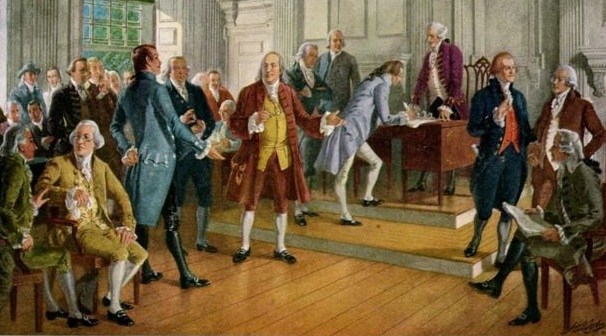
The Mecklenburg Declaration of Independence, or “Meck Deck, as its friends call it, was a document allegedly signed on May 20, 1775, in Charlotte, North Carolina by a committee of citizens of Mecklenburg County. The document declared local residents “free and independent” from British rule in response to news of the battle of Concord. Some North Carolina historians argue that Thomas Jefferson cribbed from the Meck Deck to draft his Declaration of Independence, and that’s because they are North Carolina historians.
The evidence that Jefferson plagiarized the earlier document is weak to say the least. To begin with, there is no authentic copy of the Mecklenburg Declaration of Independence in existence For me, that should end the controversy.
The story is that twenty-seven of Mecklenburg County’s civic leaders led by Col. Thomas Polk, who was the great-uncle of President James K. Polk, received news the colonial battles against the British in Massachusetts culminating in the British defeat an Concord a month earlier. They signed of the document “in a rustic backwoods courthouse which stood nearby in the center of the intersection of Trade and Tryon Streets,” according to a plaque that now stands in Charlotte’s Independence Square. The declaration was read to a large crowd that had gathered at the courthouse steps, according to eyewitness accounts. Tavern owner James Jack volunteered to deliver the document to the Continental Congress in Philadelphia, but the North Carolina delegation never brought it before the full Congress.
Like so many disputed documents, the Meck Deck was destroyed in a fire in1800 fire at the home of Meck Dec secretary John Alexander. In 1819, however, Alexander’s son, William, delivered what he claimed to be an accurate copy that had been reconstructed from memory by his father.
From memory. That makes the thing hearsay and ineligible to serve as admissible evidence in any court or even a credible investigation. Nevertheless, The Raleigh Register published it, and the text bore sufficient resemblance to THE Declaration that it set the day’s conspiracy theorist’s tongues a wagging. John Adams, then corresponding routinely with his old friend and rival, mentioned the Meck Deck in a letter to Jefferson dated June 22, 1819. Jefferson wrote that he had never heard of it, much less read it, and in a letter responding to Adams on July 9, 1819, said the document was probably a hoax. That letter was published after Jefferson’s death (on the 50th anniversary of THE Declaration’s signing in 1826, when Adams died as well) in 1829. Jefferson’s hoax accusation prompted the North Carolina legislature to establish a committee to investigate the matter.


When I was in high school, Mr. (Hal) Lyness taught American history (among other things) and had a remarkable appetite for books such that he reportedly consumed more than 100 per year.
He was always coming up with obscure, but completely captivating anecdotes that left us with eyes wide and mouths agape. He died quite a few years back, but every time you give one of these lessons with which I’m totally unfamiliar, I think of him.
You sir, are my next Hal Lyness.
Thank you, and a Happy 4th of July to you. And Happy Birthday, America!
https://todayshistorylesson.wordpress.com/2009/05/24/hal-lyness-man-about-history/
A moving, and well deserved, tribute Joel!
PWS
Nice work, Joel. Good for you.
As I started reading, I immediately thought of your example of Life, Liberty, and the pursuit of happiness. It is a phrase with several iterations.
I think George Mason’s formulation of “Life, Liberty, and the pursuit of happiness” was actually a little more wordy than Jefferson’s more succinct version. Then, of course, the earlier formulation was from John Locke: “Life, Liberty, and Property.” (For the life of me, I recall one formulation included “furniture” or something equally mundane.
it is one of those phrases that, certainly requires no attribution (though maybe the Supreme Court would provide a citation). In Jefferson’s time, the phrase had already been part of the philosophical structure of government. It could hardly be considered plagiarized.
-Jut
“The pursuit of happiness” is just brilliant. It could have appeared on a Hallmark greeting card it can sound so mundane, but it just hits the mark. “Happiness” is such a mundane and profound thing all at the same time.
53 years? I can’t remember what I ate last night for dinner. Jefferson was young and flawed, but brilliant.
Hope everyone had a great 4th.