When I left you in Part I, I was cataloguing the incompetence of the movie’s director, who some critics, probably all Batman fans, appear to regard as Orson Welles, John Ford, Stanley Kubrick, Stephen Spielberg and William Wyler rolled up in one.
Upon reflection, I need to mention another example at the risk of exposing my lack of fair reference since I never saw the second half of the movie.
Based on various reviews and analyses, I know that many aspects of the performances (Damon seems depressed and unengaged) and the unfolding story ( Why is Athena so passive?) are allegedly explained or justified by revelations in the film’s last scenes. However, with the exception of gimmick films like “The Sixth Sense,” in which fooling the audience is the central purpose of the movie, that is unconscionable story-telling, especially in a three hour movie. Finding out after Matt Damon has bored you stiff for hours and you’ve been wondering “Where the hell are all the gods?” the answer to the puzzle—“Oh! I see! Odysseus is depressed! Its complex PTSD! Now I realize in retrospect that I really enjoyed his nuanced portrayal of a serious human malady!” and “That’s it! There aren’t any gods, and “Athena” was just the hero’s way of dealing with the girls he saw beheaded!”—is unfair to the audience, to the actors, and to the source material. Rare directors, with the right material, can pull that trick off. If the first half of the movie loses the audience, it’s impossible.
2. Incompetence: The screenplay! The dialogue! Nolan is responsible for both, and shame on him. I don’t know that I have ever watched a major movie with such amateurish, hackneyed, stilted dialogue…when you could hear the dialogue. Here I have to also blame the actors as well. At least the stars have some control over what they say. Damon’s dialogue in particular was awful. He has the juice (so does Hathaway) to pull the director aside and say, “Come on. I can’t say that. Fix it.” This may be another example of how Nolan’s inflated reputation for being a genius harmed the film.
As for the screenplay, whoever got Nolan hooked on “Zeus’s Law” should be stuffed in a barrel filled with fat Lithuanian midgets. The best take-down of this thematic conceit comes from Emily Wilson appropriately enough, the scholar who wrote the translation of Homer that Nolan allegedly adapted for his movie, and who wrote, by far, the most thorough and intelligent review of it as well. (She hated it.)
After noting the obvious, that it’s weird how everyone blathers on about Zeus’s Law but Zeus is nowhere to be seen, and Odysseus doesn’t believe in the gods anyway unless they hang around as surrogates for headless girls, Wilson writes,
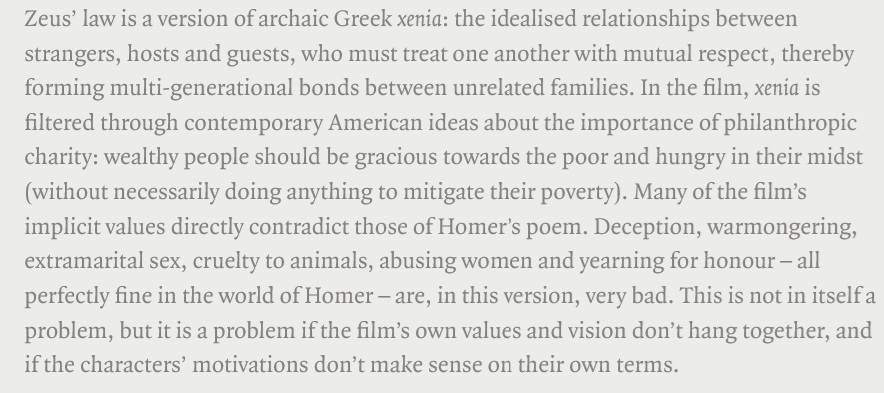

(See, Alizia? That’s an ethical “appeal to authority,” the opinion of a Homer scholar who has read the work in Greek and wrote the translation the film she’s critiquing was based on.)
Bingo! The movie, characters and plot as envisioned by Nolan are ethically incoherent. (I had the same complaint about Nolan’s Batman movies.)
Remaining notes:


https://www.facebook.com/share/1EWpEhh35d/?mibextid=wwXIfr
Come on this is hilarious.
Watched it
And….?
Wrote a long comment. Wrote a shorter version
Not here!
Is this the long comment and your first one the short comment???
I don’t object to revelations arriving at the end. Detective stories, among others, often save them for the final act. My objection is structural. The last scene is the only real dramatic tension in three hours. Homer’s Odyssey accumulates dramatic tension with each adventure, each one deepening our investment in Odysseus’s return. In Nolan’s hands, those adventures are merely a series of dull attractions, without building either. The final scene is exciting enough, but the three hours leading up to it don’t deserve it.
I basically agree, but in a mystery or detective story, you know the genre, and you are looking for clues. In Nolan’s film. the whole thing is a bait and switch.
[I]t’s long past the time when movie Romans and Greeks were expected to speak in British accents.
Hah! Cover your ears, Richard Burton!
(See, Alizia? That’s an ethical “appeal to authority,” the opinion of a Homer scholar who has read the work in Greek and wrote the translation the film she’s critiquing was based on.)
Oh bloody hell!
Jack, you are a lovely, lively, intelligent and thoughtful man with an enormously important background in the presidency of the US among many areas. And recently you carried your over-bloated self like a giant child.
And despite the also obvious fact that you drove off poor suffering Alizia (::: sob, whimper :::) solely because she made a few sharp comments directly to your face and your ego cannot handle such insubordination among your sycophantic crew here…
(No names will be mentioned …)
…and the FACT that the war against Iran has at this point been soundly lost at SIGNIFICANT COST on my levels to the US that will cost the Republican Party all of its gains Jack, all of them; and that you insist that Alizia, making reference to men who, like you, have significant background in their area of political analysis (John Meersheimer and Pape among a various few) is “appeal to authority”) and is somehow “unethical” …
… is simply stupid on your part. You are smart but you are also sort of dumb at times. But a greater stupidity on your over-stuffed, over-inflated part is to have assigned the extremely unfair term “anti-Semite” to her.
You have in truth recently acted like a spoiled child and, as she carefully pointed out, a bully.
To be ethical you should apologize. Most important though, you should encourage people to participate on your blog who hold opinions contrary to those you insist are absolutely right. They have all flown away! and you know it.
Remember: Cassandra saw things and made predictions but no one believed her. You will soon see the results of this idiot president’s horribly bad decisions.
Love this! Wins, hands down, the EA Tongue Piercing Cheek Pseudo Sarcasm of the Year Award
Even worse, I don’t think Wilson’s critique was that good to begin with. It was bad when the Greeks killed the Trojans because they were violating xenia in the process. They entered Troy under the pretense of a gift and proceeded to kill their “hosts.” Odysseus’ killing the suitors was good because they were violating xenia. It is perfectly consistent.
What happened as a result? Agamemnon went home to be killed and Odysseus was tormented for 10 years on his way home. Menelaus seemed to do okay though. Ajax, however, did not fare so well.
(This was part of the theme of Euripides’ Trojan Women, which I read recently with my book club; some of them had seen the Odyssey, so the conversation went in that direction.)
-Jut
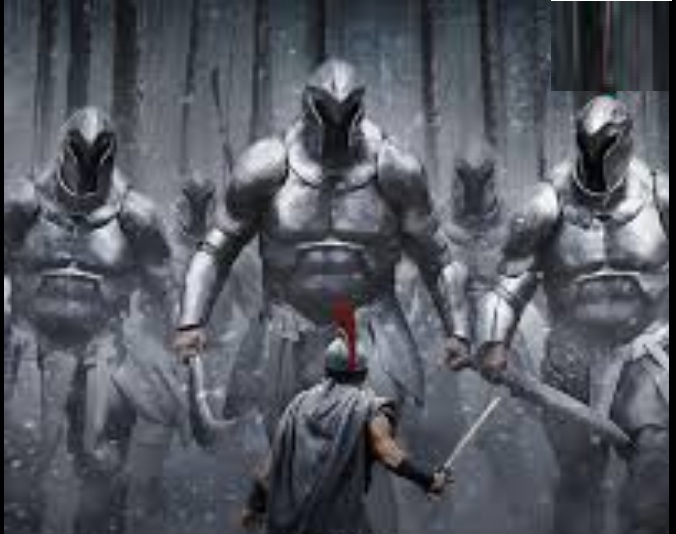
When I saw the picture, I thought they were fighting Cylons.
YES! That’s exactly what they looked like. And probably their inspiration, ’cause it sure wasn’t Homer.