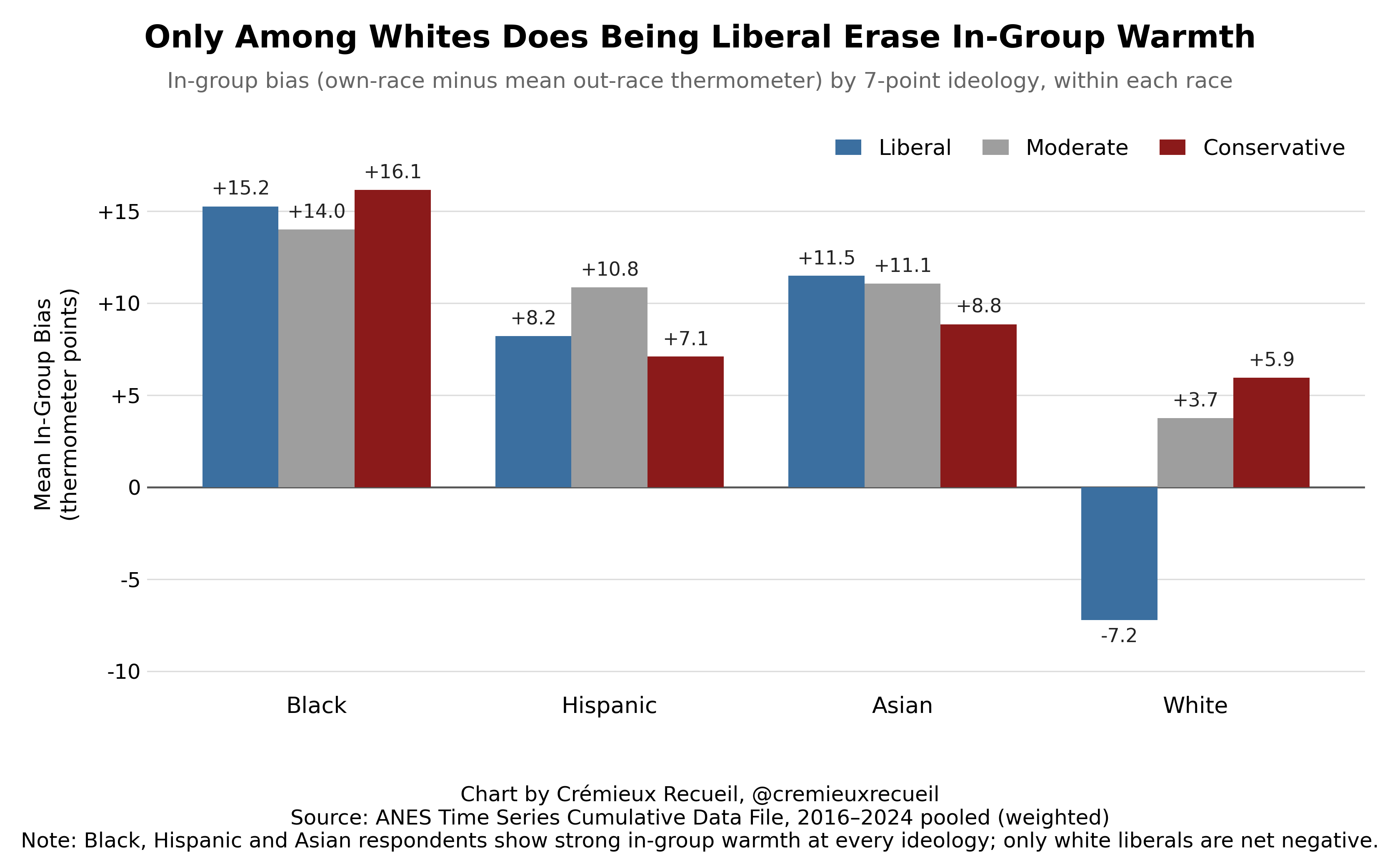
White leftists are the only groups that considers the natural human preference for one’s own ethnic group to be wrong, toxic, racist and a mark of bigotry.
This certainly shouldn’t surprise anyone who has been paying attention for the past, oh, 50 years or so.
Now what?
My reflex instinct is to presume that a group that vilifies those who display natural human characteristics that are not only permitted for everyone else but extolled (“I want to see performers/ elected officials/ judges/ Cabinet members/ etc. who look like me!”) is an unethical group.
Is that instinct wrong?


First, I would like to see if this result is replicable, and what all the real underlying data shows. As always with surveys there are the following questions: how nuanced were the questions? how granular were the allowed responses? what assumptions went into the data crunching? Does the data actually tell the story the surveyors claim?
But, assuming this is accurate, this is no surprise, given how liberals see a core value as being anti-discriminatory to minorities and disadvantaged groups. The flip side of how you word the analysis — White leftists are the only groups that considers the natural human preference for one’s own ethnic group to be wrong, toxic, racist and a mark of bigotry — is that white leftists are the only group that, at least verbally, expresses a stronger affection for people outside their own race. This does not ipso facto mean they view their own race as toxic, just that they view their own race less favorably than other races.
One way to approach this survey result is to ask, what would the ideal look like? If we had a truly colorblind society, would we expect all the mean in-group biases to be 0? Or would we expect a slight preference for the in-group? Let’s for a moment assume that 0’s across the board is ideal. Then what this survey shows is that across all races, we still have work to do to drive towards a colorblind society. In the case of the white liberals, we would conclude that they have overcorrected, and need to relearn warmth for their own race. Thus overall, we should be concerned that, as races, we are still too insular and need to find greater warmth for the other groups. (On the other hand, if we’re targeting a colorblind society, is even asking about warmth toward other races counterproductive?)
On the other hand, there’s a natural predilection towards associating with people who share a number of commonalities. Have shared areas of agreement, shared culture, shared ideals makes — contrary to the DEI advocates — a more harmonious environment. Diversity injects contention into an environment, which is not necessarily a bad thing, especially when considering problems like stagnation, groupthink, and inbreeding. So I think it might be more reasonable to suggest that the ideal is a mild positive value for in-group bias across the board. With that in mind, the survey results suggest that white people are actually the closest to the ideal, as the other races (Blacks especially) have much stronger in-group biases. The White liberals, again, have overcorrected.
Should we entertain the idea that the ideal might be a slightly negative in-group bias? After all, don’t we want to bring together what is good from all the different groups and cultures across the world? Test everything, and hold fast to what is good? But is this what a negative in-group bias actually means? The melting pot is certainly achievable under mildly positive in-group biases. But I would argue that the melting pot is not achievable with all-negative biases, in that this means that no one strongly hold that his own race brings anything to the table. If no one has anything they perceive as worthwhile to bring to the table, then the table remains empty. So I don’t think a slightly negative in-group bias is viable as an ideal.
This gives us the chance to re-examine the White liberal preference. This over-correction could be attributed to enlightened minds that see value in all peoples, but I think what we have witnessed in recent times tells a different story. Because White liberals see anti-racism as so vital to their identity, the warmth to other races runs the danger of being virtue-signalling. If one prefers the company of a black man because he is black, and not for his character, then one has lost sight of the person and just sees the race. Couple this with the constant drumbeat of “white privilege,” “colonialism”, and critical theory, there is significant risk of self-loathing, from which one can only be rescued by ejecting “whiteness”. One has to prove he is not like others of his race by showing a preference for anything but his race. But this creates an inherent cognitive-dissonance, made all the more problematic because unlike with other categories, a White liberal cannot identify as Black because that would just confirm his horrible whiteness through appropriation; nor can he remain white, because being white is being an oppressor. This is why we’re starting to see a new category emerge to resolve this dilemma, the “non-practicing white.”
The only solution is to continue to demonstrate that one does not need to apologize for the accident of his birth, nor for any advantages that said birth bestows; that so many factors being tormented into the label of “whiteness” are actually universal (such as hard work, timeliness, accountability, and fascination with the Roman Empire); and that ultimately it is not a vice to prefer the company of people who look, think, speak, and behave similarly. Eventually, reality has to sink in. It might require waiting for the entire current generation to die out and pass the torch to a new generation, but eventually reality will triumph.
I had never heard of this before “non-practicing white.”
Is it somewhat like an atheist priest? How does one go about not practicing/doing/being?
I can’t help but think some people are loving the power they have over these insecure whities.
I imagine a chance encounter:
Person-of-not-color: I am a non-practicing white.
Me: You? Non-practicing? Well, me too, but I don’t need no practice. I born white.
The Anglicans have atheist priests. It is someone who does the job of a priest, but doesn’t believe in the religion. It seems to be pretty common in Christianity these days, but most won’t admit to it. The Anglicans had a few priests in the early 2000’s who admitted it. I think a bishop in Texas started an atheists group he also ran. A current one is Gretta Vosper. https://thehumanist.com/contributor/gretta-vosper/
https://www.churchsociety.org/resource/topical-tuesday-atheist-priests/
Adding the variable of college educated and liberal and then its potential correlation to negative in group warmth would be worthwhile. Or perhaps more easily done, what percentage of white liberals responding have a college degree.
My assumption is college feeds this negative bias against your own group.
Your instincts are not wrong. Since the Obama administration dems have systematically stoked the fires of racism. The division and hatred in this political climate is all on them. They want all of us clawing and spitting at each other, and they particularly hate straight white men. As I’ve said many times, they are evil.
If I’m being completely fair and honest, I wouldnt want to associate with white liberals, either, given the choice. So I can hardly blame them for preferring any other groups but themselves.
I have seen these results in several different studies. The worst ones are about jury duty. Look at the in-group bias. The only group without in-group bias is white. When you ask minorities about convicting a white person of not convicting someone of their own race, it becomes relevant to ask if anyone but a white person can serve on a jury. The bias is just that bad.
In-group bias or favoritism is as the posts already indicates, natural and exists because it has evolutionary benefits (passing on your genes or the genes of those closely related to you to the next generation). Being part of a tight-knit group also creates a sense of belonging and self-esteem.
The smallest in-group to consider is your own family. Prioritizing family is not only normal but the ethical norm when it comes to allocations of resources and time. We should not emulate the example of Mrs. Jellyby in Charles Dickens’s Bleak House who prioritized the needs of the poor in the Third World over the needs of her family.
A larger in-group is your tribe or your village. Let’s say you live in a small village (a farming community) in the Mid West. It is not uncommon that everybody in that village knows each other very well. Often they all go to the same church, and marriage rate within that village community is high. In such a tight community social capital is high; neighbors are looking out for each other, in time of sickness and health the village provides a natural support system, and people can leave the door unlocked (try that in Chicago!) There are some perceived drawbacks as well: there are a lot of social obligations, conformism to common mores, gossip, and lack of privacy. Newcomers may have a hard time to settle in, and may still be considered an outsider decades after moving in.
There is a hormone name oxytocin that strongly correlates with in-group/out-group dynamics; this is what Google AI provides as to the key effects of oxytocin on in/out group dynamics.
Here it becomes ethically interesting, as we need to stay away from the naturalistic fallacy to equate natural with ethical. In-group bias is a bad thing for a juror in a criminal trial as it impedes the fairness of the trial. We have come to see in-group bias in hiring as something to avoid, due to the racism of the Jim Crow era.
I do not see in-group bias as an absolute wrong. The prevailing ethical views are a consensus that have grown as a reaction to excessive discrimination and hostility against out-group such as during slavery, Jim Crow, and due to the Holocaust. In-group bias is not wrong in principle; but there are dangers and drawbacks attached to it. Personally I would like to move away from discussing topis like this in terms of moral/ethical absolutes; instead I would like to discuss this in terms of benefits and drawbacks, interests and preferences.
Denouncing whites as “racist” is an expression of in-group / out-group dynamics; it is an example of out-group derogation, and part of a divide and conquer strategy by the left. That indicates that it is time to stop feeling guilty about racism as it makes you a tool to be manipulated.
For any immigration debate, my preference would also be to leave the moral absolutes behind and look at drawbacks and benefits at a national level. Which type of immigrants provide value to the USA? Which immigrants will assimilate easily and add positively to our culture? That may mean that we discriminate against Muslims and those who will depend on the largesse of the tax payers, and in favor of those who bring capital and skills and have attitudes favorable to a Judeo-Christian culture. I am using the term “discrimination” in an ethical neutral way meaning “making a choice based on practical discernment”.