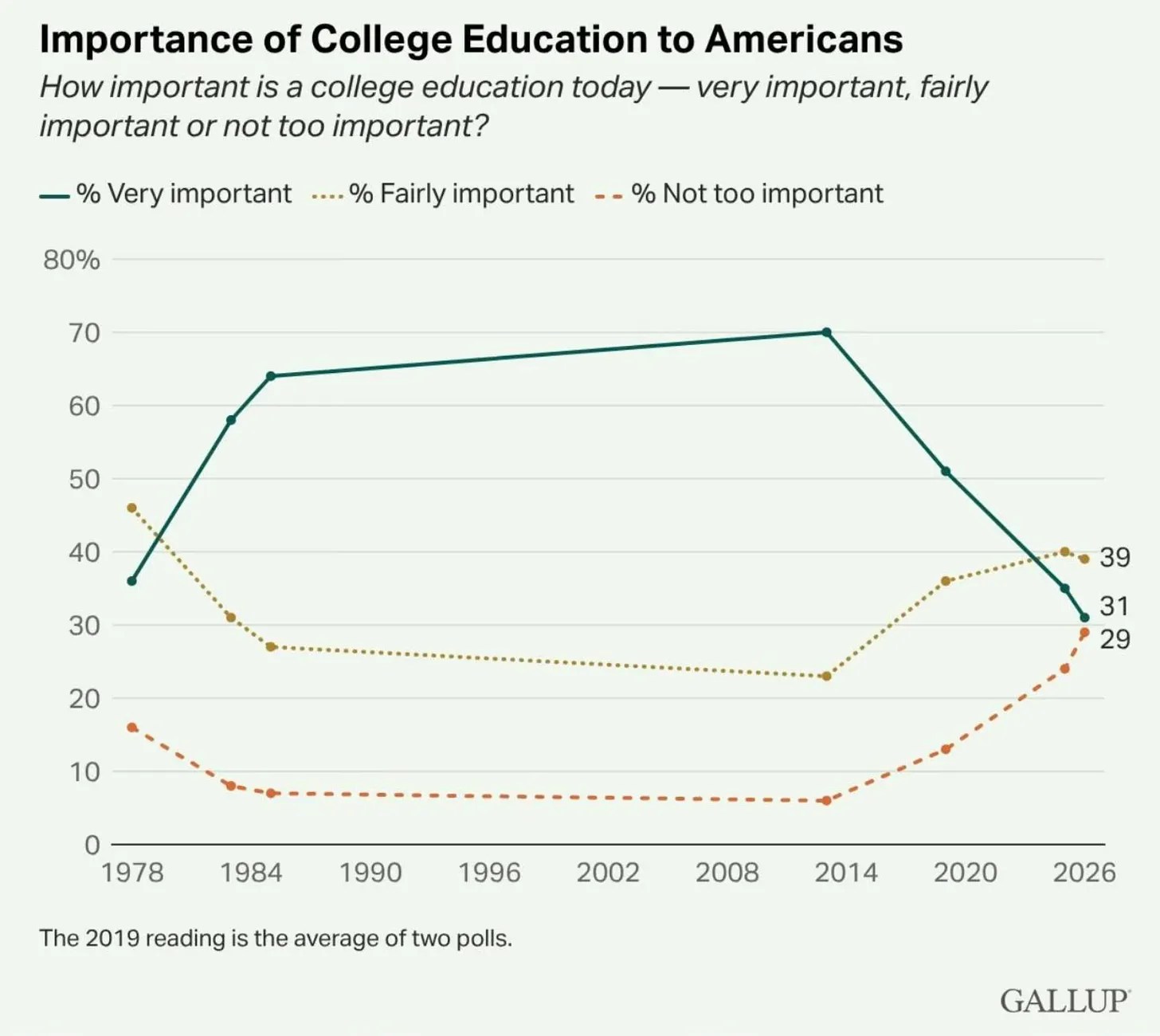
The only reason so many polled still think that colleges are essential to education is that their own education was inadequate and their critical thinking faculties are under-developed. Or they are Democrats. Or both.
Substacker Steven Hayward writes,
Nearly every day brings fresh news of another university facing a huge budget deficit and enacting significant cuts to programs and personnel. The latest is the University of Minnesota, which is imposing cuts to fill a $225 million shortfall over the next two years chiefly because of the declining enrollment that everyone knew was coming. The University of Maine is likewise imposing—gasp!—faculty layoffs to close a $19 million budget shortfall.
Yet universities were heedless of the coming financial collapse, and went on building climbing walls, plush dorms, and adding more and more layers of useless and/or mendacious administrators (you gotta put those gender studies majors to work somewhere). (I reported here previously about the travails of Syracuse University, which is cutting whole departments because of falling enrollment and plunging revenue.)
Meanwhile, here is what an Ivy League education produces:
They haven’t even been taught the meaning of “justice.”


This isn’t just the fault of the university. In the early 2000’s, I worked for a failing university. Student enrollment was dropping and we couldn’t seem to attract students. We were one of the cheapest schools in the state and we were one of the most highly ranked for quality of graduates. We were tier 1 with the Navy for their nuclear engineering program and had one of the highest med school acceptance rates in the region. We hired a consultant who surveyed prospective students about why they didn’t choose us. The main reasons are below.
(1) We had dorms, they wanted apartments.
(2) We had an old-style gym, they wanted a modern ‘wellness center’.
(3) We didn’t have enough entertainment.
Well, all those things are expensive. We hadn’t increased tuition at all for 3 years. But, we paid good money for the survey, so we built some ‘suite-style’ dorms and more students came. We increased tuition to pay for it. We built a new ‘wellness center’, more students came. We increased tuition. We added more sports and entertainment, more students came, and we increased tuition. We increased tuition by 75% or so, did nothing to academics, and doubled enrollment in just over 5 years. If the school hadn’t done that, it would have gone under. Students demanded those luxuries and were more than willing to pay for them with student loans.
Accreditation bodies have mandated the DEI and diversity positions. Colleges would lose their accreditation without them. The accreditation bodies will put your school on monitoring or worse if you don’t have a bunch of organized minority groups and enough DEI administrators. They even demand that schools maintain records about what the minority student groups do and have standards for what they have to do each year. About the only thing the accreditation bodies don’t monitor or enforce is academic standards. If you try to fight it, your school will lose accreditation and go bankrupt.
Imagine if every attorney was evaluated by the ABA every 10 years and got to keep their law license if and only if the ABA approved of that attorney. Imagine if the ABA was allowed to apply any standards they wanted (legal or not). That is higher ed accreditation. After living through 5 accreditation visits, there was not 1 math, hard science, or engineering professor on the accreditation team. The team never asked to see syllabi, final exams, or test scores.
Thanks Michael. Terrific comment. I guess the reason I kinda sorta still think a college education is essential to future success is I still have glossy memories of what college was like for me in the early ’70s. You’ve disabused me of that. The trajectory you’ve described fits that of my college. They have a huge endowment, but otherwise, they’ve played the same game.
College education is necessary for some fields. Engineering, medicine, the hard sciences, etc need college for training. One of the problems is that many of the fields seem to have lost their relevance to society or become actively destructive to society. How have the ‘grievance studies’ furthered culture and society? What great literature comes out of our literature departments? I know there is some new history that is interesting being done, but that seems overshadowed by all the ‘1619 Projects’. Psychology seems intent on exploring and promoting deviance no matter the cost.
It isn’t just that a lot of college degrees don’t help the graduates get good jobs. The fields themselves don’t seem to benefit society anymore and that is why we have universities. We have them to benefit society, not to give academics a paycheck to advance their agendas.
Looking back at my undergraduate English B.A., it was just four years on a remote campus spent reading the works of great minds and talking about those works with people with pretty high-powered minds and doctorates in their respective fields. It was terrific. We got to play being intellectuals. Was it an extravagance? I don’t know. Other than teaching high school, I wasn’t better prepared to do much of anything. (But it was good training for law school, which is good training for … passing the bar exam, not much for practicing law.)
But I think we all had an understanding the four years of college was an indulgence, even if it was a great experience. I suspect that sort of experience is no longer on offer at my college, where Bernie Sanders taught for a year decades ago and one of the prominent History professors is one of the founders(!) of the DSA! I’m pretty sure the English department has long ago been taken over by deconstructionists and post modernists and radical feminists and race hustlers. What a shame. The idea of a liberal arts education being inherently valuable for broadening one’s mind has been trashed. I would not let any of our grandchildren go there and I’m more than happy to not give the school a cent. (Why do people give hard earned money to schools that want to destroy capitalism?)
Much of the current discussion of “higher education” reminds me of conversations that took place when I was an undergraduate student in the mid-1970s. It seems that efforts to “professionalize” police service through applied higher education had drawn the ire of many faculty and staff in the more traditional subject areas / career fields taught by the university I was attending. One of my professors, an attorney who also had worked as a police officer before law school, used the following story to illustrate the opposition to criminal justice education at our school – and others as well, I’m sure;
It seems that a particular land long, long ago existed in an arctic climate; the people lived in igloos and fed themselves by ice-fishing and hunting mammals that lived in and around the arctic seas. Their schools taught these traditional ways and skills very well.
Over centuries the climate began to warm, the ice receded, and the people changed their way of life to reflect changing conditions. Igloos were replaced by grass huts, and spear fishing and bow hunting replaced previous hunting methods.
At some point the people realized that their schools were still teaching the old ways that were no longer useful to surviving and thriving. They approached the school’s administrators with a question, ”Why are you teaching these old useless skills instead of the ones we need to survive and thrive now?
The school administrators answered, “Oh, we didn’t know you wanted a Vocational School!”
(I hope I recalled the story in enough detail to convey the point. All bureaucracies resist change, but education bureaucracies do it better than most.)
This is due to elitist creep in education. For millennia, there has been a bias against any form of manual labor. Purely intellectual pursuits, especially without any practical purpose, are viewed as more noble than others. So, developing a bunch of math to decrease food losses in the use cycle is considered vulgar, but developing a bunch of new math that doesn’t do anything or have any physical meaning at all is considered elite.
As Americans, we used to reject this. We added agriculture and engineering to colleges. The Europeans laughed at us. I’m sure the Ivy Leagues did too, but look a the benefits to the world that our agricultural research brought.
Now, we are just as bad as the Europeans. Boston College refused to add a physics degree until the 1970’s because they didn’t want it to detract from their ‘liberal arts’ atmosphere. Physicists, chemists, and engineers do things with their hands and that is too ‘man’ual for them. Physicists have mostly solved their problem by ceasing to work on the real world and just do math that describes universes other than out own instead.
The green line on the polling chart is super interesting. Does it indicate there’s simply been a reversion to the norm on how people view the value of a college education? Ironically, one would have thought around 1970 would have been a peak time for the supposed value of a college degree. This was a time when everyone was supposed to go to college, all of us children of the beneficiaries of the GI Bill. You’d think there would have been a decline after the ‘seventies from a high, not a surge.