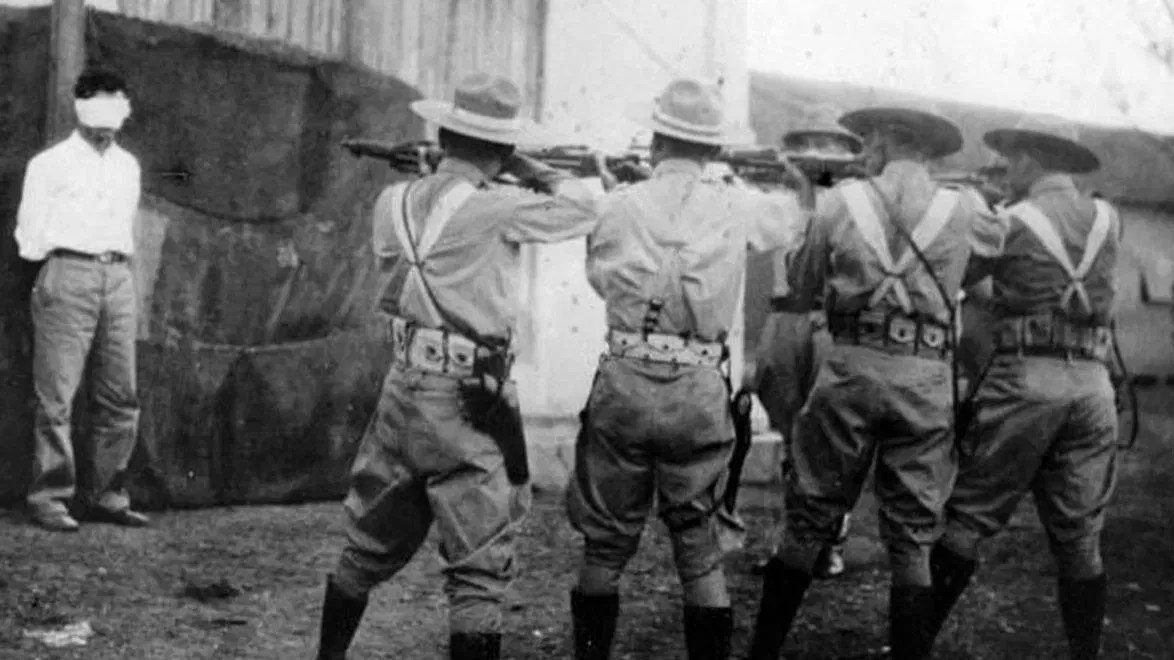
Last week the President signed off on the firing squad execution of Nidal Malik Hasan, the Muslim terrorist who killed 13 people on an Army post in Texas in 2009. Funny, I assumed he had been executed already: why I thought that, I do not know. Secretary of War Pete Hegseth announced that Hasan’s killing would be public. “People need to understand that there’s serious consequences for these types of things,” Hegseth said. I think pretty much everyone is aware that there are serious consequences for murdering a lot of human beings, unless the killer is a mother and the victims are her own children, but I digress.
The Pentagon confirmed the plan to make the execution public, with the event streamed live. Predictably, many Americans are horrified at the prospect, including the usual suspects, progressives, capital punishment opponents and the Trump Deranged. The issue was lightly debated on yesterday’s EA Open Forum, with opinions varying. AM Golden wrote, “I guess I don’t want to watch someone die. Even if he deserves it. It’s not sport. It’s not entertainment.” Remy Boudreau said, “It really is a terrible idea.” Steve Witherspoon wrote in part that it “will give this terrorist the martyrdom that he wanted. Across the globe, those that support the actions of this terrorist will hail this terrorist as a martyr and use the execution video to actively promote their ideology.” JutGory: “I do not believe public executions, which were historically routine, is edifying to the average person. Quite the contrary, they feed baser instincts. I still don’t intend to tune in.” Michael West wrote, “Had Nidal Hasan been dealt with appropriately – within the year of his conviction for what he was quite obviously guilty of – a private execution would have been sufficient. I’m not a fan of the spectacle, but I’m open to being convinced that the spectacle has some ethical claim because of how long it has taken for justice to be enacted.”
Over on the all anti-Trump, all-pro-Democrat propaganda network MS NOW, host Stephanie Ruhle and correspondent Jonathan Lemire made those counter-arguments and more.
“We will see it here in the United States,” Lemire said, “but so will people around the globe, including our adversaries, including terror groups that would probably make good use of this kind of footage of America killing someone who accused of doing these things. It raises the terror threat, it raises security risks; but more than that, it degrades who we are as a country.”
The latter point is the reflex and empty lament I keep seeing on Facebook: “Is this who we are?”—whatever that means. It is a versatile, lazy default argument that fits anything the speaker thinks is repugnant. “Is this who we are—encouraging children to mutilate themselves and calling it “gender affirming care”? “Is this who we are—encouraging anti-Semitism and the destruction of Israel while supporting brutal terrorists?” “Is this who we are, a nation that kills over 1,230,000 unborn children each year and calls it “choice”?
As Jimmy Durante would say, I got a million of ’em! And as Tonto said in a memorable joke, “What do you mean we, white man?”
Ruhle even had the gall to send a plea to Trump to block the public execution. Why should a a President that Ruhle and her colleagues denigrate, lie about and refuse to extend even minimal respect to all day, every day care what she wants?
My assessment of the public execution is as follows:
1. It is not cruel and unusual punishment, contrary to what I heard one ignorant critic exclaim today. The shooting has been judicially approved as a valid execution method, and the public part of it isn’t a tangible aspect of the punishment anyway. The man is going to be killed: we’re worried that he might be embarrassed too? The 8th Amendment forbids “cruel and unusual” punishment: at worst, a public execution by ordinary means is just “unusual.”
2. Hassan has been a paraplegic since he was shot when being apprehended after his killing spree. Another critic found it especially cruel to execute Hasan because he is disabled (due to his own criminal conduct!) Wow. That ranks a Kauffmann.
3. If anyone doesn’t want to see it, nothing will force them to tune in. Anyone who does tune in just to complain afterwards has no credibility. The act itself is, at worst, “ick” rather than unethical. Hasan won’t die any more painfully or slowly in a public execution than in a private one. He’ll be just as dead whether the shooting is on TV or held at the bottom of a mine.
4. I do believe that the decision to hold a public execution is unethical because it’s incompetent and irresponsible. From a utilitarian perspective, its negative results, expected and unanticipated, far, far outweigh anything positive that can come from the spectacle. It is undeniable that terrorists, Muslims and anyone looking for another excuse to attack the Trump Administration will exploit the event to their advantage. The President is addicted to handing his adversaries huge metaphorical sticks to beat him with. This is another one, and to do it before mid-terms is just perverse. And stupid.
5. Trump still hasn’t learned the Cognitive Dissonance Scale principle. Firing squads are associated with dictators in the public mind. Good guys don’t kill bad guys that way, it’s the other way around. The most popular and viewed U.S. movies featuring firing squads all side with the executed: “The Firing Squad” (2024), “Paths of Glory” (1957), “Valkyrie” (2008), and “Jojo Rabbit” (2019). Trump already has been branded as the equivalent of Hitler; this won’t help. Of course, most of those outraged would be similarly inclined no matter what the Trump Administration decided to do with Hasan. One of the two vocal critics I encountered with Spuds at the dog park today was wearing a “RESIST” shirt and the other a shirt reading “KAMALA.”
6. I can see one ethical argument for the public execution, though it is not sufficient to carry the day. For a capital punishment advocate, watching an execution is, if not mandatory, a demonstration of good faith. It’s easy to advocate the State killing someone in the abstract, but the State represents all of us, and we share responsibility for what our government does. Giving citizens the opportunity to see and understand exactly what they say they want bolsters seriousness and integrity.
The results of this public execution may not be what its adherents expect.
ADDED: I also want to note that this is another relatively minor source of outrage, like the vast majority of what Trump’s critics bellow about. On the consequential list, I’d put it above the reflecting poll uproar but well short of Trump’s aborted deal with the IRS for a family slush fund.

