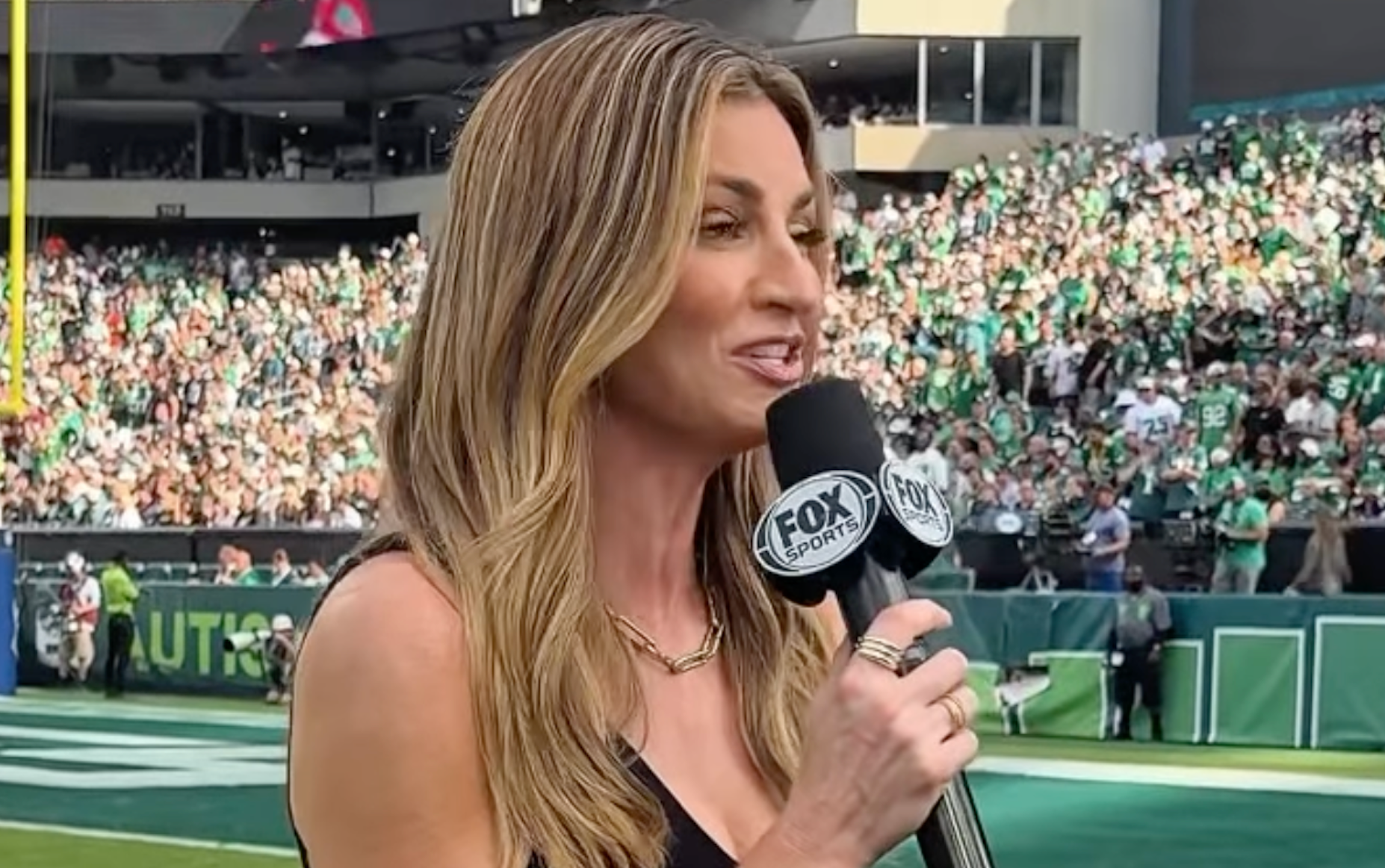
That’s Erin Andrews above. She’s a broadcast professional, a long-time sidelines reporter in NFL games. She a professional public communicator. Here she is on one of her recent podcasts:
“And then I’m like, ‘Wait, wait, fuck, what did he say about going for it?’ Because I never want to quote a coach and get it wrong, so I’m like, ‘Oh my god’…I’m fully fucking out of breath, which is inappropriate. Like, get it together, sister! In through the nose, out through the mouth. It was all because the ramp was so long. And I’m like, ‘Oh my god, how many people are watching … I’m so much better than that!”
And I’m like, “You sound like a moron, Erin, and this kind of illiterate blather just further embeds that toxic speech pattern in the next generation.”
Never mind the gratuitous “fucks,” that usage of “like” is worse than “um,” which was metaphorically beaten out of me as a child, and since I speak in public for a living, thanks, Mom, Dad, Miss Barrett, Mrs. Penwarden and the rest of my vigilent teachers. Are today’s teachers even trying to stop the “like” contagion? I doubt it: I bet they are infected themselves, and besides, they are too busy teaching kids to be communists.
My own daughter, after being taught by two articulate parents to speak grammatical and articulate English, now uses “like” every seven words, because that’s the kind of speech everyone around her all day uses. And I’m not about to correct a 32-year-old. Nonetheless, when I hear someone use “like” that way, my respect for them takes a nosedive, just as when I hear someone use “ain’t” or “we was” or “irregardless.” I can’t help it.
Frankly, I don’t want to.


“I can’t get behind that… kind of like… English”
As someone who taught at a women’s college, I trained my students to excise this from their speaking. They understood it makes them sound stupid and professionally weak.
All I had to do was play a few videos speaking this way. They understood immediately.
I even had students voluntarily “like” accounting in my class.
My mother’s primary target was “you know.” “If they already know what you’re saying, why are you telling them?”
Why did the blonde have trouble with her laundry?
“It says wash with like colors, but it doesn’t say like, which colors.”
By the way, I’ve read that “ain’t” is a perfectly valid contraction of “am not”, but nobody uses it in that context.
The first time I heard “ain’t” was in a Beatles song.
When I was in high school – before “I’m like” was the substitute for “I said” – the stupid phrase was “I go”. So instead of “he said” or “she said”, fellow students would say “he goes” or “she goes” and then “I go” and so on and so on descending into madness.
It was nauseating.
So I started responding with “where did he/she/you go?” And many of my friends looked at me with blank stares…”like…what?!?”
I think it’s Paul who often points out that many years ago, kids graduated high school having taken classes in Latin and/or Greek. Now they can barely compose a structured sentence in English. I’m guessing they have no notion of what a direct object is.
And thank you again Mrs./Senora Olga Vargas for teaching our class how to diagram sentences in sixth grade. What a terrific gift she bestowed upon us.
Joel, you must be a contemporary of our kids born in ’74 and ’76 respectively. “I go” was everywhere when our daughter was a pre-teen.
I’m just a bit older…born December of 1968.
“I think it’s Paul who often points out that many years ago, kids graduated high school having taken classes in Latin and/or Greek.”
“In 100 Years, We Have Gone From Teaching Latin And Greek In High School To Teaching Remedial English In College” Joseph Sobran
It may come as no surprise that this statement, and its author, are…um…deemed RACIST.
PWS
A speech curiosity that’s endemic right now: “Yes no.” Well, that, and “to your point.” Ugh. Fortunately, these things come and go. I remember “excellent!” being ubiquitous in the early 1980s.
I think that “excellent” was an overused movie quote from “Bill & Ted’s Excellent Adventure”. If I remember correctly, they say excellent a lot in that movie. It was overused a lot in our culture but at least most people used the quote reasonably correctly in context with the conversation not just random placement between other words when their brain farted.
Many years ago, I worked with group of maintenance employees in a huge apartment complex that way over used a quote from Ghostbusters, it was “Yes, have some.” At least they were intelligent enough to use the quote correctly in context with the conversation when someone asked them if the wanted something.
This was a big pet peeve of mine when I taught English in China. People use filler words all the time, but the Chinese would default to a Chinese filler word. The word they would commonly say was “nige (that).” Imagine how problematic that would be here.
My brother-in-law is constantly using the word “there” improperly as his filler word. A cousin and I have a standing private joke here we make a game out of guessing the number of times he will use the word “there” improperly. It’s annoying as hell!
In Japanese the word “bitter” is “nigai”. In an extreme situation, where you inadvertently take a bite of burnt toast or drink coffee that’s been on the warmer too long, the exclamation becomes “niga~a!”.Had to train a few people going to the U.S. for work out of that one!
Here an example where an Italian streamer said the wrong sounding word
https://www.youtube.com/shorts/wwW6bJmLI3k
Russell Peters does a great bit on encountering 那个 at a KFC in Beijing (NSFW):
Every time I heard “like” used in that way from my children or grandchildren, I’ve immediately stopped the conversation and told them to say the same thing without using the word “like”. After repetitive corrections this way, my teen daughter completely stopped saying it way back in her early teens and the jury is still out on my grandchildren.
It seems to me that this valley girl (my bias) styled use of “like” is predominately used by females and I say that because I honestly don’t think I’ve ever heard any guys using it the same way. Maybe I just because haven’t been in “like” the correct social circles. 😉
Oh, guys use it a lot: listen to some of the interviews with baseball players. I have an almost equivilkent objection to “awesome,” but not quite as violent.
Our son, 22 years young, awash in private school education from grades K-12, and Texas A&M, graduating a semester early at the top of his class with a Mays Business School degree in finance, and now gainfully employed with an investment firm trading in the Oil & Gas futures markets, routinely includes “like” in his conversations, usually peppered with invectives and cursing.
Repeatedly I have called him on the carpet for such crass language but his responses are, “well, like, everyone at the fucking office talks like this, so, like, I don’t see the issue.”
Whereupon, I have retrieve the Louisville Slugger from the closet and have visited a sound beating upon him about the head and neck* with instructions to clean up his act. Apparently, finance bros need to demonstrate they are masters of the universe by exhibiting their flair(s) with extreme cursings.
Then, there was the guy in court yesterday who, clearly angry that the judge ruled against him, intended to tell the judge that he was a “fucking piece of shit” but did not have the chance to express his displeasure in open court before the bailiff dragged him into the hallway (rather authoritatively, I might add . . .), suggesting that such language might not be appropriate. That was delicious.
jvb
*Ed. Note: Not really as that would be a felony.
Jack wrote, “…listen to some of the interviews with baseball players.”
I don’t watch baseball or anything related to baseball, so that’s something I’d ever see.
Oh, golly …. you’re in trouble now, Steve.
Sideline reporting itself is cringe. Nothing of importance comes from those halftime repetitive questions and answers.
On another note, the usage of “what with” is hard for me to take.
I think “um” is perfectly acceptable in spontaneous, casual conversation and even fear my aversion to “like” is just me being an old(er) man shaking my stick at the clouds. I think to do completely without both makes for rather stilted, formal speech between, say, friends.
Understandable position, Tony, but sideline reporting is not a casual conversation. The reporter is supposed to report things. She is a professional talker so she should not sound like a teenager.
jvb
We are in agreement! I was responding more to Jack’s more generalised disdain for the term.
The most recent oral utterance that is making me crazy . . . erm . . . crazier . . . is “bro” between every word.
jvb
If we’re criticising bad speech habits, the one I detest the most are those that fill in processing time to any question with “what” and then answer. It’s clear they understood, they just used it as a fill word.
One of the misunderstood features of the English language is the way that it allows people to express themselves clearly enough to spend money while making it plain to those around them that they’re actually idiots. If the language weren’t so flexible, it would take more than a few sentences to make that discovery.
Discouraging. We didn’t study hard, work hard, compete for promotions, leave our children with Mom and agitate for respect on the job – only to have this sort of representation by a ‘professional.’
Ugh. The ‘likes’ are worse than the f-bombs.
My pet peeve is ‘than me.’
There is a proper use of ‘than me’ but it rarely arises in conversation. Proper use is almost always ‘than I.’ You are not older than me, taller than me, smarter than me ……. You don’t even need to remember the rules or diagramming – just finish the sentence. You are taller than me am. No? You are older, taller and smarter than I am.
You used to be able to rely on broadcasters to use English properly. Only a few are reliable today, usually older professionals such as Victor Davis Hanson or Brits such as Stuart Varney.
Perhaps it’s a tangential dislike, but in the college classroom I would call out students who began responses to questions requiring defensible information with “I feel that…” Sure, it’s fine to use that phrase if the question is “How do you feel about…” But, as I explained during the first session of each semester, answering a question that demands an informed response with “I feel” typically indicates a lack of certainty or commitment. At least, that’s how I perceived such a response. And, as the prof, my opinion mattered.
Late to the party, but more from Erin on her “Calm Down” podcast (bolds/italics mine throughout:
“I’ve had players call me out, like literally call me out,” Andrews said. “They’ll be like, ‘Oh, really? Wow. What are you doing?’ I was working a Dallas Cowboys Christmas Eve game years ago, and I had a fabulous, like, Christmas green suit, and the Cowboys won.
“And Dak was like, ‘What are we doing?’ And I was like, ‘I swear to God, this is all about Christmas.’ He goes, ‘You couldn’t wear red?’ And I was like, ‘I wore red for Thanksgiving.’ Come on.”
PWS