Morning Ethics Warm-Up, 9/2/17: Keith Olbermann Tweet, The Rifleman On The Melting Pot, and What The Editors Of the New York Sun REALLY Wanted to Tell Little Virginia…

GOOOOOD MORNING!

1. For some strange reason AMC and the Sundance movie channel alternate showing multiple episodes of “The Rifleman” every Saturday morning. Like most of the old TV Westerns, but even more than the rest, the Chuck Connors half-hour drama about a single-father rancher who doubled as part-time lawman was about ethics, despite the fact that Chuck as Lucas McCain killed over almost tw0-hundred men over the course of the show. In one of today’s episodes, young Mark, Rifleman Jr., played by the excellent child star Johnny Crawford, fought off some bullies who were abusing a young Chinese boy who was dressed in his native clothes and wearing long hair. As the boy’s father thanked Lucas and  Mark, the Rifelman pointed out that the boy would be tormented as long as he wore his hair “like that.” “His hair is worn in the manner accepted in my country,” the father replied.

“Yes, but you’re not living in China, you’re living in the United States,” Chuck said, wrinkling his brow.

That message was not a controversial one in 1880, or in 1960, but it would be today. Still, The Rifleman was right. There is cultural pressure on immigrants to accept and adapt to U.S. culture and values, and that is for the benefit of everyone involved.  Mark made it clear that he would keep fighting for the right of the young Chinese boy to wear his hair as he chose and Chuck endorsed that, because it’s another American core value. Still, being an American citizen should mean more than just an address. Our culture used to send that message powerfully and regularly, in TV dramas and elsewhere. Now it sends the opposite message most of the time. That’s a tragic change, and the results are becoming apparent.

2. Now THIS is an uncivil tweet: The degree to which the unhinging of the Trump-hating left has reached frightening proportions was illustrated last week by a tweetstorm meltdown by onetime MSNBC star Keith Olbermann, who is still anchoring a public affairs commentary show somewhere, I think. It reached its apotheosis with this masterpiece or reason, nuance, and civility:


Olbermann finally took down the tweet, but the rest remained:
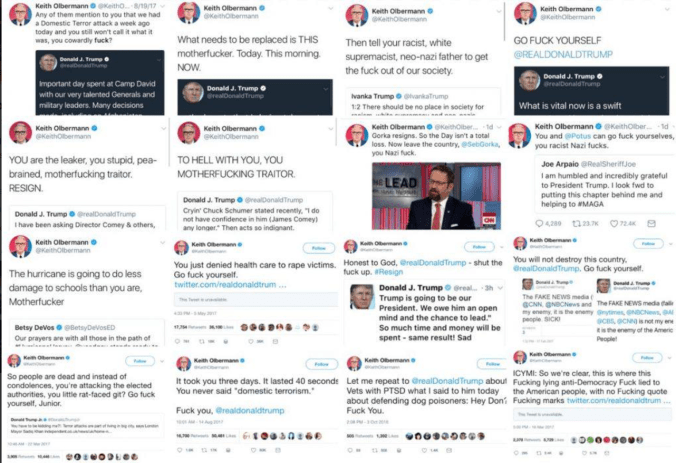
I don’t think Olbermann is significantly more addled by blind rage at Trump’s election than a large number of prominent journalists, editors, academics, professionals and others, or more emotional in his hate.  He  just has less restraint than most in giving vent to it, that’s all. Continue reading →
Comment Of The Day: Morning Ethics Warm-Up, 9/1/17: …A Sarcastic Cop

The news item involved a Georgia traffic cop being fired for a dash-cam video showing him sarcastically telling  a DUI motorist who was resisting his requests on the grounds that she had seen videos of police shooting unarmed motorists, “But you’re not black! Remember, we only kill black people. Yeah, we only kill black people, right?”

My post took the position that in the current environment for police departments, the officer had to be fired despite hsi obvious intent. Esteemed long-time commenter Charles Green articulated the opposing view, which I must admit is more ethical than mine on its face. I wonder if it is realistic, but I’m thinking, Charlie, I’m thinking.

Here is Charles Green‘s Comment of the Day on the post, Morning Ethics Warm-Up, 9/1/17: Richard Simmons, Stilettos, A Sarcastic Cop:

Regarding the sarcastic cop: as I’ve said many times in this column, I think comments have to be understood in context. This is no different.

As you note, it was obvious from the context what he meant. I’ve made the point numerous times about “black lives matter,” and about how the same words when uttered by black people have different meanings when uttered by white people.

I think this is the same. If it was obvious what he meant, then why should we defend the police department for bowing to perceived PC implications? The department should back him up and make an intelligent, forceful statement about how cops are required to make on-the-spot judgments about the individual in front of them, and not be slaves to the perception outside.

I wouldn’t even have fired him, much less go after him to make an example. By that logic, all the statues should come down (which I don’t agree with either).

How The Human Factor Foils Technology And Ethics: A Case Study (UPDATED)

Baseball finally installed a replay review system to address umpire calls that were shown by TV slow-mo to be clearly wrong. For all the complaining about the system, it was the only ethical choice. Mistaken calls were changing the results of games, and because of technology, this was now obvious to all. Only technology could solve the problem.

Unfortunately, however, human beings still control the technology. Bias, emotion and other impediments to ethics will still prevail more often than we like to think. Yesterday’s Red Sox Yankee game provided a classic example.

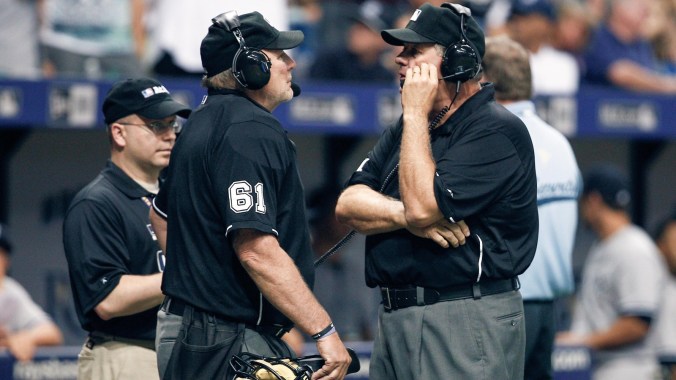
Yankees manager Joe Girardi challenged a safe call on the Sox’s Andrew Benintendi when he slid into second base for an apparent double. The video showed that the second base umpire had missed the play. Upon review—the umpires put on headsets to get the verdict from a New York studio where another set of umpires check the video from multiple angles—the call was reversed, and Benintendi was out.

In the same inning, Red Sox manager John Farrell challenged an inning-ending double play. The review showed Red Sox baserunner Mookie Betts safely reached second before the throw, allowing the Red Sox to score the game’s first run. For the second time in a single inning, Greg Gibson,  the second base umpire, had his call reversed. I have never seen this happen before. For an umpire, this is not just embarrassing, it is professionally humiliating.

Later, in the seventh inning, the same star-crossed (cross-eyed?) umpire  called Yankee Greg Bird  out as he was doubled off second base after a lineout. The video this time was more conclusive than the first challenge: the umpire blew it, again. Bird had beat the throw.

While the challenge was being reviewed, the Red Sox broadcasters, who had concluded that Bir should have been called safe at second, were talking about the rarity of the same umpire being reversed three times in a single game. Sox color man Dennis Eckersley wondered aloud if professional courtesy and loyalty might affect the review.  What he was really asking was whether the umpires in New York would allow a colleague to be exposed to the disgrace of being reversed three times in one game. This wouldn’t only  make him look bad, after all. It would make umpires look bad. Three strikes and you’re out, after all.

Sure enough, the decision from New York was that the call at second was correct. Bird was out, even though the video showed he was safe.

The umpires have plausible deniability here: this was hardly the first time that a replay review seemed at odds with a video. Nonetheless, it was a sobering display. By all appearances, the umpires distorted the game to protect one of their own who was having a terrible night. They were employing the Golden Rule in the kind of setting where the Golden Rule works against an ethical result, not for it.

Fortunately for the umpires, allowing the third blown call at second was allowed to stand had no effect on the game’s outcome, but that is just moral luck. The umpires made a very clear statement. They regard loyalty to colleagues as more important than their profession, the game, their fans, or public trust. They, or at least the umpires involved, cannot be trusted to put aside their biases and conflicts when their duties demand it. Technology may be unbiased, but the humans using it are not. Professionals are not always professional when a colleague’s fate is involved.

Humanity is the ultimate conflict.

Morning Ethics Warm-Up, 9/1/17: Richard Simmons, Stilettos, A Sarcastic Cop, And The Post Sides With Palin

GOOD MORNING SEPTEMBER!

1.Good riddance to August, which had the worst fall-off in traffic here relative to the previous year of any month in Ethics Alarms history. I only have theories, the main one being that last August’s surge was an anomaly fueled by the Presidential campaign and the fact that Ethics Alarms was analyzing the ethics deficits of Hillary, Trump, the news media and both parties in roughly equal measure, since they were misbehaving in roughly equal measure.  Since “the resistance” and their allies in the news media, academia and elsewhere decided to reject democratic institutions like elections and the office of the Presidency in their revulsion, and mount a dangerous perpetual assault on the President with the objective of  undermining his leadership and having him removed extra-Constitutionally, the left-leaning end of the blog-reading pubic has become rigid and unyielding, and unable to tolerate even considering any position but their own. I’m seeing it on Facebook, every day. Their position is indefensible on the facts, so they find any critical analysis of their conduct and attitudes unpleasant. Then again, it could be because Google is burying my posts for being insufficiently politically correct, or because I suck.

2. Here’s a perfect example of the kind of ethics issue that only deserves Warm-Up status: Melania’s shoes as she boarded Air Force One on the way to  Houston.

(She was in sneakers when she landed, and was mocked for that, too.)

The New York Times and other Trump-Hate news sources actually thought this fashion choice by the ex-model was worthy of criticism. In Melania Trump, Off to Texas, Finds Herself on Thin Heels , Vanessa Friedman spend hundreds of words dissecting how the stilettos were “a symbol for what many see as the disconnect between the Trump administration and reality.” Apparently the First Lady broke the “No high heels when leaving a disaster” rule in the First Family Ethics Manual. Letter writer Dennis Donalson correctly chided the Times, writing in part,

The fact that she wore high heels when boarding a plane, regardless of her destination, is not newsworthy. Sometimes a cigar is just a cigar and shoes are just shoes, not “the go-to stand-in for more nuanced, complicated emotions and issues.” Give Melania, and us all, a break.

Dennis notwithstanding, I’ve decided stories like this are wonderful: they are smoking gun evidence for anyone who isn’t similarly deranged that the news media is so consumed with anti-Trump mania that it is literally unable to determine what is or isn’t fair, proportionate and reasonable coverage. If the Times thinks Melania’s shoes are such a big deal, no wonder it goes nuts over what the President says to the Boy Scouts…and no wonder it is no longer reasonable to accord such a paper any credibility or respect at all. Continue reading →

Harvey Pet Rescue Ethics

I was watching a Fox News live feature about heroic efforts in Houston to rescue animal companions. I am an animal lover, and my wife is an animal worshiper, so this aspect of natural disasters is close to our hearts.

We were told that one sheriff has been going door to door for days searching for endangered non-humans in the flooded areas. Awwwww. Fox caught up with him as he was leaving one domicile with the owner, who had with him the rescued pet: his 9-year-old son’s…

…hermit crab.

His name is Crabby.

Wait, what???

We’re arguing about such dire conditions in Houston that looters are running amuck, and hearing about overwhelmed rescuers and rising death rates, and this sheriff is spending hours rescuing hermit crabs?? The tragedy is down to that then? We’re at the endangered hermit crab stage of triage, are we?

Observations: Continue reading →

Snopes’ Credibility Death Spiral: Presenting The Straw Man Fact-Check

Apparently the recent example of Snopes resorting to proving a “claim” false that nobody serious was claiming wasn’t an anomaly, but a new strategy. Here, Ethics Alarms commenter Tippy Scales discussed the struggling urban-legend-turned-partisan-hack-site post in defense of ESPN’s ridiculous removal of Asian -American Robert Lee from a football broadcast because he shared a first and last name with Robert E. Lee. Its spin: the accusation that “ESPN Fired Announcer Robert Lee Because His Name Sounds Like the Confederate General’s? was wrong! Except that was not what happened, nor what critics of ESPM were objecting to.

Why would Snopes do this?  Tippy  opined that Snopes “couldn’t stand having to confirm something that went against their worldview, so they invented a reason to avoid it.” The real reason appears to be even worse than that. Snopes’ current game is to mislead readers by convincing them that criticism from the right is dishonest and absurd, by searching for self-evidently idiotic accusations and then disproving them…which isn’t difficult when the accusations were dredged up from the social media swamp by Snopes specifically to debunk.

Today’s example is hilarious. Snopes:

Fact Check: Was Barack Obama President During Hurricane Katrina?

Twitter users tried to pin the blame for Katrina relief issues on Obama, though he wasn’t even president when it hit New Orleans.

CLAIM: Barack Obama was president when Hurricane Katrina hit New Orleans in 2005.
RATING: FALSE

ORIGIN: As damage from Hurricane Harvey continued to grow in Texas in late August 2017, some Twitter users sought to defend President Donald Trump’s response to the disaster by criticizing the actions of his predecessor, Barack Obama during similarly pervasive flooding in Louisiana in 2016. Other users took that argument even further, knocking Obama for not “doing enough” to help Louisiana during Hurricane Katrina.

Continue reading →

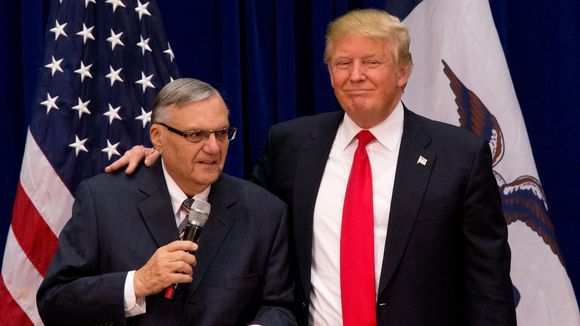
From The “Didn’t I Tell You To Stop Making Me Defend President Trump?” Files, An Ethics Alarms Popeye: More On The Joe Arpaio Pardon

I would prefer not to keep talking about the Joe Arpaio pardon, but the news media and the “resistance” won’t let the pardon go, because in the absence of anything legitimate giving them cause to scream for an impeachment, they have to latch on to whatever they can. So this is a Popeye: I’m writing it because, as the spinach-living cartoon sailor would say, “That’s all I can stands, cuz I can’t stands no more!”

Oh, before I forget: here’s what the Southern Poverty Law Center says about the pardon:

“By pardoning Joe Arpaio, President Trump has demonstrated his contempt for the rule of law and the racism at the core of his agenda. Arpaio, a Trump favorite on the campaign trail, is the former sheriff of Maricopa County, Arizona. He was convicted of criminal contempt of court for intentionally violating a federal court order prohibiting racial profiling. As a result of President Trump’s pardon, Arpaio will never be held accountable for his unconstitutional conduct.”

Following this logic, by pardoning drug dealers President Obama proved that at heart, he is a drug dealer. By pardoning Chelsea Manning, President Obama proved that sharing classified information with our enemies is at the core of his agenda. This is a “law center”  including such tripe on its website? It sounds like the legally ignorant accusation often made against defense lawyers (like Hillary Clinton) that they endorse the crimes, motives and values of their clients.

In a front page article on Sunday, the New York Times tried to break its own record for desperately trying to make a case for Presidential wrongdoing while still stating the undeniable fact that no wrongdoing had occurred:

  • The Times states, correctly, “that there is nothing in the text of the Constitution’s pardons clause to suggest that [Trump] exceeded his authority.” But it tracks down yet another law professor who has allowed the anti-Trump brain virus to swallow his integrity. Noah Feldman, a law professor at Harvard, claimed that pardoning Arpaio “would express presidential contempt for the Constitution.”

Good thinking. The President expressed contempt for the Constitution by engaging in an action described and enacted in the Constitution. A better argument, though still unfair, would be that President Obama was expressing contempt for the Constitution by not using its pardon power provision even once within his first 400 days in office.

  • More from the Professor: “Arpaio didn’t just violate a law passed by Congress…His actions defied the Constitution itself, the bedrock of the entire system of government.” Yes, and so what? If that same document gives the President an open-ended power to forgive any crime, and it does, then this is just huffing and puffing.

All Feldman is saying is that he doesn’t believe that Arpaio’s particular crime should be pardoned. When you’re President, Professor, by all means let that standard be your guide.

  • By saying Mr. Arpaio’s offense was forgivable, Professor Feldman added, Mr. Trump threatens “the very structure on which his right to pardon is based.”

Note to  Professor Feldman: Get help. The reason the President has unlimited pardon power is because, in the view of the Constitution’s authors, any offense IS forgivable. Presidents have pardoned traitors, those who have killed American citizens. They have pardoned terrorists, and a President of the United States who plotted to subvert justice and our democracy itself. No Harvard Law professor has made the claim that any of those offenses were unpardonable (that is, literally, unforgivable). Why is that? Well, a) Trump is special and doesn’t deserves to be judged by the same standards as other Presidents, and b) the Left hates Arpaio beyond all proportion, because of his opposition to illegal immigration.

  • The Times writes, “It was the first act of outright defiance against the judiciary by a president who has not been shy about criticizing federal judges who ruled against his businesses and policies.” If this pardon is “outright defiance against the judiciary,” then most pardons are. Almost all pardons erase a judicial sentence or verdict.

This is misleading, biased, inflammatory, unethical journalism.

  • The Times writes,

“Mr. Trump could pardon any of the subjects of the special counsel’s Russia inquiry, though some legal specialists believe he could increase his risk of prosecution if he is seen as abusing his pardon power.Were Mr. Trump to announce that he has pardoned himself, impeachment would remain possible. A prosecutor might also test the limits of the pardon power by indicting Mr. Trump notwithstanding such an announcement. That clash could lead the Supreme Court to weigh in on the limits of the president’s power to spare himself from punishment for criminal wrongdoing.”

This story has nothing to do with impeachment! No evidence has been found that suggests the President has committed any impeachable acts. The Times story is about the Joe Arpaio pardon. How can the Times justify suddenly piling tangential hypothetical on top of tangential hypotheticals in this article to get to a scenario where the Supreme Court has to determine whether President Trump can pardon himself for crimes as yet unalleged and undiscovered? Well, the reporter is Adam Liptak, the epitome of what Instapundit calls “Democratic operatives with bylines.” He’s not reporting here; he’s promoting a nakedly partisan narrative. Continue reading →

Morning Ethics Warm-Up, 8/31/17: Southern Poverty Law Center Edition

A Cayman Islands sunrise!

Good Morning, Everyone!

1.For the second time in two months, I had the wrong date on yesterday’s Warm-Up. This time, I was six days off. That’s incompetence, not malice. If I made anyone miss a birthday, anniversary of other appointment, I am so, so sorry.

2. D. James Kennedy Ministries of Fort Lauderdale, Florida, an evangelical Christian ministry, is suing the Southern Poverty Law Center for calling the ministry a hate group because of its stance against LGBT rights. The SPLC is an Alabama-based, self-styled  watchdog group that tracks tracks what it considers extremist organizations, and it publicly names organizations it considers hate groups. It considers hate groups to be any group that is sufficiently aggressive in opposing certain core progressive positions. The entire operation is a masterpiece of self-validating virtue. The name was carefully chosen to signal unimpeachable virtue: it’s “Southern,” so its stance against discrimination is obviously defient and in opposition to its surrounding culture and biases. Though little of its activity involves poverty, the name also signals charity and virtuous motives.  What’s a law center? Well. I grdauted from one, and that was a law school. The Southern Poverty Law Center isn’t a law school, but doesn’t the name sound impressive? Originally, the SPLC acted as a public interest law firm (I would call its use of “law center” misleading, and a breach of several states’ legal ethics rules if it were still a law firm), but now it is a progressive activist and propaganda organization. Not that there’s anything wrong with that, but part of its schtick is to designate organizations as hate groups because, well, they say so. Then the left-leaning news media accepts their verdict as fact. You will read articles saying that there are 917 hate groups in the U.S. No, there are 917 groups the Southern Poverty Law Center calls “hate groups.” .Many of the organizations on the SPLC’s list are undeniably racist and violent. Many are not, or may not be. Lumping them all together as “hate groups” is an effective way to demonize dissent. “Hate group” has no accepted definition, but SPLC defines a ‘general hate group” thusly: “These groups espouse a variety of rather unique hateful doctrines and beliefs that are not easily categorized.”

Got it. The Southern Poverty Law Center is a hate group by its own definition. To be a reliable arbiter of whether a group is promoting hate rather than a just a controversial policy position, a group would have to be non-partisan, objective and politically neutral. all things that the SPLC is not. This is an organization that designates groups that espouse views that it hates as hate groups.

I hate that. Continue reading →

First Parmesan Cheese, An Now This: A Judge Bends Over Backwards To Let The New York Times Escape Its Abuse of Journalism Rights

Oh, we knew Palin had nothing to do with this wacko, but it sure felt good to stick it to her anyway…

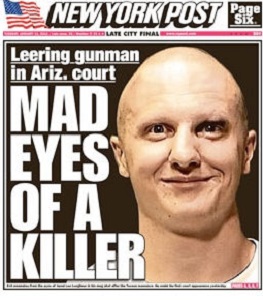
Federal judge Jed S. Rakoff  has dismissed Sarah Palin’s defamation lawsuit against The New York Times, ruling that she had failed to show that the Times  defamed her in its June editorial stating that she was responsible in part for the Tucson shooting of Rep. Gabrielle Giffords and others by the deranged Jared Loughner. Rakoff’s  ruling argued that the statements in the Times editorial were ambiguous (where have I heard this before?), and thus did not qualify as “provably false,” resulting in insufficient evidence that the Times had written the story with “actual malice.”

“[I]f political journalism is to achieve its constitutionally endorsed role of challenging the powerful, legal redress by a public figure must be limited to those cases where the public figure has a plausible factual basis for complaining that the mistake was made maliciously, that is, with knowledge it was false or with reckless disregard of its falsity,” Rakoff wrote.

Right. Except that to write what it did, the New York Times Editors had to be unaware of what the Times itself had reported regarding Palin’s alleged culpability for the shooting. The Times reported, in great detail at the time, that the claim that Palin’s website had inspired Loughner was completely without merit.

A newspaper’s editors impugning a public figure by blaming her for multiple murders and the attempted assassination of a Congresswoman without checking its own reporting doesn’t qualify as “reckless disregard of its falsity”? If that isn’t reckless disregard, what is? Continue reading →

Professor Volokh’s Ethics Dissent On The Vicious, Pazuzu-Blaming Professor’s Firing

‘Yes, I know he’s an idiot, but we should support idiots as highly paid teachers of our children, for the protection of the non-idiots…‘

Eugene Volokh is one of the best and most objective legal minds in the country. If he finds himself on the Supreme Court when Kennedy retires or Ginsberg shuffles off this mortal coil, we will not have suffered through the ugliness of the Trump years in vain. When he opines, I listen, as we all should, and he has now opined regarding the now fired idiot that I wrote about this morning, ex-University of Tampa visiting sociology professor Ken Storey.

Storey used Twitter, in the middle of the still-unfolding human disaster in Houston and soon New Orleans, to announce that flooding victims who were Trump supporters or Republicans deserved to die. He did this twice, so his later claim that his words did not intentionally convey what his words were obviously intended to convey was a desperate and obvious lie.

I wrote:

The university or college that fires an employee like Storey is protecting its reputation as a responsible institution, by stating in clear terms that people with terrible judgment and cruel and unethical instincts who are motivated by hate and intolerance are not qualified to teach….because they aren’t. That professors increasingly have no ethics alarms beeping when the prepare to publish sentiments like Storey’s (or worse) shows how thoroughly the leftist echo chambers of most campus faculties turn academics into Pat Robertson, which is to say, rigid, mean, and dumb. Once upon a time, liberals giggled themselves silly over the evangelical huckster’s periodic pronouncement about how a disaster was God’s way of punishing the U.S. for not abusing gays sufficiently, or similar bile, Now they do the same thing, and expect their colleagues and students to applaud.

Today, in the Washington Post, Professor Volokh advocates a different position:

Storey’s comments were nasty and mean-spirited; and I should note that the University of Tampa is a private university, in a state that doesn’t limit private employers’ ability to fire employees for their speech. The university’s actions thus seem legal (assuming they didn’t breach any contract). And Storey’s comments also weren’t academic or likely to be part of a serious political debate.

But the university’s action strikes me as further undermining the freedom of expression and debate at American universities, including the freedom to say things that are much more thoughtful. If you were an untenured faculty member at the University of Tampa, would you feel free to express your views on controversial subjects, when you saw how the university reacted to this tweet? Even if your views were very different politically, what do you think the University would do if people started pressuring for your dismissal, pointing to the Storey incident as precedent?

I’ve talked before about “censorship envy,” one mechanism through which these sorts of speech restrictions can grow: “If my neighbor — and especially my political adversary — gets to ban speech he reviles,” the thinking goes, “why shouldn’t I get to do the same?”

If a university has a strong policy of protecting speech, including offensive speech, administrators can point to that policy as a means of resisting calls for firing a controversial faculty member, and they can appeal to people’s desire to see speakers on their own side protected, and use that desire to help protect speakers on all sides. But once the university starts firing some people for speech “that do[es] not reflect [the university’s] community views or values,” that makes it much harder to resist calls for more suppression. Indeed, at that point tolerating speech starts implicitly conveying the message that the speech does reflect the university’s community views or values — and to avoid that implication, the university would have to fire any speaker who offended some sufficiently influential constituency.

I am very confident that in this rare case, Prof. Volokh is dead wrong. Continue reading →