Comment Of The Day: “Morning Ethics Warm-Up: 8/23/17”

Like Baltimore removing its politically incorrect statues, here I am in the dead of night trying to catch up with the Ethics Alarms Comments of the Day.

By the way, of all the statues taken down and under attack, the one I can most sympathize with is that of Chief Justice Roger Taney. There is only one reason anyone remembers Taney, and only one thing a statute to him can symbolize: the Dred Scott decision, which he authored. Since it is, by acclamation, the single most disastrous Supreme Court decision in the nation’s history, having a statue of Taney standing in front of the Maryland state house is difficult to defend.

Taney is something of a tragic figure. The rest of his judicial career was distinguished, but that is a bit like saying that the rest of that performance of “Our American Cousin” was terrific. He actually thought the Dred Scott decision would avert a civil war by settling the slavery question once and for all. He was not an evil man, just a horribly misguided one.

There is a street named after Taney in Alexandria. Every time I pass the sign, I think, “This is weird.” Who defends the Dred Scott case? Who has defended it in the last 150 years?

But I digress.

Tippy Scales is an undercover journalist, registering his period disgust at the ethical collapse of his profession here because it is not safe to do so elsewhere. He filed this Comment of the Day two days ago, on the post, Morning Ethics Warm-Up: 8/23/17

(I’ve linked to the topics and posts he  has referred to within his post.)

Let’s review the past few days… Continue reading →

Ethics Dunce: Ann Althouse

I like Ann and admire her, as readers here know. She’s quirky and smart; she’s either political moderate or apolitical; she tries very hard to stay objective; she’s an iconoclast and a contrarian, and best of all, she agrees with me about 75% of the time. Thus it pains me no end to designate her an Ethics Dunce, but I have no choice. She posted this:

“New Clinton Memoir: ‘We All Made Mistakes But You Made Most Of Them.'”

“‘I’m not suggesting it’s entirely your fault, but, let’s be frank, 99 percent of it is,’ read one passage from the chapter entitled ‘Seriously, What Were You Thinking?’ in which the former candidate conceded missteps she had made over the course of her campaign while also clarifying that none of them should have produced the final election outcome, which she characterized as ‘squarely on you fucking people.'”
It’s fake news. It’s from “The Onion,” and while that may seem obvious to some, the fact that Ann Althouse’s blog is not a satire, or fake news site means that this unmarked  gag post once removed is a lie.I have been seeing this with more frequency of late—among other, Glenn Reynolds has posted fake stories on Instapundit, assuming that readers will immediately get the joke with him having to flag it. Or maybe he was fooled: the point is that there is no way to be sure. The Althouse post above, coming on the heels of the Clinton excerpt from the book of yesterday, seemed just a step or two farther along on The Road to Lunacy. I believed it might be true, which is the only reason I clicked on the link. As I learn from commenters here every day, most people do not click on links.  Many people will repeat as fact to a third party what they read in a headline without reading the rest.

This  headline is New Clinton Memoir: “We All Made Mistakes But You Made Most Of Them.” Is that really so inherently hilarious and nonsensical that Althouse can be certain no readers with a functioning brain will believe it? Is it harder to believe she would write this in her book than say, during last year’s campaign, “I was surprised that he used personal email account if he is at State.”? Or remember when Hillary was asked about the stunned responses of viewers when she said, in her first debate with Bernie Sanders, that the reason she was getting getting millions in widespread Wall Street firm support, that “So, I represented New York, and I represented New York on 9/11 when we were attacked. Where were we attacked? We were attacked in downtown Manhattan where Wall Street is. I did spend a whole lot of time and effort helping them rebuild. That was good for New York. It was good for the economy and it was a way to rebuke the terrorists who had attacked our country.” ?

During that same  debate,  CBS passed a tweet along from a fellow head-explodee.. “And Secretary Clinton, one of the tweets we saw said this,” said CBS’s tweet-mistress Nancy Cordes. “I’ve never seen a candidate invoke 9/11 to justify millions of Wall Street donations until now.” The idea being, yes, you were a champion of the community after 9/11, but what does that have to do with taking big donations?”

Hillary answered—“Well, I’m sorry that whoever tweeted that had that impression.” HAD THAT IMPRESSION??? That’s what she had literally just said! How hard is to believe that a woman who would claim, on live, coast-to-caost TV,  that a voter is mistaken to interpret as what she just said as what she just said, wouldn’t also write in her post-election  botch memoir that “We all made mistakes but you made most of them”? Continue reading →

Morning Ethics Warm-Up: 8/24/17 [UPDATED]

GOOD MORNING!

1. I’m moving this to the top from its original placement at the end. I warned that the mania for retroactive statue-toppling and historical air-brushing was a deadly slippery slope to cultural chaos from the moment Dylan Roof’s rampage primed the Confederate flag banning push. I said that there was no clear stop on that slope, and that this was a massive ethical error that would quickly spin out of control.

I am accepting apologies and “You were right, I was wrong” messages at jamproethics@verizon.net. I will reply gracefully.

2. It’s a good thing, in some ways, that President Trump has no ethics alarms, or has them but doesn’t understand what all the ringing means, because if he did, he might realize that he has put himself in ethics zugswang in the matter of former sheriff Joe Arpaio, the anti-illegal immigration zealot who is facing up to six months in jail for defying a federal judge’s order to stop targeting Latinos based solely on the suspicion of their legal status. Trump has been urged to pardon Arpaio. Let’s see:

  • Arpaio did defy a judicial order. Should a law enforcement official be treated especially harshly when he does this?

Yes.

  • The judicial order related to Arpaio’s practice of assuming that individuals of Hispanic descent were more likely to be violating the immigration laws in his jurisdiction than other citizens. Since his jurisdiction was rife with Hispanic illegals, was this an unreasonable assumption on his part? No. Was it still discriminatory? Sure. Is the balance between profiling, which in such situations is a valuable law-enforcement tool, and the importance of equal treatment under the law a difficult one legally and ethically? Yes. Does a sheriff have the right and authority to ignore the way this balance is decided one legal authorities define it?

No.

  • Is the determination of this balance often polluted by ideological biases, in this case, against enforcement of immigration laws?

Yes.

  • Do Donald Trump, and his supporters, and those Americans who may not be his supporters but who agree that allowing foreign citizens to breach our borders at will without legal penalties is certifiably insane, believe that Arpaio’s position on illegal immigration is essentially correct and just?

Yes.

  • Nonetheless, did his ham-handed methods give ammunition to open-borders, pro-illegal immigration, race-baiting activists like the one who told the New York Times,

“Trump is delivering a slap in the face to dignified, hard-working people whose lives were ripped apart by Arpaio. Arpaio belongs in jail, getting a taste of his own medicine. Trump wants to put Arpaio above the law, showing they are both about white supremacy.”

  • Is sending Arpaio to jail a political imprisonment?

Yes, although he made it easy to justify on non-political grounds.

  • Are political prisoners the ideal objects of Presidential pardons?

Yes.

  • Would pardoning him send dangerous messages (it’s OK to violate judicial orders you think are wrong; the ends justifies the means; Presidents should meddle in local law enforcement, “extremism in defense of liberty is no vice”) as well as defensible ones ( judges and elected official enabling illegal immigration are a threat to the rule of law; Joe is an old man with a long record of public service who deserves mercy even though he was wrong…)

Yes.

  • Will such a pardon, especially as the news media is again spinning to make the case that Trump is sympathetic with xenophobes and white nationalists, further inflame an overly emotional debate that needs to be calmed, not exacerbated?

God, yes.

  • Is the most responsible course for Trump to stay out of this mess?

YES!

  • Will he?

Of course not. Continue reading →

Ethics Dunce Hillary’s George Costanza Moment

In “The Comeback,” a much admired “Seinfeld” episode, George Costanza obsesses over the fact he missed what he is sure was the perfect comeback when a colleague at a staff lunch, watching him gluttonize a bowl of shrimp, quipped that “George, the Ocean called, and they’re out of shrimp!” George wishes he had said, “Yeah? Well, the jerk store called, they’re running out of you!” The problem is that much success in life is based on timing. If you miss your moment, it’s gone, and coming back later to explain that you had the perfect response and didn’t use it is trolling for sympathy, when you don’t deserve any.

Now Hillary Clinton, in her post-Presidential-run botch excuse tour, is channeling George as she muses about whether she missed the perfect comeback when, she says, Donald Trump was “invading her space” during the town meeting style debate.

In an audio clip to promote her upcoming book (above), Clinton reads the section in which she recounts her thoughts as she claims she considered telling her Republican adversary to “back up, you creep” as he roamed the stage behind her during the second presidential debate.

“My skin crawled,” Clinton reads. “It was one of those moments where you wish you could hit pause and ask everyone watching ‘well, what would you do?'” Just two days before, Clinton says, “the world heard [him] brag about groping women.” She says she decided against telling Trump to “back up, you creep, get away from me. I know you love to intimidate women, but you can’t intimidate me,” and instead gripped the microphone “extra hard.”  Now she wonders if she made the right choice.

Hey Hillary, the loser store called, and it’s out of you! Continue reading →

Morning Ethics Warm-Up: 8/23/17

Good Morning!

(BOY, there are a lot of especially stupid ethics stories today…)

1. This:

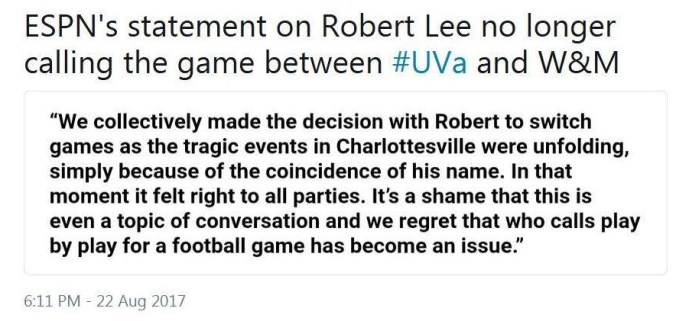
That’s right: an Asian-American broadcaster who never fought for the South during the Civil War has been robbed of a job assignment because his virtue-signaling, grandstanding mega-corporation wants to side with the statute-toppling Left. ESPN regrets that the NAME of one of its broadcasters has become an issue? Who made it an issue? ESPN, that’s who.

Nah, there’s no slippery slope! Nah, this is just about Civil War generals! Nah, the people behind the historical purge or reasonable…they won’t just keep looking for more ways to claim they are being offended!

Can you tell I am losing patience with the defenders, enablers and rationalizes of this toxic nonsense?

2. Or is this dumber? From issue scout Neil, who writes, “Watch the video. [Trump] gestures for the crowd to look up at the sky, then makes a show of looking himself (though CLEARLY not actually trying to see the eclipse). I must have seen at least a dozen other  people yesterday scan the sky in a similar fashion before accidentally getting blinded by an eye-full of rays. The man is inept beyond belief, but he’s not wearing a bib. God this  irritates me.”

These are the ways that that the newsmedia signals to anyone with an open mind and not drooling, gnashing and recoiling at the sight of water from end-stages Anti-Trump Brain-Eating Virus infection that it cannot be trusted, and has traded of its integrity, honesty, fairness and objectivity to lead the “Destroy the Elected President of the United States” effort. No, the President did not actually look directly into the sun and blind himself. In fact, I did exactly the same thing he did when I glanced up at the sun sideways for a nanosecond wondering why so many idiots were lying on the ground wearing 3-D glasses. This is the epitome of fake news—fake, because the intent of the item is to mislead, and because it is no more news than “President uses wrong fork at State Dinner.” No other President, ever, under any scenario, would be covered this way, and no news publication would ever print anything so dumb unless it was certain that its readers were gullible, deranged, and even dumber.

Prof. Glenn Reynolds: “If the press and the political opposition — but I repeat myself — were just sober, straightforward, and honest they could beat Trump easily. But then, if they were capable of that, we wouldn’t have gotten Trump to begin with.”

3. My wife reminded me that I have been flagging deception in obnoxious ways since long before ProEthics and Ethics Alarms.  When we were dating, she had a bowl of soup at a Georgetown campus hangout called The Tombs, and I had a cup of the same soup, for $1.50 less. I asked the waitress for a clean bowl and cup,  and poured water into the cup until it was at soup-level, and then poured that water into the empty bowl, which it filled. Then I asked her to get the manager, whom I asked to explain why a bowl cost more than a cup when the amount of soup was the same. he had no explanation of course.

You’ll be amazed how many restaurants do this. Continue reading →

Casting Ethics And “The Music Man”

A recently closed summer production of “The Music Man” at the Berkshires’ Sharon Playhouse illustrates many of the ethics landmines overly ambitious directors and non-traditional casting can trigger.

New York director Morgan Green was hired to direct Meredith Willson’s  1957 classic. Until “Hamilton” came along, only two Tony winning musicals had a book, lyrics and music all written by one person: “The Music Man” and “Oliver!” “The Music Man” isn’t my favorite musical, but a strong argument can be made that it is the Great American Musical, celebrating small town Americana with Sousa-style marches, barbershop quartets, and the best ending in musical theater history (stolen, with great success, by “School of Rock.”) There is no need to mess with it, since the show is pretty close to perfect. I was taught that a production should be equally satisfying for an audience member who is seeing a show for the first time and for one who is seeing it for the last time.  A version that takes the show out of 1912 and litters the landscape with anachronisms and forced 2017 social and political references isn’t fair to either of these. This was, I presume from based on Jesse Green’s review, a “Music Man” for people sick of “The Music Man” (like Jason Green.) You know what? If a director is sick of a show, she has an ethical obligation to let someone direct who isn’t sick of it.

Naturally, there was the obligatory stunt casting of women in some men’s roles (but never men in women’s roles, of course), and  the non-traditional casting of a black actress as Marion (the Librarian) Paroo, the romantic lead originally created by the recently departed Barbara Cook in the original production.

I see no problem in principle with casting Marion as black. It’s certainly ahistorical, and the hint of a trans-racial romance in 1912 Iowa is unimaginable, but “The Music Man” is, or should be, about kids, romance, parades, sentiment and fun, none of which is impeded by non-traditional casting.

There is a problem, though. One of Marion’s big solos, in which she sings about her ideal man (whom her mother believes is too ideal to be real), is called “My White Knight.”

Oh-oh. Continue reading →

Morning Ethics Warm-Up: 8/22/17

Good Morning!

1. You cannot imagine how long it takes to prepare a post on WordPress when the internet connection is going out repeatedly, requiring a trip down a flight of stairs, re-booting the modem, scanning for a channel back up the stairs in my office, and furiously searching, reading and linking until Verizon kicks out again after three to ten minutes.

Since none of my 40 phone calls to the Verizon tech who promised that the three-months’ long problem was fixed and that he would sprint like a bunny back to our home to trouble shoot if the malady returned had received the courtesy of a response, I snapped, and got into my car to visit a Verizon wireless store about five minutes away that I didn’t know existed. For some reason the world, though sun-lit, was bathed in a weird light, and my neighbors were lying on the ground wearing what looked like 3-D glasses, but never mind: I had someone to yell at.

There were two young men about the age of my son manning the store, and I told one of them, through gritted teeth, the whole infuriating saga of how much Verizon DSL sucks and what useless customer service his employer provides, rendering both my business and my communications chaotic and unbearable. I didn’t expect anything, really. I just wanted to give hell to someone face to face.

To my shock and amazement, the young man actually did something. He got on the phone—I told him that I took sadistic pleasure in watching Verizon personnel go through the infuriating phone tree, get put on hold, get disconnected, end up in the wrong department, for all of this happened to him as I watched and listened—but he finally reached a supervisor, and told him that the story he had just heard from the gentleman in his office made him ashamed to work for Verizon, and he wanted to know how my problems could be addressed immediately. Yes, he knew that I had a tech visit already scheduled, “but since the same tech has been out there three times, each time assuring him that the problem was successfully addressed, why would he trust us to fix the problem now?”

“If I were him, I would have dumped Verizon and found another provider.”

After about 45 minutes, here was what he accomplished. He got them to agree to send a different and higher level tech this time. He set in motion the process of getting me fee rebates for the three months of intermittent service. And he gave me his card, with instructions to call him immediately if the problem wasn’t fixed. “If I have to, I’ll come to your house and personally see that you have functioning internet service from a new provider,” he said. “one way or the other, I will fix this problem.”

Now THAT’S customer service.

Stay tuned!

2. From President Trump’s speech yesterday:

The men and women of our military operate as one team, with one shared mission and one shared sense of purpose. They transcend every line of race, ethnicity, creed and color to serve together and sacrifice together in absolutely perfect cohesion. That is because all service members are brothers and sisters. They’re all part of the same family. It’s called the American family. They take the same oath, fight for the same flag and live according to the same law. They’re bound together by common purpose, mutual trust and selfless devotion to our nation and to each other.

The soldier understands what we as a nation too often forget, that a wound inflicted upon a single member of our community is a wound inflicted upon us all. When one part of America hurts, we all hurt. And when one citizen suffers an injustice, we all suffer together. Loyalty to our nation demands loyalty to one another. Love for America requires love for all of its people.

When we open our hearts to patriotism, there is no room for prejudice, no place for bigotry and no tolerance for hate. The young men and women we send to fight our wars abroad deserve to return to a country that is not at war with itself at home. We cannot remain a force for peace in the world if we are not at peace with each other.

As we send our bravest to defeat our enemies overseas — and we will always win — let us find the courage to heal our divisions within. Let us make a simple promise to the men and women we ask to fight in our name, that when they return home from battle, they will find a country that has renewed the sacred bonds of love and loyalty that unite us together as one.

But as my Trump-deranged Facebook friends say, we know he doesn’t believe any of this. We know in his heart that he’s a racist Nazi. Besides, they don’t want to heal those divisions. They want to exploit them, and why would they want to be undivided from deplorable citizens they hate anyway? Continue reading →

Accumulated Ethics Notes On The Charlottesville Riots, The Statue-Toppling Orgy and The Confederate Statuary Ethics Train Wreck, Part 3 Of 3: Potpouri! [Continued]

  • Grandstanding as always, Nancy Pelosi proclaimed that all of the Confederates honored in the Capital Gallery should come down. How odd that this never occurred to her when she was Speaker of the House and the Democrats held the Senate and the White House.

The Gallery is exactly the kind of enclosed public space for display that the statue-topplers argue should house the controversial statuary, places where their context can be considered outside of the public square. They don’t mean it, though. They want the statues hidden away, so nobody will see then without searching for them like Indiana Jones.

  • It was nice of Duke to show just how calculated and hypocritical this sudden eruption of horror at long-standing monuments is. While the school is capitulating to students by removing another statue of Lee from its chapel, there seem to be no plans to tear down the statue of George Washington Duke  a Confederate soldier and a slave owner. Duke’s son, Buck, gave a large endowment to  what was then called Trinity College, and in appreciation, the school changed its name to Duke University. And this happened in the twenties, which proves that the real objective was to salute Jim Crow—or so we are being told now.

Duke was named after a confederate soldier and a slave owner, meaning that by the Left’s logic the entire school is a memorial to white supremacy and slavery. But the students who happily agreed to have his name appended to their life forever are traumatized by a campus statue of General Lee. Continue reading →

Accumulated Ethics Notes On The Charlottesville Riots, The Statue-Toppling Orgy and The Confederate Statuary Ethics Train Wreck, Part 3 Of 3: Potpouri!

The Charlottesville  fiasco combined several ethics train wrecks, as I mentioned before, creating The Perfect Ethics Train Wreck. We have the airbushing away historical figures now out of favor ETW, the progressive anti-free speech ETW, the long-running 2017 Post Election ETW, which involves the news media’s determination to blow up any word or deed by the President, large, small, ambiguous or insignificant, into a justification to remove him. We have the burgeoning “pro-violence as long as it is against the far right caboose,” and the “Let’s figure out what the motives were behind specific statues, regardless of whether they were legitimate heroes or admired historical figures in the times in which the lived” cattle car. And, of course, the intensifying assault on free expression locomotive, bolstered by the guilt by association diesel engine.

What a mess. It is made worse by the fact that many of these rooted in fascinating and nuanced ethics problems, but being discussed on line and elsewhere by  single-minded, narrow-view, partisan, doctrinaire, hypocrites and  fools.

I’m going to root through some of the wreckage now…

  • Former African American NBA star and freelance social commentator Charles Barkley weighed in on the controversy by saying, “Who the hell cares about Confederate statues?” Of course, the vast majority of Americans don’t: it’s like the Washington Redskins. The controversy is driven by small, intense minorities forcing people to take sides over issues that they never thought about before. Adds conservative blogger Allahpundit:

“Remember, 62 percent told Marist that statues honoring leaders of the Confederacy should remain in place as historical symbols. That includes a plurality of blacks (44/40). If you nudge people to state an opinion on whether CSA monuments should stay or go, you’ll get a divide but one that leans strongly towards leaving them in place. If you include a “there are more important things to worry about” or “eh” option, the numbers that are effectively in favor of the status quo can only rise. Most people, I suspect, just don’t care much either way. In the end, to Barkley and to many, many others, we’re arguing about scenery.”

But apathy and ignorance don’t mean that important principles are not at stake, or that we are not facing a dangerous slippery slope. The blogger continues,

There’s peril in that, though, if you believe firmly in leaving the statues in place. The number of people who feel passionately about smashing monuments may be small but they’re motivated and have a defensible argument that these are tributes to white supremacy more than to the Confederacy or “gallantry” or whatever. If they succeed in pressuring local governments to remove them, the “eh” contingent (which includes Barkley) will flip the other way: “Now that they’re gone, there’s no sense obsessing over them anymore. What’s done is done.” The politics of “what done is done” are slippery here, easily mutating potentially from justifying the pro-statue position to the anti-statue one. Which, I guess, is why we’re destined for a big public argument over it despite wide apathy towards the subject across the population. Dedicated believers in leaving the statues alone know that if they don’t push back diligently, the tear-’em-down contingent will prevail through sheer agitative will.

Cultures can take tragic and destructive turns when a radical minority steers the ship after the majority shrugs and says, “Oh, let them have their way.” Freedom of thought, expression and communication often die by millimeters. Continue reading →

When “Ick!” Strikes Out Ethics: The Intensifying Robo-Umpire Controversy

[I see that I last wrote about this issue in April, and before that, in June of 2016, and in 2012 before that.Well, it’s worth writing about again, and again, until ethics and common sense prevails.]

This weekend Major League Umpires held a silent protest, wearing armbands in support of colleague Angel Hernandez, whose competence was publicly questioned by Detroit Tiger player Ian Kinsler. In fact, Angel Hernandez is a terrible umpire, and terrible, indeed, even mildly fallible umpires have a problem now that they never had to worry about in the good old days: their mistakes are obvious and recorded for all to see.

Yesterday Red Sox color man and former player Jerry Remy was reminiscing during the Red Sox -Yankee game broadcast about one of his few home runs. He said he had struck out, missing with his third swing by almost a foot, and was walking back to the dugout when the umpire called him back, saying he had foul-tipped the ball. “I know that was wrong, but I’m not going to argue I’m out when the ump says I’m not.” Remy said. He went back to the plate, and on the next pitch hit a home run. “Of course, they didn’t have replay them,” Jerry added.

Before every game was televised and before technology could show wear each pitch crossed the plate, balls and strikes were called definitively by umpires, many of whom proudly had their own strike zones. “As long as they are consistent with it ” was the rationalization you heard from players and managers. It was, however, a travesty. The strike zone isn’t a judgment call; it is defined, very specifically, in the rules. A pitch is either within the legal zone or it is not. A strike that is called a ball when it is not, or vice-versa, is simply a wrong call, and any time it happens can affect the outcome of the at-bat and the game. If you watch a lot of baseball, you know that we are not just talking about strikeouts and walks.  The on-base average when a batter is facing a 2 balls, one strike count as opposed to a 1-2 count is significantly higher. The wrongly called third pitch can change the result of the at bat dramatically.

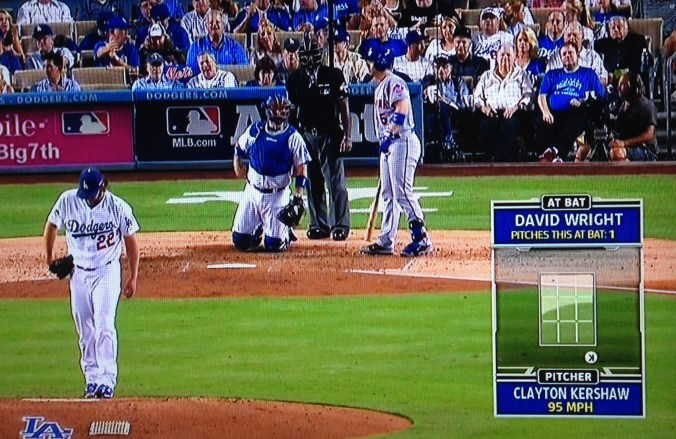
Since the technology is available to call strikes correctly 100% of the time, why isn’t the technology being used? Actually it is being used, in TV broadcasts. The fan can see exactly when the umpire misses a call, and the broadcasters talk about it all the time. “Where was that?” “That was a gift!”  “Wow, the pitcher was squeezed on that one.” Once, a missed call in a game was virtually undetectable, because one could assume that the umpire had a better and closer view than any fan or broadcaster could have. Now, there is no doubt.

Yet the players, sportswriters and broadcasters still overwhelmingly argue against the use of computer technology to call balls and strikes. It’s amazing. They know, and admit, that  mistaken  ball and strike calls warp game results; they complain about it when it happens, point it out, run the graphics repeatedly to show how badly a crucial call was botched, and yet argue that a completely fixable problem with massive implications to the players, the games and the seasons, should be allowed to persist.

These are the rationalizations and desperate  arguments they advance: Continue reading →