Professor Who Most Needs To Get Over Himself Of The Month

Gilbert Kalonde, a Montana State University assistant professor of technology education, says an employee at the Bozeman, Montana Wal-Mart wrongly listed his occupation on a fishing license as “toilet cleaner” rather than “pompous assistant professor.” This, the toilet cl…er, professor says, constitutes libel, and he is suing for damages because the license has held him up to “hatred, contempt, ridicule.”

Boy, you can say that again. I know I always judge people by what it says on their fishing licenses. Come to think of it, I just judge people harshly if they have a fishing license. Actually, I’m not sure I wouldn’t regard a toilet cleaner as more admirable than a college professor. True, he doesn’t teach at Wellesley….

Why would anyone get upset over something like this? I would be hauling out that license at parties. Yes, that’s not exactly sterling service he got, but it’s Wal-Mart. Besides, based on the law suit, I bet the prof was so insufferable–“See here, my good man, make sure you place the correct occupation on that document, lest my credentials are obscured!”—that the Wal-Mart clerk decided to teach him a lesson in humility. I guess it didn’t work.

The ethical values involved here are proportion, compassion, humility, and kindness, none of which Gilbert Kalonde appears to possess.

At least he has a sense of humor.

______________________

Pointer: Fark

Higher Education Indoctrination Easter Sunday Continues: “The Least Diverse Place On Earth”

“College is a place where everyone is supposed to look different, but think the same.”

Can anyone honestly rebut this video?

Case Study: How Institutions Like Wellesley Get That Way

In the previous post about Wellesley programming its students to oppose free speech, we learned to our horror (I presume you were horrified) what the liberal college culture is doing to the minds and values of your young.

Now comes this: an anonymous account on the website Quillette on how “standards” are created and maintained at some universities. All? We better hope not.

I was appointed by the dean of General Studies to serve as the chair for a writing hiring committee, a committee charged with hiring one full-time writing professor, who not only could teach first-year writing classes but also offerings in journalism. The committee of three met late in the fall semester to discuss the first group of candidates, before undertaking the second set of Skype interviews. I mentioned that I had received an email from one of the candidates and shared it with the committee members. After reading the email aloud, I argued that the missive effectively disqualified the candidate. The writing was riddled with awkward expression, malapropisms, misplaced punctuation, and other conceptual and formal problems. Rarely had a first-year student issued an email to me that evidenced more infelicitous prose. I asked my fellow committee members how we could possibly hire someone to teach writing who had written such an email, despite the fact that it represented only a piece of occasional writing. The candidate could not write. I also pointed back to her application letter, which was similarly awkward and error-laden. My committee colleagues argued that “we do not teach grammar” in our writing classes. Sure, I thought. And a surgeon doesn’t take vital signs or draw blood. That doesn’t mean that the surgeon wouldn’t be able to do so when required.

In the Skype interview following this discussion, a fellow committee member proceeded to attack the next job candidate, a candidate whom I respected. In fact, before the interview, this colleague, obviously enraged by my criticisms of her favorite, announced that she would ruthlessly attack the next candidate. She did exactly that, asking increasingly obtuse questions, while adopting a belligerent tone and aggressive posture from the start. That candidate, incidentally, had done fascinating scholarship on the history of U.S. journalism from the late 19th through the first half of the 20th Century. He had earned his Ph.D. from a top-ten English department, had since accrued considerable teaching experience in relevant subjects, and presented a record of noteworthy publications, including academic scholarship and journalism. He interviewed extremely well, except when he was harangued and badgered by the hostile interviewer. He should have been a finalist for the job. But he had a fatal flaw: he was a white, straight male.

Continue reading →

What Wellesley College Students Consider To Be Freedom Of Speech

A recent editorial in the Wellesley College student newspaper—Wellesley, as I’m sure you know, is the alma mater of Hillary Clinton—has justly set off ethics alarms across the political spectrum. That, at least, is good news: the hostility to free thought, expression and speech that I thought had decisively corrupted one side of that spectrum apparently is not as entrenched as I thought, or at least it is being diplomatically disguised.

The editorial with the Orwellian title of  “Free Speech Is Not Violated At Wellesley ” (it would have been accurate if the headline read “We Think Free Speech Is Not Violated At Wellesley Because Wellesley Hasn’t Taught Us What Free Speech Is”), contained several month’s worth of Ethics Alarms Unethical Quotes of the Week, such as

Many members of our community, including students, alumnae and faculty, have criticized the Wellesley community for becoming an environment where free speech is not allowed or is a violated right….However, we fundamentally disagree with that characterization, and we disagree with the idea that free speech is infringed upon at Wellesley. Rather, our Wellesley community will not stand for hate speech, and will call it out when possible.

Translation: We don’t oppose free speech. We just oppose speech we disagree with.

Wellesley students are generally correct in their attempts to differentiate what is viable discourse from what is just hate speech. Wellesley is certainly not a place for racism, sexism, homophobia, Islamophobia, transphobia or any other type of discriminatory speech. Shutting down rhetoric that undermines the existence and rights of others is not a violation of free speech; it is hate speech.

By this definition, the editorial itself is hate speech. This is the kind of rhetoric that Captain Kirk used to make evil computers blow their circuits on “Star Trek.”

The founding fathers put free speech in the Constitution as a way to protect the disenfranchised and to protect individual citizens from the power of the government. The spirit of free speech is to protect the suppressed, not to protect a free-for-all where anything is acceptable, no matter how hateful and damaging.

Now we know they don’t teach American History at Wellesley as well as philosophy and logic.

We have all said problematic claims, the origins of which were ingrained in us by our discriminatory and biased society. Luckily, most of us have been taught by our peers and mentors at Wellesley in a productive way. It is vital that we encourage people to correct and learn from their mistakes rather than berate them for a lack of education they could not control.  While it is expected that these lessons will be difficult and often personal, holding difficult conversations for the sake of educating is very different from shaming on the basis of ignorance.

Wait, wasn’t this endorsement of indoctrination written by Lenin or Stalin? Surely this section should be in quotes with attribution.

This being said, if people are given the resources to learn and either continue to speak hate speech or refuse to adapt their beliefs, then hostility may be warranted.

I’m sorry, I just ran screaming from my office and momentarily lost my train of thought.

Pointing to the worst sections of the editorial fail to convey its gobsmacking intellectual flaccidity, smug certitude and hostility to the open exchange of ideas. We know where this came from, too: the  education at Wellesley. This month, six Wellesley professors who comprise the college’s Commission on Race, Ethnicity, and Equity signed a letter maintaining that Wellesley should not allow challenges to the political and social views that the campus has decreed are the correct ones, arguing that speakers who are brought to campus to encourage debate may “stifle productive debate by enabling the bullying of disempowered groups.” Continue reading →


U.S. Journalism’s Continued Unraveling, And CNN’s Unprofessional, Unethical, Destructive Disrespect For The President Of The United States

And the 2016 Post Election Ethics Train Wreck’s carnage continues…

The degree to which the Post 2016 Election Ethics Train Wreck has engulfed the news media has shocked even me, and readers know that Ethics Alarms had  swamp-level regard for U.S. journalists long before the 2016 campaign. It has obliterated any legitimate trust a citizen could have in the mainstream media’s news judgment, objectivity and competence, and with the exception of tiny pockets of professionalism here and there (Jake Tapper comes to mind), has declared itself a partisan foe of the electoral system, and the Presidency. The double standards applied regarding Democrats and Republicans as well as the smug shamelessness with which the media has applied them cannot be condemned too harshly. Naturally, the equally corrupted members of the so-called “resistance” see none of the harm and betrayal in this, since it suits their own ends.

Ethics Alarms  can’t catalogue all of the worst examples of this; there isn’t time. Last month, for example, New York Times columnist Nicholas Kristof, who once had a conscience and a mind even as you or I, authored one of the ugliest and most disgusting pieces I have read in any reputable publication. In the disgrace titled “There’s a Whiff of Treason In The Air” Kristof issued a conspiracy theory that would be at home in the archives of Alex Jones,  Mike Cernovich, or Donald Trump in his birther days, except that so many hopeful Democrats endorse it. The column is one long, vicious smear, claiming that President Trump engaged in treason, while citing absolutely no evidence whatsoever that supports such an inflammatory accusation. I considered flagging all of the slimy, dishonest, hypocritical rhetorical techniques Kristof brings to his efforts to undermine his nation’s President, but I decided to do so would insult my readers’ intelligence: it is so obvious, particularly when one considers the Russian “ties” the Clinton campaign had to Russia. Why do the business dealings of Trump campaign personnel with Russian figures spell TREASON to the Times columnist, and the more ominous ties between Russia and the Clintons get a pass? Simple: he wants Donald Trump to be proven a traitor; his readers want it; and he, the Times and the Democratic Party that has sold its integrity and soul intends to push the accusations as long as they can cripple and delegitimize the government they oppose. Continue reading →

Ethics Quiz On A Story I’m Betting Is A Hoax: The “Identical Twins” Married Couple

I have now read three accounts in borderline news sources about a Mississippi married couple who went to a fertility clinic and discovered to their horror that they were “identical twins.” I’m assuming it is a fake news story, perhaps planted through collusion with the Trump campaign by Russian government operatives, and not just because identical twins cannot be different sexes. (Hey! Maybe one of them had  gender reassignment surgery! Now that would be a story!)

I suppose it’s possible; Robert Ripley found odder coincidences for decades, but never mind: let’s assume for the sake of ethics problem-solving practice that the story is true. (I’ll be stunned if it is.)

Your Ethics Alarms Ethics Quiz of the Day is…

What is the couple’s most ethical course now that they know they are siblings, or is there one?

Key question: Is this ick rather than ethics?

Trap: I’m not asking what’s moral.

It’s all yours…

Comment Of The Day: “More Ethics Observations On The United Flight 3411 Ethics Train Wreck”

Public discussion and media reports is finally waning regarding United’s cascading botch of a full and fully seated flight in which the airline wanted to get four seats back and had neither the law, nor policy, nor sufficient justification to acquire them. Thus its agents lied, exceeded their authority, mistreated a passenger, called in police, and they further escalated the fiasco, badly injuring the victim in the process. (Their conduct was similar in some ways to that of the police officers who killed Eric Garner.)

Even now, however, many people still believe this arose from an overbooked flight. Some misguided pundits are still blaming Dr. Dao. The news media has not taken responsibility for its terrible reporting on this incident, and still hasn’t done a good job explaining what really happened. Meanwhile, Delta has taken advantage of United’s pain by announcing that it will pay up to $10,000 to bumped passengers in the future. And Southwestern won itself an all time record for audacious cheekiness with the above ad, which United deserves. [UPDATE: Apparently this is a hoax, not a real ad. Too bad.]

Here is brian’s Comment of the Day on this ethics train wreck in the sky:

The I don’t think you’re being overly cynical here. I have seen multiple responses from media, politicians, and the CEO all following the basic pattern, propose solutions that do not address what went wrong. A handful of employees acted incompetently, and United (and probably most airlines) didn’t think through their carriage contract, police were ill trained, and the culture of United is horrible in general. But instead of addressing any of those issues, they all have motivated reasons to misconstrue the issues and offer ‘solutions’ to problems that don’t exist.

Things that could be done:

1) CEO comes out and says we are going to train and empower our staff to deal with more and varied types of situations as they arise. We also recognize that our current customer facing staff do not have the appropriate level of customer service training, which is entirely the fault of management. We are going to fix this starting now. We have pulled together XYZ resources and will be meeting weekly for the next 12 weeks to generate a comprehensive plan to begin changing our culture. You can expect an interim report in 4 weeks.

2) CEO says, we are going to set up a true reverse auction, paying cash, for all situations when we have to either remove or deny a paying customer due to reasons beyond their control. We will train all gate staff and front line managers on how to conduct this easy and straight forward auction. We should have been doing it already, because the value of the additional seats we can sell by overbooking far outweigh the costs we incur from the small portion of riders who we must justly compensate for any inconvenience.

Continue reading →

Statue Ethics Stand-Off: “Charging Bull” vs. “Fearless Girl”

The Wall Street art ethics controversy pitting a nearly 30-year-old sculpture of an angry bull against the upstart statue of a defiant little girl has fascinating cultural implications. The ethical solution to the confrontation are simple and undeniable, however, though the legal issues a bit less so. “Fearless Girl” has got to go.

Arturo Di Modica created “Charging Bull” in response to stock market travails during the late 1980s. The three-and-a-half-ton sculpture was placed near Wall Street in the dead of night,  and was embraced by the financial ditrict and New Yorkers as iconic public art. The artist copyrighted and trademarked his work, which he has said was meant to symbolize “freedom in the world, peace, strength, power and love.”

I don’t get the love part, but okay: the point is that the bull is a positive metaphor, not a sinister one.

The “Fearless Girl” statue was positioned this year, the night before International Women’s Day, in a direct stand-off with the bull. It had been commissioned by State Street Global Advisors, a financial firm based in Boston, as a public relations and advertising move and classic virtue signalling. State Street Global’s home page trumpets the new statue’s message of “the power of women in leadership” and uses it to urge “greater gender diversity on corporate boards.” The metal girl’s  cynical and self-serving origins don’t seem to bother the work’s fans though.

The problem is that the message of “Fearless Girl” requires the participation of the bull to make any sense and to have any power at all. Otherwise, it might as well be Pippi Longstocking.  In essence, the new statue appropriates Di Modica’s work, and violently alters it. The artist is a furious as a charging bull that what he intended as a symbol of capitalist power and national vigor has been transformed into a sexist representation of male domination. Di Modica and his lawyers demand that the statue be moved away from its bull-baiting position, arguing that State Street Global commissioned “Fearless Girl” as a site-specific work conceived with “Charging Bull” in mind. It thus illegally commercialized  Di Modica’s statue in violation of the artist’s intent and copyright. They also claim that the city  violated the artist’s  legal rights by issuing permits allowing the four-foot-tall tyke to face off with the bronze bull without the artist’s permission. Letters to the Mayor DiBlasio, Ronald P. O’Hanley, the president and chief executive of State Street Global; and Harris Diamond, the chairman and chief executive of McCann Worldgroup, State Street Global’s marketing agency demand the removal of “Fearless Girl” forthwith.

Ethically, “Fearless Girl” doesn’t have a leg to stand on. Continue reading →

Ethics Quote Of The Week: Seattle Seahawks Defensive End Michael Bennett

“Of course I think he’s been blackballed, obviously. Maybe the players agree that there’s a place for politics in sports, but I don’t think the teams, or the organization, or even the fans believe there’s a place for politics in sports. I think people want you to do your job and shut up — score a touchdown, dunk a basketball, hit a home run and call it a day. We’ll buy your jersey, and that’s it.”

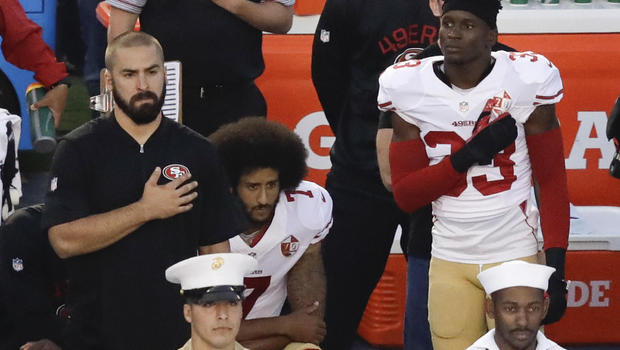
—-Seattle Seahawks defensive end Michael Bennett, speaking about the current fate of ex-NFL quarterback Colin Kaepernick, who remains unsigned after spending much of last season refusing to stand for the National Anthem because the United States “oppresses black people and people of color.”  Bennett’s comments came during an event at the artsy social justice warrior hang-out Busboys and Poets in Washington, D.C.

It’s an admittedly perverse selection for the ethics quote designation, since Bennett meant the statement as criticism. He went on to say that he endorses professional athletes taking pubic stands on social issues to “inspire others” to engage in  mass action and demonstration. The 31-year-old defensive end, who makes about 10 million dollars a year, drew attention to himself in February when he opted out of an Israeli-government-sponsored trip to register his pro-Palestinian views, as if he actually knows enough the 80-year-old conflict to intelligently protest anything. This is about par for the course in the field of professional athlete off-the-field grandstanding.

Bennett was correct in his rueful description of the state of the culture, however. There is no place for politics in sport. Sport is entertainment, and fans follow sports to escape real world problems, not to be lectured on them by pseudo-educated celebrities with neither the training, skills or expertise to justify the giant megaphone celebrity affords them. Kaepernick’s stunt created a media circus around his struggling team, the San Francisco 49’ers, distracted its management fans and players, and cost the NFL viewers and advertising revenues. Since he was unable to articulate an intelligent rationale for his protest, it was also useless. Naturally, Kaepernick was cheered by the Left, and defended by many journalists as well as athletes who think their physical gifts should entitle them to social influence they don’t deserve. Continue reading →

From The “Saint’s Excuse” Files:The Catholic Church, Penn State, and Now Choate…What Have We Learned?

Protect the hive. Always protect the hive…

The renowned private boarding school school Choate Rosemary Hall, alma mater of such luminaries as John Dos Passos, Edward Albee, Glenn Close, multiple Kennedys and dozens more of the rich, famous and powerful, , just revealed that at least twelve former teachers had sexually molested, and in one case, raped, students without the crimes being reported to police. The pattern continued over decades. In some cases, teachers were allowed to resign after being confronted with evidence of abuse, and administrators wrote still letters of recommendations for them after they were fired. The predators then went to other schools, sometimes in positions of power and authority.

After the similar institutional conduct revealed by the Catholic Church and Penn State, does anyone believe that this is a rare occurrence in institution, including the most prestigious—and virtuous!—ones? The lesson is that established, powerful, iconic institutions are programmed to protect themselves above others, and regard their own missions and continued vitality more precious than any single individual, even a child.

Revisiting one of the most important of the Ethics Alarms’ 92 rationalizations:

13. The Saint’s Excuse: “It’s for a good cause”

This rationalization has probably caused more death and human suffering than any other. The words “it’s for a good cause” have been used to justify all sorts of lies, scams and mayhem. It is the downfall of the zealot, the true believer, and the passionate advocate that almost any action that supports “the Cause,’ whether it be liberty, religion, charity, or curing a plague, is seen as being justified by the inherent rightness of the ultimate goal. Thus Catholic Bishops protected child-molesting priests to protect the Church, and the American Red Cross used deceptive promotions to swell its blood supplies after the September 11, 2001 attacks. The Saint’s Excuse  allows charities to strong-arm contributors, and advocacy groups to use lies and innuendo to savage ideological opponents. The Saint’s Excuse is that the ends justify the means, because the “saint” has decided that the ends are worth any price—especially when that price will have to be paid by someone else.

Continue reading →