An Ethics Can of Worms: The Mental Health of Airline Pilots

Great: one more thing I wish I didn’t have to worry about…

The New York Times has an article up [Gift link!] titled “Why Airline Pilots Feel Pushed to Hide Their Mental Illness.” Wait—there are mentally ill people flying planes? Yikes. But of course there are…depending on what is called a “mental illness” at any given time.

In the Denzel Washington film “Flight,” the actor plays an excellent pilot who is an alcoholic and cocaine abuser. He saves a plane full of passengers from doom by executing a brilliant but risky mid-air maneuver, then has to cover up the fact that he was drunk when he did it. I haven’t checked lately to see if alcoholism is current classified as a mental problem, but having had extensive experience in the area, I have concluded that it is a physical problem with profound effects on mental and emotional stability, so I really don’t care if it’s technically a mental illness or not. Alcoholics and recovering alcoholics should not be piloting aircraft.

Isn’t that an easy call? The same call should apply to bi-polar individuals, chronic depressives, OCD sufferers…but how far down the list do we go? It’s been estimated that as much as 20% of successful individuals, high-performers, are sociopaths. I don’t think I want to know how many airline pilots are narcissists. Once upon a time, homosexuality was considered a mental illness. Next up: transsexual pilots.

Continue reading

Oh! So THAT’S What “Gish Gallop” Means! Bite Me: You’re Banned

Today we have Ethics Alarms’ first retroactive commenter banning! That’s historic, and so, by the current rules of Bonkers Left cant, it must be a wonderful thing.

In this post I took issue with “The Ethicist’s” assertion that one was obligated to reveal a secret to the one person whose life and relationships were likely to be upended by being informed of it because “the truth belongs to her.” The comment thread that followed featured the objections to my analysis by debuting commenter “Brandy,” whom, I discerned, was hostile to your host from the minute she appeared, but obviously thoughtful and intelligent if unconvincing on this particular issue.

“People have a fundamental right to know the truth about themselves, even if painful” was the entire thrust of her argument, which is just another way of saying “the truth belongs to her.” I also am dubious when anyone asserts a new “fundamental right.” I think Tom nailed the fundamental rights in his masterpiece, and this particular proposed addition undercuts the “pursuit of happiness” rather considerably. We have a right to be made miserable for no good reason?

But I digress. At one point in our exchange, Brandy called my argument a “Gish Gallup.” I had never heard or read that label before—the only Gishes I was aware ofwere Lillian, the silent movie star, Dorothy, her sister, and unfortunate Annabelle, whose intended star vehicle (“Mystic Pizza’) that was supposed to make her the latest famous Gish instead made Julia Roberts a star, while Annabelle was henceforward condemned to supporting roles and horror movies.

So I asked Brandy what a “Gish gallop’ was, a question she did not answer. However, after seeing the phrase for the second time on another site, I looked to up. Here’s the story (via Wikipedia);

The term “Gish gallop” was coined in 1994 by the anthropologist Eugenie Scott who named it after the American creationist Duane Gish, dubbed the technique’s “most avid practitioner.”The Gish gallop is a rhetorical technique in which a person in a debate attempts to overwhelm an opponent by presenting an excessive number of arguments, with no regard for their accuracy or strength, with a rapidity that makes it impossible for the opponent to address them in the time available. Gish galloping prioritizes the quantity of the galloper’s arguments at the expense of their quality.

During a typical Gish gallop, the galloper confronts an opponent with a rapid series of specious arguments, half-truths, misrepresentations and outright lies, making it impossible for the opponent to refute all of them within the format of the debate. Each point raised by the Gish galloper takes considerably longer to refute than to assert. The technique wastes an opponent’s time and may cast doubt on the opponent’s debating ability for an audience unfamiliar with the technique, especially if no independent fact-checking is involved, or if the audience has limited knowledge of the topics. The difference in effort between making claims and refuting them is known as Brandolini’s law or informally “the bullshit asymmetry principle”. Another example is firehose of falsehoods….

Ah! So Brandy, failing to coherently refute my argument, was calling me a bad faith blooger and a liar. Nice! Also: BYE! The EA commenting rules do not give commenters leave to impugn me in that manner. I may not always express my points perfectly (and when I do, there are likely to be typos), but I do not lie or set out to use unfair debate tactics, and, as I state in the Comment Rules, when I do cross an ethical line, I will apologize for it.

In addition, Brandy used the insult incorrectly. A Gish Gallup only can be used orally, in a verbal debate. Written arguments cannot “overwhelm” a competent critic, as I and others on this site prove regularly when we fisk unethical articles, op eds or essays.

Accusing me of a “Gish Gallup” in a comment thread means,”I don’t have the wit or ammunition to argue with you, so instead I’m going to call your points dishonest without raising any viable rebuttal other than “you’re wrong.”

Brandy did make some substantive arguments, and there is some evidence that she didn’t know what “Gish Gallup” meant. Therefore a nicely worded, sincere apology promising never to similarly impugn this ethicist’s ethics will result in her reinstatement.

And I’m grateful for learning a new term.

Confronting My Biases, Episode 19: Movie Continuity Errors and Cheats

A long time ago, I read an article complaining about how nobody says “goodbye” at the end of phone calls in movies and TV shows. Characters just hang up. “Now that I’ve pointed this out, I guarantee that it will drive you crazy,” the author wrote. It does drive me crazy: in stage and movie director terms, it “takes me out of the story.” Because it’s so obviously a device to save time, the omission of “goodbye” reminds me that I’m watching a performance. (Lately, I have noticed, “goodbyes” are appearing here and there, but still in a minority of productions.)

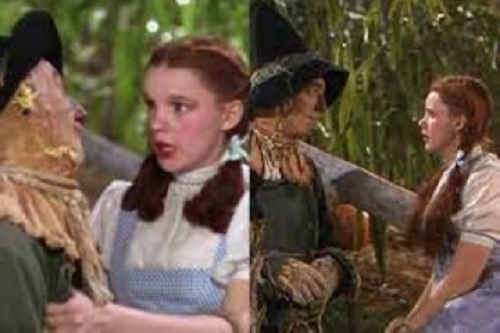
My late wife was a fanatic about such things, and she ruined many a show and film by pointing then out. One of her favorites, a pretty famous continuity botch, was Judy Garland’s constantly changing pig-tails in “The Wizard of Oz”: they are shorter and longer not only from scene to scene, but sometimes from shot to shot in the same scene. Grace was also the one who first pointed out to me the absence of rear-view mirrors in most shots of a character driving a car; now that drives me crazy.

Continue reading

“Nah, There’s No Mainstream Media Bias!”: Once Again, the Fake Non-News Phenomenon

One of the many promised posts that I have failed to complete was a full list of the many varieties of “fake news.” I am sorry about that; indeed, I apologize for all of the supposed follow-ups I recklessly announce and never get to. (I know everyone is sick of my bemoaning the fact that I can’t make a living with an ethics blog, and how charging for commentary via substack et. al. would undermine my mission, so I won’t elaborate on THAT again…but boy, could I use a staff). One of the sub-categories of fake news is what I call fake non-news, when major Axis news organizations deliberately bury or hide news stories that would harm The Cause, (or Causes), like turning the U.S. into a European-style socialist nanny state, ensuring that Democrats run the nation in perpetuity, advancing expensive and futile climate-change policies, or cancelling the Second Amendment.

Surely many examples of this breach of journalism ethics leap to mind: Joe Biden’s dementia, Hunter Biden’s laptop, Hillary Clinton’s campaign seeding the Russian Collusion hoax, the Wuhan lab leak source of the pandemic, Biden’s Senate staffer who accused him of rape, and more. There is another one making its non-visibility clear now: This story…

Continue reading

Seeking Accountability For Giving Anti-White, Anti-American Talking Heads Broadcast Platforms

The recent head-exploding statement by (finally) fired MSNBC racist Joy Reid would be an Unethical Quote of the Day if it were spewed out of the mouth of most people. Reid constantly said such disgusting things and I reflexively put her racist comments in the Julie Principle files long ago. But what she said in a conversation with fellow racist Ta-Nehisi Coates at a program at Xavier University in New Orleans raises another, broader ethics issue.

Reid said, “When my mother came from Guyana, she realized it is not a land of opportunity for people like us.” That claim, coming from someone with the American experience Joy Reid has enjoyed, is beyond insulting and false on its face: it is also incredibly stupid, even for Reid. When she was finally let go, Reid was making $3 million a year, and had been pulling down a seven figure salary for at least a decade. Her life is powerful evidence that the U.S. is a “land of opportunity” for people like her, meaning, as she did, black people. (It is also obviously a land of opportunity for America-hating, anti-white bigots who will make self-evidently false claims designed to divide the country.)

Continue reading

From the Res Ipsa Loquitur Files: The Most Unethical “American Idol” Audition of the Century (So Far)

Two minor points:

1. If it’s obvious that the woman is saying “Shut the fuck up,” then it’s pointless to bleep it out. In fact. it’s dishonest. The show deliberately featured a woman repeating a vulgar phrase, and pretends that it disapproves.

2. As the audition’s are screened, ABC is responsible for taking one more chunk out of American public civility. But then ABC inflicts “The View” on the nation, so this hardly represents a major lowering of standards.

I Just Took Down a Completely Legitimate Ethics Alarms Post. Why? It Was the Right Thing To Do…

It’s an email variety I have come to dread, though EA has received very few of them over the 15 years of this blog’s existence.

“We are reaching out on behalf of our client,” the missive read, “regarding the URL posting mentioned below. We kindly request [its] removal… [Our client] has experienced significant distress and negative consequences in both his personal and professional life. The damage caused by this article has affected his relationships, employment opportunities, and overall well-being….”

The article at issue was posted in 2012. Naturally, I didn’t remember it. I reviewed the post and found it well-sourced and reasonably stated. (Gee, I wasn’t as swashbuckling back then!) The episode I had focused on from an ethics perspective indeed had some embarrassing features: it involved a dentist who had dismissed an assistant because her pulchritude was causing domestic problems at home. (I’ve been watching “Bombshell,” the movie about the sexual harassment scandal at Fox News. The story I posted on would be the equivalent of one of the Fox News blondes suing because she had been fired in the wake of rumors that she had slept her way to a prime time show when nothing of the kind occurred. )

Continue reading

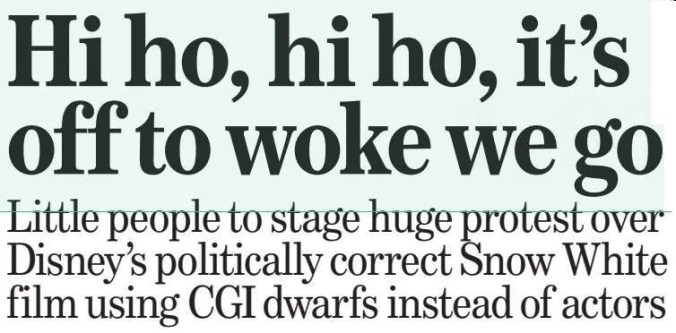
Disney Faces An Inevitable Consequence of the Wokism Game: Ginsberg’s Theorem

Ginsberg’s Theorem is a parody of the laws of thermodynamics applied to other human pursuits, in the current case, the hopeless race for woke virtue recognition in the Age of the Great Stupid. It begins with the fact that an entity or an individual has begun playing a game, and continues,

1. You can’t win the game.

2. You can’t break even in the game.

3. You can’t quit the game.

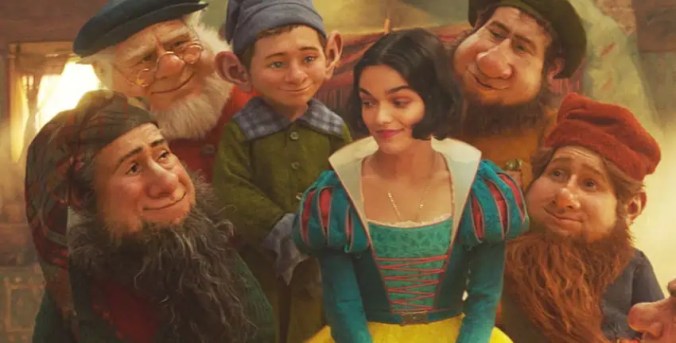
The Disney Corporation stumbled into Ginsberg Theorem territory when it decided to make a live action version of “Snow White and the Seven Dwarfs” in the throes of the company’s self-destructive woke virtue-signaling addiction. It began by casting a Snow White “of color,” which, of course, made no sense at all, since the whole story is based on an obsession to be the “fairest one of all,” and the central character is named Snow White. Snow that is not white has many icky implications.

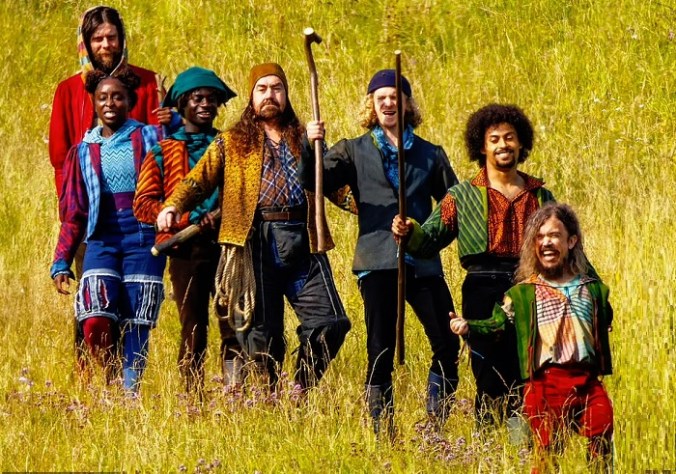
Having started to play the game, Disney felt it had to react appropriately when actor Peter Dinklage of “Game of Thrones” fame, the best known of all performing “Little People,” gratuitously attacked the project, saying, “It makes no sense to me. You’re progressive in one way, but then you’re still making that fucking backward story about seven dwarfs living in a cave together!” That single critique from a single individual who had appointed himself as the voice of all small people everywhere was all it took for Disney to make the mind-blowing—but woke!—decision to make “Snow White and the Seven Dwarfs” without dwarfs. As chronicled here at the time, as soon as a picture of the seven replacements hit social media…

…the backlash and ridicule was so furious that those whatever-the-hell they were supposed to be were canned, the movie’s premiere was cancelled, and the whole film went back to the drawing board. Let’s see now: the live action version of “Snow White and the Seven Dwarfs” couldn’t have dwarfs play dwarfs because…well, because Peter Dinklage said so. They couldn’t replace Little People actors with non-dwarfs, no matter how “diverse” and “inclusive” they were, because that made no sense, though it took the social media mob to explain this to Disney’s creative team. Ah-HA! The solution was to have a live action movie with 7/8 of the title characters not played by actors, but by weird CGI things reminiscent of the original animated film’s iconic dwarfs, but neither as charming nor as convincing….

Continue reading

Why DEI Must DIE: Exhibit A

On the bright side, I suppose its reassuring to know that The Great Stupid is even worse “across the pond” than it is here…

Shakespeare’s Birthplace Trust, which cares for buildings in the immortal playwright’s home town of Stratford-upon-Avon, has announced that it wants to “create a more inclusive museum experience.” Therefore, the center of Great Britain’s essential public appreciation of the fact that it was so fortunate to be the birthplace of the greatest writer the world has ever known (unless the Bard was really a visitor from another planet, which has been my personal theory since I had to study “King Lear” in detail in order to direct a production of it) will seek ways to act on the diagnosis that Shakespeare’s works have been used to advance white supremacy.

Yes, these are morons. The legacy of one of the most vital catalysts of Western civilization is in the hands of morons. Now what?

Continue reading

Societal Enabling of Abnormal Behaviors

Guest Post by Steve Witherspoon

[My first reaction to this passionate guest post was “Gee, how do you really feel, Steve?” My second was “The opinions expressed are not necessarily those of the host.” My third is: I wouldn’t laugh yet. One of my oldest friends is visiting D.C. to meet his new grandson, birthed by the wife of his former daughter, now son. When I went to the memorial service of a former thoroughly Irish Catholic boss from the streets of Brooklyn, I discovered that two of his three sons, all of whom I knew as children, are now middle aged women, and seemingly very happy about it. A close member of my immediate family is “transitioning.” Whatever it is that’s going on here, its getting dig in like a tick.]

I have raised the question in an earlier essay titled, What’s Considered Normal, where I looked into the differences between what is considered to be “normal” and “abnormal”. You can read the arguments presented in the entire post if you like, but I’ll briefly summarize some of the details as I go along in this essay.

I think it’s extremely important that everyone understands the core of an argument based on the words used and how those words are defined. So with that in mind, let’s start by presenting some generally accepted “norms”.

NORMAL

  • Conforming to a standard; usual, typical, or expected
  • Conforming to a type, standard, or regular pattern..
  • …characterized by that which is considered usual, typical, or routine.
  • If something conforms to a general pattern, standard, or average, we describe it as normal.

ABNORMAL

  • Deviating from what is normal or usual.

  • Not normal, average, typical, or usual.

  • Something that is abnormal is out of the ordinary, or not typical

ENABLING

  • Supporting or allowing (whether intentionally or unintentionally) harmful or destructive individual behaviors thus preventing the individual from facing either the consequences of their choices and/or generally accepted reality.

Dysfunctional: Deviating from the norms of social behavior in a way regarded as bad.

Delusional: Characterized by or holding false beliefs or judgments about reality that are held despite incontrovertible evidence to the contrary, typically as a symptom of a mental condition.

Now that we have the terms settled, on to the core of this essay…

Continue reading