It’s as if these situations seek me out.
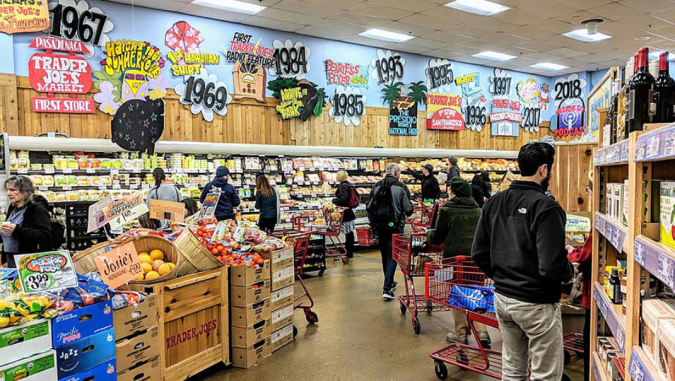
Here I was at Trader Joe’s, doing a quick grocery run after a Zoom seminar, when a small, dark, middle-aged woman woman speaking some variation of English stops me. “Please, sir.” she says, and flashes a card with words written on it. “I am poor and hungry and have children,” it says.
That’s a first: a panhandler in a grocery store. I told her to wait a second and I dug in my wallet to find six bucks, which I gave to her. Then she showed me a basket of some kind of consumables. “Buy food?” she said. What, did she take credit cards?
I shook my head and left. But by the time I got to check-out, the scenario bothered me. Trader Joe’s has a hippie vibe, even a cultish vibe, so maybe panhandlers are welcome, but an in-store competitor seemed a bit over the line. I ultimately decided to blow the whistle on her, and told the store manager on duty that someone was peddling their own commodities in the store. My reasoning: if Trader Joe’s wants to allow that sort of thing out of fatal empathy, it’s their choice. But they at least should know about it.
I half expected the manager to say, “Oh, that’s just Gladys. She’s harmless.”
This ethics decision-making episode fell into my Golden Rule basket. If I was the store owner, I would want to know about Gladys, or whatever her real name was.
I’m still feeling guilty, however.


I had a similar experience last year in a Safeway store. In that case, the woman spoke passable English, so she didn’t resort to a card. She approached me with pretty much the same story, that she had kids to feed and no (or not enough) money. I was very put off by this approach, but I offered to buy her a few items if she would tell me which ones were most needed. We went back and forth, and I told her that I would buy a few items, but not her whole grocery list, and I also offered to give her the name and link to a local food bank that could help her further. She rejected my offers and walked off, leaving me feeling uncomfortable and a bit guilty. The whole experience was disturbing to me. I think that it was partly her assumption that I was someone who would happily foot the bill for her whole grocery cart, which she had been filling even knowing that she couldn’t afford it. Ultimately, I think it was a scam, much like the people who sometimes panhandle outside the grocery stores. Perhaps I have become too jaded, but I also don’t like feeling like an easy mark for those who cynically play on a person’s desire to be helpful.
You make me wonder if I misunderstood the woman and she was asking me to buy food for her. That’s not how it sounded to me; as she showed her basket and said, “You want to buy?”
Pro Tip: Panhandling is one more job that requires English skills.
I think that’s exactly what was happening. A few months ago, I went to a local big box retailer for my weekly grocery shopping. I had barely gotten through the section with the checkout lanes after entering the store when I was approached by an African-American woman seated in a motorized cart. She gave a long-winded story about how she didn’t have any money, had a check coming in a few days, needed to feed her kids and showed me that her cart only contained food. She pointed out that she was not asking for money, just for help buying her groceries.
Red flags went up right away. This woman knew she didn’t have money, yet she went to the store anyway and filled the basket with food, some of which was perishable, parked herself by the checkout area hoping to solicit someone to buy it for her. It isn’t the worst plan in the world but it isn’t your normal scam (which, perhaps, is why I got the explanation about the check, etc).
It did help that she spoke English and made herself clear. I didn’t bite for a number of reasons: I had just entered the store and had my own shopping to do. Also, I couldn’t see the bottom of the cart. For all I knew, there could have been high denomination gift cards or merchandise in there.
Like Aliza, I believe that the stores should not permit people to actively solicit paying customers to buy for them. It’s one thing to randomly pay for something in the checkout lane for someone who went a little bit over; it’s quite another to have a total stranger approach you with a full cart and boldly ask you to buy it all for them.
Either they don’t know it’s happening (I find that hard to believe), don’t have the manpower to catch it (that I do believe!) or don’t care because someone who gives in and pays for the groceries is contributing to the store’s bottom line.
That was my first supposition too, that she was asking for you to buy the items for her. It would be very odd to carry items into the store to sell, or even try to sell random groceries (except, perhaps, home-grown vegetables or some-such) to persons outside the store. If you suspected she was genuinely in need and were inclined to help her, I’d suggest personally buying only the reasonable food items and keeping the receipt so they couldn’t be returned. Maybe tell her in advance that’s what you would do, and see if she declined. That’s usually what happens with those panhandling for “food” money outside a store.
Both of these encounters are essentially scams or better said manipulative appeals to generosity. Likely they were Latinas. Colombians or Venezuelans. Here (Colombia) everyone is used to these manipulative tactics. Often they come along if you are sitting down at a restaurant begging for money or showing some receipt for medicines they need. If you are sitting they sort of have a captivated audience. The stories are often incredible. Here they are often seeking money for drugs. Their tactics, which are shameless, require that they become very bold in their appeals. They get so used to lying that if you refuse them it means nothing and they go directly to the next person with the same storyline. Since North Americans are not accustomed to these tactics of aggressive begging, and since being generous when there is a real need is part of American social ethics, these people can “earn” a good deal of money if they perfect their technique and beg in the right places.
They should not be allowed in the stores nor even outside.
This is also typical of Eastern Europeans. I encountered this in Sarajevo in Bosnia as well as here among Romanian gypsies. So don’t feel guilty.
You might wish to evaluate this way. If she is legitimate and you gave her 6 bucks you did a good deed even if you tell the store manager who may be in a position to give her further assistance.
If not legitimate then you obtained $6 worth of good will for your own psyche because you can only assume she was in need and told the store manager who can assess the legitimacy of her plight for her benefit or the store’s.
I was once doing observations at a train station, and a woman approached me asking for money to buy a train ticket a few stop over. I went with her to the ticket machine, and bought her a ticket, and I could watch her expression drop as I did do. I asked which of several stations in that town, and she said any. I handed her the ticket, and I’m pretty sure she went inside to try to return it for cash (of course, the station didn’t even have a ticket counter, so…). Well, I was only out $7 dollars, and may or may not have helped someone out of pinch getting home.
Dear Jack,
I don’t think you need to feel guilty. Whatever the lady’s problem is, you are not hurting her in an unethical way. There is help for her if she needs it. Her tactic in the store is at odds with the customs and mores of the natives.
The panhandler wants you to feel guilty. Gladys (whatever her name is) wants you to feel guilty. “It’s not a bug, it’s a feature.”
We had a good conversation on this topic a year or two back, starting with
https://ethicsalarms.com/2024/05/11/the-student-and-the-homeless-man-a-cautionary-ethics-tale/
I wrote a number of comments, as did many others. It’s an issue that has intrigued and annoyed and provoked me for years. Fool that I am.
= – = – = – =
Somewhere in Proverbs in the Bible it says “Do not mock the poor” and also something along the lines of “Do not stop your ears to the cries of the poor.”
The more panhandlers we tolerate and/or support, the more panhandlers we are going to get.
I fall back on the concept of “The corporal works of mercy.” The corporal acts of mercy are available to the lady without her practicing the tactic you encountered.
Thanks for reading.
charles w abbott
rochester NY
Thank you for finding that, Charles. Saved me making essentially the same rant I made two years ago. Whew!
When I was in college, there was a panhandler that hung out on campus. He wore 1970’s ‘pimp clothes’ while tunelessly strumming a guitar (he never learned how to play it). One day, the student newspaper wrote a story about him because he had announced his ‘retirement’. In his interview, he said he was retiring from his ‘job’ of panhandling. He thanked the university community for their support. He discovered he could make a lot of money panhandling, so he decided to make that his ‘job’. He made more money panhandling than my father did as an engineer, so he never bothered even trying to find work elsewhere. He had a big house and a well-stocked IRA.
There are people in this world who really could use a little help. There are a lot of working people who are living just on the edge. They are just 1 failed hot water heater or a bad alternator away from the streets and homelessness. I try to support those people through my church. I am always wary of strangers asking for money because I am afraid of them being like the university panhandler. That may be sad, but the number of scammers is terrifying and the amount of money I have to use to help others is limited and not something to be squandered.
There is even a Tic-ToK account that reviews food pantries on how fast they, if they ask you questions, do they have a drive through, and how good the ‘haul’ of food is. They even tell people not to worry if you think you don’t need it because food pantries throw away a ton of food at the end because there aren’t enough people who need it. I want to live where they live if that is true. The one I am involved with sometimes ends with someone running to the store to get stuff for the last few people. No food is getting thrown away.
I try to imagine myself in that scenario, if I were desperate for food and starving, would it make sense to go inside a grocery store and beg?
I don’t know. I would likely seek out a church or a homeless shelter. If I were really starving, I may beg though. That’s the tough part of things like this. If I have loose cash, I just give it to people if they ask. People don’t ask as much as they did when I was younger though. Maybe I give off a different vibe now.
Why I’m reluctant to donate to individuals is one of life’s lessons I’ve had to learn many times over and
A while back, at Christmas, some guy came to the door, dropped some neighborhood references, piqued me with an impassioned tale of considerable woe, and left with 20 of MY dollars. As he was driving away, I observed a smug “Sure f****d THAT Whitey” smirk leveled toward his passenger.
Understandably burdened by 2nd thoughts, I called a street-wise pal who, while barely suppressing an audible guffaw, informed me that I’d just “made a donation.” To add insult to injury, her mother’s laughing her ass off in the background while saying, “You tell Paul I’m on my way over, and he ain’t gonna get rid of me for less than Fiddy.”
Ouch!
Later that day, I went up the block to the house we were refurbishing and told my story to the carpet guy. Sez he: “You know, he stopped by here too. I told him he should set aside some of his haul for acting lessons.”
Ouch 2.0!
Not too long after that I was on my way to the car wash and at a median enroute stood a young blond woman holding one of those “request” signs. Returning home with a clean ride not 15 minutes later, that same intersection, lo-n-behold: A young man was occupying the same site and holding the exact same sign.
Couple of weeks before that at Sam’s Club, I saw a reasonably well-dressed adult male with two children holding “request” signs on the median at the entrance/exit.
While stowing my purchases ~ 1/2 an hour later, all three were leaving their posts and heading over to a late model van parked in the shade. There, I assume, mom was seated comfortably in a lawn chair; resting up after her shift?
They all piled in and as they drove away, I noticed “Land Of Lincoln” license plates.
An old Irish proverb, courtesy of Margaret Schroeder (the eminently fetching Kelly Macdonald in Boardwalk Empire)
“Charity Degrades Those Who Receive It And Hardens Those Who Dispense It.”
Words to live by; there are plenty of other ways to give back.
PWS
Was “Gladys” trying to sell you edible bits which were Trader Joes inventory or canned Beanee Weenees from the corner store?
Clearly something was amiss, but I can’t help imagining that she is a street-vendor of some flavor who preferred the indoor climate and was trying to sell you Trader Joe’s inventory directly. Or, perhaps TJ’s is experimenting with the Costco model of having an outside third-party hawking product samples.
If Gladys looked anything like Bill Gates, you were wise to report it to management…and wiser not to buy or eat anything.
Two questions need to be asked:
Panhandling can theoretically be a valid plea for help for people who are truly desperate and hit rock bottom. In the Bible we find panhandlers who are in that situation due to physical disabilities that prevents them earning an income through labor in a society without a safety net. And example can be found in Acts 3 where the apostles heal a lame beggar.
In our society, with an extensive social safety net, we find that most panhandlers are homeless, and the major factors contributing to homelessness are untreated mental problems and substance abuse. The stories that many of those panhandlers tell are not truthful and designed to manipulate gullible people into donating. E.g. the book “Stolen Valor: How the Vietnam Generation Was Robbed of its Heroes and its History: (1998) by B.G. Burkett and Glenna Whitley documents instances of panhandlers who claim to be disabled veterans who in fact never served in the military. The panhandling proceeds are often used to buy substances. This means that donating to a panhandler often enables substance abuse and a homeless lifestyle. This in fact makes donating to a panhandler unethical.
Why do people give to panhandlers? My impression is that this is due to a sense of guilt, often informed by religion. In various religious tradition almsgiving is regarded as a moral obligation. The Islam regards almsgiving as one of the five pillars of faith. In the Old Testament, providing for the poor, stranger, widow, and orphan was considered a righteous command (Deuteronomy 15:10-11, Proverbs 10:2). Jesus taught in the Sermon on the Mount (Matthew 6:2-4) to not “sound a trumpet” when giving, meaning charitable acts should be done in secret, not for human praise. Matthew 25 is often quoted as an admonishment to give to the needy, as this is considered to be a gift to Christ. The following link illustrates the Catholic view on almsgiving.
https://thedialog.org/catechetical-corner/giving-alms-is-not-just-a-good-idea-its-our-moral-obligation/
The practical question is on how to give alms in a proper and prudent way. In the church that I am a member of we discourage giving directly to panhandlers as they will abuse that money; instead the alms should be directed to ministries that help the poor in a meaningful way, and also help turn around the life of those who find themselves in dire straits. This is in line with Acts 3: 1-10 where the apostles did not give money to the lame beggar, but heal him and preach the Gospel.
Cees Van Barneveldt wrote (in part):
I strongly object to the assertion that “we find that most panhandlers are homeless.” From my perspective, you have assumed a fact that is not in evidence. It’s plausible at face value–but maybe not true.
The assertion is not to be offered as self-evident, but rather should be held up to careful empirical scrutiny.
I would also ask that we carefully define the term “homeless.” I would suspect that many panhandlers are couch surfing or staying with family or friends. I would hypothesize that many of them lack steady work and a fixed place of residence where their name is on the lease and where they cannot be evicted without a formal eviction notice so long as they pay rent on time.
My guess: many are “living with relatives and/or friends who haven’t kicked them out yet.” That also includes “couch surfing with a friend subject to paying $10 a night for the continual arrangement.”
But please see my point: I’m not convinced that most panhandlers are “openly homeless”–sleeping outside in the elements. Nor do I believe that most are in shelters.
I just finished reviewing the old article from City Journal on the topic of panhandlers. From 2008, a bit polemical and NYC focused. 2008–an eon ago in terms of NYC policy.
https://www.city-journal.org/article/the-professional-panhandling-plague
I don’t disagree with your call for us to be compassionate. You might know far more about the issue than I do. I’m not against you, only resistant to assuming facts not in evidence, or letting the assumption go unchallenged.
I write this longwinded post to object to the notion that panhandling is a problem of homelessness. Thank you for reading and forgive any grouchy or annoying problems with my tone.
charles w abbott
rochester NY
“But please see my point: I’m not convinced that most panhandlers are ‘openly homeless’–sleeping outside in the elements. Nor do I believe that most are in shelters.”
Point seen…and agreed, upon.
PWS
I have new favorite essay that I’ll share.
“Because it’s wrong!” by Mark Atwood, on Substack. I don’t know anything about him except what’s available at his substack.
Some of us have the personality he profiles. It gets us in trouble when we can’t repress it. Perhaps there is a support group we can join!
https://markatwood.substack.com/p/because-its-wrong?utm_source=share&utm_medium=android&r=3sshb&triedRedirect=true
Thanks for reading!
charles w abbott
rochester NY